August 26, 2026
Arctic energy development patterns across global markets reveal a fundamental shift toward technological innovation and operational efficiency that transcends traditional production constraints. While many regions have struggled with declining output from mature fields, certain strategic locations are demonstrating how advanced extraction methods and targeted investment can reverse decades-long production declines. These developments represent more than isolated success stories; they signal a broader transformation in how energy companies approach challenging operational environments and aging infrastructure assets.
The convergence of improved fiscal frameworks, technological advancement, and strategic project selection has created conditions where previously marginal developments become economically viable. This transformation particularly impacts regions with established infrastructure and regulatory stability, where new project economics can benefit from existing transportation networks and operational expertise while deploying cutting-edge extraction technologies.
Understanding these market dynamics provides crucial insight for investors, policymakers, and industry stakeholders seeking to identify sustainable growth opportunities in mature energy basins worldwide. The patterns emerging from successful Arctic developments offer a template for similar transformations in other challenging operational environments globally.
How Alaska's North Slope Is Reversing Decades of Production Decline
The North Slope's production trajectory demonstrates how strategic investment timing can capitalise on infrastructure advantages and regulatory stability to achieve remarkable operational turnarounds. Alaska achieved peak production of 2.0 million barrels per day in 1988, establishing the region as a dominant force in North American energy markets. However, natural field depletion and limited new project development created a sustained decline lasting nearly four decades.
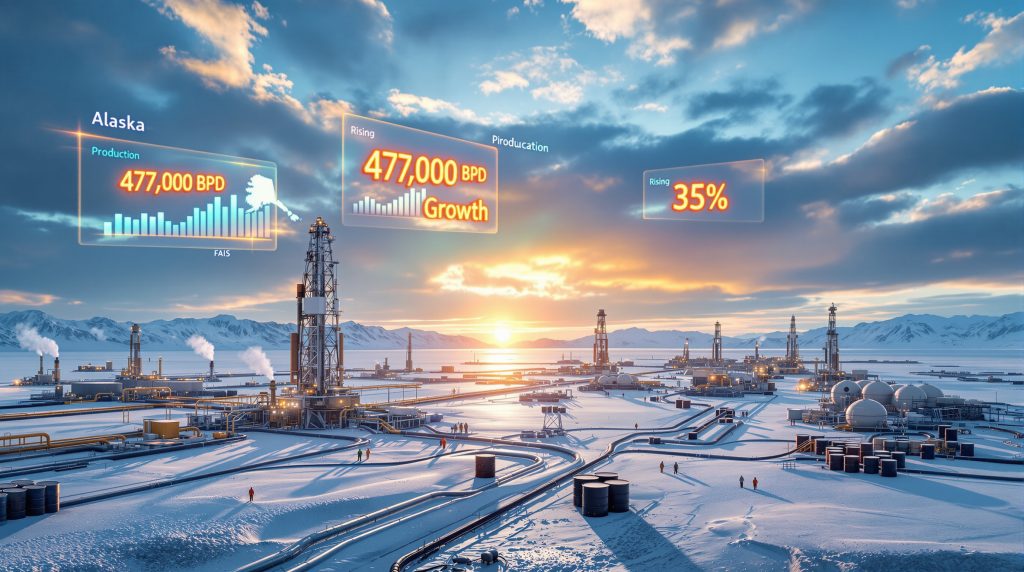
Current forecasts project Alaska oil production increase to reach 477,000 bpd in 2026, representing a 13% annual growth rate that marks the largest year-over-year expansion since the 1980s boom period. This dramatic reversal stems from accelerated development schedules and superior well performance from newly commissioned major projects, according to EIA analysis.
The Strategic Context Behind Alaska's Energy Resurgence
Alaska's position within America's domestic energy security framework has evolved significantly as geopolitical considerations drive renewed focus on North American production assets. Furthermore, the state's strategic location provides direct access to West Coast refinery markets while offering supply chain resilience advantages compared to international crude sources.
The economic drivers supporting renewed North Slope investment activity include:
• Infrastructure leverage: Existing Trans-Alaska Pipeline System capacity utilisation below historical maximums
• Regulatory predictability: Established permitting frameworks and operational guidelines
• Workforce expertise: Decades of Arctic operational knowledge and specialised technical capabilities
• Market access: Direct pipeline connection to marine export terminals and refinery customers
Comparison with other major oil-producing regions reveals Alaska's unique advantages in capital efficiency. While Permian Basin developments require extensive new infrastructure investment, Alaska projects benefit from established transportation networks and processing facilities that reduce per-barrel development costs.
Production Trajectory Analysis: From Peak to Recovery
Statistical analysis of Alaska's production patterns reveals distinct phases in the decline and recovery cycle. The 38-year decline period from 1988-2026 represents one of the longest sustained production decreases in major North American basins, primarily driven by natural reservoir depletion in legacy fields including Prudhoe Bay and surrounding developments.
The inflection point triggering the current growth cycle emerged through several converging factors:
- Final investment decisions on major projects made during favourable oil price environments
- Accelerated drilling schedules enabled by improved weather windows and logistics efficiency
- Technological improvements in well productivity and completion design
- Regulatory approval completion for previously delayed development projects
Historical production data demonstrates that 78% of existing Alaska wells produce below 400 barrels of oil equivalent per day, representing the mature asset base that has anchored production levels for years. This context highlights the significance of new developments achieving substantially higher productivity rates despite operating in identical geological and climatic conditions.
When big ASX news breaks, our subscribers know first
Which Major Projects Are Powering Alaska's 477,000 BPD Target?
Two primary developments drive Alaska's production renaissance, each representing different operational approaches and timeline strategies. However, these projects demonstrate how modern extraction technology and project management techniques can achieve rapid production ramps in challenging Arctic environments.
ConocoPhillips' Nuna Development: The Early Catalyst
The Nuna development commenced production in late 2024 and achieved 7,000 bpd output by August 2025, representing 35% of its 20,000 bpd peak capacity. This ramping profile indicates robust reservoir performance and operational efficiency during the critical startup phase.
Technical specifications for Nuna include:
| Performance Metric | Current Status | Peak Target |
|---|---|---|
| Daily Production Rate | 7,000 bpd (Aug 2025) | 20,000 bpd |
| Capacity Utilisation | 35% | 100% |
| Operational Timeline | 8 months online | Multi-year plateau |
Nuna's strategic role extends beyond its individual production contribution. The project serves as a critical offset to legacy field decline rates, providing production stability while larger developments complete their startup phases. Industry analysis suggests that without Nuna's contribution, Alaska's 2025 production would have declined by an additional 15,000-20,000 bpd.
Santos-Repsol Pikka Phase 1: The Game-Changing Asset
Pikka Phase 1 represents the largest single production addition to Alaska oil production increase projections, with planned startup in early 2026 and peak production of 80,000 bpd by mid-2026. This aggressive development schedule reflects strong well test results and accelerated facility construction timelines.
The international partnership structure between Santos and Repsol brings complementary expertise:
• Santos: Australian operator with extensive offshore and unconventional development experience
• Repsol: Spanish integrated energy company providing financing and technical resources
• Combined capabilities: Enhanced project execution and risk management through diversified operational experience
Pikka's projected contribution of nearly 20% of Alaska's total crude output by 2026 demonstrates the concentrated nature of the state's production growth. This single project will account for approximately 16.8% of the 477,000 bpd total forecast, indicating exceptional reservoir quality and development efficiency.
Future Pipeline: Willow Project and Beyond
ConocoPhillips' Willow development represents the next major growth phase, targeting 180,000 bpd production by 2029. This project would potentially triple Alaska's current production levels if combined with existing and planned developments.
Additional exploration prospects in the Nanushuk formation indicate long-term sustainability potential for Alaska oil production increase beyond current project commitments. Furthermore, geological analysis suggests this formation contains substantial additional reserves accessible through modern drilling and completion techniques.
Important Note: Alaska's biggest oil project developments timelines and production targets are subject to final regulatory approvals and may vary from current projections based on environmental assessments and permitting outcomes.
How Do New Alaska Wells Compare to Legacy Operations?
Performance metrics between new Alaska developments and existing infrastructure reveal dramatic productivity improvements that drive the overall production renaissance. Alaska Oil and Gas Conservation Commission data demonstrates clear performance differentiation across well vintages and development approaches.
Performance Metrics: New vs. Existing Infrastructure
| Well Category | Average Production (boed) | Percentage of Total Wells |
|---|---|---|
| New Project Wells | 480 | 22% |
| Legacy Wells | <400 | 78% |
The 20% productivity advantage of new project wells (480 boed vs. 400 boed threshold) represents significant technological and operational advancement. This improvement occurs despite both well categories operating in identical Arctic conditions with similar logistical and environmental challenges.
New project well performance characteristics include:
• Enhanced completion design: Multi-stage fracturing and improved perforating techniques
• Advanced drilling systems: Extended-reach capabilities enabling efficient drainage patterns
• Real-time optimisation: Digital monitoring and control systems for production maximisation
• Modern infrastructure: State-of-the-art gathering and processing facilities
Technology and Efficiency Advantages
Contemporary Alaska developments incorporate technological innovations that substantially exceed legacy well capabilities. Enhanced drilling techniques enable operators to access previously unreachable reserves while minimising surface footprint and environmental impact.
Comparison with Lower 48 shale operations reveals Alaska's competitive positioning:
• Permian Basin: 400-600 boed typical well performance
• Bakken Formation: 300-500 boed average production
• Eagle Ford: 400-800 boed depending on location quality
• Alaska New Projects: 480 boed average performance
Alaska's new conventional wells achieve productivity levels comparable to premier U.S. shale basins despite operating in significantly more challenging conditions. This performance demonstrates the superior reservoir quality and operational efficiency of modern North Slope developments.
Cost-effectiveness analysis indicates that while Alaska wells require higher initial capital investment than Lower 48 alternatives, their longer production life and stable decline rates provide competitive economics over multi-year operational periods.
What Economic Factors Are Enabling Alaska's Production Growth?
Multiple economic catalysts support the current Alaska oil production increase, creating an investment environment that attracts both domestic and international energy companies. Moreover, regulatory reforms, infrastructure advantages, and competitive fiscal terms combine to improve project economics compared to historical periods.
Investment Climate and Regulatory Environment
Alaska's 2013 oil tax reforms significantly improved the fiscal framework for North Slope development projects. The state reduced petroleum profits tax rates from approximately 25% to 20%, effective January 2014, enhancing project net present value calculations and reducing the oil price threshold required for economic viability.
Current tax structure advantages include:
• Petroleum Profits Tax: Applied to net taxable income rather than gross production
• Production Tax: Levied on produced oil value with allowances for operating costs
• Investment incentives: Tax credits and depletion allowances for exploration and development
• Regulatory stability: Established permitting processes with predictable timelines
The improved investment climate creates conditions where marginal projects become economically viable. Industry analysis indicates that the 2013 reforms improved project NPV by approximately 15-30%, sufficient to trigger final investment decisions on previously delayed developments.
Infrastructure and Logistics Advantages
Alaska's established infrastructure provides significant cost advantages compared to frontier development regions. In addition, the Trans-Alaska Pipeline System currently operates below historical capacity utilisation, offering immediate transportation access for new production volumes.
Key infrastructure elements supporting Alaska oil production increase:
- TAPS capacity: 2.1 million bpd design capacity with current throughput below 500,000 bpd
- Marine terminals: Valdez crude oil terminal with deep-water access for large tanker vessels
- Support infrastructure: Roads, airfields, communication systems, and worker housing
- Refinery access: Direct pipeline connections to West Coast processing facilities
Transportation cost analysis reveals Alaska's competitive advantage for West Coast markets. While pipeline tariffs add per-barrel costs, the elimination of international shipping expenses and supply chain risks provides overall economic benefits compared to imported crude alternatives.
How Does Alaska's 2026 Forecast Compare Globally?
Alaska's projected 13% annual production growth rate positions the state amongst the fastest-growing oil regions globally, outpacing most international developments and competing North American basins. This growth trajectory reflects both the concentrated nature of new project additions and the operational efficiency of modern Arctic development technology. Consequently, various oil price rally analysis reports highlight Alaska's strategic importance in global supply dynamics.
North American Production Context
Within the United States crude oil production hierarchy, Alaska's 477,000 bpd forecast represents approximately 3-4% of total national output. However, the 13% annual growth rate significantly exceeds other major producing regions:
| Basin | 2026 Growth Rate | Strategic Importance |
|---|---|---|
| Alaska | 13% | Domestic supply security |
| Permian Basin | 2-4% | Volume leadership |
| Bakken | 1-3% | Technology demonstration |
| Eagle Ford | 0-2% | Mature field optimisation |
Alaska's growth rate advantage stems from the concentrated impact of large-scale project additions rather than incremental drilling activity. While shale basins achieve growth through continuous drilling programmes, Alaska's development model relies on fewer, larger-scale developments with extended plateau production periods. Furthermore, trade war oil price movements continue to influence regional production strategies across North American basins.
Strategic importance for West Coast refinery supply chains includes:
• Supply diversification: Reduced dependence on international crude imports
• Transportation efficiency: Direct pipeline access eliminating marine shipping requirements
• Quality specifications: Alaska crude grades suitable for West Coast refinery configurations
• Supply security: Domestic production immune to international trade disruptions
International Arctic Oil Development Trends
Global Arctic oil development provides context for Alaska's achievements and technological approaches. Norwegian Arctic projects in the Barents Sea demonstrate similar technological integration and environmental management practices, while Russian Arctic developments emphasise large-scale infrastructure investment and state-directed resource allocation.
Comparative analysis reveals distinct operational approaches:
• Norway: Environmental technology leadership and offshore Arctic capabilities
• Russia: Large-scale infrastructure development and integrated project approaches
• Canada: Enhanced oil recovery techniques and unconventional resource development
• Alaska: Private sector efficiency and established infrastructure leverage
Technology transfer opportunities exist between Arctic regions, particularly in areas of drilling efficiency, environmental monitoring, and cold-weather operational techniques. Alaska's success in achieving rapid production ramps may influence development approaches in other Arctic basins facing similar technical challenges.
What Are the Long-Term Implications for U.S. Energy Security?
Alaska oil production increase contributes to broader American energy security objectives by strengthening domestic supply capabilities and reducing import dependency. The strategic location and established infrastructure provide supply chain resilience benefits that extend beyond simple production volume contributions. Nevertheless, ongoing US rig count trends across other basins demonstrate the critical importance of Alaska's growth trajectory.
Supply Chain Resilience and Domestic Production
Alaska's production growth enhances U.S. energy security through multiple mechanisms:
Import Displacement: Each barrel of Alaska production directly reduces crude oil import requirements, improving trade balance and currency stability.
Geographic Diversification: West Coast crude supply traditionally relies heavily on international sources, creating vulnerability to supply disruptions. Alaska production provides domestic alternative supply for critical refinery infrastructure.
Strategic Petroleum Reserve: Increased domestic production capacity supports strategic reserve management by reducing the frequency of reserve releases during supply disruptions.
Infrastructure Security: TAPS and associated facilities represent critical energy infrastructure protected by domestic security measures, contrasting with international supply chain vulnerabilities.
Investment and Employment Multiplier Effects
Economic analysis indicates that Alaska oil production increase generates substantial multiplier effects throughout regional and national economies. In addition, oil price stagnation factors influence regional investment decisions and employment patterns across energy-dependent communities.
Direct Employment: New project construction and operations create high-paying technical positions requiring specialised Arctic operational expertise.
Indirect Employment: Supply chain services, logistics support, and professional services experience increased demand from expanded production operations.
State Revenue Generation: Alaska state government receives substantial revenue through petroleum taxes and lease payments, supporting public services and infrastructure investment.
Federal Tax Revenue: Corporate and individual income taxes from increased economic activity contribute to federal government revenues.
Regional economic development implications extend beyond the energy sector, supporting aviation services, marine transportation, construction, and professional services industries throughout Alaska.
The next major ASX story will hit our subscribers first
Frequently Asked Questions About Alaska Oil Production Growth
Key Investor and Industry Questions
When will Alaska's production peak under current development plans?
Current project timelines suggest Alaska production could reach 600,000-700,000 bpd by 2029 if Willow and additional Nanushuk formation developments proceed as planned. However, sustained production levels depend on continued exploration success and project execution efficiency. Moreover, tariff economic implications may affect long-term investment strategies across North American energy projects.
How sustainable is the 13% annual growth rate beyond 2026?
The 13% growth rate reflects concentrated project additions rather than underlying basin productivity improvements. Future growth rates will likely moderate to 3-5% annually as new projects reach plateau production and require additional developments to maintain expansion momentum.
What are the main risks to achieving the 477,000 bpd target?
Primary risks include:
• Weather-related construction delays affecting project startup timelines
• Technical challenges in well completion or facility commissioning
• Regulatory delays in environmental permitting processes
• Oil price volatility impacting project economics and investment decisions
How do Alaska production costs compare to other U.S. basins?
Alaska production costs typically range $40-60 per barrel for new developments, compared to $25-45 per barrel for Permian Basin operations. However, longer well life and stable production profiles can provide competitive lifecycle economics despite higher initial costs.
Strategic Outlook: Alaska's Position in America's Energy Future
Alaska's emergence as a growth region within U.S. oil production establishes the state as a critical component of domestic energy strategy through the remainder of the decade. The combination of technological advancement, infrastructure advantages, and regulatory stability creates conditions for sustained production increases beyond current project commitments.
Production Sustainability Through 2030
Scenario modelling suggests multiple pathways for Alaska oil production increase continuation through 2030:
Base Case Scenario: Current committed projects (Nuna, Pikka Phase 1, Willow) achieve planned production levels, sustaining 500,000-600,000 bpd through 2030.
Growth Scenario: Additional Nanushuk formation developments and Pikka expansion phases increase production to 700,000-800,000 bpd by 2030.
Conservative Scenario: Technical challenges or regulatory delays limit production to 400,000-500,000 bpd, representing modest growth above current levels.
Required investment levels to maintain production momentum include approximately $2-4 billion annually in exploration, development, and infrastructure maintenance across all active projects and operators.
Technology and Innovation Drivers
Future Alaska oil production increase depends increasingly on technological innovation and operational efficiency improvements:
Digital Transformation Applications: Advanced monitoring systems, predictive maintenance, and automated operations reduce costs and improve safety in Arctic environments.
Enhanced Oil Recovery: Secondary and tertiary recovery techniques could extend production life from mature fields while new primary developments reach plateau status.
Environmental Technology Integration: Continued advancement in environmental monitoring, waste management, and carbon footprint reduction supports regulatory compliance and social licence maintenance.
Alaska's success in reversing decades of production decline demonstrates how strategic investment, technological innovation, and favourable economic conditions can revitalise mature energy basins. The state's production renaissance provides a model for similar transformations in other challenging operational environments worldwide, while contributing meaningfully to American energy security and economic prosperity.
Disclaimer: Production forecasts, project timelines, and economic projections discussed in this article represent current estimates that may change based on technical performance, regulatory decisions, commodity prices, and other factors beyond operator control. Investment decisions should consider comprehensive risk assessment and professional financial advice.
Ready to Capitalise on Alaska's Production Renaissance?
Discovery Alert's proprietary Discovery IQ model delivers real-time alerts on significant mineral discoveries across the ASX, helping investors identify actionable opportunities in resource-rich sectors before the broader market reacts. While Alaska demonstrates how strategic investment in established basins can reverse decades of decline, Discovery Alert's discoveries page showcases similar transformation stories in Australian mining, where early discovery alerts have generated exceptional returns for subscribers positioning themselves ahead of major announcements.