July 7, 2026
The Strategic Logic Behind Cross-Border Industrial Capital in Primary Aluminium
Across Europe, primary aluminium smelting has quietly become one of the most contested industrial battlegrounds of the 2020s. Not because of booming supply, but because of the opposite: a shrinking base of operational smelters, rising energy costs, and a downstream manufacturing sector increasingly unwilling to source high-emission metal from outside the continent. Against this backdrop, the question is no longer which smelters will survive, but who will own the ones that do.
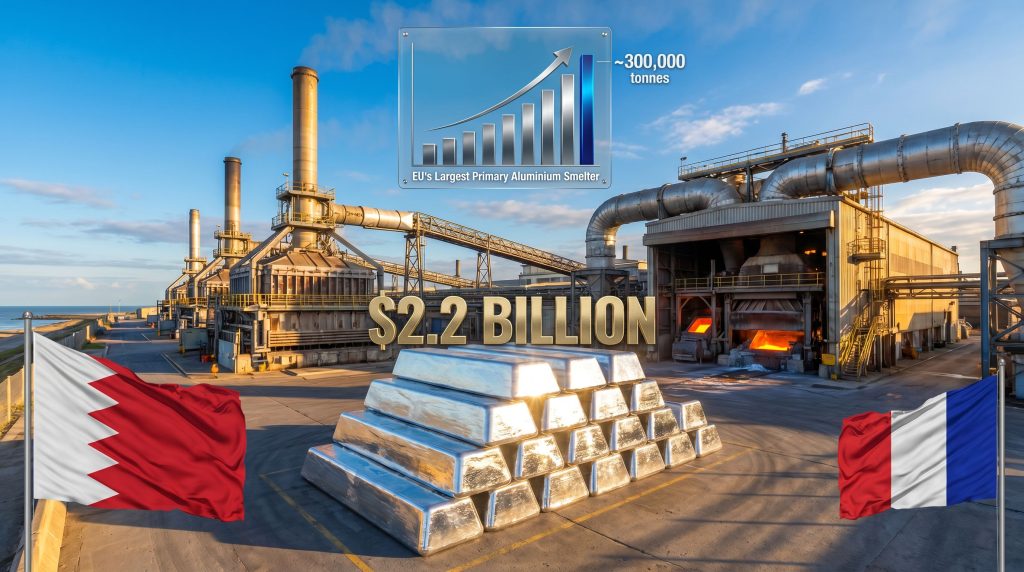
That question has now found a defining answer in northern France, where Aluminium Bahrain (Alba) has announced its intent to acquire Aluminium Dunkerque in a transaction valued at USD 2.2 billion. The Alba acquisition of Aluminium Dunkerque is not simply a change of ownership. It is a structural signal about where global aluminium capital is flowing, who controls Europe's industrial supply chains, and how the economics of low-carbon metal production are reshaping M&A logic across the sector.
When big ASX news breaks, our subscribers know first
Transaction Overview: What Is Being Bought and Sold
At its core, this deal involves Alba acquiring 100% of Aluminium Dunkerque, the European Union's single largest primary aluminium smelter by production capacity. The facility sits in Loon-Plage in the Dunkerque region of northern France, producing approximately 300,000 tonnes of primary aluminium annually.
The seller is American Industrial Partners (AIP), a US-based private equity firm whose exit follows the classic industrial asset ownership cycle: acquire, stabilise, optimise, divest. What makes this particular exit significant is the calibre of the buyer and the co-investment structure surrounding it.
| Parameter | Detail |
|---|---|
| Acquirer | Aluminium Bahrain (Alba) |
| Target Asset | Aluminium Dunkerque |
| Total Transaction Value | USD 2.2 billion |
| Alba's Ownership Post-Completion | 100% |
| Minority Co-Investor | Bpifrance |
| Bpifrance Stake | 6% (EUR 100 million) |
| Seller | American Industrial Partners (AIP) |
| Smelter Annual Output | ~300,000 tonnes |
| Smelter Location | Loon-Plage, Dunkerque, northern France |
| Financing Structure | Consortium of Alba's banking partners |
Alba will fund the acquisition through a consortium of banking partners, consistent with syndicated debt structures common in large-scale industrial M&A. Bpifrance, France's public investment bank, will contribute EUR 100 million for a 6% minority stake, alongside a seat on the holding company's board of directors.
It is worth noting that some industry observers have identified a potential distinction between the USD 2.2 billion headline figure and underlying asset valuations that some analysts place closer to EUR 1 billion (approximately USD 1.17 billion). The differential likely reflects financing costs, strategic control premiums, and the structuring of the co-investment arrangement. Until regulatory clearance is confirmed and final accounts are disclosed, precise enterprise valuation figures should be interpreted with caution.
Europe's Primary Aluminium Deficit: The Structural Context
To understand why Aluminium Dunkerque commands such strategic value, it is necessary to examine how European smelting capacity has eroded over the past decade. Energy-intensive industries across the continent have faced compounding cost pressures, and aluminium smelting, which requires enormous and continuous electrical power input, has been particularly exposed.
Several European smelters have curtailed or permanently closed operations since the early 2010s, driven by electricity price volatility, carbon compliance costs, and competitive pressure from Gulf and Asian producers operating with structural energy cost advantages. This contraction has created a widening gap between European aluminium demand and domestically produced supply. Furthermore, ongoing aluminium tariffs impact have added further complexity to how European producers position themselves competitively.
Key structural forces shaping the current environment include:
- European smelting capacity has contracted meaningfully over the past decade, with multiple facilities reducing output or shutting down entirely due to energy cost pressures
- Downstream manufacturers, particularly in automotive and packaging, face increasing pressure to document the carbon intensity of their aluminium inputs as part of corporate sustainability obligations
- The EU Carbon Border Adjustment Mechanism (CBAM), which entered its transitional phase in 2023 and is being phased in through to 2026, imposes carbon costs on imported metals, structurally favouring European-origin production with verified lower emissions profiles
- European OEMs and Tier 1 suppliers are actively seeking to reduce supply chain exposure to geopolitically sensitive origins, increasing the premium placed on domestically smelted metal
Within this context, Aluminium Dunkerque is not merely a large facility. It is one of the very few remaining large-scale primary smelters still operating within the EU, making it an effectively irreplaceable asset in the regional supply architecture.
Alba's Global Platform Strategy: Why Dunkerque Fits
Alba is majority-owned through Mumtalakat Holding Company, Bahrain's sovereign wealth vehicle. Its existing operations in Bahrain position it as one of the world's most energy-efficient primary aluminium producers, with a cost structure supported by competitive domestic energy pricing. The move into European primary smelting represents a deliberate evolution of its industrial model.
The strategic rationale can be broken into four distinct pillars:
- Geographic diversification beyond the Gulf Cooperation Council, establishing a multi-continental production footprint that reduces single-market exposure
- Direct access to European end-markets, eliminating intermediary trade flows and allowing Alba to capture more of the value chain margin on European sales
- Participation in the low-carbon aluminium premium, a growing pricing tier where European buyers pay above-benchmark prices for aluminium with verified lower lifecycle emissions — a dynamic explored further in analyses of green metals pricing trends across the sector
- Earnings resilience through currency and cycle diversification, balancing Gulf-denominated revenue with Euro-denominated income streams across different economic cycles
Alba has publicly committed to maintaining employment levels at the Dunkerque site and reinforcing the facility's low-carbon production practices. These commitments carry commercial as well as reputational weight, given the site's importance to the Dunkerque regional economy. They also align with broader aluminium decarbonisation efforts being pursued across the global industry.
The Bpifrance Dimension: Sovereign Co-Investment as Industrial Policy
The involvement of Bpifrance as a 6% minority shareholder transforms this transaction from a straightforward commercial acquisition into something more layered. Bpifrance is not a passive financial investor. It is France's primary vehicle for deploying state capital into strategically important industrial assets, with a mandate that explicitly prioritises long-term industrial sovereignty over short-term financial returns.
By securing board representation at the holding company level, Bpifrance retains a governance voice over the facility's strategic direction, investment decisions, and operational priorities. This structure reflects a model increasingly favoured by European governments: allowing foreign capital to fund industrial assets while retaining meaningful influence over their future trajectory.
Nicolas Dufourcq, CEO of Bpifrance, described the investment as a commitment to securing the long-term future of a strategically important industrial site, emphasising the objective of ensuring Aluminium Dunkerque remains central to France's industrial resilience and capacity for innovation over the coming years.
The MoU between Alba and Bpifrance was formalised in Paris at the Choose France Summit, a high-profile investment promotion event. Senior Bahraini representation included His Excellency Shaikh Salman bin Khalifa Al Khalifa, Bahrain's Minister of Finance and National Economy and Chairman of Mumtalakat Holding Company. France was represented by Nicolas Forissier, Minister Delegate for Foreign Trade and Economic Attractiveness. The summit-level signing elevates this deal beyond a bilateral corporate transaction into a formal industrial partnership between two sovereign economies.
Regulatory Pathway: The FSR Test
The transaction is subject to clearance under the EU Foreign Subsidies Regulation (FSR), a relatively new instrument that came into force in 2023 and is specifically designed to scrutinise acquisitions where the buyer may have benefited from non-EU state support that could distort competition within the single market.
Alba's ownership link to Mumtalakat, Bahrain's sovereign wealth vehicle, places the transaction squarely within the FSR's review scope. FSR investigations can proceed through a preliminary phase of 25 working days, with the option for an in-depth review extending the timeline to 110 working days if the European Commission identifies potential concerns requiring deeper analysis.
Additional regulatory conditions include:
- Standard EU competition authority notifications across relevant jurisdictions
- French national security screening under foreign investment frameworks applicable to strategic industrial assets
- Customary approvals for Bpifrance's 6% stake acquisition as specified under the MoU terms
The FSR clearance process will itself be closely watched across European M&A markets, as it represents one of the more prominent early tests of how the regulation applies to sovereign-linked acquirers from nations that are allied to but outside the European Union. The outcome could shape precedent for future Gulf-to-Europe industrial transactions.
The next major ASX story will hit our subscribers first
What the Deal Signals for Downstream European Buyers
For manufacturers sourcing primary aluminium within Europe, the ownership transition at Aluminium Dunkerque carries practical implications that extend beyond governance structure.
| Factor | Under AIP Ownership | Under Alba Ownership |
|---|---|---|
| Owner Orientation | Exit-focused private equity | Long-term strategic industrial holder |
| Low-Carbon Investment Mandate | Not explicitly defined | Publicly committed |
| French Governance Influence | Indirect | Direct via Bpifrance board seat |
| Supply Chain Confidence for Buyers | Moderate | Elevated |
| GCC-EU Industrial M&A Precedent | Limited | Establishes new template |
Alba's stated commitment to reinforcing low-carbon production practices at the site could accelerate formal certification of Dunkerque aluminium under established sustainability frameworks. For automotive manufacturers in particular, sourcing ASI-certified or equivalently verified low-carbon aluminium from a domestic EU producer reduces both the carbon accounting burden and the exposure to future CBAM-related cost escalation.
The transaction also reinforces a broader narrative that has been contested in European industrial policy circles: whether large-scale, energy-intensive primary manufacturing can remain viable within the EU. By attracting USD 2.2 billion in cross-border capital commitment to a French smelter, this deal makes a forceful commercial argument that it can.
The Emerging Gulf-to-Europe Industrial M&A Template
One of the less-discussed but potentially far-reaching implications of the Alba acquisition of Aluminium Dunkerque is the precedent it establishes for capital flows between GCC sovereign-linked industrial groups and European strategic assets. Indeed, among the top aluminium companies globally, very few have executed transactions of this scale and structural complexity within the EU.
Gulf-based industrial capital has historically concentrated in financial assets, real estate, and energy infrastructure when deploying outside the GCC. Movement into operational industrial manufacturing assets at this scale, particularly in regulated EU sectors, represents a meaningful evolution. Several dynamics make European primary manufacturing assets attractive to Gulf industrial groups specifically:
- Gulf producers possess structural energy cost advantages that make European assets complementary rather than competitive with home operations
- European assets provide currency diversification and direct access to premium-priced end markets that value low-carbon origin certification
- Sovereign-linked acquirers can take a longer investment horizon than private equity, making them more credible long-term stewards in the eyes of regulators and host governments
- Co-investment structures with entities like Bpifrance provide political risk mitigation and regulatory navigation advantages within the EU
Whether the FSR review of this deal results in unconditional clearance, conditional approval, or a more extended review process will be closely observed by other Gulf industrial groups evaluating similar European acquisition opportunities. This is similarly applicable to joint venture structures such as the Alcoa-Ignis EQT venture, which further illustrates how industrial capital is being restructured across the aluminium value chain. The outcome will materially influence how sovereign-linked industrial acquirers structure future European transactions.
Frequently Asked Questions
What is Aluminium Dunkerque?
Aluminium Dunkerque is the EU's largest primary aluminium smelter, located in Loon-Plage, northern France, producing approximately 300,000 tonnes of primary aluminium annually. It serves automotive, transport, and packaging sectors.
Who is selling Aluminium Dunkerque?
American Industrial Partners (AIP), a US-based private equity firm, is divesting its stake as part of the USD 2.2 billion transaction.
What stake will Bpifrance hold?
Bpifrance will hold a 6% minority stake acquired for EUR 100 million, with a seat on the holding company's board of directors.
Is regulatory approval required?
Yes. The deal requires EU Foreign Subsidies Regulation (FSR) clearance, French national security screening, and other standard regulatory approvals before completion.
How is Alba financing the deal?
Alba will fund its 100% ownership through a consortium of banking partners, with Bpifrance contributing EUR 100 million as a co-investor.
Disclaimer: This article contains forward-looking statements and analytical projections based on publicly available information and industry context. It does not constitute financial or investment advice. Transaction completion remains subject to regulatory approvals. Valuation figures referenced reflect publicly announced terms and should not be treated as final enterprise value assessments.
Want to Track the Next Major Resource Discovery Before the Market Moves?
Discovery Alert's proprietary Discovery IQ model scans ASX announcements in real time, instantly identifying significant mineral discoveries and turning complex resource data into actionable investment insights for traders and long-term investors alike. Explore historic discoveries and their market returns to understand the scale of opportunity, then begin your 14-day free trial to position yourself ahead of the broader market.