June 7, 2026
The Industrial Calculus Behind Long-Term Energy Contracting
When commodity producers evaluate existential risk, energy supply security consistently ranks among the most consequential variables. Aluminium smelters, in particular, operate within a cost architecture where fuel and electricity expenses can consume between 30 and 40 percent of total production costs, leaving operators chronically exposed to price cycles that fall entirely outside their operational control. The Albania and Bosnian aluminium producer US LNG supply deals, signed in late April 2026, represent a decisive response to this structural vulnerability across the Western Balkans.
Across the Western Balkans, this vulnerability has defined the competitive reality of industrial production for decades, with Russian pipeline gas representing both the dominant supply source and the primary source of geopolitical exposure. These are not routine procurement exercises. They signal a fundamental repositioning of energy strategy across a region that has long operated at the margins of European energy security architecture, with consequences extending far beyond the aluminium sector.
When big ASX news breaks, our subscribers know first
Why Energy Vulnerability Was an Unsustainable Baseline for Balkan Industry
For most of the post-Soviet era, Southeastern European economies inherited an energy infrastructure designed around Soviet-era pipeline networks. The Western Balkans occupied a particularly exposed position within this system, lacking the LNG import capacity, interconnection diversity, or long-term supply agreements that Western European industrial operators had progressively built into their energy portfolios.
For energy-intensive industries like primary aluminium production, this created a structural disadvantage that compounded over time. Smelters require consistent, high-volume electricity and gas inputs around the clock. Unlike manufacturing sectors that can adjust production schedules in response to energy price movements, aluminium smelting is governed by the continuous electrochemical demands of the Hall-Héroult process, which converts alumina into primary aluminium through sustained high-amperage electrical current.
The practical consequence was that Balkan smelter operators absorbed energy cost volatility directly onto their production economics, creating periods of near-unviable operation when spot gas prices spiked, as they did dramatically during the 2021 to 2022 European energy crisis. That crisis, driven by supply tensions preceding Russia's full-scale invasion of Ukraine, resulted in curtailments and closures at energy-intensive industrial facilities across Europe, including aluminium smelters in multiple countries.
The Structural Case for Multi-Decade Contracts
The economic logic behind 20-year supply agreements is straightforward when viewed through the lens of industrial capital planning. Aluminium smelters represent fixed capital investments measured in hundreds of millions to billions of dollars. Justifying that investment requires multi-decade revenue and cost visibility. Furthermore, a smelter operator cannot rationally commit to facility construction, workforce development, or downstream customer relationships if the energy cost underpinning the entire operation is subject to annual or spot-market renegotiation.
Long-term gas supply contracts effectively convert an uncontrollable variable cost into a manageable fixed commitment, enabling:
- Accurate long-horizon financial modelling for capital investment decisions
- Stable pricing frameworks for downstream aluminium offtake agreements
- Reduced exposure to geopolitical supply disruption events
- A defensible cost base when competing in global commodity aluminium markets
This is precisely the logic that has driven major aluminium producers globally to pursue long-term power purchase arrangements. The aluminium industry leaders, such as Norsk Hydro, demonstrate this through arrangements like its long-term power supply contract from Statkraft for Norwegian aluminium operations — securing decades of hydropower certainty to underpin smelter viability. The Balkan LNG model adapts this same strategic principle to a region where renewable baseload capacity remains insufficient to meet industrial-scale demand.
Deal Architecture: What Albania and Bosnia Have Actually Secured
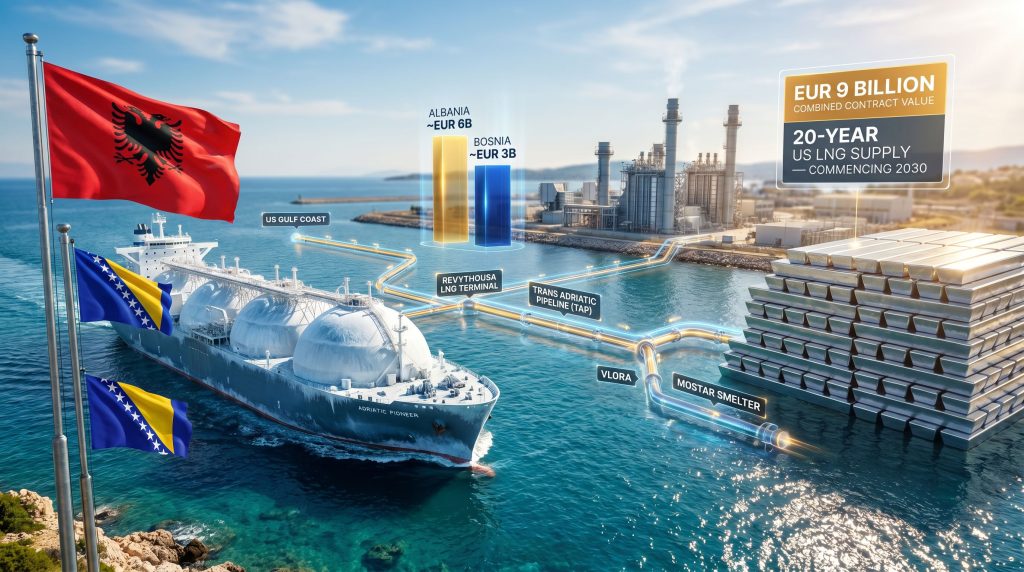
The two agreements, both announced in connection with Venture Global as the underlying US LNG supplier, carry a combined estimated value of approximately EUR 9 billion (roughly USD 10.5 billion) across their respective 20-year terms. The structural details differ meaningfully between the two countries. Albania's deal with Aktor LNG USA and Bosnia's arrangement with Atlantic-Sea LNG Trade represent distinct but complementary structures within the same regional energy push.
| Feature | Albania (Albgaz) | Bosnia (Aluminij Industries) |
|---|---|---|
| Counterparty | Aktor LNG USA | Atlantic-Sea LNG Trade |
| Annual Volume | ~1 billion cubic metres | ~0.5 billion cubic metres |
| Contract Duration | 20 years | 20 years |
| Commencement | 2030 | 2030 |
| Estimated Value | ||
| Infrastructure | 380 MW gas-fired power plant + energy hub | CCGT plant at Mostar smelter |
| Contract Status | Signed April 28, 2026 | MOU signed; binding contract expected by end-2026 |
Albgaz is Albania's state-owned gas transmission and distribution operator. Its agreement positions Albania not merely as a gas buyer but as a potential regional energy hub, with plans under discussion for a dedicated 380 MW gas-fired power plant forming part of a broader energy distribution infrastructure project.
Aluminij Industries, operating from Mostar in Bosnia and Herzegovina and part of the M.T. Abraham Group, is one of Southeastern Europe's largest primary aluminium producers. Its agreement is more narrowly focused, coupling gas supply with a combined-cycle gas turbine facility to be constructed at the Mostar smelter site, creating a vertically integrated gas-to-power-to-metal production chain.
A critical distinction between the two deals is their contractual maturity. Albania's agreement was signed as a binding contract on April 28, 2026. The Bosnia arrangement, as of announcement, remained a memorandum of understanding, with a formal binding contract anticipated by the end of 2026. This asymmetry introduces a material execution risk difference between the two agreements.
Venture Global's Regional Market Architecture
The involvement of Venture Global across both deals through separate commercial entities reflects what appears to be a deliberate strategy to establish the company as the dominant US LNG supplier across the Western Balkans. A preceding agreement, reportedly signed in November 2025 between Venture Global and Atlantic SEE LNG Trade, reportedly covered supply volumes of up to 4 billion cubic metres annually for the broader regional market.
The 1.5 BCM committed to Albania and Bosnia represents approximately one-third of that ceiling, leaving substantial headroom for additional country-level agreements across the region. Consequently, the global LNG supply outlook suggests further competitive pressure on pricing and access as more Balkan nations enter the procurement queue.
The Physical Logistics: How US LNG Reaches Landlocked Industrial Facilities
Understanding the physical delivery pathway is essential to evaluating the credibility of the 2030 commencement timeline. LNG does not travel directly from export terminals to end users. It requires a multi-stage infrastructure chain: liquefaction at US export facilities, ocean transport via LNG tankers, regasification at import terminals, and pipeline distribution to final consumers.
Albania's Infrastructure Pathway
For Albania, the supply architecture relies on a two-stage approach:
- LNG cargoes flow initially through Greece's Revythousa LNG terminal, where the liquefied gas is regasified and injected into the Greek gas network
- Gas then transits into Albania via the Trans Adriatic Pipeline (TAP), which connects Greek gas infrastructure to Albania and continues west to Italy
- Over the longer term, Albania is advancing development of a dedicated LNG import terminal at Vlora, a project that has been under discussion since at least 2021
The Vlora terminal, once operational, would give Albania sovereign import capability, eliminating dependency on Greek infrastructure capacity and providing more direct cost and scheduling control. However, as of the deal signing, the Vlora terminal remains in planning and development stages, meaning Albania's 2030 supply commencement depends either on Revythousa capacity being available or on Vlora reaching operational status within four years.
Bosnia's Southern Interconnection Route
Bosnia's supply logistics are structured around the Southern Interconnection pipeline, which would channel regasified LNG directly to the Mostar smelter complex. The planned CCGT facility at the site would convert gas into electricity on-site, creating a closed energy supply loop for aluminium production. This vertical integration model eliminates grid electricity price exposure entirely, a significant competitive advantage in a region where grid prices have been highly volatile.
Geopolitical Dimensions: Why Washington Is Invested in Balkan LNG
These agreements carry a geopolitical weight that extends well beyond their commercial terms. The Albania and Bosnian aluminium producer US LNG supply deals have been reported as marking Southeastern Europe's first long-term US gas supply contracts, a symbolic milestone in the region's energy diversification trajectory. Both agreements align with US foreign policy objectives to expand transatlantic LNG exports into Central and Eastern Europe as a structural counterweight to Russian energy influence.
The Bosnia deal being announced at a Washington energy summit signals the level of diplomatic attention these transactions have attracted. US engagement in Balkan energy infrastructure reflects a broader strategic calculation: that energy dependency on Russian supply chains creates political leverage that undermines Western alliance cohesion. According to Reuters, commercial LNG deals represent a more durable mechanism for reducing that leverage than purely diplomatic instruments.
These transactions function simultaneously as commercial contracts and as instruments of energy geopolitics. The distinction matters for risk assessment: deals with strategic diplomatic backing from a major power tend to carry different resilience characteristics than purely commercial arrangements, though this does not eliminate execution or market risks.
Implications for Aluminium Production Economics at Mostar and Beyond
For Aluminij Industries, the deal represents a potential transformation of the facility's competitive position within the European aluminium supply landscape. Energy cost certainty across a 20-year horizon enables:
- Long-term offtake agreements with downstream customers based on predictable production economics
- Capital investment in facility upgrades and capacity expansion with defensible IRR assumptions
- Workforce stability and operational continuity planning that is impossible under spot energy exposure
The CCGT plant at Mostar adds a further dimension. Combined-cycle gas turbine technology achieves thermal efficiency rates significantly above simple-cycle gas generation, typically in the range of 55 to 60 percent versus 35 to 40 percent for simple-cycle plants. This efficiency advantage reduces the effective cost of electricity generated from the LNG supply, compressing the gap between gas-based industrial power and cheaper renewable or hydropower alternatives.
The next major ASX story will hit our subscribers first
Key Risks That Could Prevent the 2030 Commencement
The four-year window between now and contract commencement is simultaneously the deal's greatest opportunity and its most significant vulnerability. Several risk categories deserve careful attention.
Infrastructure Execution Risk
- Albania's Vlora LNG terminal has no confirmed construction start date, financing arrangement, or regulatory approval as of deal signing
- Bosnia's CCGT plant at Mostar requires capital mobilisation, engineering procurement, and construction within a compressed timeframe
- The Southern Interconnection pipeline's current construction status and available capacity require verification
- Revythousa terminal capacity availability for Albanian transit flows is not publicly confirmed
Contractual and Pricing Risk
The Bosnia deal remains an MOU rather than a binding contract. LNG pricing over a 20-year horizon carries inherent structural uncertainty, particularly given the trajectory of global gas demand under accelerating energy transition scenarios. The specific pricing mechanism, whether fixed, Henry Hub-indexed, or hybrid, has not been publicly disclosed, representing a material information gap for evaluating contract economics.
Regulatory and EU Accession Risk
Both Albania and Bosnia are EU accession candidate countries. The EU's Carbon Border Adjustment Mechanism (CBAM) and broader decarbonisation policy architecture may create headwinds for gas-dependent aluminium production as the 2030s progress. A 20-year gas supply commitment signed in 2026 will extend to 2046, well beyond the horizon of current EU climate policy frameworks. This creates a structural tension between industrial energy security and long-term decarbonisation obligations that neither country has yet resolved.
What These Deals Signal for the Broader Region
The Albania and Bosnian aluminium producer US LNG supply deals may function as a structural template for other Western Balkan nations facing similar energy diversification imperatives. Serbia, North Macedonia, and Montenegro each carry analogous exposure to Russian gas dependency and comparable industrial energy security needs. Venture Global's apparent regional positioning suggests further deal activity across Southeastern Europe is plausible within the coming years.
More broadly, these agreements reflect an emerging model in which governments treat energy-intensive industries like aluminium smelting as strategic industrial anchors requiring state-level energy security frameworks. Long-term LNG contracts become, in this framing, a form of industrial policy conducted through energy supply architecture. In addition, the green transition pressures facing European industry make securing stable baseload energy supplies an even more pressing strategic priority.
The Gas-Versus-Renewables Tension
Critics of multi-decade gas commitments argue they risk embedding carbon-intensive infrastructure that conflicts with EU climate targets and the broader energy transition trajectory. However, proponents counter that gas represents an indispensable transition fuel for regions where renewable energy in mining and heavy industry cannot yet deliver the baseload reliability required by energy-intensive processes.
The debate also intersects with mining decarbonisation economics, where the cost of transitioning to fully renewable-powered smelting remains prohibitive for most operators in the near term. The 20-year contract horizon almost certainly outlasts the current regulatory and market environment. What looks like energy security from a 2026 vantage point may create carbon liability or stranded asset risk in the 2035 to 2046 period, depending on how EU policy, global LNG markets, and regional renewable capacity evolve.
Disclaimer: This article is intended for informational purposes only and does not constitute financial, investment, or commercial advice. Forward-looking statements regarding contract commencement timelines, infrastructure development, and market conditions involve inherent uncertainty and may differ materially from actual outcomes. Readers should conduct independent research and consult qualified advisers before making decisions based on this content.
Want to Stay Ahead of the Resource and Energy Discoveries Driving Market Moves?
Discovery Alert's proprietary Discovery IQ model delivers real-time alerts on significant ASX mineral discoveries — cutting through complex commodity data to surface actionable opportunities the moment they emerge on the exchange. Explore historic examples of exceptional discovery returns and begin your 14-day free trial at Discovery Alert to position yourself ahead of the broader market.