June 6, 2026
The Engineering Problem That Has Kept Solar Desalination Trapped in the Laboratory
For decades, the gap between what solar desalination can achieve in a controlled setting and what it can deliver in the real world has been the central frustration of water technology research. Prototypes have performed brilliantly under carefully managed conditions, only to fail when exposed to the chemical complexity of actual ocean water. The core issue has never been energy availability or solar panel efficiency. It has been salt.
Specifically, it has been the behaviour of multi-mineral salt mixtures under evaporative stress, and the engineering challenge of preventing those minerals from blocking the very surfaces designed to purify water.
That engineering gap may now have a credible answer. Researchers at the University of Rochester's Institute of Optics have developed a waste-free solar desalination technology that addresses the fouling problem through precision laser engineering, eliminates liquid brine discharge entirely, and demonstrates the capacity to recover critical minerals including lithium as recoverable solids. The findings, led by Professor Chunlei Guo of Optics and Physics, were published in Light: Science & Applications and represent a meaningful departure from prior solar-thermal approaches.
When big ASX news breaks, our subscribers know first
Why 2.2 Billion People Still Lack Safe Drinking Water
The global water access deficit is not a resource scarcity problem in the conventional sense. Approximately 97% of the planet's water is saline, held in oceans and saline aquifers that are geographically proximate to many of the world's most water-stressed populations. The fundamental barrier is technological and economic: converting that water into something drinkable at a cost and environmental impact that communities and governments can sustain.
Roughly 2.2 billion people around the world currently lack access to safe, clean drinking water, according to widely cited estimates. Drought-affected coastal regions face the paradox of being surrounded by water they cannot consume. Many have invested heavily in conventional desalination infrastructure to address this, but those investments carry significant environmental and financial costs that limit their scalability.
The scale of water demand compounds this challenge. Average per-capita water consumption sits at approximately 382 litres per day, but agricultural water requirements dwarf domestic use. Producing enough food to feed one person for a single day requires an estimated 3,000 litres of water, meaning that any technology capable of cost-effectively expanding freshwater supply would have implications far beyond drinking water access alone.
The Hidden Environmental Cost of Conventional Desalination
Standard desalination methods, principally reverse osmosis and thermal distillation, impose two categories of environmental harm that are frequently underweighted in infrastructure assessments.
The first is carbon intensity. Producing one cubic metre of desalinated water through conventional processes generates approximately 12.6 kg of carbon dioxide, according to research published via Frontiers for Young Minds. Scaled against global water consumption figures, this represents a substantial and growing contribution to emissions, particularly as desalination capacity expands in response to worsening water scarcity.
The second is brine discharge. Conventional desalination concentrates the salts removed from seawater into a liquid effluent that is typically returned to the ocean. This hypersaline discharge elevates local salinity, suppresses dissolved oxygen levels, and disrupts marine ecosystems in ways that are difficult to reverse. Beyond brine, the process routinely involves chemical additives including anti-foaming agents and chlorine, which are also discharged into marine environments.
Key Insight: Conventional desalination of just one cubic metre of water generates approximately 12.6 kg of carbon dioxide. When considered against an average daily personal water consumption of roughly 382 litres, the cumulative emissions burden of scaling conventional desalination to meet global demand becomes a significant barrier to its long-term viability as a climate-compatible solution.
What Waste-Free Solar Desalination Technology Actually Means
The terminology around solar desalination is frequently imprecise, and that imprecision matters when evaluating whether a given technology genuinely eliminates environmental harm or merely reduces it. The table below clarifies the distinctions between categories that are often conflated in media coverage and investment materials.
| Category | Description | Brine Discharge? |
|---|---|---|
| Brine-Free / Waste-Free Desalination | Converts dissolved salts into recoverable solids | No liquid brine discharge |
| Low-Waste Solar Desalination | Reduces chemicals and emissions; may still require brine handling | Partial |
| 100% Solar-Powered Desalination | Fully solar energy supply; does not address waste output | Yes, typically |
| Conventional Reverse Osmosis | Energy-intensive; produces concentrated liquid brine | Yes |
The University of Rochester system falls into the first category. It does not merely reduce brine output or shift the energy source while retaining the same waste stream. It eliminates liquid brine discharge entirely by converting dissolved salts and minerals into solid crystalline material that can be collected and, in some cases, sold as a commercial product.
This distinction is critical for environmental assessment. Furthermore, solid mineral deposition at a controlled surface site is fundamentally different in ecological impact from releasing hypersaline liquid into a marine environment. One is containable and potentially valuable; the other is diffuse and damaging. The environmental impacts of solar desalination more broadly are an important consideration when evaluating which technologies deserve priority investment.
How the University of Rochester System Actually Works
The technology relies on a combination of materials science, surface engineering, and an elegant repurposing of a phenomenon most people encounter in their kitchens.
The panel itself is constructed from black metal etched using femtosecond lasers. A femtosecond laser operates at pulse durations measured in quadrillionths of a second, allowing it to ablate material with extraordinary precision without generating the heat damage that conventional machining or slower laser processes produce. The etching transforms the metal surface into a near-perfect solar absorber, capturing almost all incoming radiation across a broad spectral range.
The same etching process that creates the light-absorbing properties also generates a superwicking surface. Superwicking refers to the spontaneous and rapid movement of liquid across or through a surface due to capillary forces engineered at the microscopic level. The treated panel draws a thin film of seawater across its active zone continuously, keeping the evaporation process fed without requiring pumps or pressurisation.
The step-by-step process operates as follows:
- Solar absorption – Laser-etched black metal panels capture near-total incoming solar radiation across the active surface area.
- Superwicking activation – The treated surface draws a thin film of seawater continuously across the evaporation zone through capillary-scale forces.
- Thermal distillation – Absorbed solar heat evaporates the water film, separating water molecules from dissolved mineral content.
- Salt migration via the coffee ring effect – As the water film evaporates, dissolved minerals concentrate at the edges of the wetted zone and are directed outward by precision-etched grooves toward the panel's untreated passive region.
- Solid mineral deposition – Salts and minerals crystallise as recoverable solids in the passive region rather than accumulating on the active evaporation surface.
- Condensate collection – Purified water vapour is captured and condenses as fresh, chemically untreated drinking water with no brine byproduct.
The coffee ring effect, named for the familiar ring of residue left when a coffee droplet dries on a surface, is the mechanism that prevents the system from clogging. Dissolved particles in an evaporating droplet are transported outward by convective flow as the liquid retreats. The Rochester team engineered their panel geometry to harness this natural physics, directing mineral crystallisation away from the active evaporation zone and into the passive region where it does not impede the process.
Why Earlier Prototypes Failed in Real Ocean Conditions
One of the less widely understood reasons that solar desalination has struggled to transition from laboratory success to real-world deployment is the chemical gap between test conditions and actual seawater.
The majority of prior solar-thermal desalination experiments used fresh water spiked with sodium chloride as a proxy for seawater. This is a reasonable starting point for proof-of-concept work, but it creates a misleadingly optimistic picture of real-world performance. When sodium chloride crystallises on a solar panel surface during evaporation, it forms a granular, porous residue. That residue, counterintuitively, allows water to continue passing through it and can dissolve the salt back into solution during cleaning cycles. The surface remains operable.
Real ocean water contains a far more complex mineral suite. Magnesium and calcium compounds, both present in significant concentrations in seawater, crystallise in fundamentally different ways. Rather than forming permeable granular deposits, they tend to produce dense, adhesive scale that bonds tenaciously to surfaces, restricting water flow and degrading panel performance. This is the same limescale mechanism that blocks domestic shower heads and pipework in hard-water areas, and it represents a substantially harder engineering challenge than sodium chloride management.
Important Context: The failure mode observed in many earlier solar desalination prototypes was not a flaw in the solar energy concept itself. It was a direct consequence of testing with chemically simplified water that did not replicate the crystallisation behaviour of actual seawater minerals. The Rochester system was specifically designed and validated against water samples from the Pacific, Atlantic, and Indian Oceans, representing a meaningful step toward real-world applicability.
The Rochester team's grooved panel geometry and the coffee ring effect mechanism were developed precisely to address the magnesium and calcium crystallisation problem. By directing all mineral species, regardless of their crystallisation behaviour, toward the passive region through physical surface design rather than chemical intervention, the system avoids the dependency on ideal salt chemistry that undermined earlier approaches.
The next major ASX story will hit our subscribers first
The Carbon Arithmetic: Comparing Emissions Across Methods
One of the most compelling arguments for waste-free solar desalination technology is its potential to dramatically reduce the carbon intensity of freshwater production. The following comparison illustrates the magnitude of that potential reduction.
| Method | CO₂ per Cubic Metre of Water Produced |
|---|---|
| Conventional Desalination (average) | ~12.6 kg |
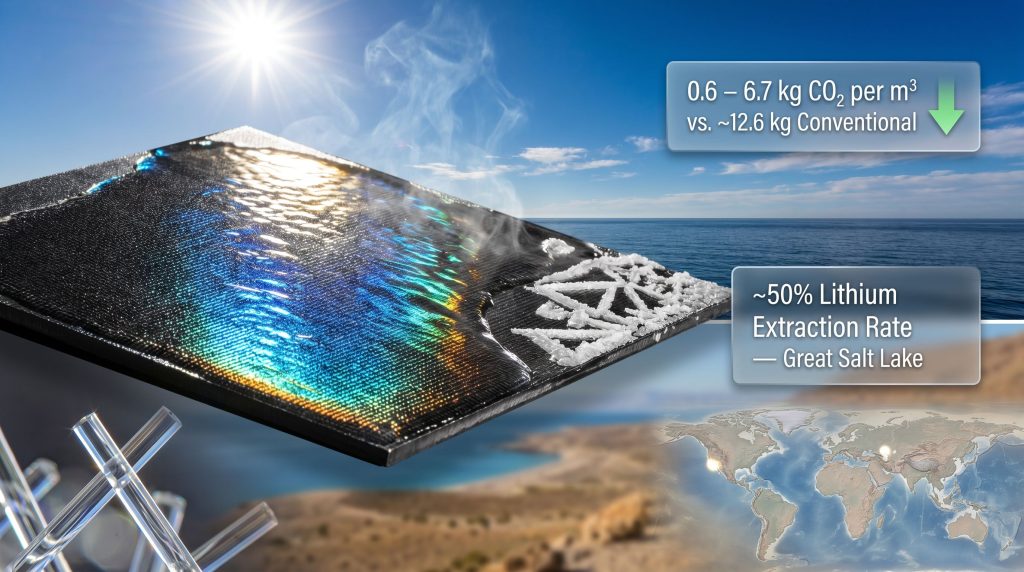
| University of Rochester Solar-Thermal System | 0.6 to 6.7 kg |
| Reduction Potential | Up to approximately 95% lower emissions |
The range in the Rochester system's emissions figure reflects variability in solar irradiance, panel configuration, and operational conditions. Even at the upper end of its estimated range, the system produces roughly half the carbon intensity of conventional desalination. At the lower end, the reduction approaches 95%, which would represent a transformative improvement in the environmental footprint of freshwater production at scale.
The elimination of chemical additives is a further environmental differentiator that does not appear in carbon accounting but carries significant ecological weight. Anti-foaming agents and chlorine compounds used in conventional desalination are discharged into marine environments as part of normal operations. The Rochester process requires no chemical pre-treatment or post-treatment, meaning that its only outputs are purified water and solid mineral material.
Critical Mineral Recovery: Where Water Security Meets the Green Transition
Perhaps the most strategically significant dimension of this technology is its capacity to recover lithium and other critical minerals as a byproduct of the desalination process itself. This convergence is particularly relevant given current critical minerals demand driven by the global energy transition.
The mechanism for lithium separation involves incorporating hydrogen titanate nanoparticles within the grooves of the passive region. Hydrogen titanate has a well-established selective affinity for lithium ions due to its layered crystal structure, which accommodates lithium at specific interlayer spacings while excluding larger ions such as sodium, magnesium, and calcium. This selectivity allows the system to isolate lithium from the complex multi-mineral solid mixture that accumulates in the passive zone during desalination.
In tests conducted using water samples from Utah's Great Salt Lake, the team achieved a lithium extraction rate of approximately 50% from the waste salt stream. While this figure requires further optimisation before commercial viability can be assessed, it demonstrates the principle of simultaneous water production and mineral recovery from a single solar-powered process. Furthermore, advances in direct lithium extraction methods more broadly suggest that refining this recovery rate is an achievable near-term goal.
Strategic Implication: The convergence of freshwater production and critical mineral recovery within a single zero-waste process positions this technology at the intersection of two of the most pressing resource challenges of the coming decades. Lithium demand growth is projected to increase substantially as electric vehicle adoption accelerates, while freshwater scarcity is expected to intensify across multiple continents. A technology that addresses both simultaneously warrants serious attention from infrastructure investors and development finance institutions.
The environmental contrast with conventional lithium extraction is particularly relevant. Hard-rock lithium mining involves significant land disturbance, tailings management, and energy consumption. Brine extraction from salars, while less energy-intensive, requires large evaporation pond areas and competes with water resources in already arid regions. Recovering lithium as a co-product of coastal desalination would introduce none of these land-use conflicts. Consequently, the battery raw materials market could benefit considerably from this alternative supply pathway.
Where This Technology Could Be Deployed and Who Stands to Benefit
The geographic potential for waste-free solar desalination technology is substantial, particularly in regions where high solar irradiance coincides with water stress and coastal or saline water access. In addition, its alignment with energy transition minerals policy objectives makes it attractive to governments pursuing resource self-sufficiency.
The following communities and regions represent the most immediate candidates for deployment as the technology matures:
- Drought-affected coastal populations across Sub-Saharan Africa where grid electricity is unreliable and seawater is the most accessible water source.
- Water-stressed nations across the Middle East and North Africa with high solar irradiance and existing desalination infrastructure that could be supplemented or replaced.
- Pacific Island communities that currently depend on expensive imported water or rainfall collection systems with limited storage capacity.
- Agricultural zones in water-scarce regions where the volume of water required to sustain food production far exceeds what domestic use alone would justify.
- Inland saline water bodies such as the Great Salt Lake basin, where water recovery could simultaneously address ecosystem decline and provide a domestic lithium source.
Scalability and the Road From Research to Infrastructure
The University of Rochester team has stated that they believe the technology is scalable, and the three-ocean validation study is a credible step toward demonstrating real-world applicability. However, it is important to distinguish between research-stage scalability assessments and the engineering and economic demands of commercial deployment.
Several challenges remain before this technology could be deployed at infrastructure scale:
- Panel fabrication at volume – Femtosecond laser etching is currently a relatively slow and capital-intensive manufacturing process. Bringing unit costs down to levels compatible with large-scale water infrastructure would require significant advances in manufacturing throughput.
- Long-term durability testing – The behaviour of laser-etched metal surfaces under sustained exposure to corrosive marine environments over years or decades has not yet been characterised at scale.
- System integration – Collecting, condensing, and distributing purified water vapour from large panel arrays introduces engineering challenges around condensate capture efficiency that are distinct from the panel-level desalination performance.
- Mineral recovery optimisation – The 50% lithium extraction rate achieved in Great Salt Lake testing is a starting point, not a commercial benchmark. Improving selectivity and recovery rates will require further materials development.
The technology is described by its developers as scalable and more sustainable than current desalination methods, with critical mineral extraction providing additional economic potential for governments and companies seeking sustainable mineral supply chains.
Key Technology Summary
| Feature | Detail |
|---|---|
| Developed By | University of Rochester, Institute of Optics |
| Lead Researcher | Professor Chunlei Guo (Optics and Physics) |
| Published In | Light: Science & Applications |
| Core Technology | Femtosecond laser-etched black metal solar panels |
| Water Sources Tested | Pacific, Atlantic, and Indian Oceans |
| CO₂ Emissions | 0.6 to 6.7 kg per cubic metre (vs. approximately 12.6 kg conventional) |
| Brine Discharge | None – salts recovered as solids |
| Chemical Additives Required | None |
| Lithium Recovery Rate (Test) | Approximately 50% from Great Salt Lake samples |
| Commercial Readiness | Early-stage; scalability under assessment |
Frequently Asked Questions About Waste-Free Solar Desalination
What is the difference between waste-free and low-waste solar desalination?
Waste-free solar desalination eliminates liquid brine discharge entirely by converting dissolved minerals into solid crystalline material. Low-waste approaches reduce chemical inputs and may use renewable energy, but typically still generate and discharge some quantity of concentrated brine. The distinction is environmentally significant because liquid brine discharge causes ongoing harm to marine ecosystems in ways that contained solid mineral recovery does not.
Does this technology require any external power source beyond sunlight?
Based on the University of Rochester research, the system is designed to operate using solar radiation as its sole energy input. The superwicking surface draws water passively through capillary action, and the thermal distillation process is driven entirely by absorbed solar heat. No pumps, pressurisation, or grid electricity are described as requirements in the published research.
Is the lithium extracted through this process commercially viable?
At a 50% extraction rate from test samples, the lithium recovery capability is demonstrably functional but not yet optimised for commercial scale. Viability would depend on panel throughput, local lithium concentrations in the water source, downstream processing costs, and prevailing lithium market prices. The Great Salt Lake results are a promising proof of concept rather than a confirmed commercial proposition.
When could this technology become commercially available?
No commercial timeline has been confirmed by the research team. The technology is at an early stage, with peer-reviewed laboratory and multi-ocean validation completed. Transition to pilot-scale deployment, industrial engineering, and commercial rollout would each represent distinct development phases. Readers should treat any specific timeline projections from third-party sources with appropriate caution.
Disclaimer: This article is for informational and educational purposes only and does not constitute financial, investment, or technical advice. Claims regarding commercial viability, scalability timelines, and mineral recovery rates are based on early-stage research findings and are subject to change as further testing and development progress. Readers should consult primary research sources and relevant professional advisers before making decisions based on emerging technology assessments.
Want to Stay Ahead of the Next Major Mineral Discovery on the ASX?
As critical mineral recovery technologies reshape resource supply chains, Discovery Alert's proprietary Discovery IQ model delivers real-time alerts on significant ASX mineral discoveries — turning complex data across more than 30 commodities into clear, actionable insights for investors at every level. Explore how historic discoveries have generated substantial returns on Discovery Alert's dedicated discoveries page, and begin your 14-day free trial today to position yourself ahead of the market.