June 6, 2026
The Quiet Architecture of a New MENA Energy Order
Across the MENA region, a structural reordering of upstream energy relationships is underway. For decades, the dominant framework for accessing hydrocarbon-rich territories involved Western international oil companies acting as technical and financial intermediaries between sovereign resource holders and global capital markets. That model is eroding. In its place, a new architecture is forming: state-linked energy entities are increasingly bypassing traditional intermediaries and establishing direct bilateral frameworks with each other, combining sovereign credibility with operational ambition in ways that pure commercial actors cannot replicate.
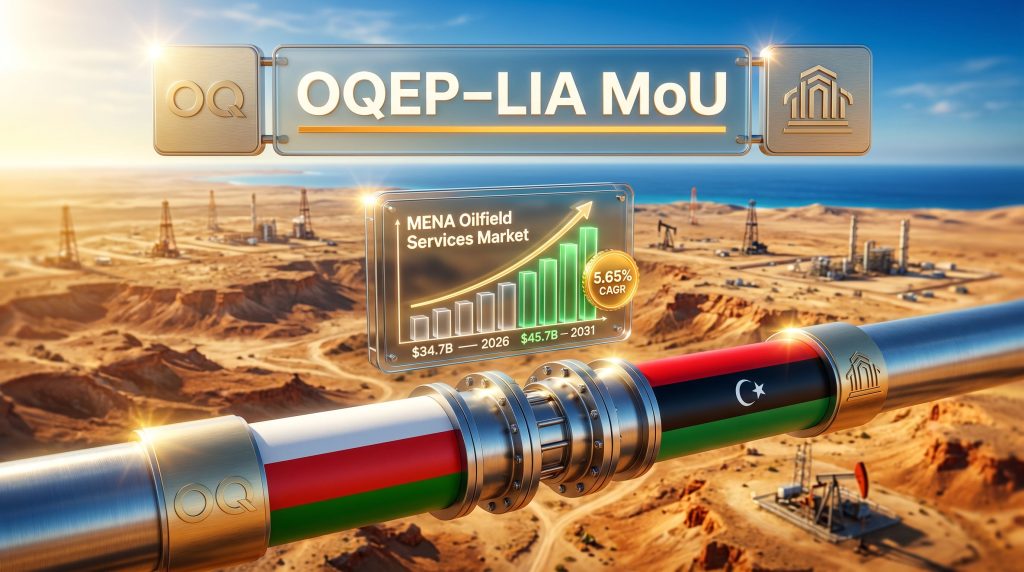
The memorandum of understanding signed between Oman's OQ Exploration and Production (OQEP) and the Libyan Investment Authority (LIA) — the Oman OQEP Libyan Investment Authority oil and gas cooperation deal — sits squarely within this structural transformation. Understanding why this agreement matters requires looking beyond the transaction itself and examining the institutional forces, market conditions, and geographic dynamics that make this particular pairing both logical and consequential for the broader MENA upstream investment landscape.
When big ASX news breaks, our subscribers know first
What an MoU Actually Does in the Upstream Sector
There is a persistent tendency in energy reporting to overstate the immediate significance of memoranda of understanding, and an equally common tendency to understate their strategic function. In the upstream oil and gas sector, an MoU is best understood as a governance pre-commitment device. It does not transfer equity, commit capital, or establish production rights. What it does is create an institutional framework within which all of those things become structurally easier to negotiate.
How Upstream MoUs Function in Practice
In practical terms, upstream MoUs perform three distinct functions:
- They signal institutional alignment to capital markets, partner governments, and regulatory bodies, reducing the perceived political risk associated with subsequent commercial negotiations.
- They establish a formal due diligence runway, allowing both parties to conduct technical assessments, legal reviews, and feasibility studies under a shared governance umbrella.
- They create precedent for deal structuring, making the progression to binding instruments such as joint venture agreements or production-sharing contracts a continuation of an established relationship rather than a new negotiation from scratch.
The Oman OQEP Libyan Investment Authority oil and gas cooperation deal fits this framework precisely. Its stated scope covers exploration and production activities across Oman, Libya, and mutually identified international markets, establishing a tri-market platform that is deliberately broad in ambition while remaining non-binding in immediate commercial obligation. Furthermore, the geopolitical risk landscape across the MENA region makes such structured frameworks increasingly attractive to both parties.
The conversion rate of MoUs into binding upstream agreements within their initial timelines remains a persistent challenge in the MENA sector. Execution discipline, technical compatibility, and regulatory navigation are the differentiating factors between deals that progress and those that stall.
The Institutions Behind the Deal and Why Their Roles Matter
OQEP functions as the upstream exploration and production arm of OQ, Oman's integrated state energy group. Its strategic mandate is explicitly oriented toward reserve base growth, production volume expansion, and international footprint development beyond Oman's maturing domestic fields. The Libya engagement, structured through a sovereign-linked counterparty rather than a direct National Oil Corporation concession, reflects a deliberate preference for partnership models that offer greater flexibility in deal structuring and capital deployment timing.
The board chairman of OQEP, Ashraf Al-Mamari, executed the agreement on behalf of the Omani side. His counterpart, Ali Mahmoud Hassan, chairman and CEO of the Libyan Investment Authority, signed the agreement on behalf of the LIA.
Why the LIA's Involvement Matters
The LIA's role in this transaction warrants particular attention. As Libya's primary sovereign wealth vehicle, the LIA's mandate spans financial assets, infrastructure investment, and strategic sector positioning. Its participation in an upstream energy cooperation framework signals something important: Libya is actively cultivating structured partnership models with credible regional operators rather than relying solely on the traditional IOC concession route. This is a meaningful shift in how Libya is approaching foreign upstream engagement.
Notably, the signing ceremony was attended by Abdul Hamid Al-Dbeibeh, Prime Minister of Libya's Government of National Unity. This attendance elevates the agreement from an institutional transaction to a state-endorsed strategic initiative, communicating that Libya's internationally recognised government views structured regional upstream partnerships as a component of its broader economic agenda. For investors and analysts monitoring Libya's investment climate, this signal carries material weight.
MENA Oilfield Services: Reading the Market Clock
The timing of the Oman OQEP Libyan Investment Authority oil and gas cooperation deal is not incidental. It coincides with a period of sustained upstream investment momentum across the MENA region, supported by measurable market expansion data. In addition, the OPEC influence on oil markets continues to shape the broader investment environment within which this deal has emerged.
| Metric | Figure |
|---|---|
| MENA Oilfield Services Market Size (2026) | $34.7 billion |
| Projected Market Size (2031) | $45.7 billion |
| Compound Annual Growth Rate (CAGR) | 5.65% |
| Global Gas Production Growth (2025) | +1.2% year-on-year |
| Primary Growth Regions | North America, Middle East, Africa |
Source: Mordor Intelligence; Gas Exporting Countries Forum
A CAGR of 5.65% through 2031 in the MENA oilfield services segment reflects sustained capital commitment to exploration and production infrastructure across the region. This is not a spike driven by short-term commodity price movements; it represents a structural investment cycle built on reserve development timelines, energy security priorities, and the monetisation of underdeveloped hydrocarbon assets.
Global gas production rising 1.2% in 2025, led by the Middle East and Africa alongside North America, reinforces the picture of renewed upstream appetite in precisely the geographies where this partnership is focused. For a country like Libya, where significant gas reserves remain largely undeveloped relative to crude production, this market dynamic creates a compelling economic rationale for attracting technically capable upstream partners now rather than later.
Libya's Upstream Fundamentals: What the Numbers Reveal
Libya's hydrocarbon resource base is frequently described in general terms, but the specific geology and reserve characteristics deserve closer examination, as they define exactly why regional operators like OQEP find the country strategically compelling.
Libya holds Africa's largest proven crude oil reserves, estimated at approximately 48 billion barrels, with additional potential in underexplored offshore and deep-basin zones. However, the more important insight for upstream investors lies not in the headline reserve figure but in the structural underdevelopment of that resource base.
Key Geological and Operational Characteristics
Key geological and operational characteristics include:
- The Sirte Basin remains the primary producing region, accounting for the majority of Libya's historical output. It is a proven, producing system with significant remaining potential, particularly in secondary formations and enhanced recovery applications.
- The Murzuq Basin in southwestern Libya contains light, sweet crude with favourable lifting economics, but has seen limited modern exploration activity relative to its mapped potential.
- The Ghadames Basin, straddling Libya's western borders with Algeria and Tunisia, is substantially underexplored despite demonstrated hydrocarbon presence.
- The Cyrenaica Basin in eastern Libya represents a frontier opportunity with limited modern seismic coverage and minimal contemporary drilling.
- Offshore Mediterranean potential remains largely uncharacterised, with only fragmented exploration data available from pre-disruption licensing rounds.
Libya's natural gas resources add another dimension. With European and Mediterranean gas demand remaining structurally elevated in the post-2022 energy security environment, Libya's underdeveloped gas reserves represent a monetisation opportunity that has historically been overshadowed by crude production priorities. An upstream partner with modern exploration and production capabilities could fundamentally reframe Libya's gas development trajectory.
Libya's combination of large proven reserves, low lifting costs in producing basins, extensive underexplored territory, and improving governance conditions creates a risk-adjusted opportunity profile that is increasingly compelling for state-linked operators with long investment horizons and sovereign risk tolerance.
Comparing Upstream Partnership Models in MENA
The structure of the OQEP-LIA agreement reflects a deliberate strategic choice from the range of partnership architectures available in the MENA upstream market. Understanding how different models compare helps clarify why the sovereign MoU framework was selected and what it implies for future deal progression. For context, WTI and Brent futures pricing dynamics also influence which partnership structures operators find most commercially attractive at any given time.
| Partnership Model | Structure | Capital Commitment | Flexibility |
|---|---|---|---|
| NOC-to-NOC Concession | Direct equity participation | High, upfront | Low |
| Sovereign MoU Framework | Intent-based cooperation platform | Low initially, scalable | High |
| IOC Joint Venture | Commercial JV with production sharing | Moderate | Moderate |
| Sovereign Fund Direct Investment | Financial stake in upstream assets | Variable | Limited operational control |
The sovereign MoU framework offers a critical advantage that the other models do not: it allows both parties to build institutional familiarity, conduct technical alignment, and structure commercial terms before committing capital. For a market like Libya, where the regulatory interface between the LIA and the National Oil Corporation (NOC) adds a layer of institutional complexity, this sequencing is not just convenient but strategically necessary.
The next major ASX story will hit our subscribers first
The South-South Energy Partnership Trend: A Broader Perspective
The Oman OQEP Libyan Investment Authority oil and gas cooperation deal should be understood within a larger pattern of state energy entity behaviour across the developing world. What analysts are increasingly describing as "South-South" energy cooperation represents a structural departure from the historical model in which OECD-based IOCs served as the primary vehicles for transferring upstream capital and technical expertise to resource-rich developing markets.
What Is Driving This Structural Shift?
Several forces are accelerating this shift:
- Sovereign risk tolerance: State-linked energy entities from Gulf and MENA countries tend to have longer investment horizons and higher tolerance for political risk in regional markets than commercially driven Western IOCs, making them better-suited partners for complex jurisdictions like Libya.
- Technical credibility: Oman's upstream sector has developed sophisticated capabilities in enhanced oil recovery, tight reservoir development, and mature field optimisation over decades of domestic production. This technical credibility makes OQEP a genuinely valuable technical partner, not merely a financial one.
- Political complementarity: Sovereign-to-sovereign frameworks reduce the perception of foreign commercial exploitation that can complicate IOC-led negotiations in politically sensitive environments.
- Diversification imperatives: Both Oman and Libya have economic reasons to diversify their energy partnerships and production profiles, creating a natural alignment of strategic interests.
For Oman specifically, deepening energy ties with Libya supports the Sultanate's broader foreign economic policy of building strategic relationships across the Arab world. This is particularly relevant as Oman simultaneously addresses the long-term challenge of declining production from its mature domestic fields, an issue also shaping projects such as the North West Shelf extension in Australia's upstream context. Furthermore, Saudi exploration licensing developments across the region are reshaping competitive dynamics that influence how state-linked operators like OQEP prioritise international partnership targets.
Execution Risks: Where MoUs Face Their Greatest Tests
Analytical integrity requires acknowledging that the path from MoU to operational upstream partnership involves significant execution challenges. The OQEP-LIA framework is no exception.
Political risk in Libya remains the most significant variable. Despite the meaningful signal provided by Prime Minister Al-Dbeibeh's attendance at the signing, Libya's dual-authority political environment and the operational independence of the eastern-based administration create ongoing uncertainty for long-term capital commitments.
Regulatory complexity adds a further layer. The National Oil Corporation operates as Libya's upstream regulatory authority and holds control over concession awards and production licences. The LIA, as a sovereign wealth vehicle, does not possess direct authority over NOC licensing processes. Effective translation of the MoU into operational upstream activity will consequently require active coordination across both institutions, a step that has historically complicated Libya-related investment timelines.
Technical compatibility between OQEP's operational methodologies and Libya's existing upstream infrastructure standards will require assessment, particularly if joint operations extend to producing fields rather than being limited to greenfield exploration.
Key Milestones Indicating Deal Progression
Key milestones that would indicate genuine deal progression include:
- Formation of a joint technical working group or bilateral steering committee.
- Identification of specific exploration blocks or producing assets for initial collaborative assessment.
- Submission of documentation to Libya's NOC for regulatory review.
- Progression to a binding joint venture or production-sharing agreement.
- Public capital commitment announcements with associated project timelines.
Frequently Asked Questions
What Does the OQEP-LIA MoU Actually Commit Both Parties To?
The MoU establishes a cooperative framework for exploring joint investment opportunities in upstream oil and gas activities across Oman, Libya, and international markets. It does not commit capital, transfer equity, or create immediate production rights. Its commercial significance lies in the institutional structure it creates for subsequent binding agreements. As reported at the time of signing, the framework is explicitly designed as a foundation for deeper commercial engagement.
Why Is Libya's Sirte Basin Particularly Significant for Upstream Partners?
The Sirte Basin is Libya's most productive hydrocarbon system, containing the majority of the country's proven reserves and most of its existing production infrastructure. For an upstream partner entering Libya, the Sirte Basin offers the fastest pathway to production-linked returns because the reservoir characterisation, infrastructure, and regulatory precedent are already established relative to frontier basins.
How Does the MENA Oilfield Services Market Growth Affect This Deal's Strategic Timing?
The projected expansion of the MENA oilfield services market from $34.7 billion in 2026 to $45.7 billion by 2031 at a CAGR of 5.65% indicates that service capacity, technical expertise, and capital are flowing into the region at scale. Entering a bilateral upstream framework now positions both parties to access this expanding infrastructure ecosystem ahead of what is likely to be an increasingly competitive market for prime exploration acreage.
What Distinguishes OQEP from a Typical IOC in the Context of a Libya Partnership?
OQEP's state-linked identity, regional cultural familiarity, and Oman's established reputation as a technically competent upstream operator give it a different value proposition than a Western IOC. Its participation in a sovereign-to-sovereign framework reduces the political friction that has historically complicated IOC-led upstream negotiations in Libya, while its technical capabilities in mature field development are directly relevant to Libya's production recovery objectives.
Disclaimer: This article contains forward-looking analysis, market projections, and scenario assessments that involve inherent uncertainty. Market size forecasts from Mordor Intelligence and gas production data from the Gas Exporting Countries Forum represent third-party estimates and should not be interpreted as guaranteed outcomes. Nothing in this article constitutes financial or investment advice. Readers should conduct independent research and seek professional guidance before making investment decisions.
Want to Stay Ahead of Significant Mineral Discoveries on the ASX?
Discovery Alert's proprietary Discovery IQ model delivers real-time alerts on significant ASX mineral discoveries, transforming complex data across more than 30 commodities into clear, actionable insights for both short-term traders and long-term investors. Explore how historic discoveries have generated substantial returns on Discovery Alert's dedicated discoveries page, and begin your 14-day free trial today to position yourself ahead of the broader market.