June 6, 2026
The Quiet Industrial Revolution Reshaping Offshore Energy Infrastructure
Most energy market observers fixate on oil prices, drilling permits, and upstream capital budgets. Far fewer pay attention to the machinery layer underneath all of it: the specialised marine equipment that makes offshore energy extraction physically possible. Yet it is precisely in this industrial stratum that one of the most consequential market consolidations of the past decade has quietly unfolded. The China offshore engineering equipment industry has not merely grown into a significant player; it has reshaped the global supply architecture for offshore energy development in ways that will echo through project economics, geopolitical risk frameworks, and energy transition timelines for years to come.
When big ASX news breaks, our subscribers know first
Understanding the Equipment That Powers Offshore Energy
What Falls Under the Offshore Engineering Equipment Umbrella
Offshore engineering equipment is a capital-intensive, technically demanding sector that encompasses the full spectrum of marine infrastructure required to find, extract, and transmit energy from subsea environments. The asset classes within this sector include:
- Deepwater drilling rigs and semi-submersible platforms capable of operating in water depths exceeding 3,000 metres
- Floating production, storage, and offloading (FPSO) units that process and store crude oil directly on the water surface
- Offshore wind turbine installation vessels (WTIVs), purpose-built to transport and erect turbines in open ocean conditions
- Heavy-lift crane vessels used for subsea construction, pipeline installation, and platform decommissioning
- Platform supply vessels (PSVs) and offshore support vessels (OSVs) that maintain logistics chains to offshore installations
- Subsea cable and pipeline-laying ships critical for both energy transmission and offshore wind grid connection
Each of these vessel and platform types requires years of lead time, highly specialised engineering capability, and access to large-scale fabrication infrastructure. These characteristics have historically favoured nations with integrated shipbuilding ecosystems, which is precisely why China's industrial policy investments over two decades have translated into such decisive competitive positioning.
From Slump to Structural Expansion: The Market Cycle in Context
The offshore engineering equipment market is not experiencing a typical commodity rebound. Understanding why requires examining the historical cycle that preceded the current expansion.
| Period | Market Condition | Primary Driver |
|---|---|---|
| Late 2010s | Industry-wide contraction | Oil price collapse, project cancellations |
| 2019-2020 | Trough conditions | COVID-19 demand destruction |
| 2021-2025 | Accelerating recovery | Energy security, offshore wind buildout |
| 2026 onward | Structural expansion | Dual-energy demand, geopolitical disruption |
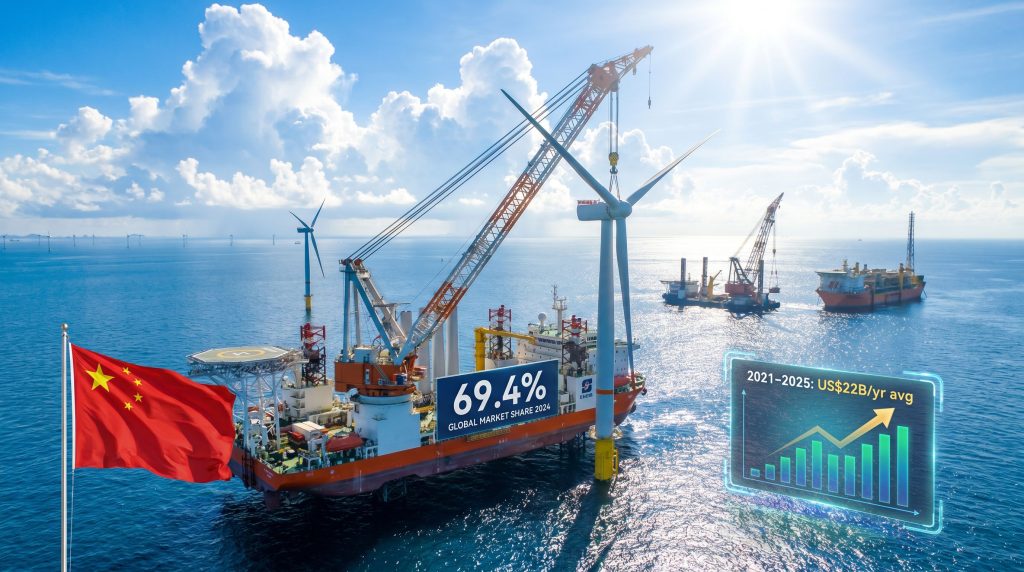
Global offshore engineering equipment orders averaged US$22 billion per year between 2021 and 2025, representing nearly double the average recorded across the preceding five-year period. This is not a gradual cyclical recovery; it is a step-change in demand intensity driven by two structurally independent forces operating simultaneously.
Furthermore, understanding the broader context of the global crude steel outlook helps illuminate why raw material supply chains feeding into offshore equipment fabrication are equally under pressure during this expansion phase.
"The current offshore equipment expansion is unusually durable because it is supported by two distinct demand pillars operating on separate economic logics: hydrocarbon security investment and renewable energy installation infrastructure. Historical offshore booms were typically tethered to a single commodity price cycle, making them more vulnerable to reversal."
The first demand driver is conventional: elevated fossil fuel prices, partly attributable to geopolitical disruptions including conflict in the Middle East, have improved the economics of offshore oil and gas developments that were shelved during the trough years. The second is structural: the global offshore wind industry is generating sustained demand for a new class of specialised installation vessels that simply did not exist at commercial scale a decade ago.
China's Market Dominance: The Statistics Behind Seven Years at the Top
How Comprehensive Is China's Lead?
China has maintained the world's largest market share in offshore engineering equipment orders for seven consecutive years. According to China's Ministry of Natural Resources, Chinese firms have consistently accounted for more than 50% of the global market across multiple years. In 2024, that figure reached a striking 69.4%, with Chinese companies undertaking 108 new projects valued at approximately US$18.6 billion within a single year.
| Metric | China | Rest of World (Est.) |
|---|---|---|
| 2024 Global Market Share | 69.4% | 30.6% |
| 2024 New Projects | 108 | Not disclosed |
| 2024 Order Value | ~US$18.6 billion | ~US$8.2 billion |
| Offshore Wind Vessel Orders | ~90% global share | ~10% |
| Consecutive Years at Global No. 1 | 7 years | N/A |
These figures represent a competitive gap that goes well beyond cost advantages. Chinese manufacturers have achieved a combination of scale, vertical integration, and increasingly sophisticated engineering capability that creates compounding barriers to competitive displacement. In addition, shifts in the China steel and iron ore market directly influence fabrication costs across Chinese shipyards, adding another layer of complexity to global competitiveness assessments.
Why the Competitive Gap Has Widened Rather Than Narrowed
Several structural factors explain why no other shipbuilding nation has meaningfully closed the distance:
- Production scale and cost compounding: Chinese shipyards operate at volumes that generate unit cost advantages unavailable to smaller national industries. As order volumes grow, these advantages compound rather than erode.
- Domestic supply chain depth: Chinese manufacturers source steel, components, and engineering services from integrated domestic ecosystems, reducing exposure to international supply chain disruptions and cost variability.
- State industrial policy alignment: Long-term policy frameworks have channelled investment, research and development resources, and export financing into the sector over multiple industrial planning cycles.
- Self-reinforcing domestic demand: Chinese state energy companies developing South China Sea reserves represent a captive domestic customer base that stabilises order books independent of export market conditions.
Crucially, Chinese shipyards are currently operating at full capacity. This detail, noted by senior engineers within China's national shipbuilding association, carries a counterintuitive implication: the market's optimism about future order growth has not yet fully translated into new order volumes precisely because manufacturers cannot commit to additional delivery schedules without capacity expansion investment.
The Technology Transition: From Volume Production to Frontier Engineering
Fourth-Generation Vessels and the Capability Frontier
The China offshore engineering equipment industry is actively transitioning from standardised volume production toward high-specification, fourth-generation offshore installation platforms. This represents a deliberate strategic shift toward technology-based leadership rather than cost-based dominance.
| Capability Dimension | Previous Generation | Fourth-Generation Standard |
|---|---|---|
| Crane Lifting Capacity | 1,000-1,500 tonnes | 3,000+ tonnes |
| Operational Water Depth | Up to 30 metres | 65+ metres |
| Dynamic Positioning | DP2 | DP3 |
| Turbine Installation Capacity | 8-10 MW turbines | 15-20+ MW turbines |
| Hull Design | Monohull jack-up | Semi-submersible / DP vessel |
Flagship projects including the Zhigao offshore installation vessel, the Zhiyuan precision installation platform, and the Haikui No. 1 floating offshore facility have each become reference points for China's advancing engineering ambition. The Haikui No. 1 in particular attracted significant attention at Asia's largest offshore engineering expo, where it was presented as a symbol of China's capability in advanced offshore infrastructure development.
The Offshore Wind Vessel Dominance Factor
China's capture of approximately 90% of global WTIV orders is arguably the most strategically significant dimension of its offshore equipment dominance. This is because WTIVs represent an entirely new vessel category, one where no established competitive hierarchy existed a decade ago. Chinese manufacturers entered the market without inheriting the competitive disadvantages of legacy vessel programmes and have rapidly defined the technological benchmark.
"As offshore wind turbines increase in unit size and projects move into deeper water and more exposed ocean environments, the engineering requirements for installation vessels escalate sharply. The manufacturers currently building next-generation WTIVs are accumulating design experience and operational data that will make them progressively harder to displace."
Next-generation WTIVs must operate in water depths exceeding 65 metres, handle turbine components for 15 to 20+ MW turbine classes, and maintain station-keeping precision in open ocean swell conditions. Chinese manufacturers are currently the primary global suppliers of this emerging vessel class. Moreover, the energy transition in mining provides a useful parallel for understanding how industrial sectors navigate dual fossil fuel and clean energy investment cycles simultaneously.
Standards, Certification, and the Regulatory Ecosystem
Building a Domestic Technical Standards Framework
An often-overlooked dimension of China's offshore equipment strategy is the parallel development of a domestic standards and certification ecosystem. By building Chinese classification and safety standards into internationally recognised frameworks, the industry is working to reduce dependence on Western certification bodies such as Lloyd's Register and Bureau Veritas, whilst simultaneously establishing Chinese technical norms as reference standards in emerging markets.
This standards development strategy serves multiple objectives:
- Reducing certification costs and approval timelines for Chinese-built vessels
- Creating technical interoperability between Chinese-manufactured equipment and Chinese-operated offshore installations
- Supporting export market penetration by offering buyers an integrated supply and certification pathway
- Building soft influence in offshore energy markets across Southeast Asia, West Africa, and South America where Chinese equipment is increasingly prevalent
The next major ASX story will hit our subscribers first
Structural Constraints and Risk Factors
The Capacity Saturation Paradox
Full capacity utilisation across Chinese shipyards creates a paradox that deserves careful analysis. On one hand, it confirms the strength of demand and validates the industry's market position. On the other hand, it represents a physical bottleneck that limits near-term revenue growth and creates delivery timeline risk for buyers.
Resolving this constraint requires capital investment in new yard capacity, which involves multi-year lead times for construction, regulatory approvals, and workforce development. This means the gap between current order book optimism and actual delivery capacity will likely persist through at least the near-to-medium term.
Geopolitical and Supply Chain Exposure
Despite its dominant market position, the China offshore engineering equipment industry carries several structural vulnerabilities worth acknowledging:
- Component dependency: Certain high-specification systems, including advanced dynamic positioning electronics and subsea control technologies, may still involve non-Chinese suppliers exposed to export control regimes.
- Market access friction: Increasing scrutiny of Chinese-built infrastructure in certain Western markets could create headwinds for export-oriented manufacturers in European and North American offshore wind markets. Broader dynamics around trade wars and supply chains are adding further uncertainty to how Chinese equipment exports are received in key markets.
- Concentration risk for global buyers: The high concentration of manufacturing capacity in a single national industry creates systemic supply chain risk for international offshore operators whose project schedules depend on Chinese equipment delivery.
How China's Dominance Is Reshaping Global Offshore Investment Dynamics
Regional Exposure to Chinese Equipment Supply Chains
| Region | Offshore Investment Trend | Dependence on Chinese Equipment |
|---|---|---|
| Southeast Asia | Accelerating | High |
| West Africa | Expanding | Moderate to High |
| Middle East | Elevated | Moderate |
| Europe (Offshore Wind) | Structural growth | High (WTIVs) |
| South America | Growing deepwater | Moderate |
| China (Domestic) | Strategic priority | Very High |
International oil majors and independent exploration and production companies planning offshore developments are increasingly integrating Chinese equipment availability into their project scheduling and capital expenditure models. Lead times for specialised vessels, already extended due to capacity saturation, have become a critical variable in offshore project timelines.
The Self-Reinforcing Industrial Ecosystem
China's simultaneous role as equipment manufacturer, domestic operator through state energy companies, and global export supplier creates a self-reinforcing industrial dynamic. Revenue from domestic South China Sea development projects funds further manufacturing capability upgrades. Those upgrades improve the competitiveness of export offerings. Export revenues fund additional R&D investment. This cycle has been compounding for over a decade and shows no signs of structural interruption.
Furthermore, renewable energy solutions adopted across adjacent heavy industries are increasingly informing how Chinese offshore equipment manufacturers approach energy efficiency and vessel emissions compliance, adding yet another dimension to their competitive evolution.
The Strategic Outlook Through 2028 and Beyond
Near-Term Expectations (2026-2028)
The near-term trajectory for the China offshore engineering equipment industry involves several concurrent dynamics:
- Order growth is expected to continue as global offshore investment expands, though capacity constraints will moderate the pace at which new orders convert to delivery commitments
- Technology upgrading toward fourth-generation vessel specifications will accelerate, with flagship projects serving as capability demonstrations for export market buyers evaluating Chinese suppliers
- Domestic South China Sea development programmes will provide a resilient demand floor that insulates Chinese manufacturers from volatility in international order flows
- The offshore wind installation segment is likely to generate increasing order complexity as turbine unit sizes and water depth requirements push vessel specifications further beyond current benchmarks
The Long-Term Structural Question
The deeper strategic question is whether China's offshore engineering equipment industry is undergoing a transition from scale-based dominance to technology-based leadership. These are qualitatively different competitive positions. Scale-based dominance can be challenged by cost competition, currency movements, or policy interventions.
Technology-based leadership, particularly in engineering-intensive sectors with long learning curves, creates barriers that are far harder to displace through conventional industrial competition. Analysts tracking marine engineering equipment comparisons across global manufacturers consistently note that China's fourth-generation vessel programmes are narrowing the specification gap with Western-designed benchmarks at an accelerating pace.
The dual demand structure underpinning the current expansion, covering both hydrocarbon extraction and offshore wind installation, provides unusual resilience across divergent energy transition scenarios. Whether global energy policy tilts toward accelerated decarbonisation or prolonged fossil fuel reliance, the offshore engineering equipment sector benefits from sustained investment flows.
"China's offshore engineering equipment industry is not simply riding a favourable commodity cycle. It is consolidating a structural position in the global maritime industrial order through simultaneous advances in production scale, engineering capability, domestic demand depth, and technical standards development. The compounding nature of these advantages suggests that competitive displacement within the foreseeable horizon remains structurally unlikely."
Disclaimer: This article contains forward-looking statements and market projections based on publicly available data and industry analysis. These projections involve assumptions and uncertainties that may not materialise as described. Readers should conduct independent research before making investment or commercial decisions based on information contained herein.
Want To Catch the Next Major ASX Mineral Discovery Before the Market Does?
Discovery Alert's proprietary Discovery IQ model delivers real-time alerts on significant ASX mineral discoveries, transforming complex geological data into actionable investment insights for both short-term traders and long-term investors — explore how historic discoveries have generated extraordinary returns, then begin your 14-day free trial at Discovery Alert to position yourself ahead of the market.