June 6, 2026
The Silent Crisis Reshaping Industrial Operations Worldwide
Every industrial sector carries its own version of the same underlying problem: the gap between the speed at which operational risk accumulates and the speed at which organisations can respond to it. Ageing infrastructure, workforce attrition, regulatory complexity, and geopolitical supply disruption do not arrive sequentially. They arrive simultaneously, compounding one another in ways that legacy management approaches were never designed to handle. Industrial automation in critical environments has moved from an operational convenience to the central mechanism through which resilient organisations are choosing to close that gap.
Understanding why this shift is happening now, and what it actually requires to execute effectively, demands a closer look at the structural forces driving it, the architecture that makes it work, and the sector-specific dynamics that determine where the highest-impact opportunities lie.
When big ASX news breaks, our subscribers know first
Four Structural Forces Accelerating Automation Adoption
The convergence of pressures now bearing down on industrial operators is not a temporary market condition. It reflects durable, structural changes in how global industrial systems function.
| Pressure Category | Operational Impact | Automation Response |
|---|---|---|
| Aging infrastructure | Increased unplanned downtime, safety exposure | Predictive maintenance, APM platforms |
| Talent scarcity | Loss of institutional knowledge, succession gaps | AI-assisted decision support, digital twins |
| Geopolitical supply disruption | Raw material delays, logistics fragility | Supply chain visibility, edge analytics |
| Regulatory intensification | Compliance cost burden, audit complexity | Automated reporting, real-time monitoring |
Ageing assets represent what many practitioners describe as the most expensive and most underestimated threat in the current industrial landscape. Facilities operating infrastructure that has exceeded its useful design life face compounding failure rates, elevated maintenance costs, and growing safety exposure. An unplanned shutdown in a high-throughput environment can extend operational downtime across days or weeks, with financial consequences that scale sharply depending on the asset class involved. In continuous processing operations, the cost of such events is rarely limited to lost production alone; it cascades through supply commitments, maintenance mobilisation costs, and regulatory reporting obligations.
The talent scarcity dimension carries a different but equally serious character. Across mining, oil and gas, chemical processing, and utilities, the retirement of experienced operational personnel is creating knowledge gaps that cannot simply be filled through conventional recruitment. The tacit expertise accumulated over decades of hands-on operation is not easily documented or transferred. Automation systems that can encode institutional knowledge into decision-support frameworks, process models, and intelligent monitoring tools are increasingly serving as the structural bridge between departing expertise and incoming workforces.
Key Insight: Geopolitical tensions have exposed fragility throughout global supply chains, affecting raw material availability, delivery timelines, and logistics costs in ways that industrial planners did not model for in prior decades. The organisations building operational resilience through automation visibility tools are better positioned to adapt dynamically to these disruptions than those relying on static procurement strategies.
What Industrial Automation in Critical Environments Actually Means
Defining the Term Precisely
Industrial automation in critical environments refers to the integration of intelligent control systems, advanced sensors, robotics, AI-driven analytics, and unified data platforms to manage operations where the consequences of failure extend beyond efficiency loss to include safety events, environmental harm, or infrastructure disruption.
The word critical carries specific meaning here. It does not simply mean important to the business. It refers to environments where operational deviations can trigger cascading consequences that are difficult or impossible to reverse quickly. These include:
- Utilities and power grids where automation underpins load balancing, grid stability, and generation asset reliability
- Chemical and process industries where reactive, toxic, or flammable materials require remote monitoring as a primary safety function
- Mining and heavy extraction where autonomous systems must operate in geologically unstable, remote, or physically hazardous conditions
- Oil and gas facilities where process deviations carry simultaneous safety and financial consequences measured in millions of dollars per day
- High-uptime manufacturing lines where anomaly detection and edge computing prevent quality failures and unplanned production halts
- Critical facilities such as hospitals, airports, and data centres where operational continuity is non-negotiable
How Critical Automation Differs From Conventional Approaches
The foundational design principle that separates automation in critical environments from standard industrial automation is the deliberate architectural separation between safety-critical control functions and AI-assisted intelligence functions. Safety logic must remain deterministic, auditable, and independent of probabilistic systems. AI and machine learning operate above this layer, enhancing decision-making and optimising performance without introducing variability into protection-critical control loops.
This layered approach is not merely a technical preference. It reflects decades of hard-won understanding about what happens when intelligent systems are given authority over functions that require absolute predictability. Furthermore, the strategic evolution of industrial automation continues to reinforce why this separation must be preserved as systems grow more sophisticated.
The IT/OT Convergence Gap: Where Digital Investment Stalls
Understanding the Structural Divide
Over the past two decades, industrial organisations have committed substantial capital to digitalisation programmes. Sensors, data historians, cloud platforms, manufacturing execution systems, and enterprise resource planning tools have been deployed across facilities globally. Yet the return on these investments has frequently fallen short of expectations. The reason, in most cases, is not the technology itself. It is the persistent structural gap between IT (information technology) and OT (operational technology) systems.
Many organisations began their digital journey by deploying isolated solutions: software for one production line, sensors for another, data platforms that lacked interoperability, and systems not designed to communicate with cloud infrastructure. The result is fragmented data, delayed decision cycles, and the burden of reconciling contradictory information that could, with proper integration, be delivered as unified operational intelligence.
Progress toward Industry 4.0 has been real, but organisations consistently fall short of capturing the full value of their digital investments precisely because the IT/OT integration layer remains incomplete. In critical environments, this incompleteness is not simply an efficiency problem. It is a structural vulnerability with direct safety and financial implications.
Why the IT/OT divide creates compounding operational risk:
- Data fragmentation: Sensors and systems that cannot communicate across platforms generate siloed datasets requiring manual reconciliation
- Delayed decision cycles: Disconnected architectures mean actionable insights arrive too late to influence real-time operational outcomes
- Cybersecurity exposure: OT networks that were historically air-gapped are increasingly connected to enterprise IT systems, creating new attack surfaces requiring purpose-built industrial security frameworks
- Interoperability failure: Legacy OT systems were not designed with cloud integration or cross-platform data exchange in mind, creating technical debt that compounds with each new digital layer added
The Four-Layer Architecture That Bridges the Gap
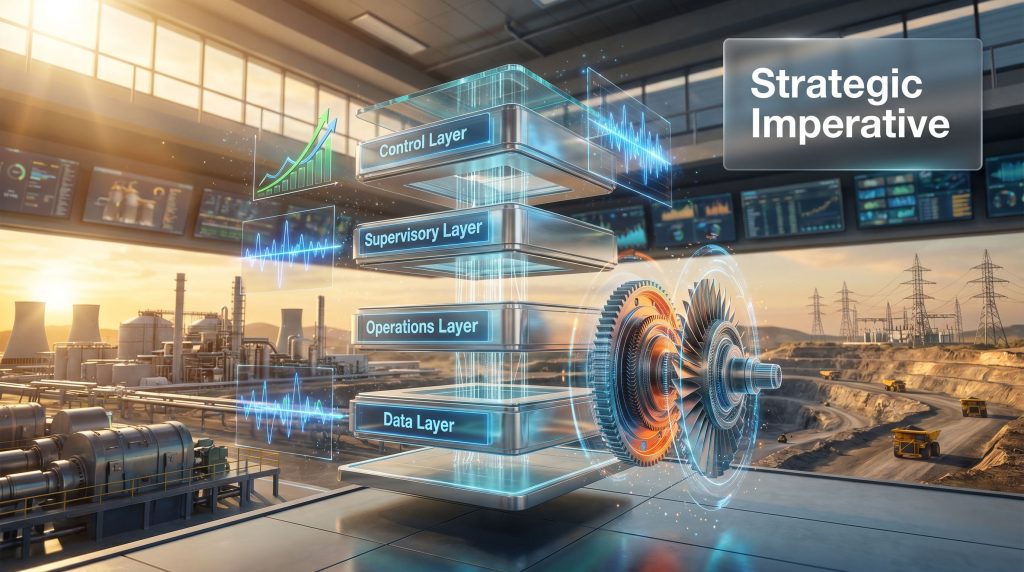
A functional automation architecture for critical environments operates across four interdependent layers that must be designed to communicate with one another from the outset:
- Control Layer – PLCs, motion control systems, robotics, and safety interlocks executing deterministic commands
- Supervisory Layer – SCADA systems and HMI interfaces providing alarm management and operator oversight
- Operations Layer – MES platforms managing execution, traceability, quality records, and shift handover data
- Data Layer – Industrial historians and IIoT platforms aggregating time-series and event data for analytics and AI model training
Transformations that consistently deliver measurable results tend to be those built on integrated, end-to-end automation architectures. Consequently, data-driven mining operations illustrate how this principle translates into real-world competitive advantage, enabling Advanced Process Control and intelligent systems that convert industrial data into real-time operational decisions rather than retrospective reports.
Advanced Process Control and Digital Twins: The Precision Layer
Moving From Reactive to Predictive Operational Models
Advanced Process Control (APC) platforms represent the transition from static process setpoints toward dynamic, self-correcting operational states. By combining first-principles engineering models with machine learning methods, APC systems can detect deviations earlier, optimise process variables continuously, and present complex multivariate operational states as clear, actionable recommendations rather than raw data streams that require expert interpretation.
Core capabilities enabled by APC in critical environments include:
- Real-time deviation detection that identifies process anomalies before they escalate into equipment failures or safety events
- Continuous dynamic optimisation that adjusts process variables in response to changing feed conditions or environmental factors
- Integrated performance benchmarking comparing live operational data against model predictions to surface efficiency gaps
- Operator augmentation tools that reduce cognitive load during high-pressure operational periods
Digital Twins: Physics-Based Intelligence at Scale
Digital twin technology creates high-fidelity virtual replicas of physical assets, processes, and systems that support simulation, training, and real-time operational monitoring without interrupting live production. The distinction between a well-designed digital twin and a basic simulation model lies in the underlying architecture.
First-principles-based digital twins, built on fundamental engineering equations rather than purely statistical correlations, perform more reliably in novel or edge-case operating conditions where data-only models may extrapolate incorrectly. The combination of physics-based modelling with machine learning calibration represents the current state of the art for high-stakes industrial environments. Tools such as Honeywell's UniSim platform have been applied in this context, enabling real-time monitoring and simulation, early anomaly detection, and more precise predictive maintenance benefits for critical equipment.
| Sector | Digital Twin Application | Operational Benefit |
|---|---|---|
| Mining | Process simulation for ore processing circuits | Early anomaly detection, predictive maintenance scheduling |
| Oil and Gas | Refinery unit modelling | Throughput optimisation, energy efficiency improvement |
| Chemical Processing | Reactor simulation | Safety scenario testing without production risk |
| Power Generation | Turbine and grid modelling | Reliability forecasting, maintenance window optimisation |
Sector-by-Sector Analysis: Where Automation Delivers Highest Impact
Mining: Automation as a Competitive Differentiator
The mining sector presents a uniquely demanding automation challenge. Operations must perform reliably in geographically remote, geologically complex, and physically hazardous conditions, while navigating increasingly restricted concession environments and heightened social licence expectations. Where mining concessions are shrinking and deposits are becoming deeper or more geologically complex, the ability to extract maximum value from existing permitted areas through precision automation is increasingly a competitive differentiator rather than an operational convenience.
Critical automation priorities in mining include:
- Predictive maintenance for heavy rotating equipment including conveyor systems, mills, crushers, and hoisting infrastructure where unplanned failure carries disproportionate cost consequences
- Water management optimisation through intelligent operating modes that balance process water consumption against scarcity constraints, a factor that increasingly determines project viability in arid mining regions
- Remote teleoperation reducing personnel exposure in blast zones, unstable ground conditions, and deep underground environments
- Sustainability compliance automation providing real-time environmental monitoring and reporting to meet tightening regulatory requirements and maintain social licence to operate
Water scarcity deserves particular attention as an underappreciated automation driver in mining. In regions where freshwater access is contested or regulated, the ability to operate processing circuits with intelligent water balance management is no longer a sustainability aspiration. It is a condition for continued operation. In addition, mining automation transformation continues to redefine how operators approach these resource-constrained challenges at scale.
Oil and Gas: Where the Margin for Error Is Structurally Narrow
In hydrocarbon processing and extraction, process deviations that would be manageable in other sectors can trigger cascading safety events, regulatory intervention, or production losses. LNG processing represents one of the most automation-intensive applications in the global energy sector, with integrated control systems deployed across a substantial portion of the world's operational LNG facilities. The precision requirements of liquefaction, storage, and regasification processes make end-to-end automation essential rather than optional.
Integrated automation in oil and gas typically addresses risk through several interconnected mechanisms:
- Asset Performance Management (APM) platforms that consolidate sensor data, process historian records, and equipment health indicators into unified dashboards supporting both real-time response and long-term reliability planning
- Industrial cybersecurity integration protecting OT networks from threat landscapes that increasingly target the control systems governing physical processes
- Energy performance optimisation reducing operating costs and carbon intensity simultaneously
- Continuous safety monitoring providing early warning of conditions that could escalate toward process safety events
Sector Note: Industrial cybersecurity has become inseparable from automation architecture in oil and gas. Securing only the IT network while leaving OT systems under-protected represents a structural vulnerability that grows as IT/OT convergence accelerates.
Logistics and Distribution: Automation at the Intersection of Speed and Scale
The structural shift toward e-commerce fulfilment has fundamentally altered the operational demands placed on distribution infrastructure. Throughput requirements, SKU complexity, and delivery speed expectations have converged to create an environment where manual operations cannot scale to meet demand economics. The outcomes achieved through warehouse automation include measurable productivity gains in picking and sortation, improved space utilisation through dynamic storage and retrieval systems, reduced workplace injury rates through collaborative robotics, and greater supply chain visibility through integrated warehouse management and IIoT connectivity.
Commercial Buildings and Critical Facilities: The Underestimated Frontier
Hospitals, airports, data centres, and large commercial campuses belong firmly in the critical environment category because operational continuity is non-negotiable. A hospital HVAC failure, an airport power disruption, or a data centre cooling malfunction carries consequences that extend well beyond financial loss into patient safety, public disruption, and regulatory liability.
Building automation capabilities for these facilities include predictive maintenance for HVAC, electrical, and fire suppression systems, energy management optimisation across complex multi-zone environments, integrated security and access control, and compliance monitoring for health, safety, and environmental standards.
The next major ASX story will hit our subscribers first
Safety-Bounded AI: The Design Principle That Changes Everything
Why Industrial AI Requires a Different Philosophy
Artificial intelligence deployed in safety-critical industrial environments requires a fundamentally different design philosophy than AI built for consumer or enterprise software applications. The governing principle is safety-bounded AI: intelligent systems that augment human decision-making and optimise processes, but operate within hard constraints defined by deterministic safety logic.
| AI Application | Layer | Primary Benefit |
|---|---|---|
| Predictive maintenance modelling | Data / Operations | Reduces unplanned downtime, extends asset life |
| Anomaly detection | Supervisory / Control | Early warning before fault escalation |
| Process optimisation | Operations | Throughput improvement, energy reduction |
| Natural language interfaces | Supervisory | Faster information access, reduced cognitive load |
| Computer vision for inspection | Control / Field | Replaces manual inspection in hazardous areas |
| Digital twin calibration | Data | Improves model accuracy over time |
The critical insight here is that automation with purpose does not mean replacing human expertise. It means amplifying it. AI mining efficiency, applied appropriately, simplifies workflows, surfaces information more clearly for decision-makers, and reduces the cognitive burden on operators managing complex multivariate process environments. The technology does not substitute for human judgement in genuinely novel situations. It extends the capacity of experienced operators to manage more variables, more accurately, with faster response times.
Design Principle: Where AI adds the most value in critical environments is precisely in the domains where human cognition is most strained: processing high-volume sensor data continuously, identifying subtle anomalies across hundreds of monitored parameters simultaneously, and presenting complex operational states as coherent, actionable intelligence rather than noise.
Industrial Cybersecurity: The Non-Negotiable Layer
OT Security Cannot Be an Afterthought
The distinct characteristics of OT cybersecurity risk set it apart from conventional enterprise IT security in ways that matter operationally:
- Availability over confidentiality: In OT environments, keeping systems running safely takes precedence over data privacy, which is the inverse of most IT security priorities
- Legacy system exposure: Many industrial control systems were designed before cybersecurity was a design consideration, creating vulnerabilities that cannot be patched without operational disruption
- Physical consequences: A successful cyberattack on an industrial control system can cause physical equipment damage, environmental harm, or safety events with no equivalent in enterprise IT breaches
- Extended detection windows: OT environments often lack the monitoring sophistication of enterprise IT networks, meaning intrusions may persist undetected for extended periods
Organisations that have invested significantly in IT security while leaving OT networks under-protected are operating with a growing and increasingly well-understood vulnerability. As IT/OT convergence accelerates, the boundary between enterprise and operational networks becomes progressively more permeable. Industrial cybersecurity frameworks such as IEC 62443 provide structured approaches to addressing OT-specific risk, but embedding security into the automation architecture from the design stage remains far more effective than retrofitting it after connectivity has been established.
Building an Automation Roadmap: A Strategic Framework
The Five Dimensions of Purposeful Automation
Effective industrial automation in critical environments is a strategic transformation, not a technology procurement exercise. The organisations that realise durable value from automation investments approach them across five interdependent dimensions:
- Safety architecture first – Define the deterministic control and interlock layer before layering intelligence above it; safety logic must be auditable, testable, and independent of AI systems
- Data infrastructure before analytics – Ensure sensor coverage, data historians, and IIoT connectivity are sufficient to support planned analytical applications; analytics built on incomplete data produce unreliable outputs
- IT/OT integration with security by design – Plan convergence architecture with cybersecurity embedded from the outset, not retrofitted after connectivity is established
- Workforce capability development – Automation amplifies human expertise rather than replacing it; operators, engineers, and maintenance personnel require structured upskilling to work effectively alongside advanced automation systems
- Phased deployment with measurable milestones – Prioritise high-impact, high-risk areas first and build organisational capability progressively rather than attempting end-to-end transformation simultaneously
Common Implementation Pitfalls
| Pitfall | Root Cause | Mitigation Strategy |
|---|---|---|
| Data silos persist post-implementation | Insufficient IT/OT integration planning | Define interoperability requirements before vendor selection |
| AI models underperform in production | Training data not representative of real operating conditions | Invest in data quality and historian coverage before model development |
| Cybersecurity gaps in OT networks | IT-centric security approach applied to OT | Engage OT-specific cybersecurity expertise and frameworks such as IEC 62443 |
| Workforce resistance to automation | Change management treated as secondary | Integrate workforce development into the automation program from day one |
| ROI not realised post-deployment | Metrics not defined before implementation | Establish baseline KPIs and measurement protocols before go-live |
Frequently Asked Questions
What Distinguishes Industrial Automation in Critical Environments From Standard Factory Automation?
Critical environment automation prioritises safety, fault tolerance, and operational continuity above throughput efficiency. Systems are designed with redundancy, deterministic safety logic, and the assumption that failure consequences extend beyond financial loss to include safety events, environmental harm, or infrastructure disruption.
How Does Predictive Maintenance Reduce Risk in Critical Industrial Operations?
Predictive maintenance uses sensor data, vibration analysis, thermal imaging, and machine learning models to identify early indicators of equipment degradation before failure occurs. This allows maintenance to be scheduled during planned windows rather than responding to emergency breakdowns, reducing both unplanned downtime and the safety risk associated with operating degraded equipment. For instance, AI in drilling demonstrates how these predictive principles are being applied to some of the most demanding operational contexts in the sector.
What Is the Relationship Between Digital Twins and Operational Resilience?
Digital twins provide continuously updated virtual models of physical assets and processes that can be used to simulate operational scenarios, test process changes, and detect deviations from expected behaviour. In critical environments, this capability allows operators to identify emerging risks and optimise responses without interrupting live production.
Why Is Industrial Cybersecurity Treated as Part of the Automation Architecture Rather Than a Separate Function?
As industrial control systems become more connected, the security of OT networks directly affects operational safety and continuity. Cybersecurity must be embedded into automation architecture from the design stage because retrofitting security onto connected OT systems is technically complex and frequently incomplete. Researchers examining AI integration in industrial automation consistently identify cybersecurity architecture as one of the most critical success factors in any connected deployment.
How Should Organisations Approach the IT/OT Convergence Challenge?
Successful IT/OT convergence requires a deliberate integration architecture that addresses interoperability standards, cybersecurity boundaries, data governance, and organisational alignment between IT and operations teams. The convergence should be treated as a multi-year programme with defined milestones rather than a single technology deployment event.
Automation as Strategic Architecture for Industrial Competitiveness
The industrial organisations that will define competitive leadership over the next decade are those treating automation not as a cost reduction mechanism but as a strategic architecture for resilience. The distinction matters because cost-reduction framing leads to point-solution deployments that fail to capture compounding value, while resilience framing drives the integrated, layered architecture that actually delivers durable operational advantage.
Today's industrial sectors do not need more data. They need better intelligence. Many of the most advanced industrial operators are moving beyond data collection toward the harder problem of converting operational data into decisions that improve safety, efficiency, and sustainability simultaneously. Automation with purpose, built on the right architecture and deployed with genuine commitment to workforce capability development, is the mechanism through which that intelligence becomes operational reality.
Disclaimer: This article contains forward-looking statements and projections relating to industrial automation trends, technology capabilities, and sector-specific outcomes. These statements involve inherent uncertainties and should not be construed as guarantees of specific operational or financial results. Individual outcomes will vary based on asset conditions, implementation quality, workforce capability, and market factors specific to each organisation. Readers should conduct independent assessment before making capital allocation or operational decisions based on information contained herein.
Want To Identify The Next Major ASX Mineral Discovery Before The Market Does?
Discovery Alert's proprietary Discovery IQ model delivers real-time alerts on significant ASX mineral discoveries, converting complex geological data into clear, actionable investment intelligence — ideal for both short-term traders and long-term investors seeking a decisive market edge. Explore historic examples of exceptional discovery returns or start your 14-day free trial today to position yourself ahead of the broader market.