June 6, 2026
Deepwater Frontiers and the Logic of Early-Mover Positioning
In the upstream oil and gas industry, the most consequential investment decisions are rarely made at the moment of discovery. They are made years earlier, when geological promise is visible but commercial certainty is absent. This dynamic defines the strategic calculus behind frontier deepwater entry, and it is precisely this logic that frames the significance of Eni awarded exploration block in The Gambia, specifically Block A1, announced on June 5, 2026.
The Atlantic margin of West Africa has long been recognised as one of the planet's most geologically coherent deepwater petroleum provinces. What distinguishes the current moment is not merely renewed operator interest, but the combination of validated regional geology, improving host-government frameworks, and the availability of large-scale acreage positions that are increasingly rare in more mature basins. For operators with the technical capability and balance sheet to absorb frontier-phase risk, this convergence creates a window of opportunity that is inherently time-limited.
When big ASX news breaks, our subscribers know first
Why West Africa's Atlantic Margin Continues to Attract Major Operators
The Geological Foundation of a Proven Petroleum System
The Atlantic margin stretching along West Africa's coastline is underpinned by a petroleum system architecture that has been progressively validated over decades of exploration and production activity. The margin's primary hydrocarbon source rock is the Cenomanian-Turonian aged marine shale, which has achieved thermal maturity across much of the deepwater domain. This source interval has generated hydrocarbons that have migrated into reservoir sequences of Late Cretaceous and Paleogene turbidite sandstones, deposited during major sea level lowstands as channel complexes and deep-water fan systems.
What makes this geological setting particularly compelling is the structural control provided by the transform fault architecture that segments the margin into distinct sub-basins. These fault zones have created structural highs against which stratigraphic pinch-outs and structural-stratigraphic traps have formed, providing the geometric configurations that have yielded commercial accumulations across multiple jurisdictions. The preservational characteristics of the stratigraphic sequence, combined with the thermal maturity distribution across the basin, mean that working petroleum systems extend across a substantial geographic area.
Key geological attributes that define the Atlantic margin's prospectivity include:
- Continuous Cenomanian-Turonian source rock distribution from Mauritania to Namibia
- Turbidite reservoir systems with documented porosity ranges of 20–28% in the most productive intervals
- Transform margin architecture providing optimal structural trap configurations
- Multiple stacked play types reducing single-target risk for explorers
- Proven vertical and lateral migration pathways connecting mature source rock to reservoir intervals
The Gambia's Position Within the Regional Hydrocarbon Corridor
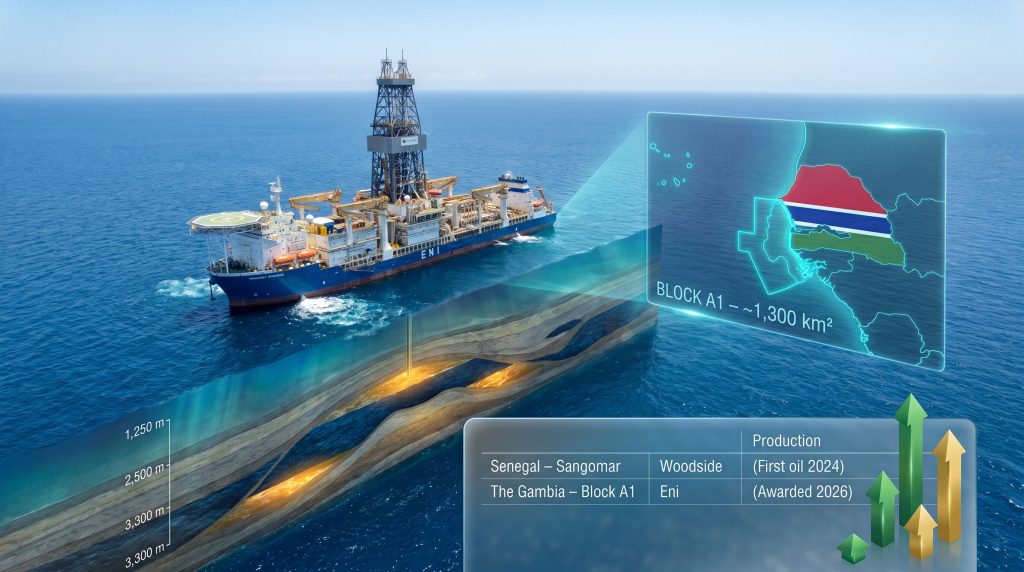
The Gambia occupies a geologically significant position within this broader petroleum province, flanked by active and producing operations in Senegal to the north. The most directly relevant regional analogue is the Sangomar field offshore Senegal, operated by Woodside, which achieved first oil production in 2024 after more than a decade of exploration and development activity. Sangomar's commercial success validated the Cenomanian reservoir play type that is considered prospective across the Atlantic margin segment encompassing The Gambia's offshore blocks.
The structural continuity between Senegalese and Gambian offshore acreage is a critical factor that reduces geological risk for explorers. Seismic data from adjacent Senegalese blocks has demonstrated that the same play fairways extend southward into The Gambia's offshore domain, though each sub-basin carries its own distinct risk profile. The absence of recent drilling on Block A1 means that exploration-phase risk remains elevated, but the regional geological context provides a meaningful de-risking foundation that would not exist in a truly frontier basin with no nearby analogues.
Furthermore, understanding the geopolitical risk landscape across resource-rich regions is essential when evaluating the commercial viability of frontier positions such as this one.
Frontier basins positioned adjacent to proven producing fields represent a structurally distinct risk-reward category. The geological de-risking from nearby production reduces exploration uncertainty while the absence of direct well control preserves significant upside potential relative to more mature acreage.
Technical Specifications of Block A1 Offshore The Gambia
Block A1: Core Parameters
The technical specifications of Block A1 define both its potential and the technical complexity involved in realising that potential. The block was awarded to Eni through a Petroleum Exploration, Development and Production License Agreement (PEDPLA) signed with the Government of The Gambia.
| Parameter | Detail |
|---|---|
| Block Designation | A1 |
| Offshore Coverage | ~1,300 km² |
| Water Depth Range | 1,250 to 3,300 metres |
| Basin Classification | Atlantic Margin Deepwater |
| License Instrument | PEDPLA |
| Awarded Operator | Eni |
| Award Announced | June 5, 2026 |
What the Water Depth Profile Reveals
A water depth range of 1,250 to 3,300 metres places Block A1 firmly within the deepwater to ultra-deepwater classification, a distinction that carries significant technical and commercial implications. Ultra-deepwater operations require specialised drilling vessels capable of maintaining station in deep water while managing wellbore pressures that can exceed 15,000 pounds per square inch at reservoir depth. The subsea engineering challenges at these depths include managing wellhead thermal dynamics, deploying blowout preventer systems on extended riser configurations, and planning for tieback distances that may exceed practical limits for conventional subsea infrastructure.
The practical consequences of this depth profile for Block A1's development pathway include:
- A phased development approach is structurally necessary, with exploration and appraisal phases required to define resource volumes before development concept selection
- Any commercial development would most likely involve an FPSO vessel rather than a fixed platform, consistent with the development approach adopted at Sangomar and other regional deepwater projects
- Rig selection for exploration drilling will be constrained to sixth-generation or newer drillships capable of operating in water depths exceeding 3,000 metres
- Subsea equipment procurement lead times of 24–36 months must be factored into development planning from an early stage
Acreage History and the Significance of Renewed Operator Interest
Block A1 was previously held by bp, which was awarded the license in 2019 before subsequently relinquishing it. The relinquishment reflected the broader industry capital retrenchment of that period rather than a specific negative assessment of the block's geology, a distinction that matters when interpreting Eni's subsequent entry. Adjacent blocks A2 and A5 have also undergone operator changes, suggesting a coordinated re-energisation of The Gambia's offshore licensing programme rather than an isolated transaction.
The fact that a major operator of Eni's calibre has chosen to re-activate this acreage following bp's departure provides a meaningful commercial signal. Major operators typically conduct extensive pre-bid technical work before committing to frontier exploration positions, and Eni's entry suggests that its geological assessment of Block A1's prospectivity meets the internal hurdle rates required to justify exploration capital allocation.
How Block A1 Fits Eni's Global Exploration Strategy
The Dual-Track Portfolio Construction Model
Eni has articulated a portfolio strategy centred on geographic diversification, targeting a deliberate mix of proven-but-underexplored basins alongside emerging frontier plays with high discovery potential. This two-track approach allows the company to balance near-term exploration success probability against higher-upside positions where competition for acreage remains limited and entry costs are correspondingly lower.
Block A1's characteristics align precisely with this framework. The block sits within a proven Atlantic margin petroleum province, satisfying the geological de-risking criterion, while remaining a frontier position relative to The Gambia's limited drilling history. This combination is increasingly difficult to find globally as mature basins become fully leased and exploration success in frontier areas has progressively matured the inventory of available high-quality acreage.
Eni's Established African Upstream Footprint
Eni's operational history across Sub-Saharan Africa provides relevant context for its Block A1 entry. The company has built one of the most extensive African upstream footprints of any international oil company, encompassing producing assets, LNG developments, and exploration positions across multiple jurisdictions. Critically, Eni's track record includes converting frontier African exploration positions into material commercial discoveries, most notably in Mozambique where its exploration work ultimately defined one of the world's largest natural gas accumulations.
This institutional knowledge is particularly relevant for deepwater Atlantic margin exploration, where the technical challenges of ultra-deepwater drilling, subsea completions, and FPSO development require experienced operator capabilities that not all entrants can credibly demonstrate. Eni's entry into The Gambia extends its West African presence into a jurisdiction where it previously held no operational stake, representing geographic diversification within an already-diverse regional portfolio.
When a major operator with an established frontier discovery track record enters a new jurisdiction, the market signal extends beyond the specific block in question. It typically prompts reassessment of adjacent acreage by mid-cap and independent operators who use major-operator entries as a proxy for geological validation.
What Eni's Award Means for The Gambia's Petroleum Sector
Reversing a Decade of Intermittent Offshore Activity
The Gambia's offshore exploration history has been characterised by cycles of initial interest followed by operator withdrawal and extended periods of reduced activity. Earlier licensing rounds attracted international attention but ultimately resulted in relinquishments that temporarily diminished the country's profile as an exploration destination. The Eni award for Block A1, combined with concurrent operator changes across blocks A2 and A5, represents a meaningful reversal of this pattern and signals improved commercial confidence in The Gambia's regulatory framework.
For the country's petroleum sector to translate this renewed interest into sustained investment, several enabling conditions must be maintained:
- Fiscal stability and predictability in the PEDPLA contractual framework
- Efficient permitting and environmental assessment processes for seismic and drilling programmes
- Transparent state participation mechanisms that provide government revenue without creating commercial disincentives
- Technical capacity development within national petroleum institutions to support effective oversight of exploration activities
Fiscal Framework and Revenue Timeline Considerations
PEDPLAs in West African jurisdictions typically structure government participation through a combination of signature bonuses payable upon license award, royalty obligations on production, production sharing arrangements that allocate a defined percentage of hydrocarbons to the state once cost recovery thresholds are met, and carried or contributing interest for the national oil company. For The Gambia, a small economy without existing hydrocarbon production, the potential fiscal impact of a commercial deepwater discovery could be transformational.
However, the timeline between exploration license award and first production in deepwater frontier environments is extended. The Sangomar field experience in Senegal, where exploration success was achieved in 2014 and first oil was not achieved until 2024, illustrates the decade-long horizon that frontier deepwater development typically requires. The Gambia should anticipate a similar or potentially longer timeline for any Block A1 development, given that drilling on the block has not yet commenced. In addition, commodity market volatility during this period can significantly affect the commercial thresholds that determine whether a discovered resource ultimately proceeds to development.
Comparative Regional Exploration Context
| Country / Block | Operator | Current Status | Water Depth | Key Context |
|---|---|---|---|---|
| The Gambia, Block A1 | Eni | Exploration awarded 2026 | 1,250–3,300 m | Frontier deepwater; proven regional geology |
| Senegal, Sangomar | Woodside | In production since 2024 | ~1,000 m | Primary regional analogue |
| Guinea-Bissau, Offshore | Various | Early-stage exploration | Variable | Adjacent Atlantic margin acreage |
| Sierra Leone, Offshore | Various | Exploration | Deepwater | Historical discoveries; limited recent drilling |
The Sangomar comparison deserves particular attention. Sangomar's reservoir is hosted within Cenomanian-age sandstones at water depths shallower than Block A1's maximum depth, but the structural and stratigraphic principles that governed its formation are considered analogous to the play types prospective in The Gambia's offshore domain. The key distinction is that Block A1's greater water depth range increases both the technical complexity and per-well drilling cost, which will directly influence the minimum commercial field size required to justify development.
Key Milestones and What Analysts Should Monitor
Typical Deepwater Exploration Timeline
Understanding the sequential nature of deepwater exploration and development allows investors and industry observers to set realistic expectations for Block A1's progression:
- License Award and Minimum Work Obligation Commitment – Eni commits to a defined work programme including seismic acquisition or reprocessing and geological studies
- 3D Seismic Acquisition and Interpretation – New or reprocessed seismic surveys define the prospect inventory and identify structurally viable drilling targets; typically completed within 12–24 months of award
- Prospect Maturation and Drilling Target Selection – Geological and geophysical analysis ranks drillable targets by resource potential and risk; rig procurement initiated
- Exploration Well Drilling – First well tests primary prospect; in frontier deepwater environments this typically occurs 3–5 years post-award
- Appraisal Phase – A discovery triggers appraisal drilling to define resource volumes and reservoir characteristics
- Final Investment Decision – Commercial viability confirmed; development concept selected and field development plan submitted
- First Production – Realistically 8–15 years from initial license award in deepwater frontier contexts
Forward Indicators Worth Tracking
Several observable signals will indicate the pace and direction of Block A1's exploration programme:
- Announcement of seismic vessel mobilisation or acquisition contracts for Block A1
- Any farm-out activity by Eni introducing joint venture partners, which would indicate internal confidence in the block's prospectivity
- Publication of updated petroleum licensing terms or fiscal framework revisions by The Gambian government
- Exploration results from adjacent Senegalese acreage that may provide geological read-across to Block A1's target intervals
- Rig contract awards specifically referencing The Gambia's offshore domain
The next major ASX story will hit our subscribers first
Frequently Asked Questions
What is Block A1 in The Gambia?
Block A1 is an offshore deepwater exploration block covering approximately 1,300 square kilometres in the Atlantic Ocean off the coast of The Gambia. Water depths across the block range from 1,250 to 3,300 metres, placing it within the deepwater to ultra-deepwater classification. The block sits within a segment of the Atlantic margin where proven hydrocarbon discoveries have been made in neighbouring jurisdictions.
Who previously held Block A1 before Eni?
Block A1 was previously licensed to bp in 2019 before being relinquished. Eni awarded exploration block in The Gambia in 2026 marks the re-activation of this acreage under a new operator, with the intervening period reflecting the broader industry capital retrenchment of that era rather than a specific geological disqualification.
Why is The Gambia considered a frontier exploration market?
Despite occupying a position within a proven Atlantic margin hydrocarbon province, The Gambia's offshore blocks have seen very limited drilling activity relative to neighbouring Senegal. This combination of validated regional geology and minimal direct well control defines the frontier classification, representing elevated geological uncertainty alongside meaningful upside potential for operators willing to accept exploration-phase risk.
The Broader Significance of Deepwater Entry in Frontier West African Markets
Energy Sovereignty and the Long-Cycle Investment Horizon
For small economies without existing hydrocarbon production, the award of a deepwater exploration license to a major international operator represents the beginning of a process that could ultimately reshape national fiscal dynamics, but only if the enabling conditions for sustained investment are maintained over a multi-decade horizon. The experience of Senegal demonstrates both the magnitude of the opportunity and the extended timeline required to realise it.
International operators like Eni contribute more than capital to frontier jurisdictions. They bring institutional knowledge of deepwater engineering, established supply chain relationships, and technical capacity that host governments typically cannot replicate independently. This knowledge transfer, formalised through local content frameworks and national oil company participation arrangements, represents a long-term developmental benefit that extends well beyond the direct fiscal revenues from exploration and production activities. A thoughtful resource strategy overview from comparable emerging producer nations illustrates how such frameworks can be structured effectively.
Why Frontier Positioning Remains Rational Despite Energy Transition Pressures
A frequently overlooked dimension of frontier deepwater entry decisions is the long-cycle nature of the investments involved. An exploration license awarded in 2026 that leads to a commercial discovery would not reach production until the late 2030s at the earliest, a timeframe in which global energy demand trajectories remain subject to significant uncertainty. Major operators have consistently argued that deepwater projects with low breakeven costs and long production lives remain commercially viable across a range of demand scenarios, including those incorporating accelerated energy transition pathways.
Eni's entry into The Gambia reflects this long-horizon thinking. The company's portfolio strategy explicitly acknowledges the need to balance near-term returns with longer-cycle resource positions that can sustain production profiles through the 2040s and beyond. Block A1, if successful, would contribute to this objective while simultaneously positioning The Gambia as an Atlantic margin producer within a proven regional hydrocarbon corridor. Understanding oil's global importance to energy security and economic stability further contextualises why such frontier investments continue to attract major operators. Moreover, considering global LNG supply dynamics adds another layer of strategic rationale, as natural gas discoveries in adjacent jurisdictions have already reshaped regional energy outlooks.
This article is intended for informational purposes only and does not constitute financial or investment advice. Exploration outcomes are inherently uncertain, and the timelines, commercial thresholds, and resource estimates discussed represent industry norms rather than project-specific commitments. Readers should conduct independent research before making investment decisions related to any companies or jurisdictions mentioned.
For additional context on West Africa's deepwater exploration landscape, readers may refer to Eni's official investor communications and the Energy Chamber of Trinidad and Tobago, which covered the Block A1 award and its broader implications for the MSGBC basin exploration race.
Want To Capitalise On The Next Major Mineral Discovery Before The Market Catches On?
While deepwater frontiers like Block A1 represent long-cycle investment horizons measured in decades, significant ASX mineral discoveries can deliver transformative returns far sooner — and Discovery Alert's proprietary Discovery IQ model ensures subscribers receive real-time alerts the moment such discoveries are announced, turning complex data across 30-plus commodities into immediate, actionable opportunities. Explore historic examples of what major discoveries have delivered for early investors and begin a 14-day free trial to position yourself ahead of the broader market.