June 6, 2026
Burkina Faso Security Forces Equipment Funding: A Strategic Budget Analysis
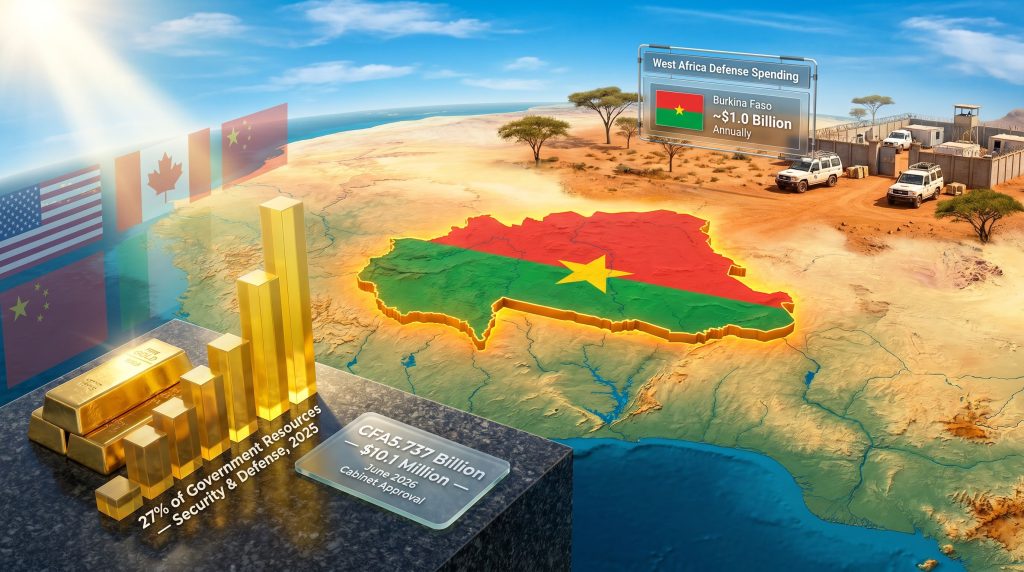
Across the Sahel, the relationship between fiscal policy and physical survival has never been more direct. For governments operating in active conflict environments, Burkina Faso security forces equipment funding decisions are not abstract policy choices — they are existential calculations made under fire, often with limited revenue and unlimited threat. Understanding how states like Burkina Faso structure, source, and justify their security expenditure reveals as much about geopolitical alignment and economic vulnerability as it does about military strategy. The CFA5.737 billion ($10.1 million) approved by Burkina Faso's Council of Ministers on June 4, 2026 is a window into this complex fiscal reality.
When big ASX news breaks, our subscribers know first
The Security Imperative Driving Defense Spending
Burkina Faso has experienced some of the most severe deterioration in public safety of any state in West Africa over the past decade. Armed groups affiliated with both al-Qaeda and the Islamic State have expanded their operational reach across the country's northern and eastern regions, displacing millions of civilians and rendering large swaths of territory functionally ungoverned. This is not a peripheral challenge — it is a structural condition that has reshaped government priorities at every level.
The transition to military governance under Captain Ibrahim Traoré, who took power in September 2022, accelerated an already-pronounced shift in budget allocation toward defence. Under the current administration, security spending has been treated as a non-negotiable fiscal priority, with approximately 27% of total government resources directed toward security and defence during the 2025 fiscal year, according to publicly available budget reporting. This places Burkina Faso among the most defence-intensive fiscal profiles in sub-Saharan Africa.
Several converging pressures explain this trajectory:
- Persistent multi-front insurgency requiring simultaneous force deployment across geographically dispersed theatres
- Armed attacks on gold mining operations, which represent the country's primary export revenue source
- Institutional capacity gaps within both the military and internal security forces that have accumulated over years of underfunding
- The dissolution of the G5 Sahel joint force framework and the departure of French military personnel, which removed previously relied-upon external security buffers
What the June 2026 Cabinet Approval Actually Covers
The June 4 cabinet session, formally designated as Council of Ministers No. 19, approved security procurement projects worth CFA5.737 billion, equivalent to approximately USD $10.1 million. While this figure represents roughly 1% of Burkina Faso's estimated annual defence budget of approximately $1.0 billion, its significance lies in what it targets and how it was authorised.
The projects aim to strengthen the operational capacities of the National Armed Forces and the Internal Security Forces deployed across the entire national territory, according to the Council of Ministers' official statement following the session.
The allocation is distributed across three distinct programme areas:
| Programme Area | Description | Beneficiary Unit |
|---|---|---|
| Mining Site Security Equipment | Specialised operational gear for units guarding extractive industry sites | National Armed Forces field units |
| Operational Equipment Procurement | Military and security hardware to expand force capability nationally | Internal Security Forces |
| Uniforms and Personnel Supplies | Clothing and related equipment for active personnel and trainees | LAABAL Brigade and Police Academy students |
The Office national de la sécurité routière has been designated as the delivery mechanism for this equipment — an administrative routing decision that reflects the pragmatic use of existing institutional infrastructure rather than the creation of new procurement channels. Cabinet-level authorisation of security procurement signals the political weight attached to this spending category, ensuring formal accountability within the government's decision-making framework.
A Multi-Source Financing Architecture: Who Else Funds Burkina Faso's Security?
What makes Burkina Faso's security financing particularly complex is that domestic budget allocations represent only one layer of a multi-source architecture. External partners have contributed substantial resources, though the composition of that external support has shifted significantly over recent years.
United States Security Assistance
The United States has maintained documented security cooperation with Burkina Faso since at least 2009, encompassing training programmes, weapons systems, vehicles, and counterterrorism capacity building. In February 2024, a U.S. mobility equipment donation valued at over 1 billion CFA francs delivered Toyota Land Cruisers, motorcycles, and logistics assets to Burkinabè security forces. The total 2024 U.S. security assistance commitment reached approximately 9.6 billion CFA francs, covering training infrastructure, weapons systems, protective equipment, and medical supplies.
This level of engagement places U.S. contributions as a significant multiplier of domestically funded security capacity, even as diplomatic relations between Ouagadougou and Washington have experienced intermittent friction under the current military government.
Canadian Counter-IED Capacity Building
Canada has funded a specialised programme targeting improvised explosive device response capability within Burkinabè law enforcement. The practical value of this investment is substantial: IED deployment has been among the most tactically damaging tools used by armed groups across the Sahel corridor. Equipment supplied includes first aid kits and basic IED detection and handling tools, accompanied by training programmes designed to develop frontline response skills. The programme addresses a specific tactical gap that general equipment procurement cannot fill.
China's Emerging Supply Role
Reports from defence analysts indicate that Chinese-manufactured armoured vehicles and fire-support platforms have entered Burkina Faso's force inventory. This development is consistent with the broader strategic realignment of the Alliance of Sahel States — which includes Burkina Faso, Mali, and Niger — away from traditional Western security partnerships. Chinese equipment typically offers cost advantages and fewer political conditionalities, but introduces long-term dependencies related to spare parts, maintenance, and technical training that differ structurally from Western supply relationships.
Furthermore, this shift in equipment sourcing is closely tied to the broader US-China rivalry in Congo and across the wider African continent, where both powers are competing for strategic influence through security partnerships and resource access.
The table below provides a comparative overview of documented and reported funding sources:
| Funding Source | Estimated Value | Equipment or Service Type | Period |
|---|---|---|---|
| Burkina Faso Domestic Budget | ~$1.0 billion annually | Full-spectrum defence operations | 2025-2026 |
| United States (2024 package) | ~9.6 billion CFA francs | Training, weapons, vehicles, medical supplies | 2024 |
| United States (mobility donation) | Over 1 billion CFA francs | Toyota Land Cruisers, motorcycles | Feb 2024 |
| Canada (counter-IED programme) | Not publicly disclosed | IED equipment, first aid kits, training | Recent |
| China (procurement reports) | Not publicly disclosed | Armoured vehicles, fire-support systems | Recent |
| Cabinet-approved package | CFA5.737 billion (~$10.1M) | Equipment, uniforms, operational gear | June 2026 |
Why Mining Site Security Is a Distinct Budget Category
The explicit inclusion of mining site security equipment within the June 2026 procurement package is not incidental. Gold is Burkina Faso's dominant export commodity and a critical pillar of government revenue. Armed group attacks on mining sites create a compounding fiscal problem: they reduce gold output, suppress royalty and tax revenues, and raise the risk premium demanded by foreign mining companies — all of which directly erode the government's capacity to fund the very security operations intended to protect those sites.
This feedback loop makes mining security economically strategic rather than merely tactical. Indeed, the natural resources in the DRC and broader central African region demonstrate a similar pattern, where resource wealth and security imperatives are deeply intertwined. Specialised equipment for units operating in extractive zones differs from standard military procurement in several important respects:
- Mobility requirements are higher, given the remote and terrain-varied nature of mining site locations
- Communication systems must function in areas with limited civilian infrastructure
- Protective equipment must account for the dual threat of armed group attacks and artisanal mining conflicts, which involve different tactical profiles
- Operational sustainment over extended deployments requires logistics solutions distinct from urban or base-centred force postures
Neighbouring states facing similar conditions, including Mali and Niger under their respective military governments, have adopted analogous approaches of embedding extractive sector protection within military procurement frameworks. This regional convergence reflects a shared recognition that resource security and fiscal solvency are inseparable in gold-dependent conflict-affected economies. Consequently, a minerals security partnership framework has become increasingly relevant to understanding how Sahel governments balance security and resource governance.
Regional Benchmarking: How Burkina Faso Compares
| Country | Estimated Defence Budget | Approx. % of Government Spending | Primary Security Challenge |
|---|---|---|---|
| Burkina Faso | ~$1.0 billion | ~27% (2025) | Jihadist insurgency, mining protection |
| Mali | Not publicly disclosed | Elevated post-coup | Sahel armed group activity |
| Niger | Not publicly disclosed | Elevated post-coup | Cross-border insurgency |
| Ghana | Moderate | ~5-7% | Coastal security, border management |
| Côte d'Ivoire | Moderate-high | ~8-10% | Northern border spillover risk |
Burkina Faso's allocation of approximately 27% of total government resources to security in 2025 places it structurally apart from more stable West African neighbours — a fiscal profile that reflects the operational severity of the security environment rather than a deliberate policy preference for defence over development spending.
The next major ASX story will hit our subscribers first
Institutional Channels and Procurement Governance
The LAABAL Brigade and Police Academy Investment
The inclusion of uniform and supply provision for the LAABAL Brigade and Police Academy students within the June 2026 package carries institutional significance beyond its monetary value. Equipping trainees at the Police Academy represents a force-multiplier investment: by ensuring that incoming personnel enter active service with adequate basic equipment, the government reduces early attrition driven by poor conditions and builds professional standards from the point of entry.
This is a recognised principle in security sector reform — that equipment provision, when paired with training, generates compounding capacity gains over time. The LAABAL Brigade's inclusion signals that internal security forces are being prioritised alongside conventional military units, reflecting an understanding that stabilisation in conflict-affected areas requires both military and civilian law enforcement capabilities operating in coordination.
Long-Term Risks: Sustainability and Supply Chain Complexity
Fiscal Sustainability Under Pressure
Sustaining approximately 27% of government resources directed toward defence raises legitimate questions about fiscal durability. Burkina Faso's revenue base is heavily dependent on gold export earnings, which are themselves vulnerable to the same insecurity that defence spending is meant to resolve. A scenario in which gold production declines due to security disruptions — while defence costs continue to rise — would create acute fiscal stress with limited adjustment options.
The risk of crowding out social spending is material. Education, healthcare, and infrastructure investment compete directly with defence allocations in a constrained budget environment. Over time, the suppression of human development expenditure can deepen the poverty and governance grievances that fuel recruitment into armed groups, creating a structural tension at the heart of the security-development trade-off. In addition, this dynamic mirrors resource-related pressures seen with the DRC cobalt export ban, where fiscal decisions tied to strategic commodities have far-reaching economic consequences.
Interoperability Challenges From Supplier Diversification
The rapid diversification of Burkina Faso's equipment supply chain — drawing simultaneously from Western, Chinese, and potentially Russian sources — introduces operational complexity that is often underappreciated in procurement discussions. The cobalt export ban impacts across central Africa similarly illustrate how supply chain decisions made at a policy level can create cascading downstream complications. Mixed-origin force inventories create interoperability challenges across several dimensions:
- Maintenance systems designed for different technical standards cannot be consolidated easily
- Spare parts sourcing requires parallel supply chains that multiply logistical overhead
- Training programmes must accommodate multiple equipment families, reducing standardisation and efficiency
- Communications compatibility between platforms from different suppliers is not guaranteed without additional integration investment
These challenges will compound over time as equipment ages and requires more intensive maintenance, according to Janes defence analysts, potentially reducing operational effectiveness even as procurement budgets remain elevated.
Key Takeaways
- The CFA5.737 billion ($10.1 million) June 2026 cabinet approval is a targeted package within a total annual defence budget estimated at approximately $1.0 billion
- Burkina Faso security forces equipment funding draws from a layered architecture combining domestic appropriations, U.S. assistance exceeding 9.6 billion CFA francs in 2024, Canadian counter-IED programmes, and emerging Chinese equipment relationships
- Mining site security has been formally embedded within the procurement framework, reflecting the government's recognition that gold sector protection is a fiscal imperative, not merely a military one
- The 27% government resource allocation to defence in 2025 is one of the most acute expressions of the Sahel security crisis in the region's fiscal data
- Supplier diversification toward non-Western platforms introduces long-term interoperability and maintenance dependencies that will shape force effectiveness well beyond the current procurement cycle
- The institutional capacity dimension — equipping the LAABAL Brigade and Police Academy students — demonstrates awareness that hardware procurement alone cannot close structural security deficits
Readers seeking ongoing coverage of West African security financing, defence budget policy, and Sahel economic developments can explore reporting from Ecofin Agency (ecofinagency.com), which provides sector-focused economic and policy analysis across key African sectors.
Want to Track the Mineral Discoveries Fuelling Africa's Strategic Resource Boom?
As Burkina Faso's gold sector remains central to both its fiscal survival and security imperatives, Discovery Alert's proprietary Discovery IQ model delivers real-time alerts on significant ASX mineral discoveries — transforming complex resource data into actionable investment insights the moment they hit the market. Explore historic discoveries and their extraordinary returns on Discovery Alert's dedicated discoveries page, and begin your 14-day free trial to position yourself ahead of the next major find.