June 22, 2026
The Commodity Cycle Mechanism That Makes Lithium Producers Unlike Any Other Mining Business
Most industrial metals follow a relatively straightforward relationship between price and profit. When prices rise, margins improve. When they fall, margins compress. Lithium producers operate within this same basic logic, but with one critical distinction: the contractual pricing structures used across the industry introduce a built-in time delay between spot price movements and reported earnings. For investors, this mechanism transforms quarterly earnings releases into something far more analytically powerful than a simple backward-looking scorecard. They become a forward visibility tool for the quarters ahead.
Understanding this dynamic is essential context for interpreting what Albemarle earnings and lithium prices are telling the market right now, because the Q1 2026 results reveal far more about where profitability is headed than where it has been.
When big ASX news breaks, our subscribers know first
Why Lithium Pricing Volatility Is in a Category of Its Own
The lithium carbonate market uses lithium carbonate equivalent, commonly referred to as LCE, as the standardised unit through which most of the industry benchmarks pricing and production volumes. Unlike copper or iron ore, where prices tend to move within narrower bands over shorter timeframes, lithium has historically demonstrated extreme cyclicality driven by a combination of structural demand acceleration, concentrated supply geography, and long development lead times for new production capacity.
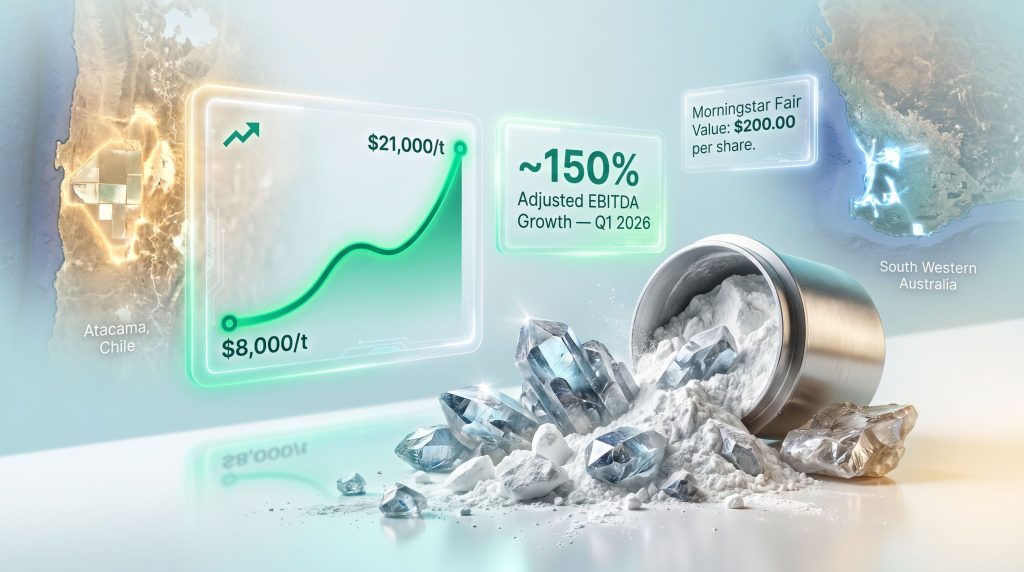
The numbers from the most recent cycle illustrate this volatility clearly. Spot lithium prices collapsed to approximately $8,000 per metric ton by mid-2025, representing a multi-year trough that rendered many higher-cost operations uneconomical. By May 2026, the same benchmark had recovered to approximately $21,000 per metric ton, according to analysis published by Morningstar. That recovery of roughly 162% within approximately twelve months places this particular price cycle among the more dramatic commodity rebounds of recent years.
What makes this price sensitivity especially consequential for producers like Albemarle is the compounding effect of operating leverage. When a company's fixed cost base remains relatively stable but revenue is entirely tied to a commodity price that can double within a year, the earnings amplification on the upside can be extraordinary. The reverse is equally true on the downside, which is precisely why the lithium market downturn of 2024 to 2025 produced such severe financial strain across the sector.
The Quarterly Pricing Lag: A Forward Earnings Signal Built Into the Business Model
One of the less widely understood features of Albemarle's commercial structure is that the majority of its lithium prices are established approximately one quarter in advance of delivery. According to Morningstar's equity research, because lithium spot prices rose during the first quarter of 2026 relative to the fourth quarter of 2025, Albemarle's contract pricing for the second quarter of 2026 was already locked in at those elevated levels at the time of reporting.
This creates a predictable earnings trajectory that operates independently of formal company guidance. The sequential logic works as follows:
- Lithium spot prices rise meaningfully during a given quarter
- Albemarle's commercial team establishes contract prices for the following quarter based on prevailing spot levels
- The subsequent quarter's revenues reflect those elevated contract prices, regardless of near-term spot price movement
- Analysts monitoring spot prices can estimate the directional shift in earnings without requiring the company to issue explicit forward guidance
Morningstar explicitly identifies this mechanism as a market proxy, noting that because Albemarle does not provide companywide guidance, investors and analysts rely on recent results combined with current spot price data to assess the likely profit direction. The quarterly pricing lag essentially transforms spot market data into a near real-time earnings forecasting tool.
Albemarle's Q1 2026 Results: What the Numbers Actually Mean
The headline result from Albemarle's first quarter of 2026 was an approximately 150% year-over-year increase in adjusted EBITDA, according to Morningstar's equity research published on 8 May 2026. The market's reaction was immediate and pronounced, with the stock advancing more than 6% on 7 May 2026.
That market reaction deserves some analytical unpacking. A 6% single-day gain on an earnings release suggests the result materially exceeded consensus expectations, not merely matched them. For a company of Albemarle's size and analytical coverage, this level of positive surprise indicates that even sophisticated market participants had underestimated the earnings leverage embedded in the pricing recovery.
The primary driver was straightforward: lithium prices had recovered substantially between mid-2025 and early 2026, and Albemarle's low-cost asset base amplified that price recovery directly into margin expansion. The cost structure that allowed the company to survive the trough period without catastrophic losses became the exact mechanism that generated outsized profits during the recovery.
Several compounding factors reinforced the earnings result:
- Low-cost Chilean brine operations in the Atacama region, representing some of the most cost-efficient lithium production globally
- Western Australian hard rock exposure through the Talison joint venture at Greenbushes, one of the highest-grade spodumene deposits in the world
- Structural cost reductions delivered during the downturn period that lowered the breakeven threshold across the portfolio
- The decision to idle higher-cost processing capacity, improving the blended cost position across remaining active operations
The combination of a recovering price environment and a deliberately lowered cost base is precisely the configuration that generates disproportionate earnings growth in commodity cycles.
The $20,000 Per Metric Ton Equilibrium: Why This Price Level Is Structural, Not Cyclical
Morningstar's long-term lithium price forecast sits at approximately $20,000 per metric ton, a figure that carries significant analytical weight because of the reasoning behind it. The forecast is not premised on sustained supply scarcity or demand euphoria. Instead, it reflects a supply-demand equilibrium model in which continued growth in electric vehicle penetration and grid-scale energy storage deployment will require progressively higher-cost marginal supply to enter the market.
In commodity economics, the long-run price tends to settle near the all-in sustaining cost of the marginal producer required to meet demand. If lower-cost brine operations and existing hard rock mines can satisfy near-term demand at $15,000 per metric ton, the structural price floor remains low. However, as demand growth outpaces low-cost supply capacity, the market must incentivise higher-cost projects, which pushes the equilibrium price upward toward $20,000 per metric ton or beyond.
Morningstar forecasts that strong growth in electric vehicles and energy storage systems in the coming years will require higher-cost supply to meet demand, underpinning the structural case for a $20,000 per metric ton long-run price. This equilibrium level is not a ceiling but a floor for sustained profitability in a demand-growth scenario.
For Albemarle specifically, this matters because the company's low-cost assets generate meaningful free cash flow at price levels that would render many competitors marginal or loss-making. If $20,000 per metric ton represents the structural equilibrium where higher-cost producers break even, Albemarle's Atacama brine operations could be generating substantial returns at the same price.
Scenario-Based Revenue Modelling: How Sensitive Is Albemarle to Price?
Because Albemarle declines to issue formal companywide guidance, the analytical framework used to assess its financial outlook centres on lithium price scenarios. The spread between realistic outcomes is substantial:
| Lithium Price Scenario | Average LCE Price | Projected Net Sales |
|---|---|---|
| Conservative / Downside | ~$10 per kg | $4.1B to $4.3B |
| Base Case (current market) | ~$20 per kg | $5.7B to $6.0B |
| Optimistic / Upside | ~$30 per kg | $7.5B to $7.8B |
The approximately $3.5 billion gap between the downside and upside revenue scenarios underscores just how profoundly lithium price assumptions drive financial outcomes. This degree of sensitivity is unusually high even by mining sector standards, and it reflects the concentrated revenue exposure that comes from being a primarily lithium-focused producer.
Disclaimer: Scenario-based projections of this nature involve significant uncertainty and should not be treated as earnings forecasts. Actual results will depend on lithium spot price movements, contract pricing structures, volume throughput, and macroeconomic conditions that cannot be reliably predicted.
Capital Discipline as a Competitive Signal
One of the more analytically interesting dimensions of Albemarle's current positioning is management's explicit commitment to capital restraint even as prices recover. According to Morningstar's analysis, management has adopted a more disciplined approach to capacity expansion in the current higher-price environment, with capital expenditures expected to remain broadly flat.
Morningstar's research explicitly endorses this posture, noting that capital discipline should allow the company to generate positive free cash flow and maintain balance sheet strength across the full price cycle. This framing matters because it signals a structural shift in how the company intends to manage commodity cycle risk, moving away from the aggressive expansion strategies that historically destroyed value in the mining sector during boom periods.
The history of cyclical commodity businesses is littered with examples of producers that overinvested during price peaks, locked in elevated capital expenditures, and then faced catastrophic balance sheet stress when prices reversed. Albemarle's stated intention to resist that pattern during the current recovery cycle is a qualitatively positive signal for long-term investors, even if it limits near-term production growth.
Asset Quality: The Geological Advantage Underpinning the Moat
Not all lithium is created equal, and understanding why requires some familiarity with the two dominant production pathways in the industry: brine extraction and hard rock mining.
Brine operations involve pumping lithium-rich brines from underground reservoirs or salt flat systems, concentrating them through evaporation, and processing the resulting slurry into battery-grade lithium compounds. The Atacama salt flat in northern Chile hosts some of the highest-lithium-concentration brines on the planet, with natural evaporation rates supported by one of the driest climates on Earth. Furthermore, this combination of resource quality and natural processing advantages produces some of the lowest all-in production costs in the global lithium industry.
Hard rock spodumene extraction involves conventional open-pit or underground extraction of lithium-bearing pegmatite ore, which is then processed through flotation to produce a spodumene concentrate before further refining into battery-grade material. The Greenbushes mine in Western Australia, operated through Albemarle's Talison joint venture, consistently produces some of the highest-grade spodumene concentrate globally, providing a cost and quality advantage over lower-grade hard rock operations.
Together, these two asset categories give Albemarle a geographic and geological diversification that few competitors can match. The brine operations provide extremely low production costs, while the hard rock operations provide volume and grade consistency.
Morningstar assigns Albemarle a Narrow Economic Moat rating, reflecting these resource quality advantages alongside scale benefits and long-standing relationships within battery-grade lithium supply chains. The accompanying Very High Uncertainty rating reflects the inherent unpredictability of lithium pricing, a factor that can overwhelm even the most structurally advantaged cost position during severe downturns.
The next major ASX story will hit our subscribers first
Key Risks That Could Interrupt the Recovery
No analysis of Albemarle earnings and lithium prices would be complete without a clear-eyed assessment of the downside risks that could disrupt the current recovery trajectory.
Supply response timing is arguably the most significant structural risk. Projects that were shelved or slowed during the 2024 to 2025 price trough may be reactivated as prices approach $20,000 per metric ton. Given typical development timelines of three to five years from feasibility study to first production, new supply could begin entering the market within an 18 to 36 month window, potentially creating another oversupply event before the structural demand inflection fully absorbs available capacity.
Demand-side uncertainties present a more nuanced risk profile. The long-term demand outlook for lithium remains constructive given EV adoption trends and the accelerating deployment of grid-scale battery storage. However, near-term macroeconomic softness, changes to EV incentive programmes in major markets, or slower-than-expected consumer adoption rates could reduce demand growth assumptions and apply downward pressure on prices.
Segment-level margin compression in Albemarle's specialties division, which encompasses bromine and catalyst solutions, represents an ongoing drag on blended company profitability. Weakness in oil and gas sector activity has weighed on catalyst demand, and bromine pricing has faced similar headwinds. The specialties business is expected to contribute flat to declining net sales relative to 2025 levels, partially offsetting the lithium recovery.
Operational disruptions at key production facilities remain a tail risk. Flooding events and other force majeure incidents can temporarily interrupt production at joint venture operations, as occurred at the Jordan Bromine Company facility in early 2026. While the impact on full-year numbers from that specific event appears limited following the facility's return to normal operating rates, similar disruptions at lithium-specific operations would carry more material financial consequences.
Albemarle as a Lithium Market Barometer
For investors with exposure to lithium-producing equities globally, including those listed on the ASX, Albemarle's quarterly results function as one of the most reliable proxy indicators for broader market conditions. The company's scale, transparency, and geographic diversification across the two dominant production pathways make it uniquely representative of industry-wide dynamics.
The approximately 150% adjusted EBITDA growth reported in Q1 2026 is not simply a company-specific achievement. It is a direct reflection of the magnitude of the lithium price recovery from the mid-2025 trough. Any lithium-exposed producer with a similarly low cost structure would have experienced broadly comparable earnings leverage during the same period. In addition, the Australia lithium industry has its own exposure to these dynamics, given the country's significant role in global hard rock supply through assets like Greenbushes.
Understanding where the current recovery sits within the broader commodity cycle framework is useful context:
| Cycle Phase | Key Characteristics | Approximate Timing |
|---|---|---|
| Trough | Sub-$10,000 per metric ton prices, widespread losses, project cancellations | Through mid-2025 |
| Early Recovery | Price rebound, margin restoration, cautious reinvestment | Q3 2025 to Q1 2026 |
| Mid-Cycle Expansion | Sustained profitability, measured capacity reinvestment | Q2 2026 onwards |
| Late Cycle / Peak | Emerging oversupply risk, price ceiling pressure | Not yet reached |
Based on current spot pricing near $21,000 per metric ton and Albemarle's forward earnings trajectory as implied by the quarterly pricing lag mechanism, the market appears to be transitioning from early recovery into the mid-cycle expansion phase. This is historically the period during which lithium equities generate sustained returns, though it is also the phase during which new project investment decisions begin to sow the seeds of the next oversupply cycle. Innovations such as direct lithium extraction could, furthermore, alter cost curves and supply timelines in ways that affect this cyclical trajectory.
Valuation and What It Implies for Investors
Morningstar's fair value estimate for Albemarle stands at $200.00 per share as of May 2026, with the stock trading at approximately $198.35 at the time of the firm's analysis. This places the equity in three-star territory under Morningstar's rating system, indicating the market has priced the recovery fairly accurately at current levels.
The practical implication is that investors seeking to benefit from the lithium price recovery through Albemarle's equity at current prices are not acquiring a significant valuation discount. The upside case from here depends primarily on lithium prices sustaining above $20,000 per metric ton or advancing further, rather than on a valuation re-rating from a depressed starting point.
This is a subtle but important distinction. The easy money in a commodity cycle recovery typically belongs to those who position early, when assets trade at distressed valuations during the trough. As the recovery matures and valuations normalise toward fair value, the investment thesis shifts from a valuation arbitrage to a commodity price directional bet. Consequently, understanding Albemarle earnings and lithium prices together, rather than in isolation, remains the most reliable framework for assessing where the risk-reward balance sits at any given point in the cycle. Reuters reporting on Albemarle's quarterly profit jump further reinforces this picture of a company whose fortunes are intimately tied to the broader pricing environment.
This article contains financial analysis and forward-looking projections based on third-party research. It does not constitute financial advice. Investors should conduct their own due diligence and consider seeking independent financial advice before making investment decisions. Lithium price forecasts involve significant uncertainty and actual outcomes may differ materially from projections.
For additional equity research and commodity market analysis, Morningstar Australia publishes ongoing coverage at morningstar.com.au.
Want To Catch The Next Major ASX Lithium Discovery Before The Market Does?
Discovery Alert's proprietary Discovery IQ model scans ASX announcements in real time, instantly identifying significant mineral discoveries across lithium and 30+ other commodities — transforming complex data into actionable investment insights the moment they're announced. Explore how historic discoveries have generated extraordinary returns on Discovery Alert's dedicated discoveries page, and begin a 14-day free trial to position yourself ahead of the next major cycle move.