June 22, 2026
The Industrial Logic of Building Batteries at Gigascale
The global energy storage industry is entering a phase of structural consolidation unlike anything seen in its short history. Manufacturing capacity is concentrating rapidly among a small number of dominant players, nearly all of them Chinese, while the rest of the world scrambles to develop credible domestic alternatives. For emerging economies with ambitious renewable energy targets, the absence of sovereign battery manufacturing capability represents not just a supply chain vulnerability, but a genuine constraint on energy independence.
India sits at the centre of this tension more acutely than almost any other nation. With a national target of over 500 GW of non-fossil fuel capacity by 2030, the country faces a structural demand gap for battery energy storage systems that its current domestic manufacturing base is wholly incapable of filling. That gap is now becoming the focal point for one of the most consequential industrial pivots by any Indian conglomerate in the clean energy era.
The scale of Reliance Industries' 120 GWh battery manufacturing capacity ambition forces a fundamental reassessment of what India's energy future could look like, and how quickly it might arrive. Furthermore, India's lithium investment push into upstream mineral security will play a critical role in determining whether this ambition can be fully realised on schedule.
When big ASX news breaks, our subscribers know first
Breaking Down the Phased Capacity Roadmap
Phase 1: 40 GWh and the Race to First Production
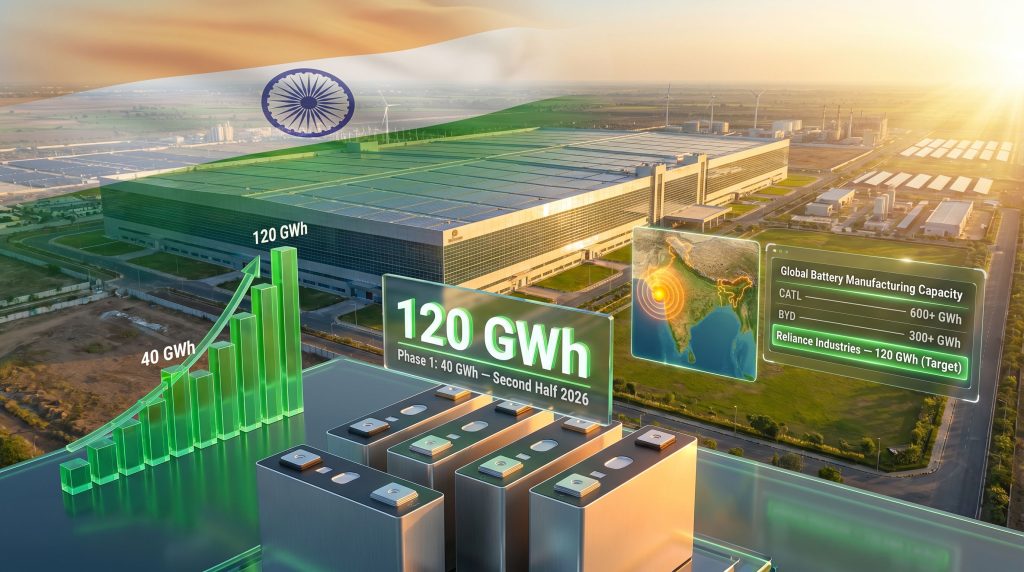
The initial phase of Reliance Industries' battery gigafactory programme targets 40 GWh of annual battery and energy storage system (BESS) cell manufacturing capacity, with commissioning scheduled for the second half of 2026. Critically, all major manufacturing equipment has already been delivered to the Jamnagar site, meaning the programme has progressed well beyond the planning stage into active commissioning.
Reliance's expanded battery ambitions were confirmed by Executive Director Anant Ambani at the company's 49th Annual General Meeting, framing the 120 GWh trajectory not as a fixed endpoint but as a demand-responsive capacity roadmap. This updated figure supersedes earlier reported targets of 100 GWh, reflecting a more aggressive scale-up timeline tied to India's accelerating grid-scale storage procurement market.
The phased approach itself carries significant strategic logic. Rather than committing full capital upfront to a facility that must immediately achieve maximum throughput, the modular expansion model allows capital deployment to match market absorption rates. This mirrors the gigafactory scaling strategies used by leading global battery manufacturers, where ramp-up phases of 12 to 24 months between design capacity and full-rate production are standard operating procedure, not exceptions.
The Jamnagar Gigacomplex: More Than a Battery Factory
The battery gigafactory does not exist in isolation. It forms one node within the Dhirubhai Ambani Green Energy Giga Complex, a 5,000-acre integrated clean energy manufacturing campus in Jamnagar, Gujarat. The complex is designed as an end-to-end renewable energy industrial ecosystem, encompassing:
- Solar PV manufacturing across the full value chain, from polysilicon to ingots, wafers, cells, modules, and glass
- Heterojunction technology (HJT) solar cell and module lines, already commissioned and producing at scale
- Green hydrogen production equipment manufacturing
- Fuel cell system fabrication
- Power electronics manufacturing
- Battery energy storage systems and LFP cell production
The geographic positioning of the complex is also strategically deliberate. Its proximity to the Kutch renewable energy zone and the dedicated Kutch-to-Jamnagar transmission corridor, currently under construction with EPC contracts awarded, creates a physical infrastructure backbone that few global clean energy industrial hubs can replicate.
Why LFP Is the Right Chemistry for India's Grid-Scale Storage Ambitions
Chemistry Matters: Understanding the LFP Advantage
The decision to anchor the Jamnagar gigafactory around lithium iron phosphate (LFP) battery chemistry is not arbitrary. For stationary grid-scale storage applications, LFP has emerged as the dominant chemistry globally for reasons that go beyond simple cost comparisons. In addition, the ongoing battery storage-driven lithium boom is reinforcing LFP's position as the preferred chemistry for large-scale energy storage deployments worldwide.
| Attribute | LFP | NMC |
|---|---|---|
| Thermal Stability | High | Moderate |
| Cycle Life | 3,000 to 6,000+ cycles | 1,000 to 2,000 cycles |
| Cost per kWh | Lower | Higher |
| Energy Density | Lower | Higher |
| Preferred Application | Grid-scale BESS | EV, portable electronics |
LFP's superior thermal stability dramatically reduces fire risk in large-format stationary installations, a factor that grid operators and project financiers increasingly treat as a hard requirement rather than a preference. Its extended cycle life also means that over a 20-year project horizon, LFP cells in daily cycling applications can complete their full service life without the premature degradation that affects NMC-based systems.
At 120 GWh of annual LFP output, Reliance would rank among the world's largest single-site LFP battery manufacturers, a category currently dominated by Chinese producers including CATL and BYD. The significance of this is hard to overstate: no non-Chinese manufacturer currently operates anywhere near this scale in LFP specifically.
The CATL Question: Technology Sourcing in a Geopolitically Complex Market
One of the less widely reported dimensions of Reliance's battery programme involves the evolution of its technology sourcing strategy. Earlier industry reporting indicated that the company faced setbacks following the breakdown of technology licensing negotiations with Xiamen Hithium, a prominent Chinese LFP cell manufacturer. Despite these complications, Reliance has publicly maintained that its commissioning timeline remains intact.
The company is now exploring CATL as a potential alternative source of components and technology for its energy storage systems. This introduces a layered risk profile that investors and analysts should understand clearly. CATL was listed under the US Department of Defense's trade restriction framework effective from 2027, which could create complications for any Reliance partnership that involves export ambitions into US-aligned markets.
India's own geopolitical positioning, combined with its desire to be a credible alternative to Chinese supply chains in Southeast Asian and Gulf markets, adds further complexity to this calculation. Consequently, the battery raw materials market dynamics will heavily influence how Reliance structures its upstream sourcing strategy going forward.
The ability to manufacture LFP batteries at scale without ongoing dependence on Chinese intellectual property licensing will ultimately determine whether Indian battery manufacturing represents genuine industrial sovereignty or merely repackaged supply chain dependency.
Solar Manufacturing Milestones: HJT Leadership in India
Advanced Cell Technology Already Delivering at Scale
While the battery programme attracts the most headline attention, Reliance's solar manufacturing achievements at Jamnagar deserve careful examination in their own right. The company has become the first in India to achieve ALMM certification for heterojunction technology solar cells, a milestone that signals both technical credibility and commercial readiness.
The technical specifications of Reliance's HJT cells are worth noting in detail:
- Cell formats: 210 mm x 105 mm with zero-busbar designs
- Efficiency ratings: up to 25.6%
- Power output range: 5.28 W to 5.66 W per cell
- Energy yield advantage: approximately 2% higher than conventional PERC modules
- Temperature coefficient performance: 15% better than conventional modules
- Long-term degradation rate: approximately 25% lower than standard PERC technology
Nearly 1 GW of HJT modules has already been produced at the Jamnagar complex. The facility is scaling toward 20 GW per annum of fully integrated solar manufacturing capacity, spanning the entire value chain from polysilicon to finished modules and glass. This level of vertical integration is rare globally and creates significant cost and quality control advantages at scale.
The Kutch Hub: Rewriting India's Energy Arithmetic
550,000 Acres and 40 Billion Units of Annual Generation
Separate from the manufacturing complex, Reliance is developing a 550,000-acre renewable energy generation hub in the Kutch region. The scale of this project places it in a category of its own within India's private sector renewable energy development.
The hub is designed to deliver round-the-clock power at gigawatt scale by co-locating utility-scale solar arrays with large-format battery storage systems. Its projected annual output exceeds 40 billion units (kWh) of green electricity, representing approximately 3% of India's total annual electricity consumption. The contribution of a single private development project to national energy supply at this level would be without precedent in India's energy history.
The operational targets are equally ambitious:
- Daily installation rate target: 55 MWp of solar modules per day
- Daily BESS installation target: 150 MWh of battery storage containers per day
- Transmission infrastructure: Dedicated Kutch-to-Jamnagar corridor under construction with EPC contracts awarded
The combination of the manufacturing complex and the generation hub creates something with very few global precedents: a single corporate entity that manufactures its own battery storage systems, produces its own solar modules, and deploys them at gigawatt scale into its own generation assets. The vertical integration implications for cost competitiveness are potentially transformative.
Global Benchmarking: Where Does 120 GWh Position India?
| Manufacturer | Country | Target/Operational Annual Capacity | Primary Chemistry |
|---|---|---|---|
| CATL | China | 600+ GWh (global) | LFP, NMC |
| BYD | China | 300+ GWh (global) | LFP |
| LG Energy Solution | South Korea | 200+ GWh (global) | NMC, LFP |
| Northvolt | Sweden | 60 GWh (target, facing challenges) | NMC |
| Reliance Industries | India | 120 GWh (phased target) | LFP |
| Indian domestic peers | India | Sub-10 GWh (combined current) | Various |
The table above illustrates a critical structural point. At full 120 GWh capacity, Reliance would not merely become India's dominant battery manufacturer; it would represent a legitimate entry into the global top tier, ahead of most non-Chinese and non-Korean producers. The collapse of Northvolt's European gigafactory ambitions in recent years further highlights how difficult gigascale battery manufacturing execution truly is, making Reliance's Phase 1 commissioning milestone in 2026 a genuinely significant industrial benchmark.
India's Production Linked Incentive scheme for Advanced Chemistry Cell battery storage has attracted multiple applicants, but actual manufacturing deployment has consistently lagged announced targets across the industry. However, global battery expansion alliances are reshaping the competitive landscape, and Tata Group's Agratas subsidiary and Ola Electric are also pursuing gigafactory ambitions, though neither approaches the scale Reliance is targeting, nor does either have the same degree of vertical integration across the full renewable energy value chain.
The next major ASX story will hit our subscribers first
Key Execution Risks Investors Should Monitor
From Equipment Delivery to Full-Rate Production
The distinction between equipment delivery and sustained full-rate production is one that deserves more attention than it typically receives in coverage of gigafactory programmes. The transition from a commissioned facility to one operating at nameplate capacity reliably and profitably typically involves:
- Cell formation and quality validation processes that can take several months to optimise
- Yield improvement cycles as manufacturing lines are tuned to target specifications
- Supply chain stabilisation for battery-grade raw materials, particularly lithium compounds and electrolyte precursors
- Customer qualification and certification processes for utility-scale BESS projects
India's battery-grade mineral supply chains remain underdeveloped domestically, creating upstream bottlenecks that will need to be managed carefully as production scales toward 120 GWh annually. The country does not currently have a battery-grade lithium refinery in India operating at meaningful scale, meaning raw material security will require either long-term offtake agreements with international suppliers or substantial upstream investment.
The Demand-Side Challenge
Even the most efficient gigafactory requires a procurement market capable of absorbing its output. India's BESS deployment market, while growing rapidly, must scale in parallel with manufacturing capacity to prevent oversupply dynamics from eroding margins. State-level grid interconnection policies and BESS procurement frameworks remain inconsistent across India's 28 states, creating demand-side uncertainty that central government policy frameworks alone cannot fully resolve.
Furthermore, Reliance's full new energy strategy extends well beyond batteries alone, encompassing solar, hydrogen, and fuel cells, which means the company's ability to cross-subsidise its battery ramp-up period is considerably stronger than that of pure-play battery manufacturers.
Disclaimer: This article contains forward-looking statements and scenario projections based on publicly available information and management disclosures. These are not guarantees of future performance. Readers should conduct independent research before making any investment decisions.
Frequently Asked Questions
What is Reliance Industries' total planned battery manufacturing capacity?
Reliance Industries' 120 GWh battery manufacturing capacity target is set for its Jamnagar gigafactory, expanding from an initial Phase 1 capacity of 40 GWh in a modular scale-up model.
When will Phase 1 of the battery gigafactory begin production?
Phase 1 at 40 GWh annual capacity is scheduled to commence production in the second half of 2026, with all manufacturing equipment already delivered to the Jamnagar site.
What battery chemistry will the Jamnagar facility produce?
The facility is designed to manufacture lithium iron phosphate (LFP) battery cells, the preferred chemistry for stationary grid-scale energy storage due to its superior thermal stability and cycle life.
How does Reliance's target capacity compare to global peers?
At 120 GWh annual output, Reliance would rank among the top-tier global battery manufacturers by capacity, behind Chinese incumbents CATL and BYD, but ahead of most non-Chinese producers operating today.
Key Metrics at a Glance
| Metric | Detail |
|---|---|
| Phase 1 Capacity | 40 GWh per annum |
| Full Target Capacity | 120 GWh per annum |
| Battery Chemistry | Lithium Iron Phosphate (LFP) |
| Facility Location | Jamnagar, Gujarat |
| Phase 1 Production Start | Second half of 2026 |
| Solar Manufacturing Target | 20 GW per annum (fully integrated) |
| HJT Cell Efficiency | Up to 25.6% |
| Kutch Hub Annual Output | 40+ billion kWh of green electricity |
| Kutch Hub Land Area | 550,000 acres |
| India Grid Share (Kutch) | Approximately 3% of annual national electricity consumption |
Want to Track the ASX Stocks Powering the Battery Storage Revolution?
As the global race for gigascale battery manufacturing accelerates, the demand for lithium and battery raw materials is creating significant discovery opportunities on the ASX — and Discovery Alert's proprietary Discovery IQ model delivers real-time alerts the moment significant mineral discoveries are announced, turning complex data across 30+ commodities into a single, actionable insight. Explore historic examples of major mineral discoveries and their market returns, then begin your 14-day free trial to position yourself ahead of the next transformative find.