June 22, 2026
Hard-Rock Lithium and the Mine-to-Converter Race: Why Integrated Supply Chains Are Reshaping Critical Mineral Strategy
The global push to electrify transport has exposed a structural weakness in Western battery supply chains: the gap between mining a lithium-bearing mineral and converting it into a battery-ready chemical compound. For decades, that gap was filled almost entirely by processing capacity concentrated in a small number of overseas jurisdictions. As allied economies move to close this vulnerability, the Rock Tech Victory project Ontario lithium acquisition illustrates the strategic logic of integrated, domestic mine-to-converter models, and Ontario is emerging as one of North America's most compelling proving grounds for exactly that kind of vertically integrated approach.
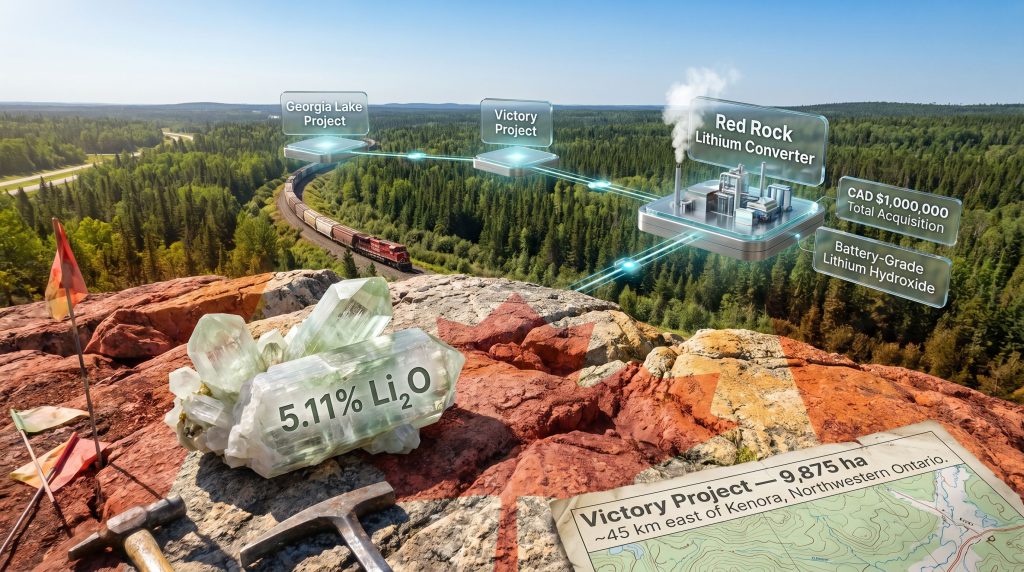
Rock Tech Lithium's acquisition of an option over the Victory Project in Northwestern Ontario represents the latest move in this broader realignment. The deal, structured as a staged option agreement with vendors Bounty Gold Corporation and Last Resort Resources, adds a 9,875-hectare early-stage exploration asset to the company's growing Ontario lithium portfolio, deepening the feedstock runway available to its planned downstream processing facility.
When big ASX news breaks, our subscribers know first
Understanding the Victory Project's Geological Credentials
The Victory Project sits approximately 45 kilometres east of Kenora in Northwestern Ontario, a region that shares geological characteristics with other established Canadian hard-rock lithium districts. The property hosts two surface-confirmed spodumene-bearing occurrences, both classified as lithium-cesium-tantalum (LCT) pegmatites, which represent one of the primary global geological hosts for hard-rock lithium.
LCT pegmatites are particularly significant in the battery minerals context because spodumene, their primary lithium-bearing mineral, yields relatively high lithium concentrations compared to brine-hosted deposits. Furthermore, they can be processed into battery-grade lithium hydroxide through established conversion pathways. Understanding spodumene extraction methods is essential for appreciating why hard-rock assets like Victory are strategically valuable.
The project's initial priority target, referred to as the Last Resort pegmatite, has returned selective grab samples of up to 5.11% Li₂O, placing early-stage results in a competitive range relative to other Canadian lithium projects. A secondary occurrence on the same property returned grab samples of up to 3.48% Li₂O.
Important context for investors: Grab sampling is a selective, non-systematic technique used to identify mineralisation at surface. High grab sample grades do not confirm the presence of a mineral resource and should not be interpreted as representative of average deposit grades. Resource-stage confirmation through systematic drilling and a compliant NI 43-101 mineral resource estimate (MRE) remains the critical next milestone.
The LCT classification carries additional exploration significance beyond lithium alone. These pegmatite types commonly contain economically relevant concentrations of cesium, in the form of pollucite, and tantalum, as columbite-group minerals, which can represent meaningful co-product value at the feasibility stage. Cesium, in particular, is a strategically sensitive metal with limited global production, primarily used in caesium formate drilling fluids and atomic clock applications.
Rock Tech's Three-Asset Ontario Framework: Building the Supply Chain from the Ground Up
The Victory Project acquisition is best understood not in isolation, but as part of a deliberate multi-asset architecture that Rock Tech is constructing across Ontario. The company now holds three distinct pieces of a mine-to-converter value chain within a single province.
| Asset | Type | Location | Development Stage |
|---|---|---|---|
| Georgia Lake Project | Advanced Exploration / Development | ~60 km north of Red Rock | Resource-defined |
| Victory Project | Early-Stage Exploration | ~45 km east of Kenora | Grab sample / target identification |
| Red Rock Lithium Converter | Processing Infrastructure | Red Rock (former Norampac site) | Development planning |
Georgia Lake provides the near-term development optionality, with an existing mineral resource underpinning future feasibility work. Victory sits at the earlier end of the exploration spectrum, contributing longer-dated upside and feedstock diversification. The Red Rock Converter is the downstream anchor of the entire strategy, a planned facility intended to process spodumene concentrate into battery-grade lithium hydroxide for Ontario's expanding EV and battery manufacturing sector.
The Red Rock facility, to be built on the former Norampac Paper Mill site approximately 110 kilometres northeast of Thunder Bay, has attracted CAD $5.5 million in investment from BMI Group. If completed, it would represent Ontario's first purpose-built lithium conversion facility, a genuinely significant piece of provincial critical mineral infrastructure.
The Victory Project is approximately five hours by road from the Red Rock Converter, a logistical consideration that becomes relevant only if exploration confirms a viable resource. However, that geographic proximity means the asset would not require transformative transport infrastructure to integrate with Rock Tech's downstream capacity.
The Financial Architecture of the Option Agreement
From a capital efficiency standpoint, the deal structure deserves close analysis. Option agreements of this kind are a standard feature of early-stage mineral exploration M&A, allowing an acquirer to earn into 100% ownership through staged payments while limiting upfront capital exposure.
Payment Schedule and Total Consideration
| Payment Component | Amount | Timing |
|---|---|---|
| Cash payments (aggregate) | CAD $600,000 | Staged: signing, 12 months, 24 months |
| Share issuance (aggregate) | CAD $400,000 in common shares | Staged over 24-month period |
| Total consideration | CAD $1,000,000 | Full option period completion |
Royalty Structure and Buyback Rights
The vendors retain a 2.0% net smelter return (NSR) royalty upon completion of the option. Rock Tech holds the contractual right to purchase 1.0% of that NSR royalty for CAD $1.0 million at any point prior to a formal construction decision.
Investor note: NSR royalty buyback provisions are a commonly used mechanism in the junior mining sector. Securing the right to reduce royalty obligations before committing to construction capital preserves project economics at the feasibility stage. A 1% NSR reduction for CAD $1 million represents a defined and relatively modest cost at the scale of a development-stage lithium project, particularly if lithium hydroxide prices recover toward prior cycle highs.
Additional milestone payments to the vendors are triggered upon publication of a compliant mineral resource estimate, which creates an aligned incentive structure between Rock Tech and the vendors during the exploration phase.
The maximum downside exposure under the option structure is capped at CAD $1.0 million in total consideration, excluding exploration expenditure. If drilling fails to confirm grade continuity at depth, Rock Tech retains the right not to exercise the option, consequently limiting financial loss to the staged payments already made.
From Grab Samples to Mineral Resource: The Exploration Pathway Ahead
Translating surface mineralisation into a compliant mineral resource requires a defined, multi-stage exploration program. The pathway from current status to MRE publication typically involves the following sequence:
-
Systematic geological mapping across both pegmatite occurrences to define structural controls on mineralisation.
-
Geophysical surveying, including airborne electromagnetics and ground-based methods, to interpret subsurface pegmatite geometry and identify drill targets beneath surface outcrops.
-
Initial core drilling program testing depth extensions and lateral continuity of the Last Resort pegmatite as the priority target.
-
Assay and preliminary metallurgical testing to confirm lithium grades from drill core and assess spodumene liberation and recovery characteristics.
-
Resource estimation compiled from drill results toward a NI 43-101 compliant MRE, the disclosure standard required for Canadian-listed companies.
-
Milestone payment trigger to vendors upon MRE publication, as specified under the option agreement terms.
A detail worth noting for those less familiar with hard-rock lithium metallurgy: spodumene undergoes a phase transformation during processing, converting from its natural alpha form to a more reactive beta form at temperatures above approximately 1,000 degrees Celsius. This thermal treatment step is essential before acid leaching can extract lithium efficiently, and it represents a key energy cost driver in spodumene-to-lithium hydroxide conversion economics. In addition, understanding the distinction between hard-rock vs brine lithium is important for contextualising these processing challenges.
Why Ontario's Infrastructure Corridor Matters for Lithium Development
The Victory Project's location along the Trans-Canada Highway corridor, with access to CPKC rail infrastructure, is not incidental. Infrastructure access is one of the defining cost variables for remote mining projects, and the ability to utilise existing road and rail networks meaningfully reduces the capital intensity of any future development scenario.
Ontario's geological terrane in the Northwestern region shares structural characteristics with the Superior Province, a Precambrian geological domain known to host pegmatite-related mineralisation. This broader geological context supports ongoing exploration prospectivity across the region, not just for lithium but for the full suite of LCT pegmatite-associated minerals.
The province also offers established permitting pathways, a mature mining services sector, and proximity to North America's largest automotive manufacturing cluster. Furthermore, innovations in direct lithium extraction technology are beginning to complement traditional processing routes, potentially strengthening the downstream demand case for Ontario-sourced lithium hydroxide.
The next major ASX story will hit our subscribers first
Scenario Analysis: What Exploration Outcomes Could Mean for Rock Tech
| Scenario | Exploration Outcome | Strategic Impact |
|---|---|---|
| Base Case | Drilling confirms surface grades at depth; MRE initiated | Victory advances toward feasibility; milestone payments triggered |
| Upside Case | High-grade intercepts define large-tonnage resource | Victory becomes a primary feedstock candidate for Red Rock Converter |
| Downside Case | Drilling fails to confirm grade continuity | Option not exercised; capital loss capped at CAD $1M plus exploration spend |
The staged structure of the agreement means each decision point is tied to new geological information, which is precisely how disciplined exploration capital allocation should function. Investors evaluating the Rock Tech Victory project Ontario lithium acquisition should weigh the exploration-stage risk of Victory against the portfolio-level benefit of feedstock optionality for the Red Rock Converter.
Consequently, the broader context of the global lithium market — including demand trajectories, pricing cycles, and geopolitical supply pressures — will ultimately determine the commercial value unlocked by Rock Tech's multi-asset Ontario strategy. For instance, critical minerals security has become a defining policy priority across allied economies, which only strengthens the strategic rationale for domestically integrated lithium supply chains of this kind.
Disclaimer: This article contains forward-looking statements and speculative analysis regarding exploration outcomes, project development timelines, and market conditions. Early-stage exploration results, including grab sample grades, do not confirm the existence of a mineral resource. Readers should not make investment decisions based solely on the information presented here. Independent financial and geological advice is recommended before making any investment decision.
Frequently Asked Questions: Rock Tech Lithium Victory Project Acquisition
What is the Victory Project?
The Victory Project is a 9,875-hectare lithium exploration property located approximately 45 km east of Kenora in Northwestern Ontario. It hosts two surface-confirmed spodumene-bearing LCT pegmatite occurrences, with the highest recorded grab sample grade reaching 5.11% Li₂O at the Last Resort pegmatite target.
How much is Rock Tech paying for the Victory Project?
Under the option agreement, Rock Tech may acquire 100% interest by making aggregate cash payments of CAD $600,000 and issuing CAD $400,000 in common shares over a 24-month period, for total consideration of CAD $1,000,000.
What royalty do the vendors retain?
Vendors Bounty Gold Corporation and Last Resort Resources retain a 2.0% NSR royalty, with Rock Tech holding the right to buy back 1.0% of that royalty for CAD $1.0 million prior to any construction decision.
What is the Red Rock Lithium Converter?
The Red Rock Converter is Rock Tech's planned lithium processing facility on the former Norampac Paper Mill site in Red Rock, Ontario, designed to convert spodumene concentrate into battery-grade lithium hydroxide for the province's EV and battery manufacturing sector. The project has received a CAD $5.5 million investment from BMI Group.
Why does the Victory Project matter for Ontario's lithium supply chain?
The Rock Tech Victory project Ontario lithium acquisition expands the upstream feedstock optionality available to the Red Rock Converter, reducing single-source dependency and strengthening the overall resilience of Rock Tech's mine-to-converter strategy across the province.
Want to Track the Next Major Hard-Rock Lithium Discovery Before the Market Does?
Discovery Alert's proprietary Discovery IQ model delivers real-time alerts the moment significant ASX mineral discoveries — including critical minerals like lithium — are announced, transforming complex geological data into actionable investment opportunities for both short-term traders and long-term investors. Explore how historic mineral discoveries have generated extraordinary returns and begin your 14-day free trial today to position yourself ahead of the broader market.