June 20, 2026
The Battery Supply Chain at a Crossroads: Five Themes Defining the Industry in 2026
Every decade or so, a commodity market undergoes a fundamental transformation in how capital flows toward it. For most of the past century, that signal was price. When prices rose, investment followed. When they fell, projects stalled. The battery materials sector has now entered a different era entirely, one where industrial policy, national security calculus, and geopolitical alignment have become the primary forces shaping where money goes and why. Understanding this shift is essential context for the global talking points ahead of the Fastmarkets Lithium, Battery and Critical Materials Conference, set to take place in Las Vegas from June 22 to 25, 2026.
The Fastmarkets conference, which draws more than 1,250 senior executives from over 40 countries, has expanded well beyond its origins as a lithium pricing forum. Its 2026 agenda encompasses co-located events covering battery and energy storage (June 23 to 25) and defence and aerospace strategic materials (June 23), reflecting how thoroughly the battery materials conversation has merged with national security strategy. The key thematic pillars include direct lithium extraction (DLE) commercialisation, project finance, AI-driven power demand, rare earths, and defence-linked critical minerals.
Five major talking points are shaping the industry's thinking heading into the gathering.
When big ASX news breaks, our subscribers know first
North American Battery Recyclers Navigate a Brutal Period of Attrition
The past twelve months have been exceptionally difficult for the North American battery recycling sector. A succession of insolvencies has reshaped the competitive landscape in ways that few anticipated even two years ago. Quebec-based Lithion Technologies entered creditor protection in November 2025. Ascend Elements, headquartered in Massachusetts, filed for Chapter 11 bankruptcy in April 2026.
Furthermore, Li-Cycle, another Canadian recycler with US operations, was acquired by commodity trading group Glencore — a move that followed the Glencore acquisition of Li-Cycle after its own bankruptcy filing in May 2025.
The structural forces behind these collapses are well understood by industry participants. Reduced grant disbursements from the US Department of Energy under the current administration, weaker private investment appetite driven by depressed battery metals valuations, and a more limited-than-expected feedstock supply have combined to create an impossible operating environment for undercapitalised players.
Analysts familiar with the sector have noted that the recycler failures represent a liquidity endurance problem rather than a fundamental flaw in the business model. Companies with technically sound operations simply could not sustain themselves through an extended period of suppressed metals prices and tightening public funding.
Black mass supply dynamics add another layer of complexity. US black mass volumes reportedly peaked during Q3 and Q4 2025 before declining materially into 2026, driven by feedstock availability constraints rather than any reduction in recycling capacity itself. This distinction matters: it signals that the pipeline of end-of-life batteries entering commercial recycling streams has not yet reached the scale required to support profitable operations at volume.
Despite the distress, payable indicators have improved sharply. Fastmarkets' price assessments for NCM/NCA black mass payable indicators for both nickel and cobalt (exw USA) stood at 104 to 109% of reference prices as of June 10, 2026, compared with 72 to 77% a year earlier. The improvement reflects stronger purchasing activity from South Korean and Chinese buyers, with China's legalisation of black mass imports under a structured compliance framework from August 2025 redirecting global secondary materials trade flows in ways the market is still adjusting to.
The Domestic Supply Chain Buildout Continues Despite Sector Headwinds
While recyclers struggle, the broader North American battery supply chain development narrative remains intact. Federal support has taken several forms, including DOE partnerships on FAST-41 transparency projects, close to $5 billion in grant awards across 39 battery supply chain projects, and total investment leveraged of approximately $16 billion.
The Loan Program Office has extended a $2 billion conditional commitment toward a Nevada battery materials campus and directed $700 million toward a domestic lithium-boron project.
California's Lithium Valley has emerged as a focal point for integrated public-private investment combining mining, refining, and manufacturing activity. Refiner Nth Cycle announced dual planned expansions and a binding offtake agreement in March 2026, citing both demand conditions and the policy backdrop as motivating factors.
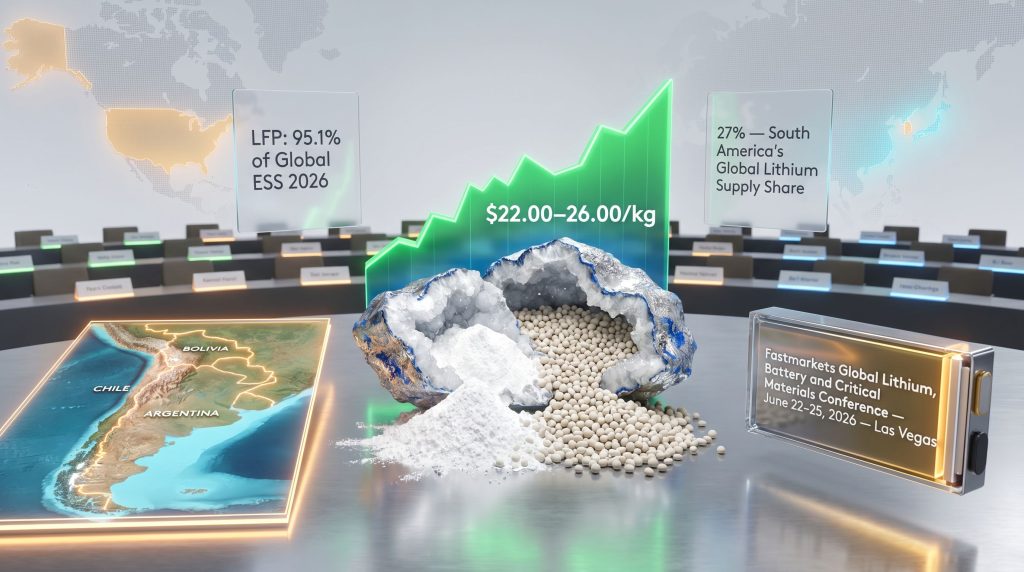
The lithium price signal reinforces the urgency. Fastmarkets' weekly assessment of lithium carbonate (99.5% Li₂CO₃ min, battery grade, spot, ddp US and Canada) reached $22.00 to $26.00 per kg on June 18, 2026, roughly double the $11.60 to $13.00 per kg assessed on the same date a year earlier.
Participants broadly acknowledge that while the direction of travel is clear, a domestic supply chain develops on multi-year timelines. Near-term demand growth could easily outpace the buildout, sustaining import dependence even as investment commitments accumulate.
South Korean Battery Makers Abandon the EV Playbook for Energy Storage
Perhaps the most significant strategic pivot in the battery industry heading into the Las Vegas conference is the acceleration of South Korea's major battery producers away from EV-focused production and toward energy storage systems. The forces behind this shift are both structural and cyclical.
The expiry of the US Inflation Reduction Act's EV purchase tax credits of up to $7,500 on September 30, 2025 materially weakened US EV uptake, removing one of the primary demand pillars for Korean battery producers. The financial damage was substantial. SK Innovation reported an operating loss exceeding KRW 931.9 billion for its battery division across the full year of 2025, attributing the result to subsidy discontinuation, customer inventory adjustments, and plant shutdowns.
Meanwhile, the rapid expansion of AI data centre infrastructure has created an entirely new demand vertical for grid-scale energy storage. LFP chemistry is leading this transition. According to Fastmarkets Research, South Korea battery expansion into LFP has accelerated dramatically, with LFP batteries forecast to represent 95.1% of global ESS deployments in 2026 — a figure that reflects both chemistry maturity and cost competitiveness at scale.
The three major Korean producers are responding with significant capital reallocation:
| Battery Producer | ESS Capacity Target | Production Location | Key Agreement |
|---|---|---|---|
| LG Energy Solution | 60+ GWh (2026) | 80%+ North America | EV-to-ESS line conversion |
| Samsung SDI | Up to 30 GWh | Indiana, USA | 1.5T KRW US energy company deal (2026 to 2029) |
| SK On | Undisclosed | Georgia, USA | LFP supply agreement with US ESS developer Flatiron Energy |
Samsung SDI secured a 1.5 trillion Korean won ESS battery supply agreement with a US energy company covering the period 2026 to 2029, with production located at its Indiana facility. SK On began transitioning its Georgia EV production lines to LFP manufacturing from late 2025 under a supply agreement with Flatiron Energy. The speed of these transitions illustrates how quickly large-scale industrial capital can redirect when policy and demand signals align.
Europe's Battery Ambitions Collide With Structural Competitive Disadvantages
Europe entered 2026 still committed to building a vertically integrated battery supply chain that would span mining, refining, cathode production, cell manufacturing, and recycling. The ambition was geopolitically coherent. However, the commercial reality has proven more complicated.
Three high-profile failures in the past year have crystallised the challenge. The Europe critical minerals supply chain has been significantly disrupted by these collapses:
- Swedish cell manufacturer Northvolt entered insolvency in 2025
- Norwegian cell producer Morrow Batteries entered bankruptcy proceedings in 2026
- French lithium refiner Viridian Lithium was placed into judicial liquidation in 2026
These were not isolated project failures. They reflected a broader pattern of projects conceived during the peak of EV optimism between 2020 and 2022 that could not survive the combination of slower demand growth, tighter financing conditions, and intensifying competition from Chinese producers operating with structurally lower cost bases.
The Rio Tinto Jadar project suspension in Serbia compounds the raw material problem. Jadar represented one of Europe's most significant potential domestic lithium feedstock sources. Its removal from the supply picture reinforces dependence on imported lithium and Chinese-controlled precursor supply chains at precisely the moment when Europe is attempting to reduce that dependence.
Ironically, some of the most commercially credible progress in European battery capacity has come from Chinese-backed investors. Projects involving CATL and BYD have largely remained on schedule, highlighting the degree to which European battery ambitions continue to rely on Asian capital and technology.
Policy responses have escalated in proportion to the commercial setbacks:
- The European Commission announced a €1.5 billion Battery Booster Strategy to accelerate domestic cell manufacturing
- France acquired a direct equity stake in the Imerys Emili lithium project, signalling a willingness to intervene financially in strategic raw material development
- Finland's Keliber project became the continent's first fully operational integrated battery-grade lithium production system
The structural argument made repeatedly by market participants is that financing support can partially offset but cannot eliminate Europe's underlying competitiveness gap. Without cost parity with Asian producers, the viability of many European battery projects depends on sustained public subsidy rather than commercial fundamentals.
South America Holds Half the World's Lithium Resources, Yet Faces Distinct Pressures
South America's lithium resource base is extraordinary. The region holds more than 50% of global lithium resources, concentrated in the Lithium Triangle spanning Argentina, Bolivia, and Chile. Despite this, Fastmarkets Research forecasts South America's share of global lithium supply to remain broadly stable at approximately 27% in both 2026 and 2036.
This figure reflects the long construction and ramp-up timelines characteristic of brine-based operations rather than any shortage of resource. In addition, the Argentina lithium brine market faces a distinct set of regulatory and investment challenges that further complicate the regional supply outlook.
Three structural forces are shaping regional supply dynamics:
| Factor | Description |
|---|---|
| Political landscape | Government changes in Chile and Bolivia; elections in Brazil (2026) and Argentina (2027) introduce policy uncertainty |
| Foreign investment conditions | Regulatory fragmentation, unclear licensing frameworks, intervention risk, and constrained financing access |
| Cost curve positioning | Integrated brine operations remain globally competitive but face rising royalty burdens and variable evaporation conditions |
Brazil represents a differentiated hard rock story within the region. Sigma Lithium's controlled production restart from February 2026 is being closely monitored as a barometer of hard rock supply recovery, with the company targeting a measured first-quarter ramp-up. The distinction between brine and hard rock matters beyond geology. Hard rock projects can be brought online faster and scaled more predictably, whereas brine operations require multi-year evaporation processes that limit responsiveness to demand signals.
South American producers occupy an unusual dual position in the global supply chain. They are simultaneously courted by Western buyers seeking to reduce Chinese dependence and by Asian buyers requiring volume at competitive cost. Managing that dual alignment without triggering political complications domestically is one of the more nuanced strategic challenges facing the region's producers.
The next major ASX story will hit our subscribers first
Lithium Price Recovery and the China Processing Question
The lithium price recovery from mid-2025 levels deserves specific attention as a market signal. Fastmarkets' daily assessment of lithium carbonate (cif China, Japan and Korea) reached $22.00 to $22.50 per kg on June 12, 2026, while lithium hydroxide monohydrate (56.5% LiOH min, battery grade, cif China, Japan and Korea) was assessed at $20.00 to $22.00 per kg on the same date.
The recovery has been driven by converging forces: ESS demand acceleration from AI infrastructure buildout, supply constraints from project delays and feedstock shortages, and policy-driven procurement creating demand floors in North American and European markets. For a broader overview of lithium market data, including price assessments and supply trends, Fastmarkets publishes regular updates across all key battery raw materials.
Underlying the entire conference agenda is the unresolved question of Chinese processing dominance. China accounts for an estimated 35 to 100% of global processing capacity across graphite, cobalt, nickel, and lithium depending on the specific material — a concentration that defines the central supply chain vulnerability for all non-Chinese market participants. This is not a short-term imbalance. It reflects decades of deliberate industrial policy investment that Western markets are now attempting to replicate on compressed timelines.
The concept of friendshoring — the deliberate routing of supply chain investment and procurement toward geopolitically aligned partner nations — has moved from policy discussion to active deal structuring. Offtake agreements, investment incentives, and trade frameworks are now explicitly designed to build alternative supply chains outside Chinese control. Whether those alternatives can achieve cost competitiveness without permanent subsidy support is the central long-term question the global talking points ahead of the Fastmarkets Lithium, Battery and Critical Materials Conference will almost certainly sharpen, even if they cannot fully resolve it.
Disclaimer: This article contains forward-looking statements, price forecasts, and market projections sourced from publicly available Fastmarkets price assessments and research. These do not constitute financial or investment advice. Past price performance is not indicative of future results. Readers should conduct independent due diligence before making any investment decisions.
Want To Stay Ahead of the Next Major Battery Materials Discovery on the ASX?
Discovery Alert's proprietary Discovery IQ model delivers real-time alerts on significant ASX mineral discoveries — instantly transforming complex commodity data across lithium, rare earths, and other critical battery materials into actionable investment insights. Explore historic discoveries and their returns to understand what's possible, then begin your 14-day free trial at Discovery Alert to position yourself ahead of the market as the battery supply chain reshapes global capital flows.