
June 11, 2026
The Hidden Vulnerability in Global Aluminium Supply Chains
Most commodity investors focus on mine output, refinery utilisation rates, and benchmark pricing when assessing aluminium sector profitability. Far fewer account for the fragility of the maritime infrastructure that connects bauxite mines, alumina refineries, and aluminium smelters across continents. When a single shipping corridor becomes compromised, the cost consequences ripple outward with surprising speed, reaching refinery operating accounts within weeks rather than months. That is precisely the dynamic now playing out, and Alcoa alumina earnings pressure from Strait of Hormuz disruption illustrates just how quickly geopolitical friction can be converted into financial pain.
When big ASX news breaks, our subscribers know first
Why Maritime Chokepoints Create Disproportionate Commodity Risk
The global aluminium production chain is, at its core, a logistics chain. Bauxite is extracted predominantly in Guinea, Australia, and Brazil, then shipped to refineries that convert it into alumina, which is subsequently transported to smelters that produce primary aluminium. Each of these transfer points relies on open, efficient sea lanes.
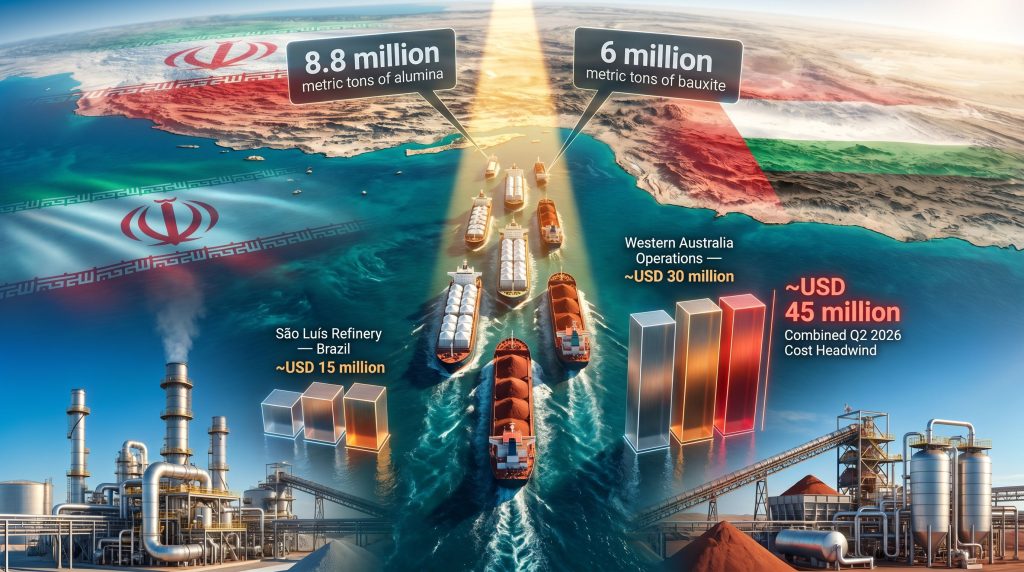
The Strait of Hormuz sits at the intersection of the Persian Gulf and the Gulf of Oman, and it functions as a critical transit corridor for a surprisingly large volume of aluminium raw materials. Approximately 8.8 million metric tons of alumina and 6 million metric tons of bauxite move through this waterway annually. While the strait is more commonly associated with oil and gas flows, its role in alumina and bauxite logistics is substantial and structurally significant.
What makes chokepoint disruption particularly damaging is the asymmetric risk profile it creates. A disruption at a single geographic point does not simply affect the vessels transiting that route; it forces a cascading series of adjustments across the entire supply network:
- Alternative routing adds significant voyage distances, increasing fuel consumption and charter costs per shipment
- Extended transit times delay bauxite deliveries to refineries, creating potential feedstock scheduling complications
- Shipping insurers elevate war-risk premiums for vessels operating near conflict zones, adding a further layer of cost
- Energy market disruption in the same region simultaneously elevates the diesel and fuel oil costs that refineries use in their processing operations
This multi-vector cost escalation is what distinguishes a maritime disruption from a typical commodity price fluctuation. It does not arrive through a single channel that can be hedged with a single instrument. Furthermore, the China metals market challenges that have already pressured aluminium demand create an increasingly difficult backdrop against which these supply-side shocks are landing.
Alcoa Alumina Earnings Pressure from Strait of Hormuz Disruption: Breaking Down the Numbers
Alcoa's disclosures at the Wells Fargo Industrials & Materials Conference quantified the financial exposure in concrete terms. The company estimated a combined incremental cost burden of approximately USD 45 million for the current quarter, split across two distinct operational geographies.
| Facility | Location | Estimated Additional Q2 2026 Cost | Primary Cost Driver |
|---|---|---|---|
| São Luís Refinery | Brazil | ~USD 15 million | Fuel and energy cost escalation |
| Western Australia Operations | Australia | ~USD 30 million | Energy and logistics inflation |
| Combined Exposure | Multi-region | ~USD 45 million | Strait of Hormuz disruption |
The São Luís refinery in Brazil is one of the largest alumina production facilities in the world, and its energy cost base is directly sensitive to global fuel oil pricing. When regional conflict elevates energy commodity benchmarks, refineries that rely on heavy fuel inputs absorb those increases rapidly given the continuous, high-volume nature of their processing operations.
The Western Australian operations carry a larger estimated cost increment, reflecting both the scale of production in that region and the compounding effect of longer rerouted shipping distances for any raw material or product flows that connect to affected trade lanes.
Alcoa's Chief Financial Officer indicated that the alumina division is expected to remain unprofitable during the current quarter, a disclosure that prompted a negative market reaction and a decline in the company's share price. The investor community's sensitivity here reflects a well-founded concern: not the absolute dollar figure in isolation, but the velocity at which these costs are arriving within a single reporting period.
The Refinery Cost Structure Problem: Why Alumina Producers Cannot Simply Absorb Shocks
Understanding why a USD 45 million quarterly cost headwind is so damaging requires some familiarity with how alumina refinery economics actually work. Several structural features of the refining process make these operations particularly susceptible to external cost shocks.
Continuous-process operations represent the first constraint. Unlike a mining operation that can reduce blasting schedules or defer ore movement, an alumina refinery uses the Bayer process, a continuous chemical conversion sequence that cannot be easily paused or throttled without significant technical and economic consequences. Once a refinery is operating, it must continue consuming energy and inputs at roughly consistent rates regardless of short-term cost movements.
Energy intensity is the second structural vulnerability. Alumina refining is among the most energy-demanding processes in the metals sector. The Bayer process requires sustained high-temperature digestion of bauxite in caustic soda solutions, followed by precipitation and calcination steps that are all thermally intensive. Energy typically represents the single largest variable cost component in alumina production, meaning that even moderate fuel price increases translate directly into material per-unit cost escalation.
High fixed-cost base creates the third layer of vulnerability. A significant proportion of refinery costs, including maintenance, labour, and capital servicing, remain essentially constant regardless of production volume. This means that when variable costs like energy and freight rise sharply, the margin compression is concentrated and cannot be diluted by adjusting the fixed-cost allocation across higher volumes.
The combination of continuous-process constraints, energy intensity, and fixed-cost concentration means alumina refineries have structurally limited capacity to absorb sudden external cost shocks. This is a fundamental characteristic of the process, not a management failure.
How the Transmission Mechanism Works: From Geopolitical Event to Earnings Line
The pathway from a maritime disruption to a refinery earnings impact follows a relatively predictable sequence, though the speed of transmission is often underestimated by analysts focused on longer-cycle commodity dynamics.
- Route disruption – Conflict-related activity near the Strait of Hormuz reduces the viability of direct shipping lanes, causing vessel operators to seek alternative routing
- Transit extension – Rerouted voyages add substantial distance and time to bauxite and alumina shipments, directly increasing per-voyage operating costs
- Freight rate inflation – Higher shipping costs feed into seaborne bauxite input costs for refineries receiving material on spot or short-term contract terms
- Energy market spillover – Regional conflict simultaneously disrupts energy commodity pricing across Gulf-adjacent markets, elevating diesel and fuel oil benchmarks used in refinery operations
- Unhedged logistics exposure – Unlike energy costs, which some producers partially hedge through forward contracts, freight cost escalation from rerouting typically falls outside standard hedging programmes
- Margin compression – Unless alumina benchmark prices rise proportionally and quickly, the incremental cost burden flows directly through to operating EBITDA
Alcoa's Q2 2026 alumina adjusted EBITDA is expected to absorb a sequential decline of approximately USD 15 million attributable to a combination of lower pricing, reduced volumes connected to bauxite offtake agreements, and the elevated energy and logistics costs described above. The broader commodity price impact on producer margins during geopolitical disruptions follows precisely this transmission pattern.
Hedging Frameworks and Their Limits Under Multi-Vector Disruption
Alcoa has communicated that its alumina cost structure provides competitive resilience relative to higher-cost global peers, and that long-term energy contracts alongside financial hedging instruments are in place to reduce direct spot energy market exposure. These are genuine risk management tools that provide meaningful protection under normal market conditions.
However, multi-vector disruptions like the current Strait of Hormuz situation challenge the boundaries of conventional hedging frameworks in several specific ways:
- Energy hedges cover forward price exposure but typically cannot neutralise the full magnitude of a USD 45 million quarterly cost shock when both fuel oil benchmarks and logistics costs are escalating simultaneously
- Bauxite offtake agreements that create volume and pricing commitments reduce operational flexibility during supply-chain disruptions, as refineries remain obligated to receive and process material even when economics are unfavourable
- Freight cost escalation from rerouting is structurally outside the scope of most energy hedging programmes, representing an unhedged exposure category that becomes increasingly significant during sustained maritime disruptions
- War-risk insurance premiums represent an additional cost layer that emerges during conflict periods and has no standard hedging equivalent in commodity producer risk management frameworks
In addition, commodity hedging strategies that work effectively under single-variable market stress are often insufficient when freight, energy, and insurance costs move adversely in tandem.
The distinction between hedged energy costs and unhedged logistics costs is one of the least-discussed but most consequential variables in assessing alumina producer earnings resilience during maritime disruption events.
The next major ASX story will hit our subscribers first
Supply-Side Tightening: The Paradox That Could Partially Offset Cost Pressure
There is a counterintuitive dynamic embedded in the current situation that warrants attention. Conflict in the Middle East has reduced or curtailed regional aluminium smelting and refining capacity, withdrawing supply from global markets. In commodity economics, supply reduction creates upward price pressure, and if alumina benchmark prices rise sufficiently, some portion of Alcoa's incremental cost burden could be offset through higher realised pricing.
A separate industry analysis on aluminium supply disruption has noted that policy uncertainty is currently supporting alumina prices while inventory overhang dynamics simultaneously cap the upside. This creates a constrained pricing environment, meaning that price-driven relief is possible but unlikely to arrive at a scale or speed sufficient to fully neutralise a USD 45 million single-quarter cost impact.
Key variables that will determine whether price recovery offsets cost pressure:
- The duration and geographic scope of conflict-related shipping disruptions through the Strait of Hormuz
- The volume of alumina and bauxite flows that are permanently rerouted versus temporarily suspended
- Inventory levels at major consuming regions including China, Europe, and North America
- The capacity and willingness of alternative bauxite suppliers in Guinea, Australia, and Brazil to accelerate export volumes and fill supply gaps
- The pace at which downstream aluminium smelters adjust purchasing behaviour in response to elevated alumina costs
Scenario Analysis: Bull, Base, and Bear Outcomes for Alcoa's Alumina Division
| Scenario | Key Conditions | Likely Earnings Outcome |
|---|---|---|
| Bear Case | Disruption persists beyond Q2; freight and energy remain elevated; alumina prices flat or declining | Alumina division remains loss-making; cost headwinds compound over multiple quarters |
| Base Case | Partial alumina price recovery; hedging absorbs moderate energy inflation; disruption stabilises | Sequential improvement in H2 2026; margins remain thin but division returns to marginal profitability |
| Bull Case | Regional supply withdrawal drives material alumina price spike; Strait disruption resolves faster than expected | Rapid margin recovery; cost headwinds offset by higher realised prices; potential earnings beat in H2 |
Disclaimer: The scenario projections above are analytical frameworks based on publicly available information and should not be construed as financial advice or earnings forecasts. Commodity markets are inherently unpredictable and actual outcomes may differ materially from any scenario described.
What the Alcoa Situation Reveals About Systemic Aluminium Sector Risk
The broader significance of Alcoa alumina earnings pressure from Strait of Hormuz disruption extends well beyond a single company's quarterly results. It illustrates a structural vulnerability that affects the entire global aluminium supply chain and one that is rarely modelled with sufficient granularity in standard sector analyses.
The aluminium industry has historically been assessed primarily through the lens of LME pricing, Chinese production capacity, and energy cost trends in major smelting regions. Maritime logistics risk has typically been treated as a tail risk rather than a core financial variable. The current situation, furthermore, suggests that framing deserves urgent reassessment. The exposure is not limited to Alcoa; major aluminium mining companies with refinery operations linked to affected trade lanes face comparable structural vulnerabilities.
Several structural realities deserve closer investor attention going forward:
- Alumina refinery economics are more sensitive to freight and energy co-movement than standard financial models typically capture
- The geographic concentration of critical maritime routes creates systemic exposure that cannot be diversified away at the individual producer level
- Continuous-process industrial operations have inherently lower short-term cost flexibility than extractive operations, making them more vulnerable to rapid external cost shocks
- Multi-vector disruptions that simultaneously affect energy costs and logistics costs challenge the assumptions embedded in conventional single-variable hedging programmes
- The speed of cost transmission from maritime disruption to refinery earnings is significantly faster than the speed of price recovery, creating an inherent lag risk for producers
Consequently, the introduction of tariffs on bulk commodities alongside maritime disruption events compounds pressure on global materials producers in ways that reinforce the case for rethinking how logistics risk is modelled.
For investors and analysts tracking the aluminium sector, the USD 45 million combined cost headwind facing Alcoa in Q2 2026 is not merely a line item in a quarterly update. It is a case study in how geopolitical risk translates into measurable industrial earnings pressure through mechanisms that deserve far more systematic modelling than they currently receive.
Want to Know Which ASX Mineral Discoveries Could Deliver Outsized Returns?
As geopolitical disruptions continue to reshape global commodity supply chains, identifying well-positioned ASX exploration and mining opportunities ahead of the broader market has never been more critical — Discovery Alert's proprietary Discovery IQ model delivers real-time alerts on significant ASX mineral discoveries, turning complex mineral data into actionable insights for investors of all experience levels. Explore historic examples of exceptional discovery outcomes and begin your 14-day free trial at Discovery Alert to position yourself ahead of the next major market move.