June 11, 2026
Why Oil Markets Are Structurally Blind to What's Coming
Throughout history, the most damaging commodity price shocks have not arrived as sudden surprises. They have built slowly beneath the surface, masked by inventory buffers, suppressed by political messaging, and ignored by financial markets still pricing derivatives rather than physical barrels. The risk of a severe oil price shock in late summer 2025 fits this pattern almost precisely, and the conditions underpinning it are more structurally entrenched than current Brent crude prices suggest.
Understanding why markets remain underprepared requires examining not just the supply side of the equation, but the psychological, political, and financial architecture that consistently delays the market's recognition of physical scarcity until the pain becomes impossible to ignore.
When big ASX news breaks, our subscribers know first
The Seasonal Demand Window That Makes Late Summer the Danger Zone
How Inventory Buffers Have Temporarily Obscured the Crisis
Global strategic petroleum reserves and commercial inventory stockpiles were built specifically to absorb short-term supply disruptions. In the months following the escalation of Middle East conflict, these buffers have functioned broadly as intended, preventing an immediate price spike that would have forced faster political and market responses.
The problem is that buffers are finite. Reports of inventory drawdowns across multiple regions, including sharp recent declines in Chinese strategic reserves that had been accumulating for years, suggest the absorption phase is nearing its limits. China, widely understood to have been building stockpiles aggressively for years, has now begun drawing those inventories down materially. When China returns as a large-scale buyer into a supply-constrained market, the repricing dynamic could be swift and disorderly.
Seasonal Demand Amplification and the Driving Season Factor
Late summer represents a structurally unfavourable demand window in global oil markets. Key seasonal drivers converge simultaneously:
- Peak holiday and driving season demand across North America and Europe
- Elevated air conditioning loads increasing electricity generation fuel requirements
- Northern hemisphere aviation demand at its highest point of the year
- Agricultural and logistics activity accelerating ahead of harvest periods
There are already signals of stress in the aviation sector, with several airlines having reduced summer flight schedules — an unusual operational decision that reflects both elevated fuel costs and the operational uncertainty created by ongoing Middle East disruption.
The Divergence Between Paper Pricing and Physical Market Reality
One of the least discussed dynamics in the current oil market is the growing wedge between western paper market pricing on exchanges such as NYMEX and the physical spot premiums being paid across Asia and the Middle East. Oil prices in Oman, Dubai, Pakistan, India, and parts of China reflect meaningfully different supply and demand realities than the electronic futures complex traded in New York and London.
A significant additional complication is the volume of crude oil currently floating on the ocean aboard vessels unable to transit key chokepoints. This floating inventory creates an illusion of supply availability in aggregate statistics while remaining entirely inaccessible to refiners who need it delivered. The headline inventory data and the accessible physical supply are not the same number, and markets are pricing the former rather than the latter.
Understanding the Structural Conditions Behind the Forecast
A Multi-Year Bear Market Has Reset the Supply Investment Baseline
The oil bear market that began in 2008 when Brent crude peaked near $150 per barrel, and which reached its ultimate low when crude prices briefly went negative during the COVID crash of 2020, lasted over a decade. That extended period of capital starvation has structurally impaired the industry's ability to respond quickly to price signals. The trade war impact on oil markets has further complicated the investment landscape for energy producers.
Following the COVID trough, oil experienced one significant recovery, then consolidated for approximately three years in what technical analysts describe as a falling wedge formation. That formation broke to the upside, consistent with a bullish continuation pattern. The broader technical structure suggests the long-term oil price rally remains intact despite short-term consolidation.
Why Oil Equities Remain Structurally Undervalued
Despite oil prices remaining approximately 50% above levels seen in late 2024, energy equities have not experienced the kind of re-rating that would normally accompany such a move. Investor sentiment toward oil and gas stocks remains largely sceptical. The prevailing mood among institutional investors appears closer to distrust of the rally than enthusiasm for it, with frequent discussion of technical gaps in the oil chart and persistent concerns about demand destruction.
This disconnect creates a structural opportunity. Energy equities, particularly large-cap dividend-paying names, still appear undervalued relative to the physical supply outlook. Smaller Canadian oil and gas producers and royalty structures offer additional leverage to the thesis as the supply shock materialises.
How Severe Could the Oil Price Shock Actually Be?
Key Scenarios and Price Trajectory
| Scenario | Brent Crude Range | Energy Equity Outlook | Key Risk |
|---|---|---|---|
| Geopolitical escalation continues | $140 to $200 | Strongly bullish | Demand destruction accelerates faster than expected |
| Partial Middle East normalisation | $110 to $140 | Moderately bullish | Lag effects and inventory deficits still drive shortages |
| Demand destruction arrives first | $80 to $110 | Mixed, quality names outperform | Recession compresses valuation multiples |
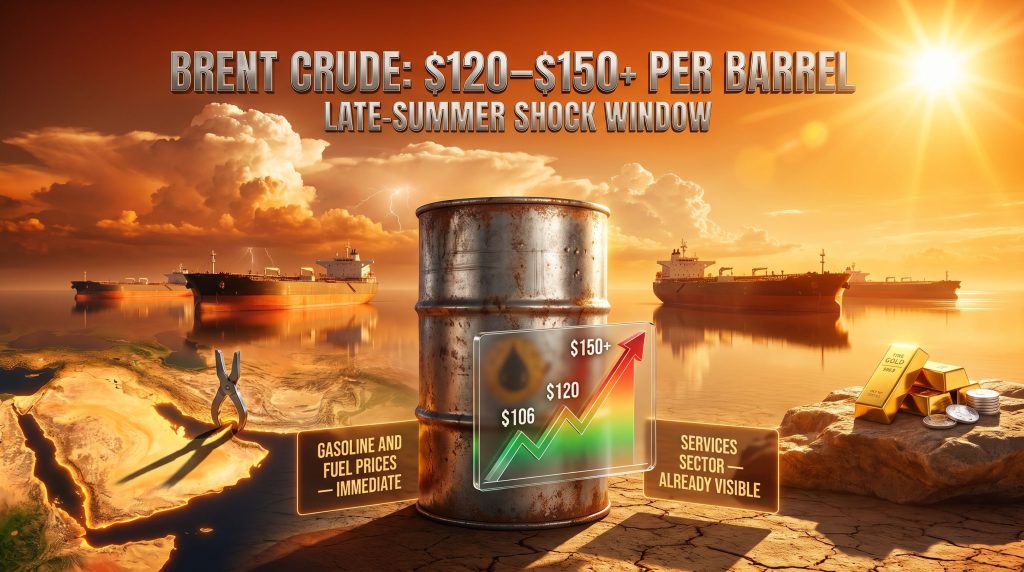
Under a sustained disruption scenario, Brent crude trajectory projections range from approximately $120 to $150 per barrel, with significant upside risk if the inventory buffer depletion accelerates faster than the seasonal demand peak. The U.S. Energy Information Administration's own disruption modelling has placed average Brent in the $105 to $106 per barrel range through mid-2026 before any meaningful supply normalisation, representing a significant premium to current prices.
Independent academic research, including work from Yale's Budget Lab, confirms that oil price shocks reduce GDP and raise core consumer prices, and that the duration of a shock matters as much as its initial magnitude. A late-summer price spike that persists into autumn carries compounding recessionary and inflationary risk simultaneously.
The Hormuz Constraint and Its Infrastructure Consequences
The geopolitical architecture behind the current supply disruption does not have a near-term resolution pathway. The Iran-Israel-America conflict remains volatile and structurally unresolved, shifting in appearance daily while making no real underlying progress. Gas production infrastructure in Qatar, one of the world's most critical LNG suppliers, reportedly faces a five-year reconstruction timeline — a figure that illustrates the multi-year nature of the supply impairment even under optimistic resolution scenarios.
Furthermore, the US natural gas outlook is also being reshaped by these same geopolitical pressures. Ships that departed the Middle East in late February are still arriving at destinations, and the absence of new departures will only become visible in physical markets with a lag of weeks to months.
What Historical Oil Shocks Teach Us About Late-Summer 2025
The 1973 and 2008 Playbooks
The 1973 oil crisis demonstrated how supply restriction, even when anticipated in aggregate, produces rapid price escalation and recessionary feedback when it finally transmits into consumer economies. The political response at the time is instructive: leaders who publicly acknowledged the severity of the energy crisis faced severe electoral consequences. Jimmy Carter's transparent communication about energy scarcity is widely credited with contributing to the end of his presidency.
This political dynamic has not changed. Official messaging from governments and central banks today continues to lag the physical market reality, which historically means the eventual price adjustment is sharper and less orderly than it would have been had the problem been acknowledged earlier.
The 2008 oil price surge to approximately $147 per barrel offered a different lesson: when demand growth, low supply elasticity, and financial market amplification converge simultaneously, price moves can exceed even the most aggressive forecasts. That price level also ultimately triggered demand destruction severe enough to collapse the market. The current setup, with oil prices not yet having destroyed demand in any material way, suggests the shock sequence has not yet reached its peak.
How a Severe Oil Price Shock Interacts With Inflation and Rate Policy
The Fed's Structurally Impossible Position
The inflationary transmission from elevated oil prices works through multiple channels with varying lag times:
| Inflationary Transmission Channel | Lag Time to Consumer Impact | Severity Indicator |
|---|---|---|
| Gasoline and fuel prices | Immediate (0 to 4 weeks) | High |
| Agricultural input costs | 4 to 12 weeks | Medium to High |
| Food retail prices | 8 to 16 weeks | Medium to High |
| Industrial goods and logistics | 12 to 24 weeks | Medium |
| Services sector (airlines, tourism) | Already visible | High |
The Federal Reserve currently faces a position of genuine policy paralysis. Bond market dynamics, including reduced foreign demand for U.S. Treasuries from Gulf state sovereign wealth funds and others, have placed upward pressure on yields. The 10-year Treasury yield acts as a critical threshold: sustained movement above the 5% range forces investors to reconsider equity risk premiums relative to risk-free government bond returns.
With grocery prices already elevated and secondary inflation effects still working through the pipeline, rate cuts have been effectively removed from the near-term policy toolkit. The more challenging scenario involves the Fed potentially needing to raise rates into an oil-driven inflationary spiral — precisely the policy action that would most severely damage economic growth and equity valuations simultaneously. Lessons from 2022's oil price shock illustrate how quickly policy options can narrow once energy inflation becomes entrenched.
The next major ASX story will hit our subscribers first
The AI Bubble and Liquidity Compression: A Toxic Macro Cocktail
Why Technology Valuations Amplify the Risk
The broader equity market context matters significantly for understanding how an oil shock will transmit through financial markets. Current semiconductor and artificial intelligence valuations exhibit characteristics consistent with late-cycle bubble behaviour: parabolic price appreciation, extreme valuation multiples disconnected from revenues, and massive capital expenditure programmes where returns remain speculative.
The historical parallel is instructive. Internet infrastructure investment in the late 1990s was not wrong in its vision — the technology did eventually reshape commerce and communication. However, the timeline between investment and adoption was far longer than investors priced in 1999, and those who bought at peak valuations waited over a decade to recover their capital.
When an oil-driven inflation spike coincides with a potential equity market correction in a sector trading at extreme valuation multiples, the resulting liquidity compression can force rapid de-risking across all asset classes, including commodities and mining equities. This is the 2008 scenario framework that sophisticated investors are currently stress-testing.
Current margin speculation levels are at or near cycle highs. The combination of overvalued technology equities, rising yields, oil-driven inflation, and approaching seasonal low-volume summer trading creates a macro environment where disorderly de-risking becomes a credible scenario rather than a tail risk.
Strategic Petroleum Reserves and the Multi-Year Demand Tailwind
The Refill Imperative Creates Structural Support
Emergency reserve drawdowns from strategic petroleum reserves in the United States and other consuming nations have provided a secondary buffer against price spikes, but this mechanism carries an important consequence: reserves that have been drawn down must eventually be refilled. The refill cycle creates years of structural demand support for oil producers operating in a supply-constrained environment.
Even in a scenario where Middle East tensions partially normalise and some supply disruption is resolved, the combination of factors below creates a persistently favourable operating environment for oil producers:
- SPR restocking requirements spanning multiple years
- Reconstruction timelines for damaged gas production infrastructure measured in half-decades
- The lag between price signals and upstream capital investment responding
- Seasonal demand patterns amplifying near-term shortfall severity
How Should Investors Position Ahead of a Late-Summer Oil Price Shock?
Defensive Positioning in a Liquidity-Constrained Environment
Given the genuine uncertainty about timing and the risk that an AI equity bubble correction could coincide with the oil shock, positioning logic favours:
- Large-cap dividend-paying energy names that generate cash flow across a wide range of oil price outcomes and can sustain returns through volatility
- Canadian oil and gas equities and royalty structures, which offer additional leverage to the physical supply theme with jurisdiction quality
- Maintaining liquidity reserves to capitalise on dislocations if a broader equity market correction forces indiscriminate selling across commodity sectors
- Hard asset allocation including precious metals as portfolio hedges against the fiat debasement dynamic that oil-driven inflation accelerates
The mining equity sector offers a cautionary lesson in timing discipline. Despite gold reaching new all-time highs, mining equities have experienced corrections of 35% to 80% from recent peaks — not because of fundamental deterioration but because liquidity flows in a small sector can be extremely violent.
Silver and Gold as Complementary Portfolio Positions
A severe oil price shock accelerates the case for hard asset allocation through several interconnected mechanisms. Oil-driven inflation erodes the purchasing power of fiat currencies, reinforcing the monetary case for gold as a safe haven not controlled by any single nation's agenda. Central bank accumulation of gold across both Eastern and Western institutions reflects this structural shift.
Furthermore, silver's dual role as both an industrial metal critical to electrification and a monetary store of value becomes particularly relevant in a scenario combining energy disruption and monetary debasement. Silver's long-term demand profile appears structurally supported even as short-term price volatility remains extreme.
Frequently Asked Questions: Severe Oil Price Shock in Late Summer
What Is a Severe Oil Price Shock and How Is It Defined?
A severe oil price shock refers to a rapid and sustained increase in crude oil prices driven by supply disruption, demand acceleration, or both, sufficient to materially impact consumer prices, GDP growth, corporate margins, and central bank policy. Historically, shocks that produce price increases of 50% or more within a 12-month period and persist for multiple quarters qualify as severe.
Why Is Late Summer 2025 Specifically Identified as a High-Risk Window?
The late summer window concentrates several risk factors simultaneously: inventory buffer depletion following months of drawdown, peak seasonal demand from driving and cooling, low trading volume amplifying price moves, and the expiration of the lag period between Middle East supply disruption and its full transmission into accessible physical supply.
How High Could Oil Prices Go If the Strait of Hormuz Remains Constrained?
Under a sustained constraint scenario, Brent crude projections range from $120 to $150 per barrel in the near term, with further upside to $200 possible if the disruption persists and demand destruction has not yet fully materialised. The 2008 precedent of $147 per barrel occurred under less severe supply disruption conditions than currently exist.
What Was the Last Comparable Oil Supply Shock and What Happened to Markets?
The 2008 oil price surge remains the closest modern analogue. Brent reached approximately $147 before demand destruction and the global financial crisis collapsed prices. The 1973 OPEC embargo is the more structural parallel, producing sustained price elevation, recessionary feedback, and inflationary spirals that took years to resolve.
How Does an Oil Price Shock Affect Inflation and Central Bank Policy?
Oil price elevation flows through transportation, agriculture, manufacturing, and services with varying lags, creating a multi-wave inflationary impact. For central banks already constrained by debt dynamics and equity market fragility, oil-driven inflation eliminates the near-term case for rate cuts while making rate hikes economically dangerous.
Which Energy Sectors and Geographies Are Most Exposed to a Late-Summer Shock?
European energy consumers face the greatest vulnerability given reduced Russian supply and dependence on LNG imports through disrupted Middle East routes. Asian industrial economies are also highly exposed. North American producers, particularly Canadian oil sands operators and royalty companies, are positioned to benefit from elevated pricing while having meaningful insulation from direct supply chain disruption.
Can Strategic Petroleum Reserve Releases Prevent a Severe Price Spike?
SPR releases can delay and moderate a price spike but cannot prevent one when the underlying supply disruption is structural rather than temporary. With reserves already drawn down materially, the remaining buffer capacity is reduced, and the political calculation around further releases involves trading near-term price relief against medium-term strategic vulnerability.
Key Takeaways: The Late-Summer Oil Price Shock Risk in Summary
-
Global oil inventories have functioned as a temporary buffer, obscuring the true severity of the supply disruption currently underway across Middle East production and transit infrastructure
-
Brent crude projections under a sustained disruption scenario range from $120 to $150+ per barrel, with upside risk to $200 if buffer depletion accelerates ahead of the seasonal demand peak
-
EIA disruption modelling places average Brent at approximately $105 to $106 per barrel through May to June 2026 before any supply normalisation, representing significant upside from current levels
-
Historical analogues including 1973 and 2008 confirm that delayed shock transmission and political suppression of honest messaging are consistent features of major supply disruptions, typically producing sharper eventual price adjustments
-
Energy equities, particularly dividend-paying large-cap names and Canadian oil and gas producers, remain structurally undervalued relative to the physical supply outlook
-
A late-summer oil shock coinciding with a potential AI equity bubble correction and liquidity compression creates a compounding macro risk environment that warrants defensive positioning, maintained cash reserves, and hard asset exposure
-
The SPR refill imperative and multi-year infrastructure reconstruction timelines create structural demand tailwinds for oil producers extending well beyond the immediate shock window
This article is for general informational purposes only and does not constitute investment advice or a solicitation to buy or sell any securities or financial instruments. All forecasts, price projections, and scenario analyses involve significant uncertainty and should not be relied upon as the basis for any investment decision. Past performance of commodity markets and energy equities is not indicative of future results. Readers should conduct their own research and consult a licensed financial adviser before making any investment decisions. Further perspectives on global commodity market dynamics, energy geopolitics, and precious metals strategy can be explored through Palisades Gold Radio on YouTube, which features independent market analysts covering macro and resource sector themes.
Want To Identify The Next Major Resource Discovery Before The Broader Market?
Discovery Alert's proprietary Discovery IQ model delivers real-time alerts on significant ASX mineral discoveries, instantly translating complex resource data into actionable investment insights — explore the historic returns major discoveries have generated and begin your 14-day free trial at Discovery Alert to position yourself ahead of the market.