June 11, 2026
The Hidden Vulnerability at the Heart of Western Industrial Supply Chains
The global titanium dioxide industry sits at a structural crossroads. For decades, Western manufacturers have quietly absorbed the risks embedded in a supply chain dominated by energy-intensive ilmenite processing concentrated in Asia, accepting the geopolitical exposure as an unavoidable cost of doing business. That tolerance is eroding rapidly. As critical minerals demand surge accelerates and industrial consumers face mounting pressure to decarbonise their supply chains, the absence of a credible Western-sourced, lower-emission titanium dioxide supply has shifted from a background concern to an urgent strategic problem.
It is within this context that Empire Metals Pitfield titanium dioxide alumina production viability demands serious examination. The project does not simply represent another undeveloped mineral resource. It represents a potential structural answer to a supply problem that Western industry has struggled to articulate, let alone solve.
When big ASX news breaks, our subscribers know first
What Is the Pitfield Titanium Project and Why Does It Matter?
Project Fundamentals: Scale, Location, and Resource Credentials
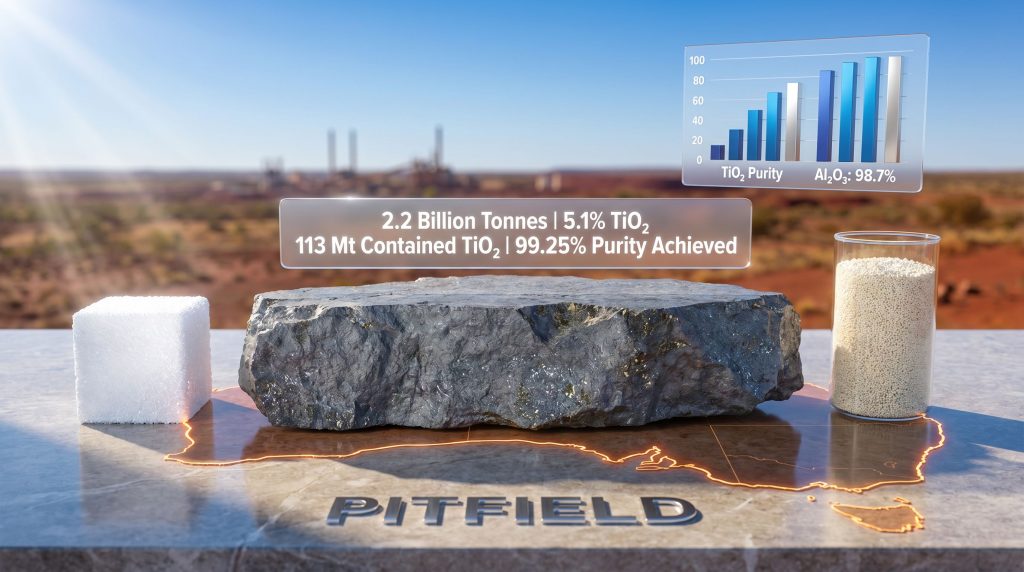
Located in Western Australia, the Pitfield project is anchored by a resource estimate of 2.2 billion tonnes at 5.1% TiO₂, translating to approximately 113 million tonnes of contained titanium dioxide. AIM-listed Empire Metals operates the project, which benefits from proximity to established Western Australian infrastructure, a factor that carries direct implications for capital efficiency and logistics costs.
| Parameter | Detail |
|---|---|
| Project Location | Pitfield, Western Australia |
| Resource Estimate | 2.2 billion tonnes |
| TiO₂ Grade | 5.1% TiO₂ |
| Contained TiO₂ | ~113 million tonnes |
| Listed Exchange | AIM (London) |
| Project Operator | Empire Metals |
To contextualise the scale, globally significant titanium deposits are typically defined by contained TiO₂ of tens of millions of tonnes. At 113 million tonnes of contained TiO₂, Pitfield sits in a category occupied by only a handful of undeveloped projects worldwide. Infrastructure proximity in Western Australia further distinguishes Pitfield from comparably scaled deposits in more remote or politically complex jurisdictions.
The state's established mining services ecosystem, port access, water availability, and power grid connectivity collectively reduce the pre-production capital burden relative to greenfield projects in frontier locations.
How Does Pitfield's Ore Body Differ From Conventional Titanium Feedstocks?
The distinction between Pitfield and conventional ilmenite sources begins at the mineralogical level. Ilmenite, the feedstock for approximately 90% of global titanium dioxide pigment production, is an iron-titanium oxide mineral that requires extensive processing to remove iron content before titanium dioxide of sufficient purity can be produced. This iron removal step is both acid-intensive and energy-demanding, generating substantial volumes of iron sulphate byproduct streams that require disposal or further processing.
Pitfield's ore body, by contrast, exhibits mineralogical characteristics that enable processing through conventional technology pathways while potentially circumventing the iron-extraction bottleneck that drives cost and emissions intensity in ilmenite-based routes. A critically important feature of the Pitfield flowsheet is the capacity for early gangue rejection, meaning that low-value silicate and other non-titanium-bearing minerals can be removed from the ore stream at an early processing stage, before the material enters the more energy and reagent-intensive leach circuits.
This mechanism reduces the volume of material requiring downstream processing, with direct implications for acid consumption, energy use, and waste generation.
Technical Note: In mineral processing, gangue refers to the commercially worthless material surrounding or mixed with economically valuable minerals in an ore body. Early gangue rejection is a cost-reduction principle that has become increasingly central to modern flowsheet design, as it eliminates the expense of processing material that adds no value to the final product.
Breaking Down the Integrated Metallurgical Flowsheet
What Processing Stages Has the Pitfield Flowsheet Validated?
Empire Metals has confirmed the completion of bench-scale testwork across all major processing stages of an integrated flowsheet. The result is a demonstrated capability to produce titanium dioxide at 99.25% purity, a grade that satisfies the specifications for both premium pigment manufacturing and titanium sponge metal feedstock applications.
According to reporting by Mining Weekly, the company confirmed the flowsheet's capacity to produce a premium 99% titanium dioxide pigment following the successful completion of bench-scale testwork across key processing stages (Arnoldi, Mining Weekly, June 2026).
The integrated flowsheet progresses through the following stages:
- Ore preparation and size classification, establishing the particle size distribution required for efficient mineral separation
- Early gangue rejection, removing low-value silicate material to reduce downstream processing volumes
- Concentration and beneficiation, upgrading the titanium-bearing fraction prior to chemical processing
- Leach circuit processing, dissolving titanium-bearing minerals under controlled acid and temperature conditions
- Purification and precipitation, removing impurities and recovering the titanium dioxide product at target purity
- Alumina recovery from pre-leach solution, capturing the aluminium fraction as a high-grade co-product
The bench-scale completion of all these stages represents a meaningful technical milestone. In mineral processing development, bench-scale validation is the stage at which processing chemistry and mineralogical behaviour are confirmed under controlled laboratory conditions. It precedes continuous pilot-scale operation, which tests the same processes under representative flow conditions over extended periods.
What Are the Key Cost Levers Built Into the Flowsheet Design?
The Pitfield flowsheet incorporates five distinct cost-reduction mechanisms that, in combination, could underpin a genuinely competitive operating cost structure relative to incumbent ilmenite-based producers:
- Early gangue rejection reduces the mass of material entering acid leach circuits, directly lowering acid consumption and processing vessel requirements
- Lower acid consumption relative to conventional sulphate-process TiO₂ production, driven by the ore's mineralogical characteristics rather than process innovation alone
- Reduced leach temperature requirements, which lower thermal energy intensity and the associated operating cost and carbon footprint
- Acid recycling enabled through the alumina recovery circuit, allowing process reagents to be recaptured and reused rather than neutralised and discarded
- Smaller residue stream generation, reducing waste management costs and the environmental liability associated with tailings and process residue disposal
Each of these mechanisms addresses a specific cost driver in conventional TiO₂ production. Sulphate-process TiO₂ plants, which represent the majority of global production capacity, are characterised by high acid consumption, significant iron sulphate waste generation, and relatively high energy intensity. The chloride process, while more efficient for high-grade feedstocks, requires rutile or upgraded ilmenite at grades exceeding 85% TiO₂, feedstocks that are themselves in constrained supply. Pitfield's approach, if validated at pilot scale, could offer a third pathway that avoids the principal cost disadvantages of both incumbent routes.
Important Caveat: The cost advantages described above are based on bench-scale testwork and flowsheet design parameters. They have not yet been validated under continuous pilot-scale operating conditions. Investors and analysts should treat these claimed cost advantages as indicative rather than confirmed until pilot programme results are published.
The Alumina Co-Product: Opportunity, Optionality, or Overstated?
What Has Testwork Revealed About Alumina Recovery at Pitfield?
One of the more technically distinctive aspects of the Pitfield flowsheet is the recovery of high-grade alumina from the pre-leach solution, a stream that would typically be treated as a process waste in conventional titanium dioxide production. Bench-scale testwork has demonstrated alumina recovery at approximately 98.7% Al₂O₃ purity, a grade that places the material within the high-grade alumina category relevant to specialty ceramics, advanced materials, and refractories markets.
| Alumina Metric | Reported Result |
|---|---|
| Purity Achieved in Testwork | ~98.7% Al₂O₃ |
| Recovery Source | Pre-leach solution |
| Development Stage | Bench-scale; further evaluation required |
| Inclusion in Studies | Planned for scoping study phase |
What makes this co-product particularly compelling from an engineering perspective is that the alumina recovery circuit is designed to generate direct benefits for the TiO₂ production process itself, not merely as an independent revenue stream. The recovery of aluminium from the pre-leach solution simultaneously lifts titanium dioxide recovery rates, reduces net reagent consumption, and decreases the volume of waste residue requiring disposal.
This dual-benefit mechanism means that the alumina circuit is not simply additive; it is structurally integrated into the cost optimisation of the primary TiO₂ production process.
The reagent cost implications are meaningful. By capturing the aluminium fraction early in the process and enabling acid recycling through the alumina circuit, the flowsheet reduces the volume of fresh acid required per tonne of TiO₂ produced. Given that sulphuric acid is a major operating cost component in TiO₂ production, representing typically 20–30% of direct operating costs in sulphate-process facilities, even modest reductions in acid consumption translate directly into material improvements in production economics.
Bull Case vs. Bear Case: How De-Risked Is the Alumina Co-Product?
Bull Case: Why Alumina Could Be a Material Revenue Contributor
- High-grade alumina at or above 98% Al₂O₃ commands premium pricing in specialty markets, with calcined alumina for advanced ceramics applications trading at significant premiums over smelter-grade alumina
- The integrated nature of alumina recovery means co-product benefits accrue to TiO₂ production economics regardless of whether alumina is ultimately sold commercially
- Co-product revenue at feasibility stage could meaningfully improve project-level economics and reduce the minimum TiO₂ price required for the project to reach its internal rate of return threshold
- Global demand for high-purity alumina is expanding across multiple growth sectors including LED substrates, lithium-ion battery separators, and advanced ceramics
Bear Case: Why Alumina Remains an Unproven Revenue Stream
- Bench-scale alumina results have not yet been replicated under continuous pilot-scale conditions, where operational variability and feed grade fluctuations can significantly affect recovery rates and product quality
- Commercial-scale alumina recovery requires dedicated circuit validation, separate capital allocation, and potentially different engineering expertise from TiO₂ production
- Inclusion in scoping studies does not confirm economic viability; it simply allows the economics to be modelled and tested against market pricing assumptions
- The specialty alumina market is relatively small and characterised by stringent customer qualification processes, meaning even technically viable co-product production does not guarantee commercial offtake
Analyst Caution: TiO₂ production is materially more advanced in its development trajectory than alumina recovery at Pitfield. The alumina co-product should be treated as an economic optionality lever with genuine upside potential, not as a confirmed revenue line. The next twelve months of piloting will be decisive in determining whether this optionality can be converted into bankable project economics.
The Piloting Programme: What Needs to Be Proven Next?
What Is the Purpose of the 12-Month Metallurgical Piloting Programme?
Continuous pilot-scale operation is the critical bridge between bench-scale chemistry validation and feasibility-grade engineering design. Where bench-scale testwork confirms that a process works under controlled laboratory conditions, pilot-scale testing confirms that it works reliably, consistently, and at representative throughput rates over extended operating periods. This distinction is commercially significant because feasibility study design criteria, capital cost estimates, and operating cost models all depend on pilot-scale data rather than bench-scale results.
Empire Metals has confirmed that the 12-month metallurgical piloting programme, which is expected to commence in the near term, will pursue three primary objectives:
- Validating process design parameters at representative scale, providing the engineering data required to size equipment, design plant circuits, and develop reliable capital cost estimates for formal feasibility studies
- Generating product samples for evaluation by potential customers and offtake partners, a step that is commercially indispensable because titanium dioxide pigment and titanium sponge metal feedstock purchasers require physical product evaluation before committing to offtake discussions
- Enabling process optimisation, allowing engineers to identify and address inefficiencies in the flowsheet before design is frozen for feasibility-level engineering
The customer sample generation objective deserves particular attention. In commodity markets, offtake agreements are rarely negotiated on the basis of technical specifications alone. Prospective customers require physical product samples to conduct their own qualification testing, assessing the material's performance characteristics in their specific applications.
For TiO₂ pigment customers, this means testing dispersibility, tinting strength, opacity, and compatibility with their existing formulations. For titanium metal producers, it means assessing feedstock purity against the requirements of their specific production processes. Without pilot-scale product samples, the offtake market development pathway cannot progress.
Key Milestones Investors Should Monitor
| Milestone | Significance |
|---|---|
| Completion of 12-month piloting programme | Validates flowsheet scalability and generates feasibility-grade design criteria |
| Scoping study incorporating alumina co-product | First full economic framing of project-level economics including co-product revenue |
| Customer sample evaluation outcomes | Signals offtake market receptivity to Pitfield product quality |
| Feasibility study commencement | Marks transition from technical to commercial development phase |
| Murdoch University molten salt electrolysis research outcomes | Determines viability of lower-emission titanium metal production pathway |
The Titanium Metal Pathway: A Lower-Emission Route to Downstream Value
What Is Molten Salt Electrolysis and Why Is It Significant for Pitfield?
Virtually all titanium metal produced globally today is made through the Kroll Process, a batch production method developed in the 1940s that reduces titanium tetrachloride with magnesium metal in an inert atmosphere. While the Kroll Process has proven commercially robust for over seven decades, it carries several structural disadvantages: it is batch rather than continuous, it is energy-intensive, and it generates magnesium chloride waste streams that require recovery and recycling.
Molten salt electrolysis, by contrast, represents an electrochemical approach to titanium metal production in which titanium dioxide is dissolved in a molten salt medium and reduced to metal through the application of electrical current. The FFC Cambridge Process, the most extensively researched variant of this approach, has demonstrated the technical feasibility of producing titanium metal directly from TiO₂ feedstock. The theoretical advantages over the Kroll Process include:
- Continuous rather than batch operation, enabling higher throughput and more efficient capital utilisation
- Lower energy intensity per kilogram of titanium metal produced, particularly when powered by renewable electricity
- Elimination of the chlorination step required in the Kroll Process, simplifying the production pathway and reducing associated emissions
- Reduced process complexity, potentially enabling smaller-scale, distributed titanium metal production facilities
What Is the Murdoch University Research Programme Investigating?
Empire Metals has commissioned a research programme at Murdoch University's Extractive Metallurgy Hub specifically to investigate the production of titanium metal directly from Pitfield's TiO₂ product through molten salt electrolysis. This research programme positions Pitfield's 99.25% TiO₂ product as the direct feedstock input for the electrolysis trials, meaning the research directly tests the downstream viability of Pitfield's primary product rather than operating in isolation from the main project.
The strategic logic of this research investment is clear. The titanium metal market commands significantly higher per-unit values than the TiO₂ pigment market. Titanium sponge metal, the intermediate product used to produce aerospace and defence-grade titanium alloys, trades at multiples of the per-tonne value of TiO₂ pigment. Furthermore, the Empire Metals titanium discovery at Pitfield adds further strategic depth to the molten salt electrolysis pathway, as a commercially viable lower-emission production route using Pitfield's TiO₂ feedstock would dramatically expand the project's addressable market and revenue potential.
Strategic Implication: If the Murdoch University research programme yields a commercially viable molten salt electrolysis pathway, Pitfield could evolve from a TiO₂ pigment supplier into a vertically integrated titanium metal producer. This would represent a fundamentally different and materially higher-value proposition, placing the project in direct relevance to aerospace, defence, and medical device supply chains rather than solely the coatings and pigments sector.
It is important to note that this research programme is at an early stage. Molten salt electrolysis for titanium metal production has not yet been demonstrated at commercial scale globally, and significant engineering and scale-up challenges remain to be resolved before this pathway could contribute to Pitfield's project economics. The research should consequently be understood as a long-duration optionality investment, not a near-term production pathway.
The next major ASX story will hit our subscribers first
How Does Pitfield Position Against the Global Titanium Supply Landscape?
Competitive Positioning Within the TiO₂ Market Structure
The global TiO₂ pigment market is supplied through three primary feedstock categories: ilmenite, rutile, and synthetic rutile. Ilmenite dominates by volume but carries the highest processing cost and emissions burden. Natural rutile, with TiO₂ content typically exceeding 90%, is the preferred feedstock for chloride-process TiO₂ production but is geographically concentrated in Australia, South Africa, and Sierra Leone, with reserves that are materially smaller than ilmenite deposits.
Synthetic rutile, produced by upgrading ilmenite through kiln-based processes, occupies a middle ground but adds processing steps and associated costs. Pitfield's product purity of 99.25% TiO₂ exceeds the specification requirements for both chloride-process and sulphate-process TiO₂ pigment production, positioning it as a premium feedstock capable of addressing multiple market segments.
What End-Markets Would Pitfield's Products Serve?
| Product | End-Market Applications |
|---|---|
| 99%+ TiO₂ Pigment | Paints, coatings, plastics, paper, cosmetics |
| Titanium Sponge Metal Feedstock | Aerospace, defence, medical implants, industrial equipment |
| High-Grade Alumina (98.7% Al₂O₃) | Specialty ceramics, advanced materials, refractories |
The breadth of this market exposure is a structural advantage. Projects dependent on a single end-market face concentration risk if that market experiences pricing or demand volatility. Pitfield's ability to direct product toward pigment, metal feedstock, or specialty alumina markets provides operational flexibility that could prove valuable in navigating commodity price cycles.
The growing preference among Western industrial consumers for traceable, sustainably sourced materials with verifiable supply chain provenance also creates positioning opportunities for Pitfield. Considerations around energy security and critical minerals are now actively shaping procurement decisions at major architectural coatings manufacturers, aerospace primes, and consumer goods companies, creating demand pull for Western-sourced alternatives to Asian-dominated supply.
Moreover, the broader critical minerals policy shift reshaping procurement frameworks across Western governments is accelerating this trend, as industrial buyers seek to align their supply chains with policy directives that incentivise domestic and allied-nation sourcing.
Viability Assessment: Where Does Pitfield Stand Today?
How Should the Current Development Stage Be Interpreted?
A structured assessment of Pitfield's current development status reveals a project with a compelling technical foundation but meaningful execution risks ahead of commercial validation.
| Dimension | Current Status | Risk Level |
|---|---|---|
| TiO₂ Product Purity | 99.25% achieved at bench scale | Low to Medium |
| Flowsheet Integration | Completed across key processing stages | Medium |
| Alumina Co-Product | 98.7% Al₂O₃ at bench scale; further work required | Medium to High |
| Cost Structure | Claimed advantages pending pilot validation | Medium to High |
| Resource Scale | 2.2 billion tonnes at 5.1% TiO₂; 113 million tonnes contained TiO₂ | Low |
| Pilot Programme | Imminent commencement; not yet complete | High |
| Feasibility Study | Not yet initiated | High |
The resource scale risk is assessed as low because the maiden resource estimate has been established through systematic drilling and estimation, providing a credible technical foundation. Product purity risk is assessed as low to medium because bench-scale results are well documented and reproducible, though pilot-scale replication remains to be confirmed. The pilot programme and feasibility study are rated as high-risk dimensions not because failure is expected, but because these are the stages at which most projects encounter their most significant technical and economic challenges.
What Would Confirm or Undermine Pitfield's Commercial Viability?
Confirmatory Signals to Monitor:
- Continuous pilot programme replicating bench-scale TiO₂ purity and recovery rates consistently over the full 12-month programme duration
- Alumina circuit demonstrating consistent recovery at or above 98% Al₂O₃ purity under pilot-scale conditions
- Customer sample evaluations resulting in formal expressions of offtake interest from industrial end-users
- Scoping study delivering operating cost estimates that are competitive with incumbent TiO₂ producers on a landed cost basis
Risk Factors That Could Undermine the Thesis:
- Pilot-scale recoveries falling materially below bench-scale results due to feed variability or process scaling challenges
- Alumina co-product economics proving insufficient to justify dedicated circuit capital allocation, reducing the economic benefit of the dual-recovery approach
- Reagent cost assumptions proving optimistic under continuous operating conditions, eroding the claimed cost advantages
- Feasibility timeline extensions reducing competitive positioning as other critical minerals projects progress through development
Frequently Asked Questions: Empire Metals Pitfield Titanium Project
What purity of titanium dioxide has Pitfield's flowsheet produced?
Bench-scale testwork has produced titanium dioxide at 99.25% purity, a grade suitable for both premium pigment manufacturing and titanium sponge metal feedstock applications, as confirmed by Empire Metals following the completion of integrated flowsheet testwork across key processing stages.
What is the size of the Pitfield titanium resource?
The Pitfield project hosts a resource of 2.2 billion tonnes at a grade of 5.1% TiO₂, representing approximately 113 million tonnes of contained titanium dioxide, placing it among the largest undeveloped titanium resources globally.
Is alumina production confirmed at Pitfield?
Alumina production has been demonstrated at bench scale, achieving approximately 98.7% Al₂O₃ purity from the pre-leach solution. Commercial-scale viability remains subject to further pilot-scale testing and incorporation into formal scoping studies.
What is the next major development milestone for Pitfield?
A 12-month continuous metallurgical piloting programme is the next critical proof point, designed to validate flowsheet design criteria at representative scale, optimise processing parameters, and generate product samples for evaluation by potential offtake partners.
How does Pitfield differ from conventional ilmenite-based titanium production?
Pitfield's ore mineralogy enables processing through conventional technology pathways while potentially offering lower energy intensity, reduced acid consumption through early gangue rejection and acid recycling, and a smaller waste residue footprint compared to standard ilmenite-based sulphate process production routes.
What is the Murdoch University research programme investigating?
Murdoch University's Extractive Metallurgy Hub has been commissioned to investigate the production of titanium metal directly from Pitfield's TiO₂ product using molten salt electrolysis, a process that could offer a lower-cost and lower-emission alternative to the conventional Kroll Process for titanium metal production.
A Differentiated Project at a Critical Juncture
Realistic Outlook for Pitfield's Production Viability
Assessed against comparable critical minerals projects at analogous development stages, Empire Metals Pitfield titanium dioxide alumina production viability occupies a credible but unproven position on the development risk curve. The project's three foundational strengths — resource scale, demonstrated product purity, and infrastructure proximity — provide a solid technical platform. The integrated flowsheet's cost-reduction logic is internally coherent and grounded in established metallurgical principles rather than speculative processing chemistry.
The alumina co-product, while not yet commercially validated, adds a dimension of economic resilience that few titanium dioxide projects can claim. The realistic scenario for Pitfield's near-term trajectory depends heavily on the outcomes of the upcoming piloting programme. If pilot-scale results replicate bench-scale performance, the project will advance to feasibility with a technically de-risked foundation and a credible pathway to offtake market engagement.
The Broader Significance for Critical Minerals Supply Chain Diversification
Pitfield's development trajectory unfolds against a backdrop of accelerating Western industrial interest in diversifying titanium dioxide supply chains away from Asian-dominated production sources. Empire Metals' managing director has noted that the project is emerging as a differentiated, large-scale critical minerals project positioned to address the needs of titanium and titanium dioxide end-users during a period when new, lower-cost supply solutions are increasingly sought after (Arnoldi, Mining Weekly, June 2026).
In addition, the strengthening focus on US titanium supply chain resilience further amplifies the strategic relevance of projects like Pitfield to Western industrial policy frameworks. Projects of this scale and technical differentiation are uncommon in the Western critical minerals landscape. The combination of a world-scale resource, a validated high-purity product, a structurally integrated co-product recovery mechanism, and a research pipeline targeting next-generation titanium metal production creates a multi-dimensional value proposition that extends well beyond the typical junior mining project narrative.
For further context on the company's broader corporate strategy and asset portfolio, Empire Metals' corporate overview provides additional background on the team and project pipeline underpinning this development thesis.
The next 18 to 24 months of technical milestones, anchored by the piloting programme and its downstream consequences for scoping studies and customer engagement, will be decisive in determining whether Pitfield's technical promise translates into the commercial development trajectory its resource scale and product quality suggest is achievable. For investors seeking deeper analytical context, a detailed project assessment by The Oregon Group provides a thorough independent examination of Pitfield's global-scale potential and strategic positioning.
Disclaimer: This article is produced for informational purposes only and does not constitute financial advice. The Pitfield titanium project remains at the pre-feasibility stage of development. All forward-looking statements, cost assumptions, and production viability assessments are subject to material risks and uncertainties. Readers considering investment decisions should conduct independent due diligence and consult a licensed financial adviser. Past exploration results and bench-scale testwork outcomes are not necessarily indicative of future commercial performance.
For further industry context on titanium processing technology and critical minerals supply chain dynamics, Mining Weekly at miningweekly.com provides ongoing coverage of mineral sands, titanium, and critical minerals developments across Australia and globally.
Want To Be First When the Next Major Critical Minerals Discovery Hits the ASX?
Discovery Alert's proprietary Discovery IQ model delivers real-time alerts on significant ASX mineral discoveries — including critical minerals like titanium — instantly converting complex geological data into actionable investment insights for both short-term traders and long-term investors. Explore how historic discoveries have generated extraordinary returns on Discovery Alert's dedicated discoveries page, and begin a 14-day free trial today to position yourself ahead of the broader market.