August 21, 2026
Why Aluminium's Comeback Story Is Bigger Than Any Single Producer
The global industrial materials landscape is undergoing one of its most consequential reconfigurations in decades. Structural forces that were quietly building for years, ranging from decarbonisation commitments and electrification investment to shifting trade architectures, are now converging into something more durable than a typical commodity cycle. Aluminium sits at the intersection of nearly all of them. Understanding how major producers are navigating this environment, particularly through the lens of the Alcoa aluminium production forecast, requires looking beyond quarterly earnings and into the mechanics of supply restoration, price formation, and long-term demand trajectories.
When big ASX news breaks, our subscribers know first
The Mechanics of Smelter Restarts and Why They Are Never Straightforward
Capacity Recovery Across Three Continents
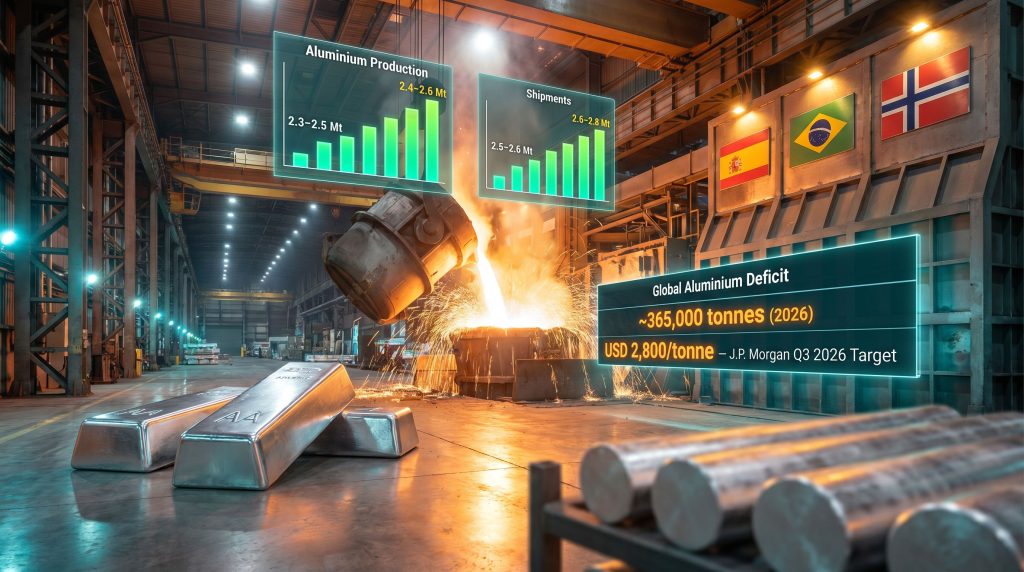
The Alcoa aluminium production forecast for 2026 is not the result of new greenfield investment. Instead, it reflects the gradual reactivation of smelting capacity that had been curtailed during prior periods of depressed prices or unfavourable energy economics. Three facilities sit at the heart of this recovery cycle: San Ciprián in northern Spain, Alumar in Brazil, and Lista in Norway. Each represents a different regional energy and regulatory context, and each contributes incrementally to the company's overall production base.
Smelter restarts are among the most operationally demanding activities in primary metals manufacturing. Unlike a factory that can resume operations with a shift change, an aluminium smelter requires the progressive energisation of electrolytic cells, known as pots, through a technically precise process called pot start or pot bake-in. During this phase, individual cells must reach the correct temperature and electrochemical equilibrium before they can begin producing primary aluminium at specification. Rushing this process risks pot failure, which can set back production timelines by months and increase capital costs substantially.
Energy procurement adds another layer of complexity. Aluminium smelting is one of the most electricity-intensive industrial processes in existence, with electricity costs typically representing between 30 and 40 percent of total production costs at a given facility. Securing affordable, long-term power supply agreements before committing to a restart is a prerequisite, not an afterthought. In European markets like Spain and Norway, energy price volatility in recent years has added significant uncertainty to restart economics that would have been more predictable in earlier decades.
San Ciprián as a Case Study in Forecast Sensitivity
The San Ciprián smelter in Spain provides a particularly instructive example of how restart complexity translates directly into production guidance adjustments. Delays at this facility contributed to a downward revision in Alcoa's 2025 shipment forecast of approximately 0.1 to 0.2 million metric tonnes, demonstrating a direct relationship between operational milestones and investor-facing guidance. This kind of sensitivity is important for analysts and investors to internalise: production forecasts for companies in active restart cycles carry an embedded uncertainty premium that headline ranges do not fully communicate.
Smelter recommissioning involves overlapping technical, regulatory, and energy procurement processes. When any one of these tracks encounters delays, the ripple effects across annual production guidance can be material. San Ciprián illustrates exactly this dynamic.
Alcoa's 2026 Production and Shipment Guidance at a Glance
The table below summarises the year-on-year shift in Alcoa's aluminium production and revenue metrics, based on reported and forecast figures.
| Metric | 2025 Level | 2026 Forecast |
|---|---|---|
| Aluminium Production | 2.3 to 2.5 million tonnes | 2.4 to 2.6 million tonnes |
| Aluminium Shipments | 2.5 to 2.6 million tonnes | 2.6 to 2.8 million tonnes |
| Q1 Third-Party Revenue | USD 1.91 billion | USD 2.54 billion |
| Q1 Aluminium Product Sales | USD 1.96 billion | USD 2.58 billion |
Shipment volumes exceeding production volumes in 2026 reflect a combination of inventory drawdowns and tolling arrangements, where Alcoa processes metal on behalf of third parties and counts the resulting shipments against its sales base. This structural feature explains why the shipment guidance range sits above the production range, a relationship that is sometimes overlooked when reading headline forecast figures in isolation.
A notable feature of the 2026 forecast is the widening of the production range itself, from a 200,000-tonne band in 2025 guidance to a 200,000-tonne band at a higher absolute level in 2026. This range width is a deliberate signal that management is accounting for residual restart uncertainty, particularly at European facilities where grid dependencies and regulatory approvals remain variable.
How Demand Fundamentals Are Driving the Alcoa Aluminium Production Forecast Higher
Three Structural Demand Pillars
The Alcoa aluminium production forecast for 2026 is being pulled forward by demand growth across three distinct end-use categories, each with its own growth logic and timeline.
Packaging and Consumer Goods
Aluminium's role in packaging remains one of the most stable demand anchors in the entire metals complex. Beverage cans, food containers, and pharmaceutical packaging all rely on aluminium's combination of light weight, barrier properties, and recyclability. This sector is relatively defensive against economic downturns compared to automotive or construction demand, providing a base load of consumption that underpins price floors during periods of macroeconomic uncertainty.
Electrical Infrastructure and Grid Expansion
The energy transition has created an accelerating demand wave for aluminium in electrical infrastructure. Transmission and distribution cables, transformer windings, and overhead power lines all require large volumes of high-grade aluminium conductor material. As major economies invest in grid modernisation and renewable energy integration, the upstream demand for primary aluminium from electrical applications is growing at rates that would have seemed implausible a decade ago. Furthermore, this is a multi-decade demand driver, not a cyclical one, and it is reshaping the long-term supply-demand calculus for primary producers.
Electric Vehicles and Transportation
The electric vehicle sector represents arguably the fastest-growing demand vector for aluminium in transportation. Each modern EV platform uses aluminium extensively across body structures, battery enclosures, heat management systems, and chassis components. The material's combination of strength, formability, and weight reduction capability makes it structurally preferred over steel in applications where mass reduction directly extends driving range. As Alcoa has noted in its corporate communications, demand growth from EVs, recycled aluminium products, and rechargeable battery applications is a material contributor to its near-term business outlook.
The Global Supply-Demand Gap Widening Through 2026
Independent market analysis paints a picture of tightening aluminium supply through the forecast horizon. The projections below are drawn from publicly available analyst research and industry bodies, and carry the inherent uncertainty of any forward-looking estimate.
| Forecast Metric | Projected Value | Source |
|---|---|---|
| Global aluminium demand by 2030 | 119.5 million tonnes | International Aluminium Institute |
| Required annual increase to meet 2030 demand | 33.3 million tonnes | International Aluminium Institute |
| Estimated global supply deficit (2025) | approximately 100,000 tonnes | Reuters analyst consensus |
| Estimated global supply deficit (2026) | approximately 365,000 tonnes | Reuters projection |
| J.P. Morgan deficit scenario (2026) | up to 600,000 tonnes | J.P. Morgan research |
| J.P. Morgan price target (Q3 2026) | USD 2,800 per tonne | J.P. Morgan research |
Disclaimer: Forward-looking forecasts involve significant assumptions about supply additions, demand growth, trade flows, and macroeconomic conditions. Actual outcomes may differ materially from these projections. This article does not constitute financial advice.
A widening supply deficit environment is structurally favourable for large-scale, vertically integrated producers. When global inventories tighten, spot prices tend to move toward the upper end of analyst price ranges, and producers with flexible, restarting capacity are positioned to capture marginal pricing premiums that smaller or less integrated operators cannot access. In this context, examining the broader aluminium and alumina markets reveals how interconnected supply-side pressures are reinforcing this dynamic.
The Macroeconomic and Geopolitical Forces Amplifying Aluminium Prices
How US Trade Policy Created a Domestic Price Premium
Among the external forces shaping aluminium price dynamics in 2025 and 2026, US trade policy stands out as particularly significant. In June 2025, the US administration raised tariffs on imported aluminium to 50 percent, framing the measure as a mechanism to support domestic smelting capacity and reduce trade imbalances. The immediate effect was the creation of a meaningful price premium in the US domestic market relative to international benchmark prices.
For producers with operations or customer relationships tied to the US domestic market, this tariff structure functions as an earnings support mechanism. It raises the effective cost floor for imported metal, allowing domestic producers to realise higher prices than they would in a freely traded market. However, US aluminium tariffs represent a policy instrument rather than a structural market condition, and carry their own risk profile.
Key considerations for investors assessing the tariff impact include:
- The 50 percent tariff rate represents a significant escalation relative to prior aluminium import duty structures
- Tariff structures can be modified, challenged under trade agreements, or reversed through policy change
- Retaliatory measures from affected trading partners could create headwinds for US aluminium exporters in other markets
- Downstream manufacturers reliant on aluminium inputs face cost inflation that may compress their margins and reduce volume demand over time
Geopolitical Disruptions and the Strait of Hormuz Variable
Geopolitical tensions in the Middle East, specifically disruptions to trade flows through the Strait of Hormuz, have added a supply-side constraint to the aluminium pricing environment. The Strait of Hormuz is a critical chokepoint for energy commodity flows, particularly liquefied natural gas and oil. Since natural gas is a significant input cost for certain aluminium smelting configurations and a major energy source for power generation in the Gulf region, disruptions to Hormuz transit create upstream cost pressure that propagates into aluminium spot markets.
The energy-aluminium cost linkage is less understood by generalist investors than the direct LME price relationship. Approximately 30 to 40 percent of primary aluminium production costs are attributable to electricity, and in regions where power generation relies on gas-fired capacity, geopolitical energy disruptions translate directly into smelting cost escalation. This cost push dynamic can simultaneously reduce regional supply and increase regional prices, creating a compounding effect on aluminium market tightness.
A lesser-known dynamic in aluminium price formation is that geopolitical disruptions rarely impact the metal directly. Instead, they operate through the energy cost channel, making Middle Eastern tensions a genuine pricing variable for global aluminium markets even where no direct aluminium trade flows through the affected region.
Peer Comparisons: What Industry-Wide Revenue Growth Reveals
Q1 2026 Competitive Revenue Benchmarking
The breadth of revenue growth across aluminium-related companies in Q1 2026 confirms that Alcoa's strong performance is not an isolated phenomenon. It reflects a sector-wide repricing that is pulling revenue higher across the value chain. Furthermore, the top aluminium producers are collectively benefiting from this structural upswing in ways that reinforce the durability of the current cycle.
| Company | Business Focus | Q1 2026 Revenue Change | Key Driver |
|---|---|---|---|
| Alcoa Corporation | Primary aluminium production | Third-party sales up 33% year on year | Smelter restarts combined with higher realised prices |
| Constellium SE | Packaging and automotive rolled products | Revenue up 24% year on year | Higher metal prices, despite shipment volumes falling 3% |
| Ryerson Holding Corporation | Aluminium products distribution | Revenue up over 30% year on year | Olympic Steel merger plus higher selling prices |
The Constellium data point is particularly instructive. A 24 percent revenue increase alongside a 3 percent decline in shipment volumes reveals that price uplift is doing the heavy lifting across the sector, not volume growth. This is a subtle but important distinction for investors. When revenue growth is primarily price-driven rather than volume-driven, it signals that demand is strong enough to absorb higher prices without significant volume destruction, but it also means that any price correction would flow directly through to revenues without a volume buffer.
Ryerson's growth story is structurally different, combining inorganic expansion through the Olympic Steel merger with the same underlying aluminium price tailwind. This contrast between Alcoa's organic capacity restoration and Ryerson's acquisition-driven growth illustrates the multiple pathways through which companies are capitalising on the current pricing environment.
Alcoa's Valuation Profile in the Current Cycle
Share price and valuation metrics offer a snapshot of how the market is positioning relative to the fundamental earnings recovery underway.
- Alcoa shares appreciated 124.7 percent over the prior 12-month period
- The company's forward price-to-earnings ratio stood at 7.96 times, below the industry average of 8.49 times
- The 2026 earnings per share estimate was revised upward by 53.2 percent over a 60-day period
The combination of a below-industry-average forward multiple and a 53 percent earnings estimate revision in 60 days creates an analytically interesting setup. Rapid upward earnings revisions of this magnitude typically reflect a fundamental re-rating event, where analysts are recalibrating their models to account for a new pricing or production environment. Alcoa's aluminium business has demonstrated this momentum clearly, with the broader market still absorbing the full implications of the fundamental shift underway.
This analysis is observational and does not constitute investment advice. Valuations are highly sensitive to aluminium price movements, operational execution, and macroeconomic conditions. Past share price performance is not indicative of future returns.
Key Risks That Could Disrupt the Production Recovery Trajectory
Operational Execution Uncertainty
The most proximate risk to Alcoa's 2026 production guidance remains the operational complexity of managing multiple smelter restarts simultaneously across different geographies. The San Ciprián experience demonstrates that even partial delays at a single facility can compress annual shipment guidance by a meaningful amount. The 2026 production range of 2.4 to 2.6 million tonnes acknowledges this uncertainty, but investors should track facility-level operational updates rather than relying solely on the headline range.
Specific risks within this category include:
- Technical failures during pot start sequences requiring extended recommissioning timelines
- Regulatory approvals for increased power consumption or emissions at restarted facilities
- Grid capacity constraints at European facilities, particularly during periods of peak regional electricity demand
- Supply chain delays for specialist refractory materials, cathode blocks, or other consumables required for pot start procedures
Energy Cost Exposure at European Facilities
European aluminium smelters operate in one of the world's most volatile electricity pricing environments. San Ciprián in Spain and Lista in Norway both face energy cost structures that are materially higher than historical norms, and while Power Purchase Agreements and energy hedging strategies provide partial insulation, they do not eliminate exposure to energy market volatility. A sustained period of elevated European electricity prices could consequently compress margins at restarted facilities even if aluminium prices remain strong.
Trade Policy Reversal and Downstream Demand Elasticity
The 50 percent US aluminium tariff is among the most consequential policy instruments currently supporting domestic aluminium producer margins. However, tariffs are instruments of policy, not market structure, and are subject to renegotiation, legal challenge through trade tribunals, or reversal by future administrations. A reduction or removal of this tariff would directly compress the domestic price premium that is currently supporting Alcoa's realised prices.
On the demand side, several factors warrant monitoring:
- EV adoption rates are sensitive to interest rate environments, consumer credit conditions, and the continuation of government purchase incentives in key markets
- Packaging demand is relatively defensive but not fully immune to consumer spending contractions during recessions
- High aluminium prices sustained over extended periods can incentivise material substitution by downstream manufacturers, particularly in automotive and construction applications where aluminium competes with steel and composites
The next major ASX story will hit our subscribers first
The Vertical Integration Advantage and the Re-Industrialisation Supercycle
Why Vertical Integration Matters More in a Tight Market
Alcoa's structure as a vertically integrated producer, encompassing bauxite mining, alumina refining, and primary aluminium smelting, creates margin advantages that become more pronounced during periods of supply tightness and elevated prices. When aluminium prices rise, vertically integrated producers capture margin at each stage of the value chain rather than paying market rates for intermediate inputs. This structural advantage is often underweighted in short-term earnings analysis but becomes highly material during sustained upcycles.
The recycled aluminium component of the production mix adds a further dimension. Secondary aluminium production from recycled scrap requires approximately 95 percent less energy than primary smelting from bauxite, dramatically lowering cost exposure to energy price volatility. Initiatives around green metals production are increasingly influencing how the market values producers who demonstrate credible sustainability credentials alongside cost efficiency.
A Multi-Decade Demand Architecture
The convergence of energy transition investment, EV manufacturing scale-up, and grid modernisation is creating demand conditions for aluminium that are qualitatively different from prior commodity cycles. Previous upcycles were primarily driven by construction and infrastructure investment in developing economies. However, China industrial demand dynamics are also evolving in ways that could either amplify or moderate the global aluminium supply-demand balance depending on domestic policy directions.
The current cycle is being shaped by the simultaneous buildout of clean energy infrastructure, electrified transportation systems, and the transmission networks needed to connect them, across multiple major economies simultaneously. This structural demand backdrop means that even if individual drivers prove more variable than currently projected, the aggregate demand trajectory for aluminium remains substantively upward. For large-scale, low-cost producers positioned to absorb incremental volume demand as supply deficits widen through 2026 and beyond, the fundamental earnings environment is more supportive than at any point in the recent commodity cycle.
All production forecasts, price projections, and demand estimates referenced in this article involve forward-looking assumptions that carry material uncertainty. Readers should conduct independent research and seek professional financial advice before making investment decisions. Past performance and analyst forecasts are not reliable indicators of future outcomes.
Ready to Identify the Next Major Minerals Discovery Before the Market Does?
Discovery Alert's proprietary Discovery IQ model scans ASX announcements in real time, delivering instant alerts on significant mineral discoveries across more than 30 commodities — turning complex data into actionable investment insights for both short-term traders and long-term investors. Explore Discovery Alert's dedicated discoveries page to see how historic ASX discoveries have generated substantial returns, and begin your 14-day free trial today to position yourself ahead of the broader market.