June 14, 2026
Governance at an Inflection Point: Why Leadership Architecture Defines Development-Stage Mining Outcomes
In the world of precious metals development, the distance between a company's strategic intent and its operational output is rarely measured in kilometres or metres of drill core. It is measured in the quality of decisions made at the intersection of the boardroom and the management suite. When that intersection becomes a friction point, the consequences ripple outward: delayed milestones, capital erosion, and the kind of investor fatigue that can prove terminal for a junior miner. When that intersection is engineered for cohesion, the opposite becomes possible.
This dynamic sits at the heart of Hycroft Mining Holding Corporation's (NASDAQ: HYMC) May 2026 governance restructuring, in which Hycroft Diane Garrett Executive Chairman and CEO roles were combined under a single credentialed leader. To understand why this matters, it helps to first understand the structural conditions that make unified leadership either a liability or a value creation lever, and why the current development environment at Hycroft Mine tips decisively toward the latter.
When big ASX news breaks, our subscribers know first
The Governance Debate in Resource Development Companies
The combined Chairman-CEO model carries a complicated history in institutional governance circles. For years, large-cap producers and well-capitalised resource companies faced pressure from institutional shareholders and proxy advisory firms to separate executive management from board leadership, on the grounds that unchecked authority concentrates risk and weakens independent oversight.
However, that framework was largely designed for mature, cash-generating businesses where strategic direction is relatively stable. The development-stage mining company operates in a fundamentally different context. Capital intensity is high, technical complexity evolves rapidly, and the window between a major project milestone and obsolescence can be narrow.
Research into corporate governance in capital-intensive industries identifies three recurring conditions under which a combined Chair-CEO structure tends to create, rather than destroy, value:
- When the company is navigating a critical inflection point, such as the transition from technical study completion to construction decision
- When the executive holds deep technical and capital markets knowledge that significantly exceeds the board's collective experience in that domain
- When the governance structure is simultaneously being refreshed with stronger independent counterbalances
All three conditions apply to Hycroft Mining's current situation. The company is advancing from a pre-development technical study phase toward what could become a construction decision. Its newly titled Executive Chairman brings more than 25 years of directly applicable mining development experience. Furthermore, the board is being actively expanded with three additional independent directors, with a formal Lead Independent Director role having been established to preserve oversight integrity.
Governance restructuring at development-stage miners is most consequential when it compresses the decision latency between strategic intent and operational execution. At Hycroft, the consolidation of board and management authority under a single credentialed executive is a calculated response to a technically demanding project phase, not a shortcut around accountability.
Who Is Diane R. Garrett? A Career Built for Exactly This Moment
The relevance of an executive appointment in mining is almost always a function of specific track record fit. Generic C-suite experience transfers poorly across the sector's development stages. The skills required to advance an exploration asset from grassroots discovery to resource definition differ materially from those required to manage a construction programme, and both differ from the capital markets fluency needed to finance a large-scale project in a competitive funding environment.
What makes the Hycroft Diane Garrett Executive Chairman and CEO appointment particularly significant is that her career trajectory spans all three of these competency domains.
Her most frequently cited credential is her leadership of the Haile Gold Mine project at Romarco Minerals, where she guided the asset from early-stage discovery through the full development lifecycle to construction, in what became one of the more notable U.S. gold development achievements of the past two decades. The Haile project, located in South Carolina, presented its own technical and regulatory complexities, and its successful advancement under Garrett's stewardship established her reputation as a leader capable of executing on large-format, technically demanding deposits in the United States.
Her subsequent role as Chief Executive Officer of Nickel Creek Platinum added a cross-commodity dimension to that profile. Nickel Creek's primary asset involved complex sulfide mineralisation, a geological context with direct technical relevance to Hycroft's own development challenge, as discussed further below.
| Career Milestone | Technical Relevance to Hycroft |
|---|---|
| Haile Gold Mine development (Romarco Minerals) | Proven ability to advance large U.S. gold deposits through construction decision |
| CEO of Nickel Creek Platinum | Executive experience with complex sulfide mineralisation environments |
| 25+ years across full development spectrum | Technical geology, corporate strategy, and capital markets fluency in one profile |
The board's decision to extend Garrett's authority to the chairmanship reflects a calculated judgement that project delivery risk at this stage of Hycroft's development is best mitigated by concentrating decision-making authority in the individual with the deepest contextual knowledge of the asset. It is also worth considering management red flags as a counterpoint — understanding what poor leadership architecture looks like helps clarify why this consolidation has been received positively.
What Is Hycroft Mine? The Asset Behind the Leadership Story
The Hycroft Mine occupies a substantial land package in northern Nevada, a jurisdiction that consistently ranks among the world's most mining-friendly regulatory environments. Nevada's combination of established permitting frameworks, existing infrastructure, and deep pools of experienced mining workforce talent reduces several categories of project risk that would be material concerns in less developed jurisdictions.
The deposit itself ranks among the world's largest precious metals accumulations, hosting significant gold and silver mineralisation at scale. It is a resource of genuinely global significance in terms of contained metal endowment, and therein lies both its enormous appeal and its primary development challenge.
The 2023 High-Grade Silver Discovery: A Value Catalyst Hidden Inside a Giant Deposit
A key aspect of Hycroft's current investment thesis that is often underappreciated relates to the structural heterogeneity of the deposit itself. Large bulk-tonnage precious metals systems are typically characterised in the market as low-grade, high-volume operations, where economic viability depends on processing efficiency at scale rather than selective high-grade extraction.
The 2023 announcement of two distinct high-grade silver systems within the known resource boundary introduced a genuinely different dimension to that characterisation. These systems represent zones of concentrated silver mineralisation that depart from the broader deposit's bulk character, and they introduce the possibility of selective, higher-margin mining scenarios that could change the economic sequencing of how the deposit is developed.
The active 2025-2026 exploration drill programme is specifically targeting:
- Lateral and vertical extent definition for both high-grade silver systems
- Grade continuity and structural controls governing the high-grade mineralisation
- New discovery opportunities within the broader resource boundary
This is geologically important work. Understanding gold drill results and how analogous high-grade zones behave within large, complex deposits is directly applicable here, particularly given that high-grade shoots often follow predictable structural orientations. Understanding whether Hycroft's silver systems conform to such patterns would materially affect mine planning and the potential sequencing of higher-grade material early in a production scenario — a factor that significantly improves project economics and return on investment timelines.
The Oxide-to-Sulfide Transition: The Central Technical Challenge
Hycroft Mine's historical production was based entirely on oxide heap-leach processing, a method well-suited to near-surface, oxidised material where precious metals can be recovered by percolating dilute cyanide solution through crushed ore stacked on lined pads. The process is relatively low-cost and operationally straightforward, but it only works efficiently on oxidised material.
The overwhelming majority of Hycroft's contained metal value resides in sulfide mineralisation at depth, where precious metals are locked within sulfide mineral structures such as pyrite and arsenopyrite. These minerals resist conventional heap-leach recovery because the cyanide solution cannot efficiently access the encapsulated gold and silver particles.
Unlocking sulfide value requires milling, a fundamentally different processing pathway:
| Processing Dimension | Oxide Heap-Leach | Sulfide Milling |
|---|---|---|
| Material type | Near-surface oxidised ore | Primary sulfide mineralisation |
| Processing complexity | Relatively low | Significantly higher |
| Capital requirement | Lower | Substantially higher |
| Recovery mechanism | Cyanide percolation on pads | Fine grinding, flotation, and/or pressure oxidation |
| Economic model | Lower capex, lower margin per tonne | Higher capex, potentially superior long-term margins |
| Processing timeframe | Shorter cycle | Longer cycle with higher throughput economics |
Completing the technical studies necessary to validate a milling operation — including metallurgical testing, engineering design, environmental baseline work, and economic modelling — is the company's primary near-term objective. These studies are the prerequisite for any formal construction decision, and they represent the single most important value unlock event in Hycroft's near-term development trajectory.
The shift from heap-leach to milling at Hycroft is not an incremental operational change. It is a fundamental reimagining of the mine's economic model, requiring new capital structures, new technical validation, and potentially new financing partnerships. The governance architecture required to navigate this transition successfully is materially different from what would be needed to manage a steady-state heap-leach operation.
What the Dual Role of Executive Chairman and CEO Actually Means in Practice
Defining the Structural Change
Prior to May 7, 2026, Hycroft Mining operated under a conventional governance separation, with Thomas S. Weng serving as an independent Chairman overseeing board functions, and Garrett exercising executive authority as CEO. The board of directors review completed in connection with the company's growth strategy led to a determination that consolidating these roles would enhance the alignment between governance oversight and management execution.
Weng's transition to Lead Independent Director is a meaningful governance safeguard within this structure. This role carries responsibilities that specifically address the concentration risk inherent in a combined Chair-CEO model:
- Presiding over sessions of the independent directors without executive management present
- Providing a direct communication channel between independent directors and the Executive Chairman
- Leading the board's formal evaluation of the CEO's performance
- Serving as the primary point of contact for shareholders seeking independent board engagement
Board Expansion as a Governance Counterbalance
The concurrent initiation of a process to recruit three additional independent directors is not a peripheral detail. In the context of a combined Chair-CEO governance structure, the quality and depth of the independent director cohort is the primary mechanism through which governance integrity is preserved.
The incoming directors are expected to bring expertise relevant to the company's immediate development priorities, which likely means capital markets experience for financing strategy, technical or engineering credentials relevant to the milling transition, and potentially operational experience from analogous large-scale precious metals projects.
Strategic Execution Under the New Leadership Model
Three Interconnected Workstreams
The practical significance of the governance consolidation is best understood through its expected effect on three specific strategic priorities:
- Exploration Programme Execution (2025-2026): Accelerating drill programme decisions targeting the two high-grade silver systems, including target selection, rig allocation, and assay turnaround optimisation
- Technical Studies Completion: Finalising the metallurgical, engineering, and economic analysis required to support a formal milling decision, where cross-functional coordination between technical teams and board-level strategic direction is critical
- Capital and Partnership Strategy: Positioning the company to access the significant financing required for a potential construction programme, leveraging Garrett's established capital markets relationships and credibility with institutional investors
Building Organisational Depth: Eric Colby and Beyond
The appointment of Eric Colby as Executive Vice President, Corporate Development signals that the governance restructuring is accompanied by deliberate organisational build-out. Corporate development at a pre-construction mining company encompasses a wide remit, including partnership origination, strategic financing, project acquisition assessment, and investor relations strategy.
Additional senior hires are anticipated in the coming months, suggesting a phased approach to building the management depth required to support a significantly more complex operational and capital phase than the company has previously managed.
The next major ASX story will hit our subscribers first
What Investors Need to Evaluate: HYMC Risk and Opportunity Framework
The Constructive Backdrop: Gold Above $4,600/oz
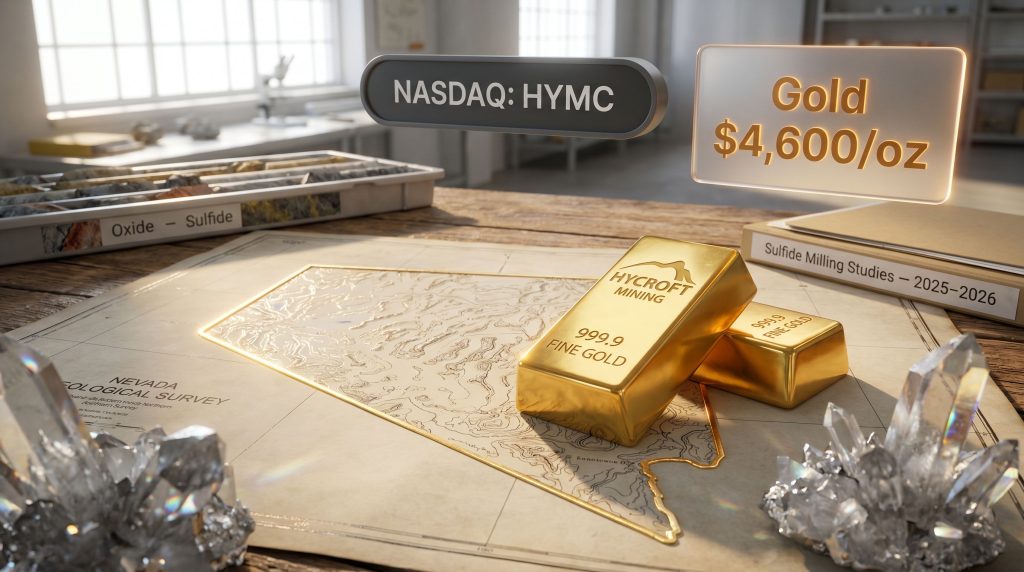
The governance transition is occurring against a precious metals price backdrop that is historically favourable for development-stage project advancement. The current gold price outlook is particularly supportive, with gold prices above $4,600/oz as of May 2026, meaning the projected economics of a future milling operation improve substantially, widening the margin between projected operating costs and revenue assumptions in feasibility-level economic models.
Elevated gold prices also improve financing access for development-stage companies. Lenders and equity investors apply more favourable assumptions to project economics at higher commodity prices, which can reduce cost of capital and expand the universe of viable financing structures.
Key Risk Variables to Monitor
The governance restructuring mitigates organisational and strategic execution risk but does not eliminate the inherent technical and financial challenges of the development programme. Investors should monitor:
- Independent director quality: The effectiveness of the combined Chair-CEO model depends heavily on the calibre and independence of the three incoming board members
- Milling study timeline and outcomes: Metallurgical test results and engineering parameters will determine the capital requirement and economic viability of the milling transition
- High-grade silver system drill results: Assay results from the 2025-2026 drill programme will either validate or require recalibration of the deposit's selective mining potential
- Financing environment: Large-scale construction programmes require substantial capital; access to that capital on acceptable terms will depend on commodity prices, market conditions, and the company's technical credibility at the time of the financing decision
HYMC Key Parameters at a Glance
| Parameter | Detail |
|---|---|
| Exchange | NASDAQ: HYMC |
| Asset | Hycroft Mine, Northern Nevada |
| Commodity Focus | Gold and Silver |
| Development Stage | Exploration / Pre-Development (Sulfide Milling Studies) |
| Executive Chairman and CEO | Diane R. Garrett (effective May 7, 2026) |
| Lead Independent Director | Thomas S. Weng |
| Board Expansion | 3 additional independent directors being recruited |
| High-Grade Discovery | Two high-grade silver systems (identified 2023) |
| Active Drill Programme | 2025-2026 |
| Gold Price Context | Above $4,600/oz (May 2026) |
How Hycroft's Governance Model Compares to Industry Norms
A Comparative Governance Framework
| Governance Model | Typical Context | Primary Advantage | Primary Risk |
|---|---|---|---|
| Separated Chair and CEO | Large-cap, mature producers | Strong independent oversight | Potential strategic misalignment |
| Combined Executive Chair and CEO | Development-stage, transformational phase | Rapid decision-making, strategic cohesion | Governance concentration |
| Non-Executive Chair with separate CEO | Post-founder transition, scaling businesses | Balance of authority and oversight | Role ambiguity during transitions |
| Lead Independent Director model | Combined Chair-CEO with governance safeguards | Preserves independent voice and shareholder access | Dependent on Lead Director's effectiveness |
Historical precedent within the precious metals development sector suggests that combined Chair-CEO appointments generate the most durable value when three supporting conditions are present: a credible and empowered Lead Independent Director, active board renewal introducing fresh independent expertise, and a clearly articulated strategic roadmap with measurable near-term milestones. Hycroft's May 2026 announcement incorporates all three elements.
The Broader Trend: Founder-Style Authority in Junior Mining
Across the junior and mid-tier mining sector, there is a discernible investor preference for technically credentialed executives who carry genuine project delivery track records and are willing to accept expanded governance accountability in exchange for operational authority. This preference intensifies during bull market cycles for precious metals, when the opportunity cost of slow decision-making is highest and the competition for capital, talent, and project partnerships is most acute.
Furthermore, the broader context of gold M&A activity in 2025 demonstrates that well-governed, technically credentialed development assets attract acquirer interest precisely when leadership clarity is evident. The appointment of Hycroft Diane Garrett as Executive Chairman and CEO reflects this broader market dynamic, positioning the company with a leadership profile that institutional investors increasingly treat as a primary due diligence variable alongside resource size, grade, and jurisdiction quality.
Frequently Asked Questions About Hycroft Mining's Leadership Transition
When did Diane R. Garrett's appointment as Executive Chairman take effect?
The appointment became effective on May 7, 2026, as confirmed through Hycroft Mining's SEC Form 8-K filing. Garrett simultaneously continued in her role as Chief Executive Officer.
What role does Thomas S. Weng now hold?
Following the 2026 annual board review, Weng transitioned from the position of independent Chairman to Lead Independent Director, preserving an independent governance voice within the restructured board.
How many new independent directors is Hycroft recruiting?
The company has initiated a formal recruitment process for three additional independent directors as part of its broader board renewal strategy.
What is the significance of the 2023 high-grade silver discovery?
The identification of two structurally distinct high-grade silver systems within the existing resource boundary introduces selective, higher-margin mining potential to a deposit previously characterised primarily as a bulk, lower-grade system. This discovery materially alters the range of economic scenarios available to the company. Consequently, interpreting drill results from the ongoing programme will be critical to quantifying how these systems extend at depth.
Why does the oxide-to-sulfide transition matter so much to Hycroft's value?
The deposit's historical oxide heap-leach operations accessed only a fraction of the total resource. The dominant share of contained gold and silver value resides in sulfide mineralisation, which requires milling to process. Completing technical studies to validate milling economics is the single most important near-term value catalyst for the asset.
What does the gold price environment mean for Hycroft's development prospects?
With gold trading above $4,600/oz as of May 2026, the projected economics of a future milling operation improve substantially across most sensitivity scenarios, and the financing environment for development-stage precious metals projects is materially more favourable than during periods of lower commodity prices.
This article is intended for informational purposes only and does not constitute financial or investment advice. Forecasts, projections, and analysis related to development timelines, commodity prices, and financing outcomes are inherently speculative and subject to material change. Readers should conduct their own due diligence before making any investment decisions. Source material includes Hycroft Mining Holding Corporation's official announcement published via Crux Investor on May 12, 2026, and the company's SEC Form 8-K filing effective May 7, 2026.
Want to Track the Next Major Mineral Discovery Before the Broader Market Does?
Discovery Alert's proprietary Discovery IQ model delivers real-time alerts the moment significant ASX mineral discoveries are announced, transforming complex geological data into clear, actionable investment insights for both short-term traders and long-term investors. Explore how historic discoveries have generated extraordinary returns on Discovery Alert's dedicated discoveries page, and begin your 14-day free trial today to secure a market-leading advantage.