May 13, 2026
The Policy Trap at the Centre of Every Oil Shock
Supply-side economic disruptions have a long history of exposing the structural limits of monetary policy. When energy markets seize up due to geopolitical events rather than demand cycles, central banks find themselves holding instruments designed for an entirely different problem. Interest rates can cool an overheating economy driven by excess credit creation, but they cannot restore a tanker route, reopen a pipeline, or reverse a military closure of a critical maritime chokepoint. This fundamental mismatch between policy tools and supply-shock causes defines the challenge facing the Federal Reserve in 2026.
Understanding how the oil shock and Fed response dynamic actually plays out requires separating what economic theory prescribes from what institutional behaviour consistently delivers. The gap between those two outcomes has enormous implications for investors, businesses, and households navigating one of the most complex macro environments in recent decades.
When big ASX news breaks, our subscribers know first
Why Oil Shocks Create a Policy Trap for Central Banks
The Dual-Pressure Problem: Inflation and Growth Moving in the Wrong Direction
An oil price spike of significant magnitude creates what economists describe as a stagflationary dynamic: consumer prices rise while real economic output simultaneously contracts. This combination is uniquely hostile to conventional monetary policy because the two standard policy responses to each problem directly conflict with each other.
When inflation rises, orthodoxy calls for rate hikes to slow spending and cool price pressures. When growth slows, the prescription is rate cuts to stimulate borrowing and investment. An oil shock triggers both simultaneously, leaving central banks without a clearly correct path forward.
The transmission mechanism works through several channels at once:
- Energy costs embed directly into transportation and logistics, raising prices for virtually every physical good in the economy
- Agricultural production depends heavily on fuel and petrochemical inputs, meaning food prices follow oil prices with a short lag
- Manufacturing sectors with energy-intensive processes face immediate margin compression, leading to output cuts or price increases
- Household disposable income is eroded as a larger share of spending is absorbed by fuel costs, suppressing demand elsewhere
The critical distinction that shapes the entire policy debate is whether inflation originates from demand-side excess or supply-side scarcity. Demand-driven inflation reflects too much money chasing too few goods, and rate hikes directly address this by making credit more expensive and slowing spending. Supply-driven inflation reflects a genuine reduction in the availability of a critical input, and rate hikes cannot restore that supply. They can only further suppress demand, deepening the growth damage without meaningfully resolving the price problem.
Furthermore, this creates what can be described as the sequencing trap: elevated inflation prevents the central bank from cutting rates in the short term to cushion growth, yet the recession accumulates regardless. By the time inflation moderates sufficiently to justify easing, the economic damage may already be entrenched. The policy response arrives precisely when its effectiveness is most diminished.
How the 2026 Iran Conflict Triggered the Current Shock
The specific catalyst for the 2026 oil shock was the escalation of conflict involving Iran and the strategic closure of the Strait of Hormuz, through which roughly 20% of global oil supply transits daily. Estimates from energy market analysts suggest the disruption has taken somewhere between 10% and 20% of total global crude production offline in the near term, representing one of the most significant acute supply disruptions in modern energy market history.
Crude oil price trends surged more than 40% following the onset of hostilities. This shock compounded an economy that was already transitioning from a growth model supported by strong income expansion into one increasingly reliant on household and business dis-saving to sustain consumption levels. That transition had been gradually generating economic softness heading into 2026, and the oil shock arrived at precisely the moment of maximum vulnerability.
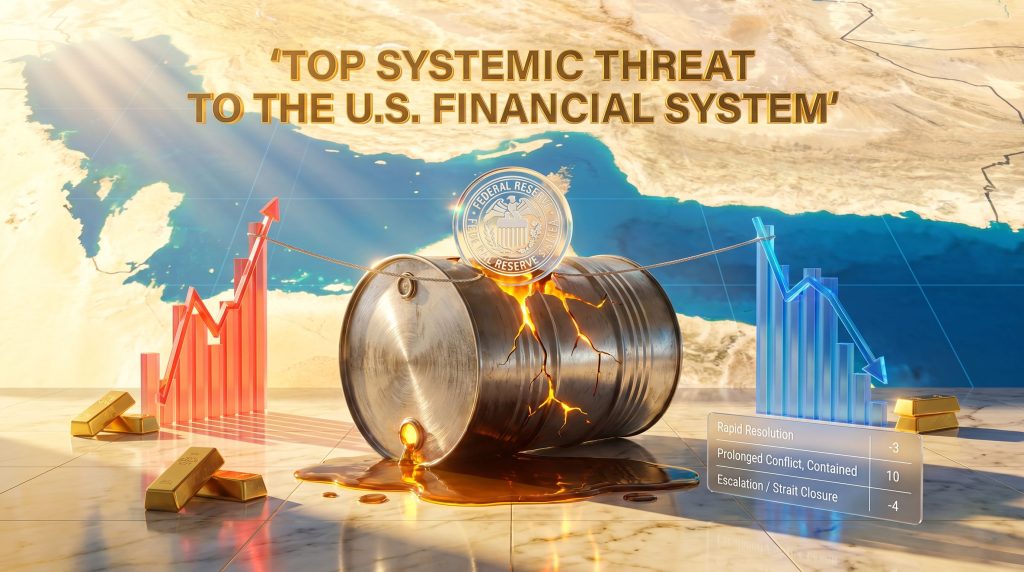
The IMF has flagged the risk that a prolonged conflict scenario could not rule out a broader global economic downturn. The Federal Reserve's own May 2026 semi-annual financial stability report formally identified the oil shock and associated geopolitical risk as the top systemic threat to the U.S. financial system, an unusually direct acknowledgment of how central the disruption has become to financial stability considerations. Indeed, geopolitical risks cited as top worries in the Fed's own financial stability report underscore just how seriously this shock is being taken at the highest levels of policy.
What Does History Tell Us About How the Fed Responds to Oil Shocks?
Pre-1987 vs. Post-1987: A Structural Shift in Fed Behaviour
Academic research, including the influential 1997 study by Bernanke, Gertler, and Watson, identified a troubling pattern in early Federal Reserve responses to oil price shocks: preemptive tightening in response to oil-driven inflation systematically amplified recessionary outcomes. The logic was understandable but counterproductive. Policymakers targeted the inflationary signal from oil prices directly, tightening monetary conditions even though the underlying cause was outside the reach of interest rate policy.
The evidence from updated econometric analysis using vector autoregressive models suggests a meaningful structural break after 1987. Post-1987, there is no statistically consistent pattern of systematic Fed policy responses to oil shocks or to the inflationary pass-through they generate. The implication is significant: the historical record suggests that oil shocks themselves, rather than monetary policy reactions to them, are the primary drivers of associated economic downturns. The harm comes from the shock, not the policy response.
This post-1987 shift is likely attributable to several reinforcing factors:
- The Volcker disinflation had successfully re-anchored inflation expectations, meaning temporary supply-driven price spikes were less likely to embed into wage and pricing behaviour
- The Fed had institutionalised a more credible inflation framework, reducing the pressure to respond preemptively to every commodity price movement
- Improved data and forecasting allowed policymakers to better distinguish transitory supply shocks from durable inflationary dynamics
- The financial system had evolved in ways that changed how monetary policy transmitted into the real economy
The Volcker Precedent and the "Chicken Out" Threshold
Perhaps the most instructive historical data point for the current environment involves Paul Volcker himself. Volcker is remembered as the most inflation-hawkish Fed chair in the post-war era, the architect of the brutal disinflation of the early 1980s that involved raising the federal funds rate to 20% and tolerating severe recession to break the inflationary cycle. Yet even Volcker, facing sufficient economic pain, initially cut rates when conditions deteriorated sharply enough, before being forced to reverse course when inflation re-accelerated.
This establishes what appears to be a durable pattern across economic cycles and geographies: policymakers absorb pain up to a threshold, then respond aggressively. The threshold appears to be remarkably consistent when examined across multiple historical episodes.
The historical record across multiple cycles and central bank jurisdictions shows that policymakers tend to shift behaviour once equity markets approach a 20 to 30% correction threshold, regardless of the stated policy regime or prior commitments.
The supporting case studies across major downturns are instructive:
| Cycle | Approximate Equity Drawdown | Fed Response |
|---|---|---|
| 2000 Dot-Com Bust | ~50% (Nasdaq peak to trough) | Aggressive rate cuts |
| 2008 Global Financial Crisis | ~57% (S&P 500 peak to trough) | Emergency easing, QE |
| 2020 COVID Shock | ~34% (S&P 500 peak to trough) | Immediate and substantial intervention |
The tariff episode earlier in 2026 provided a more recent illustration of the same dynamic. When equity markets fell approximately 20% in response to initial trade policy announcements, policy posture shifted relatively quickly. The oil market volatility layered on top of trade tensions has further reinforced the pattern of accepting pain up to a threshold, then reversing, which appears to be a reliable feature of the policy landscape, not an exception to it.
What Should the Fed Do vs. What Will It Actually Do?
The Theoretical Case for Tightening Into a Supply Shock
Central bank orthodoxy provides a clear prescription for an economy already operating above its inflation target when a significant supply shock arrives: tighten monetary conditions to prevent inflation expectations from becoming unanchored. The logic is that accommodating higher energy prices through loose policy risks embedding them into wage negotiations and core pricing behaviour, making the inflationary episode both larger and more persistent than it needs to be.
This logic is already being partially reflected in market pricing for central banks with stronger inflation mandates. Both the European Central Bank and the Bank of England are seeing tightening scenarios priced into their rate paths, reflecting their institutional mandates and track records of prioritising price stability even at cost to near-term growth.
The Practical Case for Doing Nothing
However, the path of least resistance for any central bank facing genuine uncertainty is inaction, and this is a well-documented institutional tendency rather than a failure of analytical rigour. The "do nothing" posture preserves optionality: if the supply shock proves transient and resolves quickly, no policy error is made in either direction. If it persists, the central bank can respond with more information about duration and severity than it possesses at the outset.
The risk of this approach is that it can mean falling behind the curve on inflation. The 2021–2022 experience, where delayed responses to post-pandemic inflation required significantly more aggressive subsequent tightening than would have been necessary with earlier action, illustrates this cost. The longer a central bank waits, the more compressed the eventual response may need to be.
The U.S. Fed's Specific Dilemma in 2026
The Federal Reserve enters the current shock in a structurally different position to its European counterparts. Historically and institutionally, the Fed has demonstrated greater tolerance for inflation overshoots relative to growth concerns compared to the ECB or Bank of England. Consequently, current market pricing and commentary surrounding the incoming Fed chair suggest a tilt toward rate cuts rather than hikes, even in the face of oil-driven inflation.
This creates a meaningful divergence risk with significant feedback implications. If the Fed eases while European central banks tighten, the result could be meaningful USD weakness, which would amplify import cost pressures in the United States and create a secondary inflationary loop that further complicates the policy picture. Notably, the bond market's view on the Fed's likely response suggests it will look through the oil shock entirely, prioritising growth protection over inflation containment.
| Central Bank | Inflation Sensitivity | Likely Response to Oil Shock | Market Pricing Direction |
|---|---|---|---|
| U.S. Federal Reserve | Moderate | Hold / Potential easing bias | Rate cut expectations building |
| European Central Bank | High | Tightening bias | Hikes being priced in |
| Bank of England | High | Tightening bias | Hikes being priced in |
| Bank of Japan | Low | Hold | Minimal response expected |
How Does Geopolitical Uncertainty Complicate the Policy Framework?
Why War Scenarios Break Standard Macro Models
Conventional macro policy frameworks operate on an implicit assumption: the decision-maker controls the primary variables. Interest rate settings, asset purchase programmes, and forward guidance are all instruments that the central bank commands unilaterally. A geopolitical shock of the type currently unfolding introduces a fundamentally different dynamic, because a counterparty on the other side of the conflict retains substantial disruptive capacity regardless of what any central bank decides.
Iran's ability to selectively open or close the Strait of Hormuz represents a form of asymmetric leverage that no interest rate adjustment can neutralise. This is not a situation where monetary policy tools, however well-calibrated, can address the source of the disruption. The supply shock continues or resolves based on military, diplomatic, and geopolitical developments that operate entirely outside the economic policy system.
This introduces a non-linear risk profile to the macro outlook. Outcomes are not distributed along a smooth probability curve where more information steadily reduces uncertainty. Instead, the situation is subject to sudden, discontinuous shifts based on decisions made in arenas policymakers cannot control. The result is that conventional macro regime analysis becomes substantially less reliable as a forecasting tool.
When a key variable driving the macro outlook is controlled by a military adversary rather than by an economic institution, the precision of standard policy frameworks degrades significantly. Scenario-based thinking replaces point forecasting as the appropriate analytical method.
Policy Credibility Under Uncertainty
Frequent policy reversals, even when individually rational in response to changing conditions, accumulate into a credibility problem over time. Central banks depend on forward guidance to manage expectations efficiently. When markets cannot reliably model the policy reaction function because it appears to change based on short-term market pressure rather than fundamental economic analysis, risk premiums rise across asset classes.
This risk premium increase effectively tightens financial conditions even without any formal rate moves, creating a policy tightening effect that the central bank did not deliberately choose. The challenge for investors is determining whether the current posture represents genuine commitment to a framework or tactical flexibility that will dissolve when equity drawdowns reach the historical threshold.
What Is Happening to Gold and What Does It Signal?
Contextualising the Performance Record Correctly
Narratives about gold failing as a safe haven asset require careful interrogation of the measurement baseline. Gold has appreciated approximately 56% over the trailing 12-month period and has roughly doubled in value over five years. These are not the performance characteristics of a failing asset class. The perception of underperformance largely reflects measurement from a speculative price peak in the mid-$5,000 per ounce range rather than from a fundamental entry point.
The distinction between fundamental demand drivers and speculative momentum positioning is critical for evaluating gold's current situation accurately. Gold safe-haven demand remains structurally intact, and understanding what is driving prices requires separating genuine investment demand from speculative flows.
Fundamental demand drivers include:
- Central bank gold demand as sovereign reserve diversification away from USD-denominated assets continues
- De-dollarisation trends among emerging market reserve managers
- Geopolitical hedging demand from institutional investors seeking assets uncorrelated with financial system stress
- Inflation protection demand in a structurally higher price environment
Speculative positioning dynamics include:
- Leveraged hedge fund momentum trades that pushed prices into bubble-like territory
- Crowded long positioning that creates vulnerability to rapid unwinding
- Cross-asset correlation effects when institutional deleveraging occurs simultaneously across multiple positions
The Hedge Fund Deleveraging Effect
The recent pullback in gold prices is more accurately attributed to broad-based institutional deleveraging than to any deterioration in gold's fundamental investment case. Hedge funds that had accumulated profitable positions across multiple asset classes, including long European equities, long Japanese equities, yield curve positioning, and short USD trades, simultaneously reduced exposure to lock in gains.
Gold was caught in this cross-asset unwind as part of portfolio-level risk reduction, not because of gold-specific selling pressure based on changed fundamentals. The evidence for this interpretation is visible in the concurrent reversals across unrelated asset classes. When long European equity positions, long Japanese equity positions, and fixed income trades all reverse simultaneously alongside gold, the signal is institutional portfolio rebalancing, not a fundamental repricing of gold's role as a macro hedge.
After the acute deleveraging episode in the second half of March 2026, gold prices largely moved sideways rather than continuing to decline, which is consistent with the deleveraging interpretation. Had the selling been driven by fundamental deterioration in gold's investment case, the decline would have been more sustained and consistent.
Gold's Role in a Stagflationary Macro Regime
In historical stagflationary environments characterised by above-target inflation alongside below-trend growth, gold has outperformed both equities and nominal bonds. The market volatility and gold relationship in the current environment underscores how the macro configuration of oil-driven inflation combined with growth deceleration and policy uncertainty remains structurally supportive of gold as a portfolio allocation over a medium-term horizon.
The primary risk to this thesis is a rapid geopolitical resolution that normalises oil supply, removes the inflationary impulse, and allows central banks to pivot toward growth support. In that scenario, the fundamental tailwinds supporting gold would diminish meaningfully.
The next major ASX story will hit our subscribers first
How Should Investors Position Portfolios During an Oil Shock?
Defensive Allocation Principles Under Stagflationary Pressure
The combination of supply-driven inflation and slowing growth creates a specific set of headwinds and opportunities that differ from either a pure inflationary environment or a pure recessionary one. Defensive repositioning in this environment involves several considerations:
- Increase cash and short-duration assets: Reduces sensitivity to both rate volatility and credit spread widening, preserving optionality as the situation evolves
- Reduce cyclical equity exposure: Consumer discretionary, industrials, and growth-oriented technology face dual headwinds from margin compression as input costs rise and multiple contraction as growth expectations are downgraded
- Reassess reflation trade positioning: The macro conditions that drove the reflation narrative, coordinated fiscal stimulus alongside accommodative monetary policy, have materially changed
- Consider real asset exposure: Energy producers, commodity-linked assets, and inflation-linked bonds offer partial hedges against sustained price pressure
- Evaluate gold allocation: Despite short-term volatility driven by institutional deleveraging, the structural macro tailwinds remain intact
Scenario Analysis: Three Macro Paths From Here
| Scenario | Oil Price Trajectory | Fed Response | Equity Market Outcome | Gold Outlook |
|---|---|---|---|---|
| Rapid Resolution | Sharp reversal below $80 | Hold / gradual easing | Relief rally, cyclicals outperform | Pullback from highs |
| Prolonged Conflict, Contained | Elevated $100–$120 range | Hold with easing bias | Sideways / modest decline | Supported, range-bound |
| Escalation / Strait Closure | Spike above $150 | Forced hold despite recession | Significant drawdown | Strong upside |
The geopolitical dimension makes scenario analysis particularly important in the current environment. Because key outcomes depend on decisions made by parties outside the economic policy framework, point forecasts carry unusually wide confidence intervals. Investors should size positions and manage liquidity to remain functional across multiple scenarios rather than concentrating on a single base case.
Frequently Asked Questions: Oil Shocks and Fed Policy
What is an oil shock and how does it affect the economy?
An oil shock occurs when a sudden, significant disruption to global oil supply causes energy prices to spike rapidly. The economic effects are twofold: inflation rises as energy costs pass through to goods and services across the economy, while real growth contracts as purchasing power erodes and business costs increase. This combination — rising prices alongside slowing output — is known as stagflation and represents the most difficult environment for central bank policy calibration.
Why can't the Federal Reserve simply raise rates to stop oil-driven inflation?
Raising interest rates addresses demand-side inflation by making borrowing more expensive and slowing spending. However, oil shock inflation originates from a supply disruption. There is physically less oil available, not more money chasing the same goods. Rate hikes cannot restore oil supply or reopen a maritime chokepoint. They can only suppress demand further, which risks deepening the economic slowdown without meaningfully reducing energy prices at their source.
Has the Fed responded to oil shocks differently over time?
Research indicates that prior to 1987, the Fed occasionally tightened preemptively in response to oil price movements, which may have worsened recessionary outcomes by amplifying the demand destruction without resolving the supply problem. Post-1987, academic evidence using VAR methodology suggests no systematic Fed policy response to oil shocks or their inflationary effects, a shift attributed to improved policy frameworks and better-anchored inflation expectations.
What is the current Fed stance on the 2026 oil shock?
As of mid-2026, the Federal Reserve appears to be in a cautious, wait-and-see posture, holding rates steady while monitoring the duration and severity of the supply disruption. The Fed's May 2026 financial stability report formally identified the oil shock and Fed response challenge as the top systemic risk to the U.S. financial system. Market expectations suggest a potential easing bias if growth deteriorates materially, though this remains contingent on how inflation dynamics evolve.
Is gold still a reliable hedge during oil shocks?
Gold has historically performed well in stagflationary environments. Its recent price volatility is largely attributable to institutional deleveraging across multiple asset classes rather than a fundamental change in its investment case. Over the trailing 12-month horizon, gold has delivered approximately 56% returns, a strong performance record that contextualises short-term fluctuations driven by hedge fund position liquidation rather than changed fundamentals.
What is the sequencing trap in central bank policy?
The sequencing trap describes the situation where elevated inflation prevents a central bank from cutting rates to support growth, even as economic conditions deteriorate. By the time inflation moderates sufficiently to justify easing, the economy may already be in recession, meaning the policy response arrives too late to prevent significant damage. This timing mismatch is a structural feature of supply-shock episodes rather than a policy error specific to any individual central bank.
Key Takeaways: The Oil Shock and Fed Policy Landscape in 2026
- The 2026 oil shock, triggered by the Iran conflict and Strait of Hormuz disruption, represents a classic supply-side stagflationary event compounding an economy already transitioning from income-driven to savings-drawdown-driven growth
- Historical evidence consistently shows the Fed does not systematically respond to oil shocks post-1987, preferring inaction over the risk of compounding growth damage through premature tightening
- The do-nothing default is the most probable near-term Fed response, with a potential easing bias if equity markets deteriorate beyond the 20 to 25% threshold that has historically triggered policy pivots
- Gold's recent volatility reflects institutional portfolio rebalancing across multiple asset classes, not fundamental deterioration in its investment case, with 56% trailing 12-month appreciation providing important context
- Investors should consider defensive repositioning: higher cash, shorter duration, reduced cyclical equity exposure, and selective real asset allocation calibrated to multiple scenarios
- The geopolitical dimension introduces non-linear risk that standard macro frameworks cannot adequately price, making scenario-based thinking essential and point forecasts unreliable as the sole analytical tool
This article is intended for informational and educational purposes only and does not constitute financial advice or a recommendation to buy or sell any asset class. All forecasts, scenario analyses, and historical pattern observations involve inherent uncertainty. Past policy responses do not guarantee future central bank behaviour. Readers should conduct independent research and consult qualified financial professionals before making investment decisions.
Want to Profit From the Next Major Mineral Discovery Before the Market Catches On?
While macro forces like oil shocks and Fed policy shape the broader investment landscape, significant wealth is also created through ground-level mineral discoveries — and timing is everything. Discovery Alert's proprietary Discovery IQ model scans ASX announcements in real time, instantly identifying high-potential mineral discoveries across more than 30 commodities and turning complex data into actionable investment insights. Explore historic discoveries and the extraordinary returns they have generated, then begin your 14-day free trial at Discovery Alert to position yourself ahead of the market.