July 20, 2026
The Geological Bet Nobody Wanted to Take Twice
Few sedimentary basins in the world carry a more striking reversal-of-fortune story than the Guyana-Suriname Basin. For the better part of six decades, petroleum geologists largely wrote off this stretch of equatorial Atlantic shelf as underperforming and capital-inefficient. Dry holes drilled through the 1960s and 1970s reinforced that consensus, pushing exploration dollars toward Africa's Atlantic margin and Brazil's deepwater pre-salt plays. When the United States Geological Survey published its formal assessment in May 2001, the numbers did little to change minds. The agency placed mean undiscovered oil resources in the basin at 15.2 billion barrels, with estimates ranging from 2.8 billion to 32.6 billion barrels depending on geological assumptions. By prevailing industry standards, that range positioned the basin firmly below the threshold of strategic interest for supermajors with capital to allocate elsewhere.
Then ExxonMobil drilled the Liza-1 exploration well in Guyana's Stabroek Block in 2015 and upended four decades of received wisdom.
The discovery was not just commercially significant. It was geologically disorienting. Over 35 high-quality finds followed within the Stabroek Block alone, with ExxonMobil now estimating the acreage contains a recoverable resource base of at least 11 billion barrels. The 6.6-million-acre block became the upstream industry's most closely studied acreage, and attention rapidly shifted to the directly adjacent offshore territory of Suriname, where the same stratigraphic plays extended across the international boundary.
The geological continuity was the decisive argument. Light, sweet crude with API gravity ratings of 35 to 40 degrees was found consistently across both jurisdictions, confirming that the basin's hydrocarbon characteristics were commercially attractive and broadly uniform. For Suriname, the implication was clear: the resource potential that had been dismissed was now being validated by one of the industry's most rigorous operators, literally next door.
When big ASX news breaks, our subscribers know first
Why the Suriname Offshore Oil Boom Took Six Years to Gain Traction
When APA Corporation intersected a commercial oil column with the Maka Central-1 exploration well in offshore Block 58 in January 2020, the result generated immediate optimism. Four additional commercial discoveries followed within the same 1.4-million-acre concession, establishing an apparent foundation for development. Suriname's government in Paramaribo began cautiously planning around an economic windfall that the country desperately needed.
What followed, however, was a more complicated story, and understanding it is essential to appreciating the technical and financial discipline that has ultimately shaped the Suriname offshore oil boom into a more credible development proposition.
Three interrelated technical challenges created genuine uncertainty for TotalEnergies, which had assumed operatorship of Block 58:
- Elevated gas-to-oil ratios at several of the discovery wells complicated the economics of early development concepts. In FPSO-based deepwater projects, high associated gas volumes require dedicated processing infrastructure and create operational complexity when no immediate gas monetisation pathway exists.
- Disappointing appraisal drilling results at certain well locations failed to confirm the full geographic and volumetric extent of the resource base. Appraisal wells are specifically designed to delineate the commercial boundaries of a discovery, and weak results introduce uncertainty into resource volume estimates that underpin development economics.
- Seismic data mismatches between pre-drill subsurface models and actual formation conditions encountered during drilling introduced reservoir uncertainty that required additional evaluation time before any capital commitment could be responsibly sanctioned.
The consequence was a deferred Final Investment Decision in late 2022, a development that sent shockwaves through Paramaribo at a particularly difficult moment. Suriname had entered a formal debt restructuring process in 2023, inflation reached 18.9 percent in 2024, and the broader macroeconomic environment had made the offshore programme a politically critical pillar of national economic recovery. With a 2025 GDP per capita of approximately $21,830, Suriname ranked as the fifth poorest country in South America. The stakes for getting the oil development right could not have been higher.
Furthermore, the geopolitical trade tensions shaping global energy investment during this period added further complexity to the timeline, as international capital allocation decisions became increasingly sensitive to frontier market risk.
The delay was not a signal that the resource had failed. It was a signal that the engineering complexity required more time to resolve. That distinction matters enormously for evaluating the credibility of what came next.
Gran Morgu: What the $10.5 Billion Project Actually Involves
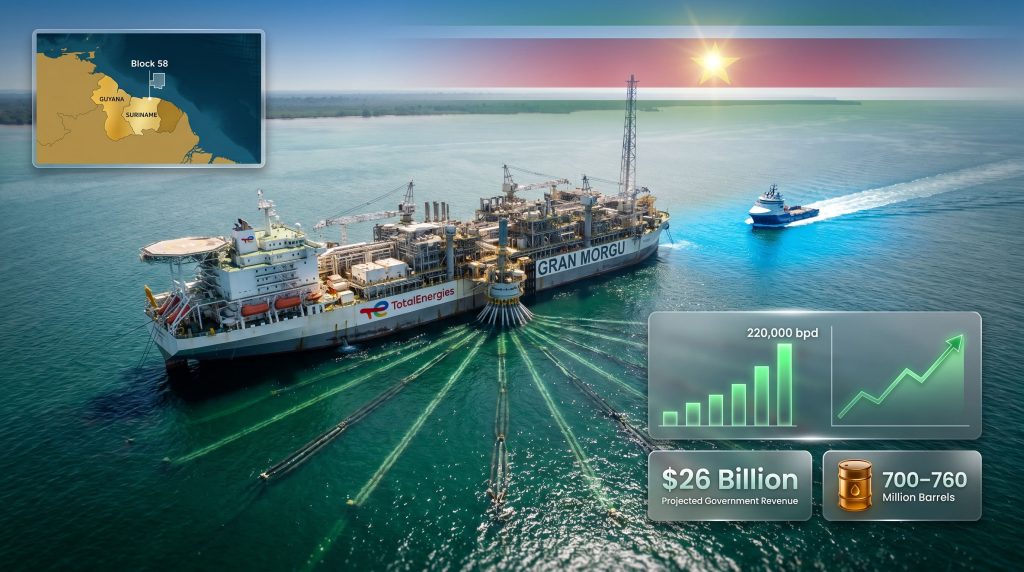
In October 2024, TotalEnergies and APA Corporation formally sanctioned the Gran Morgu project, ending two years of uncertainty and setting Suriname on a trajectory toward becoming one of the more consequential emerging oil producers of the late 2020s. As of April 2026, the project is reported to be approximately 50 percent complete, with first oil targeted for 2028.
The scale and structure of Gran Morgu are worth examining in detail, because the numbers themselves tell a story about the potential transformation of Suriname's fiscal landscape.
| Parameter | Detail |
|---|---|
| Project Name | Gran Morgu |
| Location | Block 58, Offshore Suriname |
| Operator | TotalEnergies (50%) |
| Partner | APA Corporation (50%) |
| NOC Stake | Staatsolie 20% operating interest |
| Target Fields | Sapakara and Krabdagu |
| Recoverable Resource | 700–760 million barrels |
| Crude Quality | Light, sweet (API 35–40°) |
| Development Cost | $9–10.5 billion |
| Production Capacity | 220,000 barrels per day |
| Well Count | 16 production + 16 injection wells |
| Completion (April 2026) | ~50% complete |
| First Oil Target | 2028 |
| Government Revenue Projection | Up to $26 billion (project lifetime) |
The Sapakara and Krabdagu fields form the twin pillars of Gran Morgu's initial development phase, with a combined recoverable resource estimate of 700 to 760 million barrels. At a nameplate capacity of 220,000 barrels per day, the project represents a step-change in Suriname's production profile relative to its current onshore output of approximately 16,000 barrels per day.
Staatsolie's 20% Stake: A Structural Shift in Revenue Capture
Suriname's national oil company, Staatsolie, acquired a 20 percent operating interest in Gran Morgu for approximately $2.4 billion in 2025. This is a strategically significant element of the project's structure that deserves more attention than it typically receives in coverage of the Suriname offshore oil boom.
Equity participation fundamentally changes how a host government captures resource value. Traditional royalty and corporate tax arrangements expose governments to revenue only after operators have recovered costs and declared profits. Direct equity participation, by contrast, aligns the national oil company's financial interests with the project's gross production economics from day one of first oil.
The projected $26 billion in cumulative government revenues over Gran Morgu's project lifetime includes the enhanced capture made possible by Staatsolie's equity position. To contextualise that figure: it represents roughly three times Suriname's current annual economic output, and it arrives at a moment when the country is actively working to stabilise public finances following formal debt restructuring. Suriname's fortunes are shifting dramatically, as analysts and observers across the region have noted, given the scale of offshore discoveries relative to the country's existing economic base.
Gran Morgu's Carbon Footprint in a Global Context
One of the less-discussed but commercially relevant dimensions of Gran Morgu is its environmental design architecture. TotalEnergies has specified an all-electric, low-emission facility that eliminates on-site fossil fuel combustion, removing the direct scope 1 emissions associated with conventional gas turbine drives and auxiliary diesel power generation.
The result is a projected greenhouse gas intensity of fewer than 16 kilograms of CO₂ per barrel of crude produced.
| Production Source | CO₂ Intensity (kg per barrel) |
|---|---|
| Gran Morgu (Suriname) | <16 kg/barrel |
| Global Average | ~18 kg/barrel |
| Venezuela's Orinoco Belt | Up to 1,460 kg/barrel |
The comparison to Venezuela's Orinoco Belt is instructive. Orinoco Belt crude is ultra-heavy bituminous oil with API gravity in the range of 8 to 12 degrees, requiring thermal recovery techniques and significant upgrading infrastructure. The energy intensity of that extraction process drives emissions to levels approximately 91 times higher than Gran Morgu's projected profile. Gran Morgu's light, sweet crude characteristics, combined with the all-electric facility design, produce an emissions profile that sits below the global average and positions the project favourably in an environment where institutional capital increasingly scrutinises lifecycle carbon intensity.
The Broader Offshore Picture: 23 Blocks and a Regional Gas Opportunity
Gran Morgu is the first chapter of a substantially larger offshore story, not the complete narrative. Suriname currently has 23 delineated and allocated offshore blocks attracting a roster of international operators that includes TotalEnergies, APA Corporation, ExxonMobil, Chevron, Petronas, and Shell. The concentration of supermajor interest across a relatively small sovereign territory reflects the basin's perceived resource potential following the validation provided by the Guyana experience.
| Operator | Block | Working Interest | Primary Focus |
|---|---|---|---|
| TotalEnergies | Block 58 | 50% (operator) | Gran Morgu crude oil |
| APA Corporation | Block 58 | 50% | Gran Morgu crude oil |
| Staatsolie | Block 58, Block 52 | 20% each | NOC equity participation |
| Petronas | Block 52 | 80% (operator) | Sloanea gas development |
Block 52 and the Sloanea Gas Discovery
Suriname's next major project milestone is expected to emerge from offshore Block 52, where Malaysia's national oil company Petronas holds an 80 percent working interest alongside Staatsolie's 20 percent stake. The Sloanea-1 gas discovery, made in 2020, was formally declared commercial in November 2025, with Petronas targeting a Final Investment Decision by late 2026.
The timing carries significant regional strategic weight. Trinidad and Tobago has historically served as the Caribbean basin's dominant natural gas supplier, but the island nation is experiencing a structural decline in both reserves and production capacity that threatens regional supply chains. Consequently, the natural gas supply outlook for the Atlantic basin is shifting meaningfully, with Suriname's emerging gas sector entering a supply vacuum at precisely the moment when alternative sources are being actively sought.
This dynamic adds a second major revenue pillar to Suriname's emerging hydrocarbon portfolio, potentially diversifying the country's petroleum income beyond crude oil dependence.
The Economic Transformation Thesis: Realistic Upside and Genuine Risks
The macroeconomic calculus for Suriname is striking. The IMF has projected that Gran Morgu's production ramp-up could generate a GDP surge of approximately 55 percent, a magnitude of economic acceleration that would be virtually unprecedented for a nation of Suriname's size and current fiscal position. The government has established a sovereign wealth fund structure modelled on Norway's petroleum fund principles, designed to capture and steward long-term petroleum revenues across production cycles.
The country's leadership has also articulated a revenue-sharing ambition under which citizens would receive direct annual payments derived from oil proceeds, reflecting the political imperative to ensure visible public benefit from hydrocarbon development in a country with a documented history of fiscal inequality.
However, the transformative potential of the Suriname offshore oil boom must be evaluated alongside a set of structural risks that are well-documented in the academic and policy literature on resource-dependent developing economies. In addition, the market volatility risks present in the current global environment introduce further uncertainty for frontier market producers.
Key risk factors warrant serious analytical attention:
- Dutch Disease dynamics arising from rapid currency appreciation as export revenues surge, potentially eroding competitiveness in Suriname's agricultural and manufacturing sectors
- Governance opacity concerns, including limited public disclosure of production sharing agreement contract terms and bidding process transparency
- Concentration risk stemming from an over-reliance on Gran Morgu as the singular transformative project before diversification of the economic base is established
- Commodity price exposure, with project breakeven costs estimated at $40 to $45 per barrel leaving meaningful sensitivity to sustained oil price weakness below prevailing market levels
Disclaimer: Revenue projections, GDP growth forecasts, and commodity price scenarios referenced in this article involve forward-looking assumptions that are inherently uncertain. Actual outcomes may differ materially from projections based on oil price movements, project execution timelines, fiscal policy decisions, and macroeconomic conditions. This article does not constitute investment advice.
The next major ASX story will hit our subscribers first
Suriname vs. Guyana: The Neighbouring Benchmark
No analysis of the Suriname offshore oil boom is complete without reference to the Guyana comparison, because it simultaneously provides the strongest validation of the basin's potential and the most instructive cautionary framework for policymakers.
| Dimension | Guyana (Stabroek Block) | Suriname (Block 58) |
|---|---|---|
| First Major Discovery | 2015 (Liza-1) | 2020 (Maka Central-1) |
| Current Production | ~375,000 bpd (scaling to 1M+ bpd) | ~16,000 bpd (onshore) |
| Peak Offshore Target | 1,000,000+ bpd | 220,000 bpd (initial phase) |
| Resource Estimate | 11+ billion barrels (Stabroek) | 700–760 million barrels (Block 58) |
| Primary Operator | ExxonMobil | TotalEnergies |
| First Offshore Oil | 2019 | 2028 (projected) |
Guyana's transformation from one of South America's poorest nations to its wealthiest by GDP per capita within a decade of first oil is the aspirational reference point. However, the pace at which Guyanese institutions adapted to petroleum revenues, the degree to which social investment was prioritised over consumption, and the governance frameworks applied to revenue management are equally important variables in determining whether Suriname replicates the outcome or falls into the resource mismanagement patterns that have historically undermined hydrocarbon-dependent developing economies.
Suriname is entering its production phase roughly nine years behind Guyana's offshore timeline, with the advantage of an observable case study and the disadvantage of a more fragile fiscal starting position. How Suriname and Guyana plan to share oil and gas wealth with their respective citizens remains one of the most closely watched policy questions in the region.
Breakeven Economics and Investment Attractiveness
For investors and industry observers evaluating the Suriname offshore oil boom within a global upstream context, the fiscal terms deserve specific attention. Production sharing agreements in Suriname run for up to 30 contract years, among the longest available in the global upstream industry, providing the long-horizon revenue certainty that justifies the capital intensity of deepwater FPSO developments. Furthermore, the crude oil price trends currently underpinning investment decisions reinforce the commercial viability of projects with breakeven economics well below prevailing market benchmarks.
| Metric | Suriname (Gran Morgu) |
|---|---|
| Estimated Breakeven Price | $40–$45 per barrel |
| PSA Contract Duration | Up to 30 years |
| Crude Type | Light, sweet (premium pricing) |
| Facility Design | All-electric FPSO (lower opex profile) |
At a breakeven range of $40 to $45 per barrel, Gran Morgu retains positive economics across a broad range of oil price scenarios. The all-electric facility design further strengthens the economics by reducing ongoing operational expenditure. The combination of low breakeven costs, long-tenure contracts, premium crude quality, and an environmentally favourable facility specification creates a compelling investment profile. Investors tracking commodity price exposure across the energy sector will note that Gran Morgu's cost structure positions it well even in a moderated price environment.
Key Milestones to Watch Through 2028
The Suriname offshore oil boom is moving from the exploration and sanction phase into active execution. The milestones most likely to influence market perception and project momentum over the next two years include:
- Late 2026: Petronas Final Investment Decision for the Block 52 Sloanea natural gas development
- 2026–2027: Continued Gran Morgu construction, commissioning activities, and subsea infrastructure installation
- 2028: Targeted first oil from the Gran Morgu FPSO at initial production rates
- Post-2028: Production ramp-up toward 220,000 barrels per day nameplate capacity across 16 production wells
- Ongoing: Further exploration and appraisal activity across Suriname's remaining offshore block portfolio involving ExxonMobil, Chevron, Shell, and other operators
The broader global oil market context also matters here. Current supply disruptions associated with geopolitical tensions affecting Middle Eastern production have materially strengthened the investment economics for new frontier developments. With breakeven costs well below prevailing WTI and Brent benchmarks, Suriname's offshore programme is positioned to attract sustained capital commitment even under moderate price correction scenarios.
The central variable for the Suriname offshore oil boom has consequently shifted. The resource question was answered in 2020 and confirmed in the years since. The question now is whether the institutional, fiscal, and governance infrastructure surrounding that resource can be built at sufficient pace to translate proven hydrocarbon wealth into durable, broadly shared national prosperity — the precise challenge that has defined the difference between success and failure for every oil frontier economy before it.
Want to Stay Ahead of the Next Major Resource Discovery?
Discovery Alert's proprietary Discovery IQ model delivers real-time alerts the moment significant mineral discoveries are announced on the ASX, transforming complex geological and commodity data into clear, actionable investment insights — explore Discovery Alert's discoveries page to see how historic finds have generated substantial returns, and begin your 14-day free trial to position yourself ahead of the broader market.