
May 12, 2026
The Eastern Mediterranean's Last Unexplored Frontier Is Finally Opening Up
Frontier exploration in the eastern Mediterranean has always carried a particular tension between geological promise and geopolitical complexity. For decades, the Levantine Basin's hydrocarbon potential was understood primarily through the lens of what neighbouring countries were finding, while one of its most geologically significant jurisdictions remained locked behind sanctions, conflict, and diplomatic isolation. That equation is beginning to shift in ways that carry profound implications for how international energy companies think about risk, opportunity, and the evolving post-conflict resource landscape.
The basin-wide geological system stretching beneath the eastern Mediterranean has demonstrated a remarkable capacity for large-scale gas accumulation. What makes the current moment genuinely significant is not any single transaction, but rather what a structured technical engagement with Syria's offshore sector reveals about how the international energy industry is recalibrating its assessment of geopolitical risk in frontier basins. Furthermore, the geopolitical risk landscape for resource development globally is shifting in ways that make previously inaccessible jurisdictions increasingly relevant to portfolio strategy.
When big ASX news breaks, our subscribers know first
Understanding the Levantine Basin as a Hydrocarbon System
To understand why QatarEnergy Syria offshore exploration Block 3 matters, it helps to understand the geological framework in which the block sits. The Levantine Basin is a deep sedimentary basin underlain by Mesozoic carbonate sequences and overlain by thick Miocene evaporite deposits, a geological configuration that has proven highly effective at trapping and preserving hydrocarbon accumulations across the region.
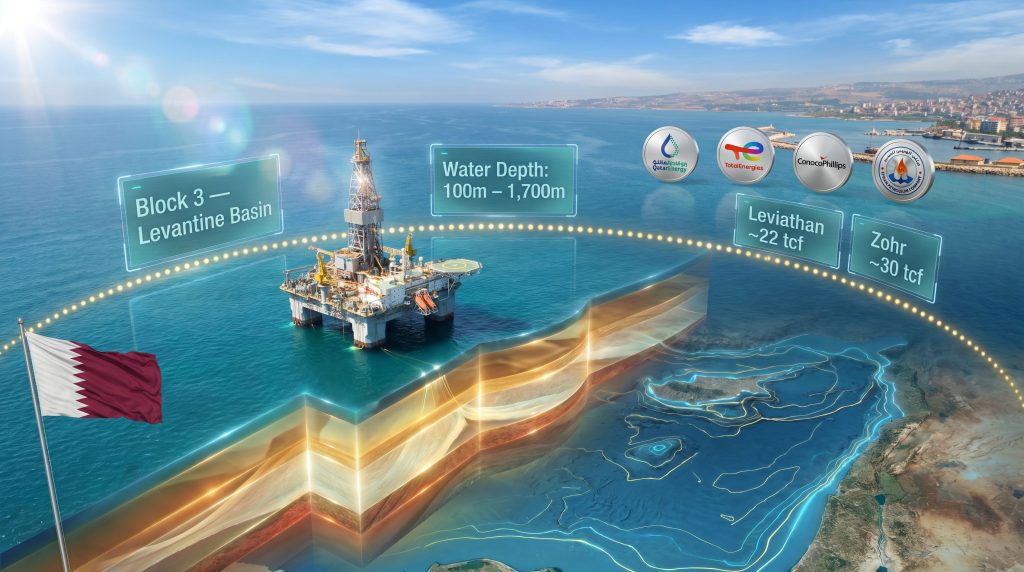
Israel's Leviathan gas field, which holds an estimated 22 trillion cubic feet of recoverable natural gas, and Egypt's Zohr supergiant, with resource estimates of approximately 30 trillion cubic feet, both produce from structural and stratigraphic traps within this same geological system. Cyprus's Aphrodite field, carrying estimates of around 4.5 trillion cubic feet, adds further confirmation that the hydrocarbon system is basin-wide rather than jurisdiction-specific.
The critical geological insight that makes Syria's offshore sector compelling is straightforward: petroleum systems do not respect political boundaries. The source rocks, reservoir formations, and structural traps that generate and contain gas accumulations in Israeli and Egyptian waters extend, at least in part, into Syrian offshore territory. The question for Block 3 is not whether hydrocarbons exist in the basin, but whether the specific structural configurations within Syrian waters have trapped commercially significant volumes.
What Block 3's Depth Range Tells Exploration Geologists
Block 3's water depth range of 100 to 1,700 metres is technically significant beyond just classifying it as a deepwater frontier prospect. This bathymetric profile means the block spans multiple geological environments simultaneously.
- Shallow shelf zones (below roughly 300 metres) are more accessible to conventional drilling programmes and may contain structural traps associated with carbonate reef complexes or fault-bounded closures
- Mid-water environments typically offer access to different stratigraphic intervals and may expose exploration targets in turbidite sandstone systems
- Deep water zones approaching 1,700 metres present the highest technical drilling challenge but often correspond to the basin's most prolific structural trap types, including the Miocene carbonate buildups that host giant discoveries elsewhere in the Levantine Basin
This geological diversity means a single block can potentially offer multiple independent play types, which is precisely why technical reviews of seismic data are so critical before any well commitment. Understanding which play type offers the most prospective entry point determines not just the location of any future well, but the entire capital allocation strategy for the programme.
The May 2026 MoU: What Was Actually Signed and What Was Not
On May 12, 2026, QatarEnergy formalised a Memorandum of Understanding at its Doha headquarters with TotalEnergies, ConocoPhillips, and the Syrian Petroleum Company (SPC), covering a joint technical evaluation of Block 3 offshore Syria. The precise language of the agreement, as confirmed by QatarEnergy, describes a technical review to evaluate the potential of Block 3 and establishes a framework for further technical and commercial discussions.
This distinction between an MoU and an exploration commitment is not semantic. It has material implications for understanding where each party's obligations actually begin and end.
| Agreement Element | Confirmed Status |
|---|---|
| Joint technical data review for Block 3 | Confirmed under MoU |
| Framework for commercial and technical discussions | Confirmed under MoU |
| Formal drilling programme or well commitments | Not established |
| Production sharing agreement or concession award | Not yet in place |
| Binding financial obligations from international partners | Not applicable at MoU stage |
| Regulatory approvals for exploration activities | Pending |
The deliberate structuring of this agreement as a pre-commitment technical review phase is standard practice in high-risk frontier exploration, particularly where the regulatory and sanctions environment remains subject to change. It allows each party to conduct due diligence, assess data quality, and evaluate commercial viability before assuming legal or financial exposure.
Why Each Consortium Member's Participation Is Strategically Distinct
The choice of partners in this consortium is not incidental. Each company brings a different strategic rationale, and together they form a consortium designed to distribute the reputational, regulatory, and technical risks of engaging with a jurisdiction emerging from prolonged isolation.
QatarEnergy has been systematically building an internationally diversified upstream portfolio that complements its dominant position in Qatari LNG production. Its recent expansion activity has spanned sub-Saharan Africa, South America, and the broader Mediterranean region, often through co-investment arrangements with the same companies appearing in the Syria MoU. As a Gulf state national oil company, QatarEnergy also carries a diplomatic positioning advantage in Syrian engagement that purely Western majors do not enjoy.
TotalEnergies brings something no competitor can replicate: institutional memory. The French energy major maintained an active operational relationship with the Syrian Petroleum Company from 1988 through 2011, when sanctions forced the suspension of commercial engagement. That 23-year history includes technical databases, field relationships, and an understanding of SPC's operational culture that provides a meaningful advantage in any renewed engagement.
ConocoPhillips contributes deepwater technical expertise and financial capacity. Its participation, however, is the most legally complex element of the consortium, given its status as a US-domiciled company subject to the extraterritorial reach of US sanctions legislation.
Syrian Petroleum Company (SPC) is the sovereign counterparty through which the Syrian government manages its upstream sector. Its participation is the enabling condition for any international exploration programme within Syrian territorial waters.
The Geopolitical Architecture Behind This Deal
The emergence of the QatarEnergy Syria offshore exploration Block 3 arrangement cannot be separated from the broader geopolitical reconfiguration that has unfolded since the fall of the Assad government. That political transition altered the fundamental risk calculus that international energy companies apply to Syrian engagement, not by eliminating risk, but by creating a credible pathway through which sanctions relief and regulatory normalisation become plausible outcomes. Indeed, resource geopolitics is increasingly shaping how energy majors allocate capital across frontier jurisdictions.
Several factors are converging to make this timing viable:
- The change in Damascus's governing structure has altered how Western governments approach sanctions enforcement and potential licensing exemptions for the energy sector
- Syria's pre-conflict oil production capacity, which reached approximately 380,000 barrels per day at its peak before 2011, represents a meaningful baseline from which a recovering industry could rebuild
- Qatar's historically distinct diplomatic posture toward Syria has given QatarEnergy a first-mover advantage over competing national oil companies and majors that lack equivalent political access
- TotalEnergies' pre-2011 operational history with SPC creates a foundation for rapid technical re-engagement that new entrants would take years to replicate
The Sanctions Complexity That No Party Can Ignore
The central legal question facing this consortium is whether international energy companies can currently operate within Syrian waters in compliance with applicable sanctions frameworks. This is an unresolved question with significant consequences.
US Office of Foreign Assets Control (OFAC) regulations, European Union Council restrictions, and UK Office of Financial Sanctions Implementation frameworks all maintain provisions relating to Syria. These are not monolithic restrictions, and energy sector licensing exemptions have historically been negotiated in comparable jurisdictions including Libya and, more recently, Venezuela. However, ConocoPhillips' participation as a US-domiciled entity subjects the entire consortium's activities to a level of regulatory scrutiny that would not apply to a consortium composed exclusively of non-US companies.
The MoU's structure as a non-binding technical review phase is partly a function of this legal complexity. Before committing to drilling expenditures or production sharing arrangements, each party needs regulatory clarity on what operations are permissible, under what licensing conditions, and with what ongoing compliance obligations. This mirrors the broader pattern of strategic minerals deals struck in geopolitically sensitive regions, where phased legal frameworks precede binding commitments.
Sanctions compliance in post-conflict hydrocarbon jurisdictions typically follows a sequenced pathway: diplomatic engagement precedes sanctions relaxation, which precedes licensing exemptions, which precedes investment commitment. The Block 3 MoU appears to be operating in the early middle phase of this sequence, where engagement has advanced but regulatory clarity remains incomplete.
Risk Assessment: Scenarios for Block 3's Development Trajectory
Investors and industry observers evaluating the QatarEnergy Syria offshore exploration Block 3 arrangement should consider multiple development scenarios rather than assuming a linear path from MoU to exploration well.
| Scenario | Probability Assessment | Primary Trigger Conditions |
|---|---|---|
| Technical review yields positive seismic interpretation, progresses to PSA negotiations | Moderate | Sanctions relief confirmed, data quality sufficient for well targeting |
| Technical review concludes without further commitment | Moderate to High | Sanctions ambiguity persists, existing seismic data insufficient |
| Consortium expands to include additional international partners | Low | Positive initial data triggers competitive interest |
| Geopolitical escalation or sanctions tightening halts programme | Low to Moderate | Regional conflict expansion or reversal of diplomatic progress |
| Accelerated progression driven by uncommonly positive seismic results | Very Low | Discovery of high-quality, drillable targets in early review phase |
The data quality risk deserves particular attention. Syria's offshore seismic database predates many of the advances in seismic acquisition and processing that have transformed frontier exploration over the past two decades. Modern full-waveform inversion techniques, ocean-bottom node seismic acquisition, and advanced amplitude-versus-offset analysis may reveal target geometries that older datasets could not resolve. However, if the available data is too degraded or sparse to support reliable subsurface interpretation, the technical review may reach its limits before any commercial decision can be made.
Eastern Mediterranean Gas: The Regional Context That Drives Commercial Logic
The broader strategic context for this deal is the growing importance of eastern Mediterranean gas supply to European energy markets. European demand for pipeline-independent LNG and Mediterranean-sourced gas has intensified since the structural disruption of Russian pipeline supply, creating an incentive framework for accelerated development of Levantine Basin resources. Furthermore, global trade tensions have reinforced Europe's desire to diversify its energy supply chains away from geopolitically vulnerable corridors.
Eastern Mediterranean Gas Landscape
| Country / Field | Estimated Recoverable Resource | Current Development Status |
|---|---|---|
| Israel, Leviathan | ~22 trillion cubic feet | In production, exporting |
| Egypt, Zohr | ~30 trillion cubic feet | In production |
| Cyprus, Aphrodite | ~4.5 trillion cubic feet | Development planning phase |
| Lebanon, offshore blocks | Unquantified | Early exploration stage |
| Syria, Block 3 | Unquantified | Pre-drill technical review |
Syria's offshore sector occupies a singular position in this table: it is the only jurisdiction in the Levantine Basin with confirmed geological prospectivity, proximity to producing neighbours, and effectively zero modern exploration coverage. That combination creates both the rationale for first-mover engagement and the analytical uncertainty that makes the MoU structure appropriate at this stage.
If Block 3's technical review yields encouraging results, the downstream implications extend well beyond a single exploration licence. Confirmed hydrocarbons in Syrian waters would catalyse interest in Syria's other unassessed offshore blocks, potentially attracting a new wave of international capital into a post-conflict economy with genuine infrastructure development needs.
The next major ASX story will hit our subscribers first
What Sophisticated Observers Are Watching Beyond the Headlines
Several dimensions of this deal are underappreciated in general coverage but carry significant weight for industry insiders:
The data room dynamic: When TotalEnergies re-engages with SPC, it likely has access to historical technical data from its pre-2011 operational period that competitors cannot access through public sources. This proprietary dataset could meaningfully accelerate the technical review phase and give the consortium a structural advantage in identifying high-priority drill targets.
The PSA template question: Syria will need to establish or update its production sharing agreement framework to accommodate modern international investment standards. The terms of that framework, particularly the cost recovery structure, profit oil split, and stabilisation provisions, will determine whether Block 3 is economically viable even if geological results are positive.
The infrastructure gap: Syria's onshore oil and gas infrastructure suffered significant damage during the conflict period. Even a successful offshore discovery would require substantial investment in gas processing, pipeline, and potentially LNG or pipeline export infrastructure before production could be monetised. The economics of that infrastructure gap must be factored into any commercial evaluation.
The competitive pressure: Once a credible MoU is signed by a consortium of this calibre, the window for other international companies to establish comparable positions may narrow. Companies currently watching from the sidelines are evaluating whether early partnership with the existing consortium or independent pursuit of other Syrian offshore blocks represents a better strategic pathway. In addition, commodities investment trends suggest that frontier energy assets are attracting renewed institutional attention as portfolio diversifiers. Observers should also note the formal cooperation details published following the Doha signing, which outline the shared intent to progress technical discussions in the near term.
Disclaimer: This article is intended for informational and educational purposes only and does not constitute financial, investment, or legal advice. Statements regarding resource estimates, production figures, sanctions environments, and scenario probabilities involve significant uncertainty and should not be relied upon as the sole basis for any investment decision. Readers should consult appropriate professional advisers before acting on any information contained herein. All figures cited, including resource estimates for regional fields, are drawn from publicly available industry sources and are subject to revision.
Want to Stay Ahead of the Next Major Resource Discovery?
Discovery Alert's proprietary Discovery IQ model scans ASX announcements in real time, instantly identifying significant mineral discoveries and translating complex resource data into actionable investment insights — ideal for investors tracking frontier opportunities across energy and minerals sectors. Explore how historic discoveries have generated extraordinary returns and begin your 14-day free trial today to position yourself ahead of the broader market.