
May 13, 2026
The Regulatory Gauntlet: Why Federal Permitting Now Defines Canadian Critical Mineral Investment
Across the global mining industry, a quiet but consequential shift has been underway for the better part of a decade. The technical capacity to find, define, and engineer large-scale mineral deposits has never been more sophisticated. Geological models are sharper. Metallurgical processes are more efficient. Yet despite these advances, the variable most likely to determine whether a world-class project ever reaches production is no longer found underground. It lives inside a regulatory framework, and the Crawford Nickel Project federal permitting story illustrates this reality more clearly than almost any other case in recent Canadian mining history.
Canada's 2019 Impact Assessment Act fundamentally changed the rules of engagement for major mining developments. Where its predecessor legislation focused primarily on environmental screening, the IAA expanded the mandate to encompass health outcomes, social and economic consequences, and the rights of Indigenous peoples. The result is a permitting process that is analytically richer, more inclusive, and considerably more complex to navigate. Understanding the mining permitting realities under this framework is essential for any investor tracking Canadian resource development.
When big ASX news breaks, our subscribers know first
Crawford Nickel: Project Fundamentals and Strategic Context
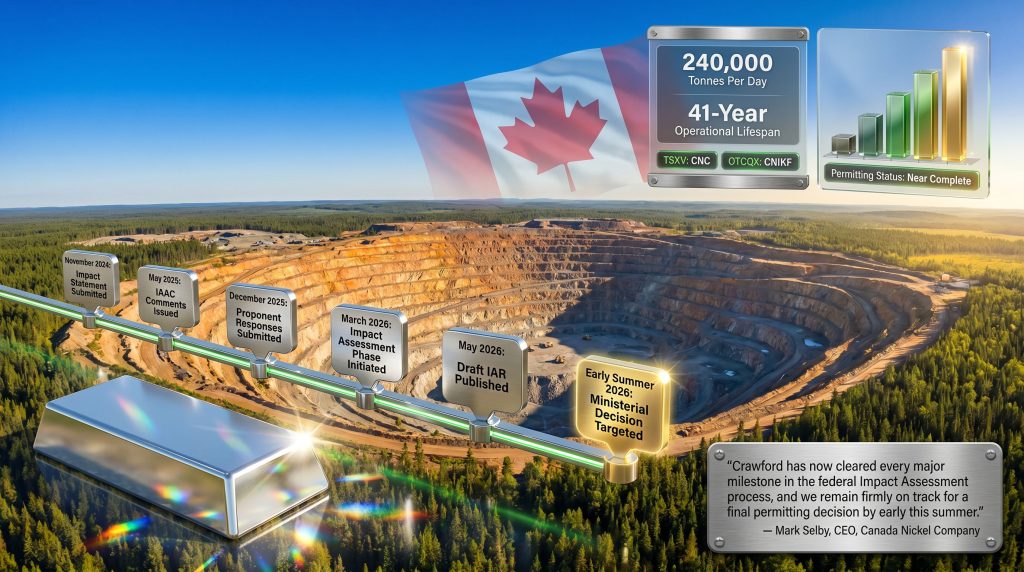
Located 42 kilometres north of Timmins, Ontario, within the historically productive Timmins-Cochrane mining camp, the Crawford Nickel Project is the flagship asset of Canada Nickel Company Inc. (TSXV: CNC | OTCQX: CNIKF). The project is wholly owned by the company and is designed around an open-pit mining configuration with a throughput capacity of 240,000 tonnes per day and a projected operational lifespan of 41 years.
Those numbers alone place Crawford among the largest nickel development projects in the Western world. However, the project's significance extends well beyond scale.
Crawford targets nickel-sulphide mineralisation, a deposit type that carries specific strategic and metallurgical advantages over the laterite nickel deposits that dominate Indonesian nickel supply. Sulphide ores generally support processing routes with lower energy intensity and, crucially, lower carbon footprints than the high-pressure acid leaching (HPAL) and rotary kiln electric furnace (RKEF) processes typically required for laterite feedstock.
This geological distinction is directly relevant to Canada Nickel's stated objective of developing net-zero carbon nickel, cobalt, and iron production processes for the electric vehicle and stainless steel markets.
Why Nickel-Sulphide Geology Matters to Battery Supply Chains
The global EV battery industry has increasingly differentiated between nickel feedstock types. Class 1 nickel, the refined form required for battery-grade applications such as nickel sulphate, is most efficiently produced from sulphide ore sources. Furthermore, while Indonesian producers have dramatically scaled nickel output using laterite feedstocks processed via HPAL, concerns around carbon intensity, waste management, and geopolitical concentration have intensified scrutiny from Western battery manufacturers.
Consequently, Crawford's nickel-sulphide deposit positions the project as a potential domestic source of Class 1 nickel for North American and European supply chains that are actively seeking non-Indonesian, non-Russian alternatives. The broader critical minerals demand picture gives the Crawford Nickel Project federal permitting timeline a geopolitical dimension that extends well beyond Ontario's mining jurisdiction.
How Canada's 2019 Impact Assessment Act Works
Understanding what Crawford has achieved requires understanding what the IAA actually demands. The 2019 legislation replaced the Canadian Environmental Assessment Act, 2012 (CEAA 2012) with a framework that is considerably broader in scope and more demanding in its evidentiary standards.
Under CEAA 2012, the primary question was whether a project would cause significant adverse environmental effects. The IAA reframes that question entirely. Projects must now demonstrate positive outcomes across a much wider set of dimensions, with the Impact Assessment Agency of Canada (IAAC) evaluating submissions against criteria that include:
- Health and social effects on directly affected communities
- Economic impacts at local, regional, and national levels
- Effects on Indigenous peoples and their constitutionally protected rights
- Environmental consequences within federal jurisdiction areas
- Gender-based analysis and intersectionality considerations
This expanded mandate does not merely add complexity. It changes the fundamental nature of the document a proponent must prepare and the quality of evidence required to satisfy the agency's review.
The Federal Jurisdiction Triggers That Apply to Crawford
Not every mining project triggers federal review. The IAA applies when a project intersects with specific areas of federal jurisdiction. For Crawford, the principal triggers include:
- Fish and fish habitat under the Fisheries Act (R.S.C. 1985, c. F-14), which applies wherever mining operations have potential to affect fish-bearing water bodies
- Migratory birds under the Migratory Birds Convention Act, 1994, relevant to habitat disturbance during construction and operations
- Indigenous peoples' rights, explicitly embedded in the IAA as a mandatory assessment dimension under Section 19(1)
- Interprovincial and transboundary effects, where applicable
These triggers collectively explain why Crawford required federal assessment rather than provincial environmental review alone, and why the IAAC's involvement was mandatory from the outset.
The Six-Phase Federal Process: Crawford's Position on the Timeline
| Phase | Description | Crawford Status |
|---|---|---|
| Planning Phase | Early engagement, tailored guidelines, Indigenous consultation | Completed (2023) |
| Impact Statement Submission | Proponent submits comprehensive assessment document | Submitted November 22, 2024 |
| IAAC Review and Comments | Agency technical review with federal and provincial authorities | IAAC comments issued May 30, 2025 |
| Proponent Response | Company addresses agency and stakeholder comments | Responses submitted December 30, 2025 |
| Impact Assessment Phase | IAAC prepares draft Impact Assessment Report (IAR) | Draft IAR published May 2026 |
| Ministerial Decision | Federal Minister of Environment and Climate Change issues decision | Targeted early summer 2026 |
The draft IAR published in May 2026 is a formal analytical document containing the IAAC's preliminary conclusions regarding adverse effects within federal jurisdiction, proposed conditions of approval, and the agency's overall assessment of whether the project aligns with the IAA's positive outcomes standard. It is subject to a public comment period before the final version is submitted to the Minister of Environment and Climate Change for decision.
What the Draft IAR Publication Actually Means
Reaching the penultimate stage of the IAA process carries a specific regulatory meaning that is worth unpacking carefully. The IAAC's publication of a draft IAR is not a conditional green light. It is a formal confirmation that the project's Impact Statement satisfies the requirements of IAA subsection 19(1), meaning the agency has sufficient information to conduct its own independent assessment and formulate preliminary conclusions.
For Crawford, this represents the successful navigation of every substantive analytical hurdle in the federal process. The IAAC has reviewed the Impact Statement, issued technical comments, received and accepted the proponent's responses, and now produced its own assessment document. What remains is the public comment process on the draft IAR and the Minister's final decision.
According to Crux Investor's coverage of the milestone, Crawford is the first mining project to reach this stage under Canada's 2019 Impact Assessment Act, a framework that has faced sustained industry criticism for its complexity, timeline uncertainty, and the breadth of its evidentiary demands.
That distinction matters beyond the project itself. It means Crawford's regulatory journey is establishing the first complete procedural precedent for large-scale mining under the IAA. Every future applicant navigating this framework will be able to reference Crawford's timeline and methodology as a benchmark.
Proposed Conditions of Approval: What Investors Need to Understand
The proposed conditions of approval embedded in the draft IAR are frequently mischaracterised in early-stage coverage. They are not rejection mechanisms. They are operational requirements that the proponent must satisfy during construction and operation if federal approval is granted.
For a project of Crawford's scale and setting, typical condition categories under the IAA framework would include:
- Water quality monitoring programmes with defined trigger thresholds and remediation obligations
- Fish habitat offsetting requirements to compensate for any loss of productive habitat within federal jurisdiction
- Wildlife management plans covering species identified as potentially affected during the assessment
- Indigenous oversight and monitoring mechanisms, often involving community representatives in ongoing compliance verification
- Reporting and record-keeping obligations to allow the IAAC to verify compliance throughout the project's operational life
The public comment period that follows draft IAR publication provides an opportunity for communities, Indigenous Nations, technical agencies, and the general public to identify whether the proposed conditions are sufficient. Those submissions can refine the conditions in the final IAR before it reaches the Minister.
Indigenous Rights and Consultation: The IAA's Most Significant Departure
One of the most consequential differences between the IAA and CEAA 2012 is the explicit treatment of Indigenous peoples' rights as a mandatory assessment dimension rather than a consultation obligation to be managed alongside environmental review.
Under the IAA, the IAAC is required to assess the effects of a designated project on the rights of Indigenous peoples as recognised and affirmed by Section 35 of the Constitution Act, 1982. This is a materially higher standard than what existed under predecessor legislation, and it shapes both the content of the Impact Statement and the conditions that appear in the draft IAR.
For Crawford, Indigenous consultations have been underway since at least 2023, spanning the Planning Phase and continuing through the Impact Statement review. The depth of that consultation record is part of what has enabled the project to reach the draft IAR stage without significant procedural challenge.
Parallel Processes: Provincial Permitting and Grid Infrastructure
Federal Impact Assessment is not the only regulatory stream running concurrently. Crawford is also subject to Ontario's provincial environmental assessment framework, and the two processes have been advancing in parallel rather than sequentially.
This parallel processing approach is significant for construction timeline management. Sequential approvals, where provincial review begins only after federal approval is secured, can add years to project development schedules. The concurrent advancement of both streams compresses the overall timeline considerably.
Beyond regulatory processes, Canada Nickel signed a grid connection agreement with Hydro One for engineering and procurement work at Porcupine Station in early March 2026. This infrastructure milestone signals that the company is managing Crawford's development as an integrated project delivery programme, with construction-phase procurement advancing alongside the final stages of regulatory review.
What a Summer 2026 Federal Decision Would Mean
A federal permitting decision issued in early summer 2026 would represent more than a milestone for Canada Nickel. It would be the first full-cycle approval under the IAA for a major mining project, a regulatory outcome that the Canadian mining industry has been waiting for since the Act came into force in 2019.
The implications extend across several dimensions:
| Scenario | Trigger | Implication |
|---|---|---|
| Federal approval issued (summer 2026) | Ministerial decision with conditions | Construction financing secured; ground-breaking timeline confirmed |
| Conditional approval with revised requirements | Draft IAR conditions refined post-public comment | Minor timeline adjustment; project fundamentally de-risked |
| Approval delayed beyond summer 2026 | Ministerial review extended | Construction timeline deferred; financing conditions reassessed |
For development-stage mining companies, permitting certainty typically functions as a significant re-rating catalyst. The removal of regulatory uncertainty allows financing institutions and strategic investors to underwrite project capital requirements with greater confidence, often narrowing the discount applied to development-stage assets in capital market valuations. In addition, the broader battery metals investment landscape means that a successful Crawford approval could attract renewed institutional attention to Canadian critical mineral projects more broadly.
Net-Zero Ambitions and ESG Capital Alignment
Canada Nickel's objective of developing net-zero carbon production processes for nickel, cobalt, and iron is not merely a marketing position. It represents a potential structural advantage in accessing ESG-focused institutional capital, which has increasingly differentiated between mining projects on the basis of their carbon intensity and social licence credentials.
The IAA's positive outcomes framework, which requires assessment across health, social, economic, and Indigenous rights dimensions, creates a degree of regulatory alignment with ESG criteria that projects assessed under older frameworks simply cannot claim. A project that has satisfied the IAA's comprehensive requirements has, by definition, undergone more rigorous third-party scrutiny across these dimensions than any of its predecessors.
This convergence of regulatory achievement and ESG positioning may prove to be one of Crawford's less-discussed competitive advantages as it approaches construction financing discussions. Furthermore, nickel's strategic importance to clean energy technologies ensures that a project of Crawford's scale and credentials will remain closely watched by both investors and policymakers.
The next major ASX story will hit our subscribers first
Frequently Asked Questions: Crawford Nickel Project Federal Permitting
What is the Impact Assessment Agency of Canada (IAAC)?
The IAAC is the federal agency responsible for administering Canada's 2019 Impact Assessment Act. It coordinates technical reviews involving federal and provincial authorities, manages public participation processes, and prepares the Impact Assessment Report that forms the analytical basis of the federal Minister's permitting decision.
What is an Impact Assessment Report (IAR)?
The IAR is the IAAC's formal assessment document evaluating a project's effects within federal jurisdiction, setting out proposed conditions of approval, and presenting preliminary conclusions. The draft IAR is published for public comment before a finalised version is submitted to the Minister of Environment and Climate Change.
Why is Crawford the first mining project under the 2019 IAA to reach this stage?
The IAA came into force with substantially more demanding requirements than its predecessor legislation. The breadth of the assessment, the volume of evidence required, and the multi-dimensional scope of review have meant that projects entering the process under these standards take longer to navigate each phase. Crawford's early entry into the process and the scale and quality of its assessment submissions have enabled it to reach the penultimate stage first.
What is the difference between the Impact Statement phase and the Impact Assessment phase?
The Impact Statement phase involves the proponent preparing and submitting a comprehensive assessment document covering all required dimensions. The Impact Assessment phase begins once the IAAC confirms that document is complete and involves the agency conducting its own independent analysis and preparing the IAR.
When is the final federal permitting decision expected?
The Crawford Nickel Project federal permitting decision is targeted for early summer 2026, following the public comment period on the draft IAR and the IAAC's finalisation of its report to the Minister.
What are proposed conditions of approval?
Proposed conditions are binding operational requirements that may be attached to a project approval. They are management, monitoring, and reporting obligations the proponent must meet during construction and operations, not mechanisms for project rejection.
Crawford's Regulatory Significance Beyond a Single Project
The Crawford Nickel Project federal permitting journey is best understood not as an isolated corporate milestone but as the first complete stress test of Canada's most demanding mining regulatory framework.
In establishing the first complete procedural roadmap under the 2019 IAA, Crawford's six-year arc from initial drilling through to draft IAR publication now serves as a benchmark that every future large-scale mining applicant in Canada will reference. The timeline, the evidentiary standards, the Indigenous consultation depth, and the parallel processing strategy all become reference points for the next generation of critical mineral developers navigating the same framework.
A summer 2026 federal decision, if issued as targeted, would confirm that Canada's IAA framework is capable of delivering critical mineral approvals within commercially viable timeframes, a question the industry has been asking since the legislation came into force. The answer carries consequences not just for Canada Nickel, but for Canada's broader capacity to attract the long-term capital commitments that large-scale critical mineral development requires.
This article contains forward-looking statements regarding regulatory timelines, project development schedules, and market conditions. These statements are based on information available at the time of publication and are subject to risks and uncertainties that could cause actual outcomes to differ materially. Readers should not place undue reliance on forward-looking information and should conduct their own due diligence before making any investment decisions. This article does not constitute financial advice.
Want to Track the Next Major Critical Mineral Discovery the Moment It Hits the ASX?
Discovery Alert's proprietary Discovery IQ model instantly scans ASX announcements across more than 30 commodities — including nickel and battery metals — delivering real-time alerts on significant mineral discoveries before the broader market has a chance to react. Explore historic discovery returns on Discovery Alert's dedicated discoveries page to see what early positioning in transformative finds has meant for investors, and begin your 14-day free trial today to secure a genuine market-leading edge.