
May 13, 2026
The Geopolitical Fault Line Running Through Global Nickel Supply
Critical mineral supply chains are rarely disrupted by geology alone. The more consequential shocks tend to arrive through politics, and the most damaging of those are the ones that compress slowly over years before snapping into visibility all at once. What is unfolding with Sherritt International's suspension of its Cuban nickel operations in May 2026 belongs firmly in that category. This is not a story about a mine running out of ore. It is a story about how geopolitical pressure, sustained across multiple revenue channels and multiple years, eventually finds its way into the commodities markets that battery manufacturers, EV producers, and resource investors depend upon.
Understanding the depth of this event requires looking past the surface-level characterisation of a Sherritt International sale from Cuba. No sale has occurred. What has happened is something structurally different, with implications that extend well beyond a single Canadian mining company's balance sheet.
When big ASX news breaks, our subscribers know first
What the Suspension Actually Is, and What It Is Not
A critical distinction needs to be established at the outset. As of May 2026, Sherritt International has not divested, sold, or transferred its Cuban assets to any third party. The company formally suspended its direct participation in Cuban joint venture operations in response to a U.S. executive order issued in May 2026, which imposed new sanctions targeting entities involved with Cuba's natural resource sector. The decision was a compliance response, not a commercial exit driven by operational or financial strategy.
In practical terms, this means:
- Sherritt notified its Cuban joint venture partners of the suspension by formal letter
- All expatriate personnel were repatriated from Cuba following the executive order
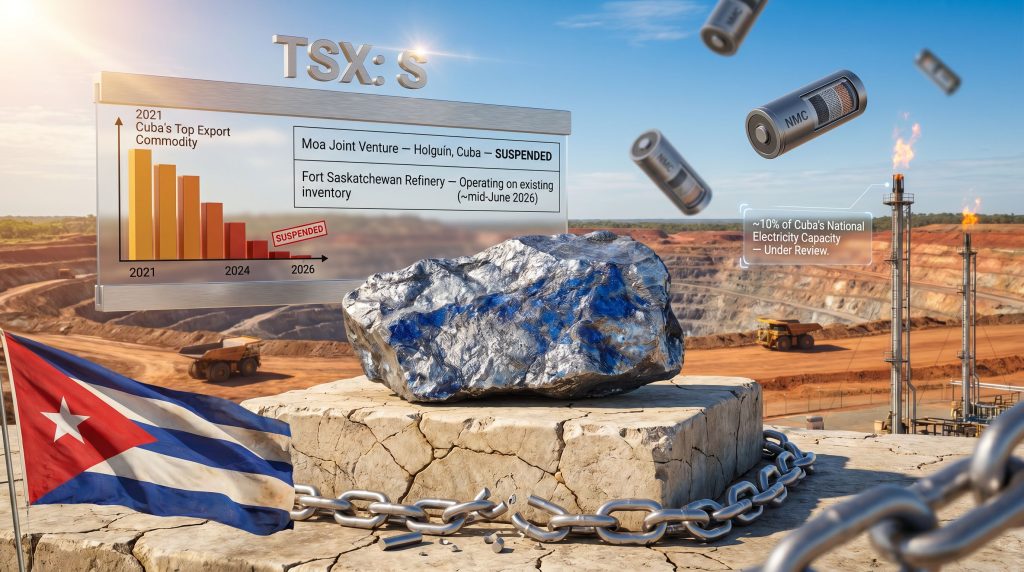
- The company's Fort Saskatchewan refinery in Alberta, Canada, continued processing pre-existing nickel and cobalt inventory
- That inventory stockpile was estimated to sustain refining operations only until approximately mid-June 2026
- Sherritt confirmed it was consulting advisors and actively monitoring the regulatory environment
The company has not announced any buyers, asset transfer structures, or divestment timelines. The legal status of its Cuban holdings remains intact, even as operational activity has ceased. For investors tracking the Sherritt International sale from Cuba narrative circulating in markets, this nuance carries significant weight.
The Moa Joint Venture: Decades of Operations Placed on Hold
Sherritt has operated in Cuba since the 1990s, making it one of the longest-standing foreign mining presences on the island. Its primary Cuban asset is the Moa Joint Venture, a nickel-cobalt mining and processing operation located in Holguín Province in eastern Cuba. The Moa deposit is one of the most laterite-rich nickel environments in the Western Hemisphere, and the joint venture has historically supplied refined nickel and cobalt through the Fort Saskatchewan processing facility.
The operation's value lies not just in its scale but in its dual-commodity output profile. Moa produces both nickel and cobalt simultaneously, two minerals that sit at the centre of lithium-ion battery cathode manufacturing. This means that any sustained disruption to Moa does not create a single-market supply shock. It creates parallel tightening across two critical battery input markets at once.
Beyond mining, Sherritt holds a stake in Energas SA, Cuba's largest independent electricity producer. Energas generates power from local natural gas and, according to Omar Everleny Pérez, former director of the Center for Studies of the Cuban Economy at the University of Havana, is responsible for approximately 10% of Cuba's total national electricity generation capacity. The potential disruption of Energas operations compounds an already severe humanitarian and infrastructure problem on the island.
| Operation | Location | Primary Function | Post-Suspension Status |
|---|---|---|---|
| Moa Joint Venture | Holguín, Cuba | Nickel-cobalt mining and processing | Suspended |
| Energas SA | Cuba (multiple sites) | Natural gas-based electricity generation | Under review |
| Fort Saskatchewan Refinery | Alberta, Canada | Nickel-cobalt refining | Processing existing inventory only |
Cuba's Nickel Economy: From Export Leader to Structural Vulnerability
To appreciate the scale of what this suspension means for Cuba, consider the trajectory of nickel's role in the country's export economy. In 2021, nickel surpassed both tobacco and sugar to become Cuba's single largest export commodity, a milestone that reflected years of investment by Sherritt and its joint venture partners in developing the Moa deposit and its downstream refining capability. By 2024, however, that export value had deteriorated significantly, reflecting a combination of global nickel price weakness, operational challenges, and the compounding effects of U.S. economic pressure.
Paolo Spadoni, an academic specialist in Cuban economic affairs, has characterised U.S. sanctions policy as having systematically targeted every major external revenue channel available to the Cuban government. According to Spadoni, the sequential pressure on tourism receipts, remittances, medical services exports, and now strategic mineral exports represents a deliberate and cumulative economic strategy, with the Sherritt suspension marking the latest and arguably most operationally concentrated pressure point.
| Year | Nickel's Role in Cuba's Export Economy |
|---|---|
| 2021 | Top export commodity, surpassing tobacco and sugar |
| 2024 | Significant decline in export value recorded |
| 2026 | Primary foreign mining operator suspended by U.S. sanctions |
The Energy Dimension: A Crisis Within a Crisis
Cuba was already experiencing severe electricity shortages before the Sherritt suspension. Rolling blackouts, fuel scarcity, and ageing grid infrastructure had become defining features of daily life across the island by early 2026. Energy restrictions introduced by Washington earlier in the year had further constrained fuel supply chains. Against this backdrop, the potential disruption of Energas operations carries consequences that extend well beyond economics.
Omar Everleny Pérez, the former director of the Center for Studies of the Cuban Economy at the University of Havana, described the anticipated electricity impacts as the most immediate concern arising from Sherritt's departure. In his assessment, the removal of Energas's generation capacity would compound an energy system that is already operating at its limits.
"With approximately 10% of Cuba's national electricity generation potentially affected, the suspension creates compounding pressure on an energy system that was already experiencing severe structural stress well before the sanctions were applied."
This is a critical detail that distinguishes the Sherritt situation from a straightforward commodity supply story. Furthermore, the implications here are simultaneously economic, humanitarian, and geopolitical.
How U.S. Sanctions Policy Created This Moment
The May 2026 executive order that triggered Sherritt's suspension reflects a broader U.S. foreign policy posture under the Trump administration, which has increasingly targeted entities involved in extracting economic benefit from Cuban state-linked enterprises. U.S. Secretary of State Marco Rubio framed the sanctions as accountability measures against companies exploiting Cuba's natural resources to generate revenues for the Cuban government, according to reporting by Reporte Minero.
The Cuban government's response was categorical. Foreign Minister Bruno Rodríguez characterised the measures as economic coercion designed to destabilise the country's institutional and financial infrastructure, framing them as a form of blackmail directed at Cuba's sovereign economic activities.
This divergence in framing is not merely rhetorical. It shapes how third-country investors, particularly from Canada and Europe, are now being forced to reassess their own exposure to Cuba-linked operations. Consequently, Sherritt, as a TSX-listed company with decades of Cuban history, was not a peripheral actor. Its suspension sends a direct compliance signal to any foreign entity that derives revenue from Cuban state-linked operations, regardless of sector. The geopolitical landscape for metals has, in effect, been permanently altered by this development.
The next major ASX story will hit our subscribers first
What This Means for Global Nickel and Cobalt Markets
Cuba contributes an estimated 4% of global nickel supply, a figure that does not immediately suggest systemic risk. However, commodity market dynamics rarely operate on simple proportionality. In markets that are already structurally tight, a concentrated supply disruption from a single jurisdiction can generate price volatility that outpaces its nominal contribution to global output.
Several compounding factors heighten this risk in the current context:
- The Moa mine produces both nickel and cobalt, creating simultaneous tightening in two battery-critical commodity markets
- Cuba's nickel production was already under stress from fuel shortages and a mining pause in February 2026, reducing effective output before the Sherritt suspension
- Alternative supply sources for nickel suitable for battery cathode applications face their own constraints across Indonesia, the Philippines, and other key producing jurisdictions
- Battery manufacturers and EV producers are operating supply chains that cannot easily absorb simultaneous multi-commodity shocks
The laterite-origin nickel produced at Moa is particularly relevant to battery chemistry. Laterite deposits typically yield nickel in forms amenable to hydrometallurgical processing, which produces the high-purity nickel sulphate required for NMC and NCA battery cathode formulations. This is not interchangeable with ferronickel or nickel pig iron, which serve the stainless steel industry. Furthermore, losing Moa's output is not simply a volume problem; it is a quality and chemistry-specific supply problem for battery manufacturers. For instance, Indonesian nickel market trends illustrate just how competitive alternative supply sources have become, yet they cannot fully substitute for Moa's specific output profile.
In addition, cobalt mining globally faces its own structural pressures, meaning that the dual-commodity disruption from Moa arrives at a particularly sensitive moment for battery material supply chains.
The Compliance Precedent and the Chilling Effect on Foreign Investment
Perhaps the most significant long-term consequence of the Sherritt suspension is the precedent it sets for other foreign operators with Cuban exposure. The mechanism by which U.S. sanctions forced Sherritt's operational pause did not require the company to be directly designated. The executive order restructured the compliance landscape sufficiently that continued operations became legally and financially untenable.
This mechanism, applying maximum compliance pressure without direct designation, creates a chilling effect that operates across sectors simultaneously. Tourism operators, state-linked business partners, and other mining or energy entities with Cuban exposure now face a common risk calculus: if Sherritt, with its legal resources, compliance infrastructure, and decades of Cuban operational experience, found suspension unavoidable, the threshold for continued engagement has effectively shifted for the entire investment community.
Three broad trajectories now appear plausible for foreign business activity in Cuba:
- Accelerated withdrawal, in which additional operators suspend Cuban activities within the next 12 months, concentrating economic pressure and deepening the island's fiscal and energy crises
- Strategic pause and monitoring, where companies maintain their legal structures and asset holdings while halting active operations pending clearer regulatory signals
- Sanctions relief and selective re-engagement, contingent on a shift in U.S. foreign policy creating conditions under which revised compliance frameworks allow some operations to resume
None of these scenarios is imminent or certain. What is certain is that the compliance environment for Cuba-linked operations has been permanently recalibrated by the Sherritt suspension. The energy transition's critical minerals agenda makes this recalibration particularly consequential for policymakers and investors alike.
Investor Considerations: Reading Between the Lines of a Compliance Pause
For investors tracking Sherritt International (TSX: S), the distinction between a compliance-driven suspension and a strategic divestment or asset impairment is financially material. Suspension preserves optionality. If the regulatory environment shifts, the legal structures and operational knowledge embedded in the Cuban joint ventures could be reactivated. Divestment would eliminate that optionality permanently.
However, the near-term risk profile is real and pressing:
| Risk Category | Severity | Time Horizon |
|---|---|---|
| Fort Saskatchewan inventory depletion | High | Near-term (by mid-June 2026) |
| Financial institution support withdrawal | Medium-High | Short to medium term |
| Permanent asset impairment in Cuba | Medium | Medium to long term |
| Sanctions escalation affecting Canadian operations | Low-Medium | Ongoing |
| ESG-related reputational exposure | Medium | Ongoing |
The inventory depletion risk at Fort Saskatchewan is the most time-sensitive concern. Once the pre-existing nickel and cobalt stockpile is exhausted, the Canadian refinery loses its input feed, and downstream processing revenues cease. This creates an earnings cliff that investors should monitor closely against the company's forthcoming guidance.
The broader advisory consultation process underway at Sherritt may signal several possible strategic responses, including partial asset restructuring, introduction of new joint venture structures with non-U.S.-exposed partners, or positioning for eventual re-engagement if sanctions conditions change. Sherritt's corporate update confirms that none of these pathways have been publicly confirmed at this stage.
Disclaimer: This article is intended for informational purposes only and does not constitute financial advice. Commodity price forecasts, operational timelines, and geopolitical scenario analyses involve significant uncertainty. Investors should conduct independent due diligence and consult qualified financial advisors before making investment decisions related to any securities or commodities discussed in this article.
Frequently Asked Questions
Has Sherritt International completed a sale from Cuba?
No. Despite widespread references to a Sherritt International sale from Cuba, no sale, divestment, or asset transfer has been announced as of May 2026. The company has suspended active operations in its Cuban joint ventures as a compliance measure in response to U.S. sanctions. Its legal ownership of Cuban assets remains in place, and Sherritt is actively consulting advisors on its strategic options.
What is the Moa Joint Venture and why does it matter?
The Moa Joint Venture is a nickel-cobalt mining and processing operation in Holguín Province, Cuba. It is significant because it simultaneously produces two battery-critical minerals, nickel and cobalt, whose combined supply contribution to global battery cathode manufacturing makes any prolonged disruption consequential beyond Cuba's modest share of global nickel output.
How does the Sherritt suspension affect Cuba's electricity supply?
Sherritt's Energas division operates as Cuba's largest independent electricity producer, generating power from local natural gas. Energas contributes approximately 10% of Cuba's total national electricity generation capacity, according to Omar Everleny Pérez, former director of the Center for Studies of the Cuban Economy at the University of Havana. Any disruption to Energas compounds a pre-existing energy crisis characterised by prolonged blackouts and widespread fuel shortages.
Could nickel prices rise because of the Moa suspension?
Cuba contributes an estimated 4% of global nickel supply. While not dominant in volume terms, the Moa operation's laterite-origin, battery-grade nickel profile means its removal from supply does not affect all nickel markets equally. Battery cathode manufacturers reliant on high-purity nickel inputs face a more concentrated exposure than the headline percentage suggests. Whether prices respond significantly will depend on the duration of the suspension and the availability of alternative supply from other laterite-producing jurisdictions.
What does this mean for other foreign companies operating in Cuba?
The compliance mechanism that forced Sherritt's suspension — an executive order that restructured the legal risk environment without directly designating the company — creates a precedent applicable to any foreign entity deriving revenue from Cuban state-linked operations. Tourism operators, energy companies, and other resource sector participants with Cuban exposure are all reassessing their risk positions in light of the Sherritt case. As reported by The Globe and Mail, the broader implications for Canadian-listed companies with Cuba exposure remain a significant area of concern for the investment community.
Want to Stay Ahead of the Next Major Mineral Discovery Before the Market Moves?
Discovery Alert's proprietary Discovery IQ model delivers real-time alerts on significant ASX mineral discoveries — cutting through the complexity of 30+ commodities to surface actionable opportunities the moment they're announced. Explore historic discoveries and their extraordinary returns, then begin your 14-day free trial at Discovery Alert to position yourself ahead of the market.