June 11, 2026
When Geography Becomes Destiny: The Hidden Risk Architecture of Alumina Refining
The global aluminum supply chain rests on a narrow industrial corridor in southwestern Australia that most investors never think about until something goes wrong. The Bayer process, which converts bauxite ore into alumina before smelting transforms it into aluminum metal, is one of the most thermally unforgiving industrial operations on earth. Unlike a mine that can suspend operations and resume within days, an alumina refinery is essentially a continuous chemical reactor. Interrupt the energy supply, and the consequences cascade rapidly through the entire process stream.
This technical reality explains why Alcoa Australian alumina shipments after cyclone damage to LNG supply infrastructure at Pinjarra refinery in March 2026 translated so quickly and so expensively into a measurable financial event. Understanding how that cascade unfolded, and what it reveals about the structural fragility of Australian alumina production, requires looking beyond the headline numbers to the underlying mechanics of the industry.
When big ASX news breaks, our subscribers know first
The Bayer Process and Why Continuous Energy Is Non-Negotiable
Alumina refining via the Bayer process operates at digestion temperatures between approximately 140 and 280 degrees Celsius, maintained continuously to keep aluminum hydroxide dissolved in caustic soda solution. When thermal energy supply is interrupted, the dissolved compounds begin precipitating within process vessels and pipelines. Cleaning and recommissioning these systems is not a simple task, and industry practice suggests that even a disruption lasting less than 24 hours can require ten to fourteen days of recovery operations before throughput returns to normal levels.
This is the critical technical distinction that separates alumina refining from most other mining and mineral processing activities:
- Mining operations can pause, secure equipment, and restart with minimal chemical consequences.
- Alumina refineries run as continuous chemical systems where interruption creates compounding downstream effects across multiple process stages.
- Energy sourcing for Australian refineries is approximately 75% natural gas dependent, with the remainder sourced from coal or backup alternatives.
- LNG infrastructure serving the Western Australian refinery corridor follows coastal routes that intersect directly with the region's cyclone risk zone.
Furthermore, the International Aluminium Institute documents that alumina refining consumes approximately 15 to 20 gigajoules of energy per metric ton of alumina produced, placing it significantly above steel production at 8 to 10 gigajoules per metric ton. This energy intensity is not a design inefficiency but a chemical necessity, and it creates a structural exposure to energy infrastructure disruption that competitors using different processing routes do not face to the same degree. Notably, natural gas price trends can further amplify this exposure when refineries are forced to source alternative energy at short notice.
What Cyclone Narelle Actually Cost Alcoa at Pinjarra
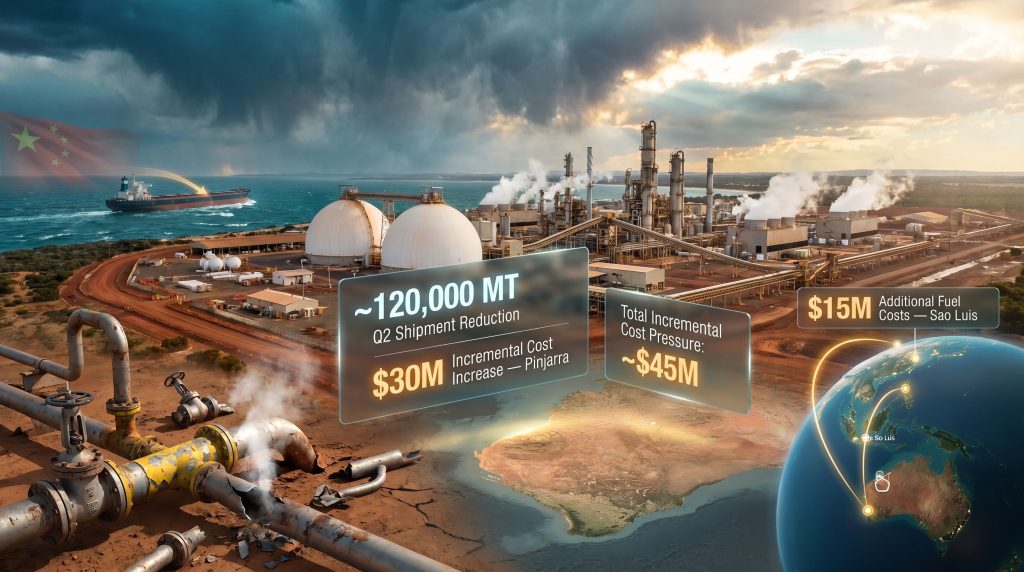
The financial impact of Alcoa Australian alumina shipments after cyclone damage to LNG infrastructure was disclosed by Alcoa's Chief Financial Officer at the Wells Fargo Industrials and Materials Conference in Chicago on June 11, 2026. The numbers, reported by Engineering News, present a clear picture of how energy infrastructure disruption translates into operational cost:
| Impact Category | Estimated Magnitude |
|---|---|
| Q2 shipment reduction from Pinjarra vs. Q1 | ~120,000 metric tons |
| Incremental Q2 production cost increase at Pinjarra | $30 million |
| Additional fuel cost exposure at Sao Luis, Brazil | $15 million |
| Total incremental unplanned cost pressure | ~$45 million |
The Pinjarra facility operates at a nameplate capacity of 4.7 million metric tons of alumina per year, making it one of the largest single alumina processing assets globally. A 120,000 metric ton reduction in a single quarter represents roughly 10% of quarterly capacity, a meaningful disruption that extends well beyond the immediate storm event.
The $30 million cost increase at Pinjarra does not reflect physical reconstruction expenditure. It represents the premium cost of sourcing alternative energy and the operational inefficiency of running a partially recovered process system. This distinction matters significantly when modelling how long the financial impact will persist beyond the quarter in which it was reported.
Consequently, Alcoa's shares fell 9.5% on the day of this disclosure, closing at $65.55, as the market processed both the cyclone impact and the broader admission that the alumina segment as a whole was operating below the line of profitability. The broader impact of such commodity price swings on mining company performance is well documented across the sector.
A Compounding Problem: Low Prices, Poor Bauxite, and Now a Cyclone
The Cyclone Narelle disruption landed on top of an alumina segment already under severe margin pressure from two independent structural forces.
The Bauxite Quality Deterioration Challenge
The Darling Range deposits supplying Pinjarra and other Western Australian refineries represent lateritic bauxite resources that have been mined intensively for decades. Average ore grades in the region have declined from approximately 45% alumina content in the 1980s to around 35% in recent years, according to assessments from the Commonwealth Scientific and Industrial Research Organisation. This grade decline is not a short-term fluctuation but a geological trend reflecting the progressive extraction of higher-quality ore zones.
The practical consequence of lower ore grades is that more raw material must be processed, more caustic soda consumed, more thermal energy applied, and more residue managed per tonne of alumina produced. Industry estimates suggest that the per-tonne processing cost penalty from this grade decline has added approximately 15 to 20% to operational costs over the past two decades at affected refineries. For broader context on bauxite importance and production, the grade decline issue is increasingly recognised as a global concern across major producing nations.
This is a cost headwind that exists entirely independently of weather events, energy prices, or alumina market conditions. Even if LNG supply were perfectly stable and cyclones never made landfall, the underlying economics of processing declining-grade bauxite continue to erode the competitiveness of specific Western Australian assets.
The Alumina Price Environment
Beyond ore quality, globally depressed alumina prices have compressed refinery margins across the entire portfolio. Alumina spot pricing follows aluminum smelter economics closely, and with smelters facing their own cost pressures from energy prices and geopolitical disruption, downstream demand for contracted alumina at premium prices has weakened.
The combination of structurally higher production costs from ore quality decline and structurally lower realisable prices from market conditions has placed the Western Australian portfolio in a challenging position that predates Cyclone Narelle. Alcoa's CFO described the Western Australian refineries as being in a genuinely difficult position due to the intersection of low alumina prices and poor-quality bauxite, with the segment as a whole positioned to record a loss for the quarter.
Brazil's Sao Luis Refinery: A Geopolitically Driven Cost Event
While Cyclone Narelle dominated the Australian narrative, Alcoa's Sao Luis refinery in Brazil faces a separate but simultaneous cost pressure. The $15 million in additional fuel costs at Sao Luis during Q2 2026 is attributed to energy market volatility connected to ongoing Middle East conflict.
This is a meaningfully different type of cost event:
- Source of disruption: Geopolitical rather than meteorological.
- Nature of impact: Fuel cost inflation rather than throughput reduction.
- Operational status: Sao Luis remains profitable despite the additional cost burden.
- Duration profile: Geopolitical fuel price volatility can persist over extended periods depending on conflict resolution trajectories.
The contrast between Sao Luis and the Western Australian portfolio is instructive. A refinery operating with better ore quality and lower base costs can absorb a $15 million fuel cost shock and remain in positive territory. A refinery already under margin pressure from declining ore grades and low alumina prices has far less capacity to absorb additional cost events without moving into loss-making territory.
When a single quarterly reporting period generates $45 million in unplanned costs across two continents, driven by two entirely unrelated macro events, it illustrates how globally integrated commodity producers face simultaneous, geographically dispersed risk exposures that are difficult to hedge through conventional financial instruments.
Global Supply Chain Rerouting: China as the Marginal Demand Absorber
Beyond the direct cost impacts, Cyclone Narelle's effects intersect with a separate supply chain dynamic involving Middle Eastern aluminum smelters. War-driven production constraints have reduced the capacity of Middle Eastern smelters to absorb their contracted alumina volumes, creating a situation where contracted cargoes require alternative destinations.
Alcoa has been facilitating the redirection of these contracted alumina cargoes primarily toward Chinese buyers, a dynamic that carries several important market implications:
- China's role as marginal demand absorber: The redirection of unplaceable alumina volumes to Chinese buyers reinforces China's structural position as the world's largest and most flexible alumina consuming market.
- Spot price dynamics: Additional alumina entering the Chinese market adds to near-term supply availability, which can create downward pressure on spot prices in an already-weak pricing environment.
- Contract flexibility: The ability to redirect contracted cargoes reflects provisions built into major alumina supply agreements, but it also signals that supply chains are absorbing stress in real time.
- Feedback loop risk: Downward spot price pressure from redirected cargoes would further compress the margins of Western Australian refineries already operating below profitability thresholds.
In addition, China's steel and iron ore market challenges offer a parallel lens through which to understand how Chinese industrial demand shapes global commodity trade flows. This rerouting dynamic demonstrates that the impacts of geopolitical disruption in consuming regions can reshape global alumina trade flows within a single quarter, with measurable consequences for producers operating under thin margins on the supply side.
The next major ASX story will hit our subscribers first
Western Australia's Geographic Concentration Risk
The Western Australian alumina refinery corridor represents an unusually high concentration of global alumina export capacity in a region with documented and recurring cyclone exposure. The Australian Bureau of Meteorology records indicate that the state's resource-producing coastal zones have experienced multiple significant cyclone events over the past decade, and the Department of Fire and Emergency Services classifies the Darling Range and adjacent coastal infrastructure as sitting within moderate to high cyclone risk zones during the November to April season.
Consider the scenario comparison for downstream aluminum markets:
| Disruption Scenario | Alumina Supply Impact | Downstream Aluminum Effect |
|---|---|---|
| Single refinery LNG disruption, one quarter | Moderate, ~120,000t reduction | Limited spot price response |
| Multi-refinery cyclone event, extended duration | Significant, potentially 500,000t+ reduction | Meaningful cost-push pressure on smelters |
| Concurrent geopolitical fuel cost shock | Margin compression without volume loss | Indirect, via producer financial stress and investment decisions |
The systemic implication is that investors and downstream aluminum producers should treat Western Australian refinery disruption as a recurring seasonal variable requiring explicit risk modelling, rather than treating each individual cyclone event as an isolated occurrence.
What Investors and Downstream Buyers Should Understand
The combination of factors exposed by Cyclone Narelle's impact on Alcoa's Australian alumina operations points toward several investment and procurement considerations worth examining carefully.
The Hidden Cost of Continuous Process Industries
Industries built around continuous chemical processes carry a category of operational risk that discrete manufacturing does not. The cost of an energy interruption is not simply the lost production volume; it includes the premium cost of alternative energy sourcing, the inefficiency cost of partial operation, the chemical and mechanical costs of process recovery, and the reputational and contractual costs of delivery shortfalls.
At $30 million for a single quarter at one refinery, these costs are material relative to the marginal profitability of an alumina segment already under pressure. Business News Australia's coverage of Alcoa's disruptions similarly highlights how production interruptions at a single site can generate outsized financial consequences across an integrated operation.
The Bauxite Grade Decline as a Long-Horizon Risk
Declining bauxite ore quality at Western Australian operations is a geological trend that will not reverse without significant capital investment in either deposit development or processing technology upgrades. Investors evaluating alumina-exposed equities should model this as a structural cost escalator embedded in the long-term cost curve of specific assets, distinct from and additive to cyclical commodity price risks. Furthermore, understanding top aluminium mining companies and how they are navigating ore quality challenges can provide useful comparative context.
Geographic Diversification as a Partial Hedge
The performance differential between Alcoa's profitable Sao Luis operation and its challenged Western Australian portfolio during Q2 2026 illustrates the value of geographic diversification in reducing the concentration of weather and geopolitical risk within a single producing region. However, as the simultaneous stress events in two geographies demonstrate, diversification reduces but does not eliminate the risk of simultaneous unplanned cost events.
This article provides analysis and commentary based on publicly reported information and should not be construed as financial or investment advice. Forward-looking assessments involve uncertainty, and actual outcomes may differ materially from scenarios described.
Frequently Asked Questions: Alcoa Australian Alumina Shipments After Cyclone
How much did Cyclone Narelle reduce Alcoa's Australian alumina shipments?
Alcoa projected a reduction of approximately 120,000 metric tons in Q2 2026 shipments from its Pinjarra refinery compared to Q1, directly attributable to LNG supply disruption caused by Cyclone Narelle.
What is the production capacity of Alcoa's Pinjarra refinery?
The Pinjarra facility operates at a nameplate capacity of 4.7 million metric tons of alumina per year, placing it among the largest single alumina processing facilities globally.
How much did the cyclone increase Alcoa's production costs?
Cyclone Narelle increased Q2 production costs at Pinjarra by approximately $30 million, primarily through the cost premium of alternative energy sourcing following LNG supply disruption and the operational inefficiency of running a partially recovered process system.
Why did Alcoa's share price fall after the cyclone disclosure?
Alcoa shares declined 9.5% to $65.55 on June 11, 2026, the day the financial impacts were disclosed at the Wells Fargo Industrials and Materials Conference. The market response reflected both the direct cost impacts and management's broader characterisation of the alumina segment as operating under significant financial pressure.
Why is Australian alumina being redirected to China?
Middle Eastern aluminum smelters facing war-driven production constraints have been unable to absorb their contracted alumina volumes. Alcoa has consequently facilitated the redirection of these cargoes, with China absorbing the majority due to its structural role as the world's largest marginal alumina consumer.
What are the long-term structural risks for Western Australian alumina refineries?
Beyond cyclone exposure, these assets face declining bauxite ore grades, which structurally increase processing costs over time, combined with a persistently challenging alumina price environment. These forces compress operating margins independently of weather events and represent ongoing headwinds that require careful monitoring by investors and downstream buyers alike.
Want To Stay Ahead of Major ASX Mineral Discoveries Before the Market Moves?
Discovery Alert's proprietary Discovery IQ model delivers real-time alerts on significant ASX mineral discoveries, transforming complex commodity data into actionable investment insights for traders and long-term investors alike — explore historic discovery returns to understand what early positioning can mean for a portfolio, and begin a 14-day free trial today to secure a market-leading advantage.