June 11, 2026
The Hidden Fragility Built Into Global Energy Infrastructure
Most commodity markets can absorb supply shocks through a combination of inventory drawdowns, production flexibility, and alternative sourcing. Crude oil is no exception, but with one critical caveat: the entire architecture of that resilience assumes that Persian Gulf barrels continue flowing freely through a narrow strip of water between Oman and Iran. When that assumption breaks down, the rules of normal market adjustment no longer apply. Understanding why requires examining not just the geography of the Strait of Hormuz, but the specific mechanics through which Strait of Hormuz disruption oil prices can remain elevated long after the headline crisis has passed.
When big ASX news breaks, our subscribers know first
What Makes the Strait of Hormuz So Irreplaceable to Global Oil Markets?
The Scale of Dependency: How Much Oil Actually Flows Through Hormuz?
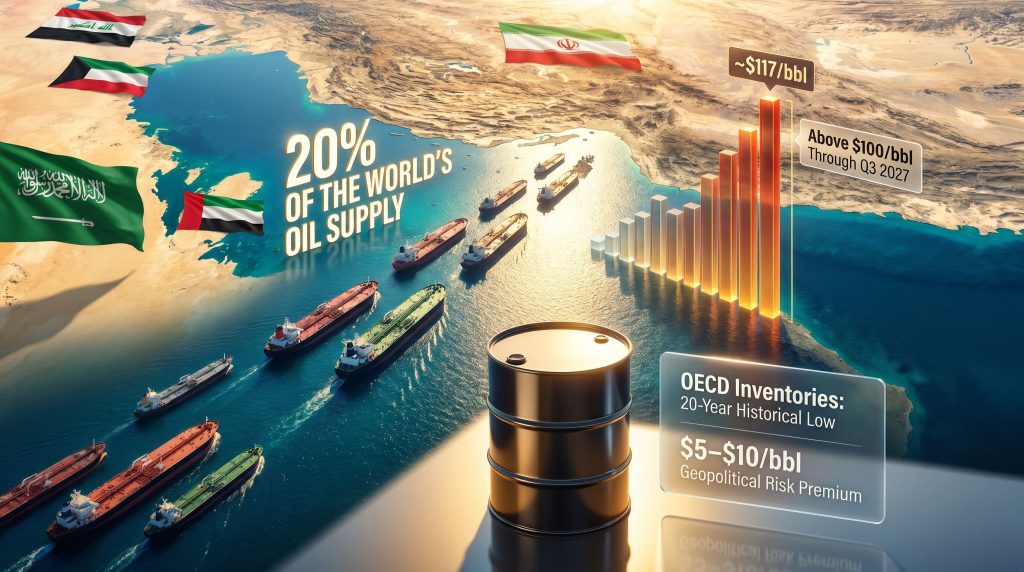
The numbers alone tell a sobering story. Approximately 20% of the world's total oil supply transits the Strait of Hormuz daily, placing it in a category of strategic importance that no other maritime corridor can match. Under normal operating conditions, this equates to roughly 17 to 21 million barrels per day of crude oil and petroleum products moving through a waterway that, at its narrowest navigable point, spans only 33 kilometres.
The producing nations feeding into this corridor represent the core of global oil supply:
- Saudi Arabia, the world's largest single crude exporter, relies almost entirely on Hormuz for seaborne shipments
- Iraq, the second-largest OPEC producer, has no viable alternative export route for the majority of its output
- Iran, Kuwait, and the UAE each depend on unobstructed Strait access to monetise their reserves
- Qatar, the world's dominant LNG exporter, moves virtually all of its liquefied natural gas exports through the same corridor
This concentration of export dependency within a single chokepoint creates what risk analysts describe as a single point of failure in the global energy supply chain, with no engineering solution currently capable of fully mitigating it.
Why Alternative Routes Cannot Fully Compensate
The instinctive assumption that pipelines and alternative sea routes can simply absorb Hormuz volumes in a disruption scenario does not survive quantitative scrutiny. The following table illustrates the gap between available bypass capacity and actual Strait throughput:
| Alternative Route | Maximum Capacity (Approx.) | Key Limitations |
|---|---|---|
| Saudi Arabia's Abqaiq–Yanbu Pipeline | ~5 Mbbl/d | Crude only; no petroleum product capacity |
| UAE's Abu Dhabi Crude Oil Pipeline | ~1.5 Mbbl/d | Partial offset only; specific crude grades |
| Suez Canal / SUMED Pipeline | Indirect routing | Adds significant transit time and shipping cost |
Even if every available bypass pipeline operated simultaneously at maximum rated capacity, the combined throughput would offset only a fraction of normal Hormuz daily volumes. The arithmetic of alternative routing simply does not close the gap created by a full or partial Strait closure.
How Does a Strait of Hormuz Disruption Actually Affect Oil Prices?
The Mechanics of a Supply Shock: From Chokepoint to Commodity Market
The transmission pathway from physical Hormuz disruption to crude oil price response is not a single event but a cascading sequence that unfolds across distinct timeframes. Understanding this sequencing helps explain why price effects tend to compound rather than stabilise in the early weeks of a disruption.
The process typically follows three successive phases:
- Immediate futures market repricing — Within hours of a credible disruption signal, crude oil futures contracts begin incorporating a risk premium as traders adjust probability-weighted supply expectations
- Physical spot market tightening — Over subsequent days, declining tanker arrivals at Asian and European refinery hubs create tangible product shortages, pushing spot crude differentials higher
- Inventory drawdown acceleration — As import volumes fall below consumption rates, global petroleum stockpiles begin declining faster than any production increase or reserve release can offset, compounding the deficit
Furthermore, the geopolitical oil price drivers at play in the Persian Gulf region amplify each of these phases, making the price transmission sequence more severe than purely logistical models would suggest.
What the Data Shows: Price Response in the Current Disruption
The most recent disruption event produced price dynamics that exceeded most pre-crisis modelling scenarios. Key observations from market data include:
- Global oil supply was reduced by an estimated 10.1 million barrels per day at peak disruption impact
- Brent crude surged approximately 65% within a single month following the onset of restricted Strait flows
- Even after a ceasefire announcement, Brent remained anchored near $100 per barrel, with tanker traffic through the Strait still operating below pre-disruption norms
- Market participants demonstrated that diplomatic progress alone does not unlock the inventory rebuild process, keeping upward price pressure intact
According to reporting from CNBC, experts modelling various closure scenarios consistently found that even partial disruptions produced outsized price effects relative to the volume of supply actually removed.
Key Insight for Investors: The gap between physical flow recovery and inventory recovery is the critical variable that most retail investors underestimate. A resumption of tanker transits does not equal a resumption of normal pricing conditions.
What Does the Forward Price Outlook Look Like After a Major Hormuz Disruption?
Inventory Deficits as the Dominant Pricing Driver Through 2027
Analysis from Enverus Intelligence Research, published in World Oil on June 11, 2026, provides the most detailed quantitative framework currently available for understanding how the current disruption will shape oil prices over the medium term. The central finding is striking: the inventory deficit created by the disruption can outlast the disruption itself, fundamentally extending the period during which elevated prices are justified by market fundamentals rather than speculation.
The specific projections are as follows:
- OECD crude and product inventories are forecast to decline from approximately 2.82 billion barrels at end-2025 to roughly 2.36 billion barrels by Q4 2026
- This projected level represents a 20-year historical inventory low, a threshold that has consistently correlated with materially stronger crude prices in prior cycles
- Each additional month of restricted Strait flows could add an estimated $10 to $15 per barrel to average Brent prices during the second half of the year
The research makes clear that market participants may be systematically underestimating the duration of elevated prices by anchoring their expectations to the timeline of diplomatic progress rather than the timeline of inventory recovery. Consequently, the current crude oil outlook points to a structurally tighter market than many forecasters had anticipated entering 2026.
Brent Crude Price Trajectory: A Scenario-Based Framework
| Time Period | Base-Case Brent Forecast | Key Assumptions |
|---|---|---|
| H2 2026 Average | ~$110/bbl | Partial flow restoration; persistent inventory deficit |
| Q4 2026 Peak | ~$117/bbl | Inventory bottoming; seasonal demand uplift |
| Through Q3 2027 | Above $100/bbl | Slow stock rebuild; embedded geopolitical premium |
| World Bank Scenario Range (2026) | $95–$115/bbl | Dependent on pace of supply normalisation |
The Stock Hole Concept: Why Inventory Recovery Lags Physical Flow Recovery
The term stock hole describes the cumulative volume of barrels that were never produced, shipped, or stored during a disruption period. This concept is central to understanding why elevated pricing persists well beyond a ceasefire or flow resumption announcement. Unlike physical infrastructure, which can resume operations within days or weeks, a supply stock hole requires sustained periods of above-trend production and below-trend demand to fill, a combination that rarely occurs simultaneously in the real world.
Several structural factors slow the inventory rebuild process:
- OPEC's market influence and spare capacity limitations that constrain the pace of compensatory production increases
- Refinery throughput scheduling that lags crude availability by weeks due to operational planning cycles
- Strategic petroleum reserve replenishment demands from importing nations that deployed reserves during the crisis
- Resilient Asian demand that limits the contribution of consumption softness to inventory rebuilding
- Shipping and logistics bottlenecks that persist even after the Strait formally reopens to normal traffic
Is a Permanent Geopolitical Risk Premium Now Embedded in Oil Prices?
Understanding the Structural Shift in Market Risk Pricing
Beyond the inventory dynamics that dominate medium-term price forecasting, a Hormuz disruption of significant scale introduces a structural repricing of geopolitical risk that does not simply evaporate when tanker transits normalise. Enverus Intelligence Research's analysis specifically highlights this dimension, estimating that a $5 to $10 per barrel geopolitical risk premium is likely to remain embedded in Brent crude pricing even after physical flows fully recover.
This durable premium reflects four interlocking market forces:
- Heightened probability weighting by futures traders, who now assign greater likelihood to future Strait closure scenarios than they did prior to the current event
- Insurance and freight cost escalation for tanker operators routing through or near the Persian Gulf, costs that are ultimately passed through to crude price benchmarks
- Precautionary inventory buffer demand from oil-importing nations that experienced the consequences of thin stockpile cushions and now actively seek to maintain larger strategic reserves
- Diplomatic uncertainty overhang that persists even after formal agreements, given the historical pattern of Gulf tensions cycling through periods of relative stability and acute crisis
Historical Precedents for Durable Geopolitical Premiums
The historical record provides strong empirical support for the thesis that major Hormuz disruptions produce lasting, not temporary, shifts in market risk pricing:
- The 1973 Arab Oil Embargo permanently reshaped how Western nations approached strategic petroleum reserves, with the IEA's 90-day reserve requirement emerging directly from that experience
- The 1980 to 1988 Iran-Iraq Tanker War embedded a multi-year risk premium into Persian Gulf crude differentials that outlasted the conflict itself by several years
- The 2019 Abqaiq attack on Saudi Arabian processing infrastructure demonstrated that even a single infrastructure event, quickly restored, could sustain a market premium for an extended period as traders repriced the vulnerability of Gulf energy infrastructure
- Each of these events created structural memory in market pricing frameworks, permanently increasing the risk premium assigned to Persian Gulf supply
What Are the Broader Economic Consequences of Sustained High Oil Prices?
Inflationary Transmission: From Energy Markets to the Broader Economy
A Strait of Hormuz disruption that sustains oil prices above $100 per barrel does not confine its economic consequences to the energy sector. The inflationary transmission pathway moves systematically through the broader economy following a predictable sequence:
- Direct fuel and energy costs rise across transportation, manufacturing, agriculture, and petrochemical production
- Freight and logistics costs escalate, raising input costs at every stage of global supply chains
- Consumer price inflation increases as energy-intensive goods and services become more expensive at the retail level
- Central bank policy responses become constrained, as supply-side inflation is structurally resistant to conventional monetary tightening without triggering demand destruction
However, the consequences extend beyond inflation alone. The oil price trade war impact dynamic adds a further layer of complexity, as nations reliant on energy imports may face simultaneous pressure from elevated crude costs and deteriorating trade conditions.
Investor Warning: Sustained Brent crude prices above $100 per barrel have historically compressed corporate profit margins across energy-intensive industries including airlines, shipping, petrochemicals, and consumer staples. The second-order equity market risks extend well beyond pure energy sector exposure and can affect diversified portfolios significantly.
Who Bears the Greatest Economic Exposure?
The distributional consequences of sustained oil price elevation vary considerably by economy type and structural vulnerability:
| Economy Type | Primary Vulnerability | Mitigation Capacity |
|---|---|---|
| Oil-importing emerging markets | Currency depreciation combined with fuel subsidy fiscal strain | Low, due to limited foreign exchange reserves |
| European energy importers | Industrial cost escalation and trade balance deterioration | Moderate, with SPR access and LNG diversification options |
| Asian manufacturing exporters | Input cost inflation and freight cost increases on export goods | Moderate, given some domestic refining capacity |
| Oil-exporting nations including Gulf states | Revenue windfall partially offset by regional geopolitical risk | High, as direct price beneficiaries |
In addition, the LNG supply outlook adds another dimension to this vulnerability matrix, given that Qatar's LNG exports transit the same Hormuz corridor as crude oil, potentially compounding energy shortfalls for import-dependent nations.
The next major ASX story will hit our subscribers first
How Should Investors and Energy Analysts Interpret the Hormuz Risk Framework?
Three Analytical Lenses for Assessing Market Exposure
Effective investment decision-making in a post-disruption oil market requires applying multiple analytical frameworks rather than relying on a single forecast. The three most important lenses are:
1. Duration Risk Assessment
The expected duration of restricted flows is the single most consequential variable in any Hormuz disruption analysis. Price sensitivity modelling reveals dramatically different outcomes depending on disruption length:
- A one-month disruption produces a significant but largely recoverable supply shock that markets can absorb through reserve releases and demand adjustment
- A three-month disruption begins creating structural inventory deficits that persist well beyond the physical event, triggering the stock hole dynamic described above
- A six-month or longer disruption fundamentally resets the global oil supply-demand balance for multiple years, creating a new pricing regime that remains elevated even after flows fully normalise
2. Inventory Level Benchmarking
OECD total petroleum inventory levels function as the most reliable leading indicator of price direction in the post-disruption environment:
- Inventories above the five-year average indicate likely price pressure relief
- Inventories at the five-year average suggest a neutral pricing environment
- Inventories 20% or more below the five-year average have historically been associated with Brent prices consistently exceeding $100 per barrel, precisely the scenario projected for late 2026
3. Geopolitical Premium Decay Rate
Risk premiums embedded after major disruptions do not dissipate linearly. Based on historical precedent, they tend to follow a non-linear decay path:
- Remain elevated for three to six months following formal resolution
- Partially persist for 12 to 18 months as market memory sustains precautionary positioning
- Fully normalise only when inventories return to comfortable levels and diplomatic stability is demonstrated over multiple consecutive quarters, a combination that rarely arrives quickly
Furthermore, ING's revised oil forecasts following the current disruption reflect precisely this non-linear dynamic, with analysts pushing back their price normalisation timelines in response to slower-than-expected inventory recovery.
FAQ: Strait of Hormuz Disruption and Oil Price Impact
How much oil passes through the Strait of Hormuz each day?
Approximately 20% of global oil supply, equivalent to roughly 17 to 21 million barrels per day under normal conditions, transits the Strait of Hormuz, making it the world's single most important energy chokepoint.
How quickly do oil prices respond to a Hormuz disruption?
Futures markets typically begin repricing within hours of a credible disruption signal. Physical spot markets follow within days as tanker arrivals decline at key refining hubs across Asia and Europe.
Can OPEC+ compensate for lost Hormuz supply?
OPEC+ spare capacity can partially offset disruptions, but the pace and scale of compensation is limited. A loss of 10 or more million barrels per day cannot be fully replaced by any combination of spare capacity activation and strategic reserve releases within a short timeframe.
Why do oil prices stay elevated even after a disruption ends?
Prices remain elevated because the physical inventory deficit created during the disruption takes considerably longer to rebuild than it takes to restore shipping flows. A durable geopolitical risk premium also typically becomes structurally embedded in market pricing following major events.
What is a geopolitical risk premium in oil markets?
A geopolitical risk premium is the additional price per barrel that markets price above fundamental supply and demand value to account for the possibility of future supply disruptions. Following a major Hormuz event, this premium is currently estimated at $5 to $10 per barrel by Enverus Intelligence Research.
What Brent crude price level is associated with 20-year inventory lows?
Historical data consistently shows that when OECD inventories approach 20-year lows, Brent crude trades above $100 per barrel, as the market lacks sufficient buffer capacity to absorb additional supply shocks without significant price response.
Key Takeaways: What the Hormuz Disruption Tells Us About Oil Market Fragility
The analytical picture that emerges from examining the current disruption's market impact is one of compounding vulnerabilities rather than isolated shocks. Several structural conclusions stand out:
- The Strait of Hormuz remains fundamentally irreplaceable as a global energy transit corridor, with no combination of alternative routes capable of absorbing its full throughput volume
- Strait of Hormuz disruption oil prices operate across immediate, medium-term, and structural timeframes simultaneously, not as a single event with a single resolution
- The inventory stock hole created by a major disruption is the most persistent pricing factor, outlasting the physical event by quarters to years
- A $5 to $10 per barrel geopolitical premium is projected to remain structurally embedded in Brent pricing following the current disruption, according to Enverus Intelligence Research analysis published in World Oil
- Current market modelling projects Brent crude remaining above $100 per barrel through at least Q3 2027 under base-case assumptions, driven primarily by the projected inventory deficit rather than ongoing physical supply constraints
- Investors and policymakers should treat Hormuz disruption scenarios not as rare tail risks but as recurring structural features of the global energy risk landscape, requiring permanent adjustments to portfolio construction, reserve management, and energy security planning
Disclaimer: This article contains forward-looking projections and scenario-based analysis sourced from publicly available market research. Commodity price forecasts involve significant uncertainty and should not be construed as investment advice. Past price behaviour during disruption events does not guarantee equivalent outcomes in future scenarios. Readers should consult qualified financial advisers before making investment decisions based on energy market analysis.
Want to Stay Ahead of the Next Major Resource Discovery While Energy Markets Shift?
While sustained oil price disruptions reshape global commodity markets, significant mineral discoveries on the ASX continue to create transformative investment opportunities — and Discovery Alert's proprietary Discovery IQ model delivers real-time alerts the moment they are announced, turning complex data across 30-plus commodities into clear, actionable insights. Explore historic discovery returns on Discovery Alert's dedicated discoveries page and begin your 14-day free trial to position yourself ahead of the broader market.