June 11, 2026
The Hidden Fragility Inside Battery Metal Supply Chains
Most investors tracking the energy transition focus on demand forecasts, EV adoption curves, and gigafactory announcements. Far fewer scrutinise the physical geography of where battery metals actually come from, or how a single weather event on a remote island can ripple through global supply chains within weeks. The story of how Ambatovy resumes nickel production after cyclone damage is precisely that kind of event, one that exposes structural vulnerabilities embedded in the battery metals industry that rarely surface in mainstream commodity analysis.
Understanding why this matters requires stepping back from the headlines and examining the technical, geological, and financial architecture that makes laterite nickel operations like Ambatovy simultaneously irreplaceable and inherently fragile.
When big ASX news breaks, our subscribers know first
Why Laterite Nickel Is Structurally Different From Sulphide Nickel
The global nickel industry is broadly divided into two ore types: sulphide deposits and laterite deposits. This distinction is not merely geological — it is commercially and strategically decisive.
Sulphide nickel, found in hard rock formations typically in Canada, Russia, and Australia, can be processed through conventional smelting and refining into Class 1 nickel metal or nickel sulphate. Laterite nickel, by contrast, forms through the deep weathering of ultramafic rocks in tropical environments. Madagascar, Indonesia, the Philippines, New Caledonia, and Cuba are the dominant laterite nickel jurisdictions globally.
Processing laterite ore is significantly more energy and capital intensive. The dominant technology used at Ambatovy is High Pressure Acid Leach (HPAL), a hydrometallurgical process where ore slurry is treated with concentrated sulphuric acid at temperatures exceeding 250 degrees Celsius and pressures above 40 atmospheres. This dissolves nickel and cobalt into solution, which is then processed through a series of precipitation and purification steps to yield finished briquettes.
The critical insight here is that HPAL plants are extraordinarily capital intensive to build, highly sensitive to operational disruption, and extremely difficult to restart quickly after unplanned shutdowns. Unlike a sulphide mine that might ramp up production relatively quickly after a weather event, an HPAL facility requires sequential recommissioning of interconnected chemical systems, with acid plants serving as the essential first gateway.
The acid plant is not merely a supporting unit in HPAL processing. It is the chemical backbone. Without sulphuric acid production restored to specification, the entire leach circuit cannot function, and no nickel or cobalt recovery is possible downstream.
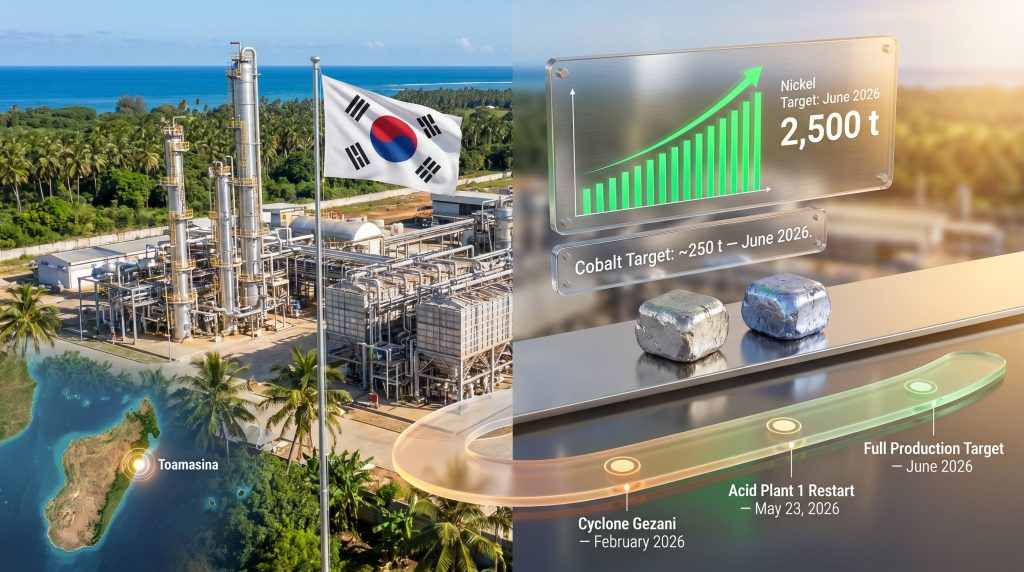
This explains why Ambatovy's restart timeline following Cyclone Gezani stretched to approximately 3.5 months, from the February 2026 impact to the May 23 recommissioning of the first acid plant.
Cyclone Gezani and the Scale of Operational Damage
Eastern Madagascar sits within the South Indian Ocean cyclone corridor, a region that generates some of the Southern Hemisphere's most intense tropical systems. The Toamasina province, where Ambatovy's processing plant is located, is geographically exposed to direct cyclone landfalls during the November-to-April season.
Cyclone Gezani struck in February 2026, inflicting material damage on the Toamasina hydrometallurgical processing facility. The damage triggered an immediate operational suspension, consistent with international best practice protocols that require full structural and environmental integrity assessments before any chemical processing recommences.
The estimated production loss across the outage period is significant when quantified against Ambatovy's 2025 operating rates:
| Metric | 2025 Annual Rate | Monthly Equivalent | Estimated Outage Loss (Feb to May 2026) |
|---|---|---|---|
| Nickel Production | ~29,000 tonnes/year | ~2,417 tonnes/month | ~8,458 tonnes |
| Cobalt Production | ~2,700 tonnes/year | ~225 tonnes/month | ~787 tonnes |
Note: These figures are estimates based on annualised 2025 production rates and are intended to illustrate potential market impact only, not confirmed reported losses.
For context, roughly 8,400 tonnes of nickel represents approximately 0.3% of annual global nickel mine supply, which sounds modest in isolation. However, the relevant market is not total nickel supply but rather battery-grade nickel supply in briquette format, where Ambatovy is one of a very small number of producers globally. In that narrower context, the disruption carries considerably more pricing weight.
The Six-Stage Restart: How HPAL Operations Recommission After Major Damage
The recommissioning of an HPAL operation after infrastructure damage is a methodical, sequenced process. Skipping or accelerating any stage risks catastrophic chemical incidents or environmental breaches. The restart sequence at Ambatovy followed this general framework:
-
Structural Safety Verification — All processing buildings, containment structures, and pressure vessels were assessed for cyclone-induced damage before any personnel re-entered operational zones.
-
Environmental Containment Inspection — Tailings storage facilities, effluent management systems, and acid containment infrastructure were inspected and certified before any chemical processes could be initiated.
-
Acid Plant Recommissioning — Sulphuric acid production capacity was restored first, as this feeds all downstream HPAL processing. The first acid plant came back online on May 23, 2026, with the second targeted for end of June 2026.
-
Slurry Circuit Restoration — Ore preparation, grinding, and high-pressure leach circuits were brought back online in a controlled ramp sequence, typically starting at reduced feed rates before reaching nameplate throughput.
-
Product Recovery and Refining — Nickel and cobalt separation circuits, including solvent extraction and electrowinning stages, were recommissioned to yield finished briquettes.
-
Product Quality Certification — Finished briquettes underwent specification testing before commercial shipment could resume, as battery-grade customers maintain strict purity requirements.
The June 2026 production targets reflect a near-full capacity restart rather than a cautious ramp:
| Product | June 2026 Target | 2025 Monthly Average | Variance |
|---|---|---|---|
| Nickel | 2,500 tonnes | ~2,417 tonnes | +3.4% above average |
| Cobalt | 250 tonnes | ~225 tonnes | +11.1% above average |
The cobalt target being notably above the historical monthly average suggests operational confidence in the recommissioned circuits, though investors should note that single-month targets can vary based on ore feed grade and circuit efficiency.
Ownership in Transition: Sumitomo's Exit and What It Signals
Concurrent with the cyclone rebuild, Ambatovy underwent a significant ownership restructure. Sumitomo completed the sale of its 54% stake to a group of investors in May 2026, a transaction that was notable for an unusual structural feature: Sumitomo reportedly provided financing to facilitate the sale itself.
This arrangement reflects the broader challenge of exiting a capital-intensive, long-duration laterite project in a period of mixed nickel price signals. The asset had strategic value, but finding buyers willing to fund the full acquisition price from their own balance sheets proved difficult enough that vendor financing became necessary to complete the transaction.
The joint funding of the post-cyclone rebuild by both KOMIR and Sumitomo prior to the ownership transfer illustrates a pragmatic cooperation between exiting and continuing shareholders to preserve asset value during a critical period.
Korea Mine Rehabilitation and Mineral Resources Corporation (KOMIR) remains the anchor shareholder following the transaction. KOMIR operates as South Korea's state vehicle for securing overseas mineral resource exposure, and its continued commitment to Ambatovy reflects the strategic calculus of an economy that is heavily dependent on imported battery materials for its domestic EV and electronics manufacturing base.
South Korea's retention of strategic nickel and cobalt exposure through KOMIR is not incidental. It reflects a deliberate national industrial policy to secure upstream battery material supply in the face of concentrated geographic risk in global nickel markets, particularly given Indonesia's dominance of new nickel supply capacity.
Sumitomo's exit, meanwhile, is consistent with a broader pattern of Japanese trading houses reassessing legacy commitments to high-capital, lower-margin laterite projects as returns failed to meet hurdle rates over a decade of operation. Furthermore, this shift highlights how the Indonesian nickel industry has reshaped competitive dynamics for legacy laterite producers globally.
Climate Risk: The Underpriced Variable in Battery Metal Supply Analysis
One of the least discussed dimensions of the Ambatovy restart story is what it implies for how physical climate risk should be priced into battery metal supply assessments.
Madagascar's cyclone season creates a recurring, multi-month window of operational vulnerability for Ambatovy every single year. The facility cannot simply be relocated, and hardening tropical-zone hydrometallurgical infrastructure against Category 4 or 5 cyclone impacts requires capital expenditure that may not be fully reflected in project economics built on historical weather assumptions.
The broader implications extend across the laterite nickel sector:
- New Caledonia's Goro operation has faced its own operational challenges tied in part to geographic and political exposure.
- Philippine laterite operations face typhoon risk on a similarly recurring seasonal basis.
- Indonesian HPAL projects, while sheltered from the worst cyclone corridors, face flood and seismic risks in some locations.
Insurance markets and project lenders are increasingly incorporating climate physical risk into asset valuations and financing terms, a trend that will structurally raise the cost of capital for tropical laterite projects relative to higher-latitude sulphide operations. This is a dynamic that is not yet widely reflected in public market valuations of nickel-exposed equities. Consequently, understanding the properties and uses of nickel in the context of climate exposure becomes increasingly relevant for investors.
The next major ASX story will hit our subscribers first
Comparing Ambatovy Against the Global HPAL Landscape
Ambatovy operates in a small peer group of large-scale HPAL laterite nickel-cobalt producers. The comparison below contextualises its scale and output format:
| Operation | Location | Primary Output | Annual Nickel Capacity (approx.) | Ownership |
|---|---|---|---|---|
| Ambatovy | Madagascar | Nickel/Cobalt Briquettes | ~29,000 t/year | KOMIR + New Investor Group |
| Goro (Prony Resources) | New Caledonia | Nickel/Cobalt | ~40,000 t/year | Various |
| Moa (Sherritt) | Cuba | Mixed Sulphides | ~33,000 t/year | Sherritt International |
| Ravensthorpe | Australia | Mixed Hydroxide | ~40,000 t/year | First Quantum |
Capacity figures are approximate and sourced from publicly available industry data for comparative purposes only.
A critical technical distinction is that Ambatovy produces nickel and cobalt briquettes, a higher-purity finished product format compared to the Mixed Hydroxide Precipitate (MHP) or Mixed Sulphide Precipitate (MSP) produced by many newer HPAL operations in Indonesia. Briquettes require less further processing by downstream battery material manufacturers, which creates a modest quality premium in certain market conditions. In addition, the cobalt mining sector faces its own structural pressures that make Ambatovy's dual-metal output particularly strategically significant.
Near-Term Market Implications of the Restart
The return of approximately 2,500 tonnes of nickel per month and 250 tonnes of cobalt per month to global supply from June 2026 represents the removal of a meaningful supply disruption. Markets had been tracking the outage since February, and some degree of the supply shortfall will have been partially priced into spot and forward nickel and cobalt assessments during the intervening months.
The restart dynamic creates an interesting asymmetry for market participants:
- Traders who positioned for supply tightness during the outage may rotate out of length as supply resumes, creating near-term price softness.
- Longer-duration investors focused on battery raw materials will likely view the restart as neutral to slightly positive, as it restores a reliable non-Indonesian nickel source to the market.
- The cobalt dimension is particularly worth watching. Cobalt markets have faced persistent pricing pressure from DRC supply volumes, and any restoration of demand-side confidence from battery chemistry trends favouring higher-cobalt NMC formulations could amplify the market impact of Ambatovy's return.
Ambatovy's recommissioning confirms the operation's resilience despite a prolonged outage, though the broader market implications will take several months to fully materialise.
This analysis reflects publicly available market dynamics and does not constitute financial or investment advice. Commodity markets are subject to rapid change, and past supply disruption patterns are not reliable indicators of future price movements.
Frequently Asked Questions
What caused Ambatovy to halt nickel and cobalt production?
Cyclone Gezani struck eastern Madagascar in February 2026, causing material infrastructure damage to the Toamasina hydrometallurgical processing facility, forcing a complete operational suspension.
When did Ambatovy begin its restart sequence?
The first acid plant was recommissioned on May 23, 2026, approximately 3.5 months after the cyclone impact. The second acid plant is targeted for restart by the end of June 2026.
What production volumes is Ambatovy targeting for June 2026?
The operation is targeting 2,500 metric tonnes of nickel and approximately 250 tonnes of cobalt for June 2026, broadly consistent with historical monthly run-rates.
Who funded the cyclone rebuild?
Both KOMIR, the continuing anchor shareholder, and Sumitomo, the former 54% stakeholder, jointly funded the rebuild prior to the completion of Sumitomo's stake sale in May 2026.
Why does Ambatovy produce briquettes rather than mixed hydroxide precipitate?
Ambatovy's HPAL process and refining circuits are configured to produce finished nickel and cobalt briquettes, a higher-purity output format that is directly usable by battery material manufacturers without significant further refining, distinguishing it from newer Indonesian HPAL projects that predominantly produce MHP.
Is Ambatovy exposed to cyclone risk every year?
Yes. The Toamasina province sits within the South Indian Ocean cyclone corridor, and the November-to-April cyclone season creates a recurring annual window of elevated operational risk for the facility.
Want to Track the Next Major Battery Metals Discovery Before the Market Moves?
Discovery Alert's proprietary Discovery IQ model scans ASX announcements in real time, instantly identifying significant mineral discoveries across nickel, cobalt, and more than 30 other commodities — turning complex data into actionable opportunities for both short-term traders and long-term investors. Explore historic discoveries and their returns, then begin your 14-day free trial to position yourself ahead of the broader market.