June 11, 2026
Surface Drilling at a Crossroads: Why Electrification Can No Longer Wait
The construction and mining equipment sectors have spent decades incrementally improving diesel powertrains, squeezing marginal efficiency gains from engines already operating near the limits of combustion technology. Yet as urban air quality legislation tightens and zero-emission site mandates accelerate across Northern Europe, the incremental approach is giving way to something more fundamental. Surface drilling, long considered one of the final frontiers of equipment electrification, is entering a period of genuine technological transition. The launch of the Sandvik all-electric Commando drill rig, designated the DC310RiE, marks a pivotal moment in that transition, representing the Swedish engineering group's first fully commercialised all-electric top hammer surface drill rig and a direct response to regulatory and operational pressures reshaping the construction drilling landscape.
When big ASX news breaks, our subscribers know first
What Is the Sandvik Commando DC310RiE?
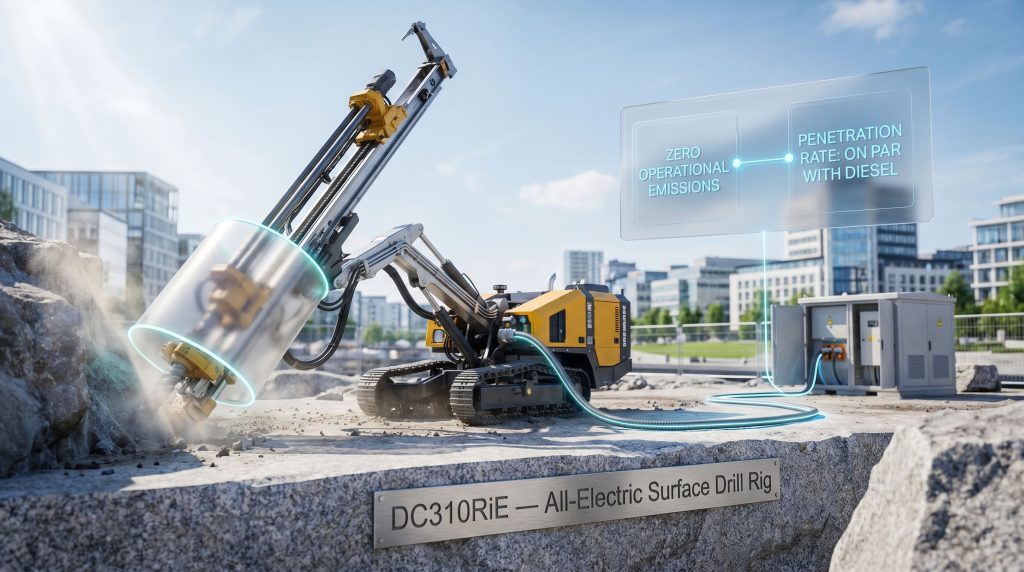
The DC310RiE is a rubber-tired, mobile surface top hammer drill rig that draws its primary power from a direct cable connection to site electrical infrastructure. This tethered architecture distinguishes it fundamentally from battery-only designs and from Sandvik's own underground electric platform, the DD422iE, which relies on onboard battery packs for primary propulsion and drilling power.
The design philosophy behind the DC310RiE reflects a pragmatic engineering decision: surface drilling cycles are predominantly stationary operations, with rigs spending the majority of their working hours positioned over a single drill point rather than in continuous motion. Cable-connected power delivery is therefore well-suited to the operational rhythm of surface construction drilling, where energy demand during active drilling is high and sustained, while tramming distances between drill points are comparatively short.
To address those repositioning requirements, Sandvik offers an optional battery tramming module that allows the rig to move between drill points without requiring cable disconnection and reconnection at each location. This hybrid approach, combining tethered power for drilling with battery flexibility for movement, reflects a design compromise optimised for real-world site conditions rather than theoretical zero-emission purity.
DC310RiE vs. Diesel Commando DC300Ri: A Direct Comparison
The DC310RiE's closest reference point within Sandvik's existing portfolio is the diesel-powered Commando DC300Ri, a proven surface top hammer platform powered by a CAT 3.6 engine producing 74.4 kW and certified to Tier 4 Final and Stage V emissions standards. The table below illustrates the key differences between the two platforms:
| Feature | DC310RiE (All-Electric) | DC300Ri (Diesel) |
|---|---|---|
| Primary Power Source | Cable electric connection | CAT 3.6, 74.4 kW diesel engine |
| Emissions Profile | Zero operational emissions | Tier 4 Final / Stage V diesel exhaust |
| Noise Output | Substantially reduced | Standard diesel noise levels |
| Acoustic Mitigation Option | NoiseShield add-on available | Not applicable |
| Drilling Performance | On par with diesel equivalent | Established industry benchmark |
| Tramming Flexibility | Optional battery tramming module | Self-propelled diesel drivetrain |
| Primary Target Market | Urban, emission-regulated, noise-sensitive sites | General surface construction drilling |
Both platforms share the Commando chassis lineage, preserving the mobile, rubber-tired configuration that has made the platform commercially successful across construction and civil engineering applications.
The Regulatory Pressure Driving Demand
Understanding why the DC310RiE exists requires understanding the regulatory environment that made its development commercially rational. Nordic countries, particularly Sweden, Finland, and Norway, have emerged as global leaders in transitioning urban construction activity toward zero-emission equipment. Furthermore, these markets are actively legislating diesel-powered construction machinery off sensitive urban sites, creating immediate commercial demand for compliant alternatives in segments that have historically resisted electrification.
Surface drill rigs present a particular challenge for this regulatory transition. Unlike excavators or wheel loaders, which benefit from larger battery markets and longer electrification development cycles, surface top hammer rigs operate at high instantaneous power loads during drilling, creating energy delivery challenges that favour tethered cable power over battery-only solutions at current battery technology maturity levels.
The construction sector is also under broader scrutiny for its contribution to urban particulate matter and nitrogen oxide concentrations. Diesel-powered construction equipment, including surface drill rigs, represents a measurable share of localised air quality degradation in urban environments, particularly in confined project areas such as tunnel portals, foundation excavations, and road-cutting operations in built-up zones. The DC310RiE eliminates tailpipe emissions entirely during drilling operations, offering contractors a compliance pathway for projects in emission-restricted zones without sacrificing drilling capability.
Consequently, the broader mining electrification transition is accelerating across both underground and surface applications, creating additional commercial momentum for products like the DC310RiE.
The shift toward zero-emission urban construction is not a future scenario, it is an active procurement reality in several Northern European markets, with contractors facing the prospect of losing contract eligibility on regulated sites if their equipment fleets cannot meet increasingly strict emission standards.
Field Trial Outcomes: Performance Without Compromise
One of the most commercially significant findings from Sandvik's field trials is that the DC310RiE achieves penetration rates equivalent to diesel-powered surface top hammer rigs of comparable class. This result directly addresses the primary technical objection that procurement teams and site managers raise when evaluating electric alternatives: the assumption that removing the diesel powertrain will result in reduced drilling performance.
Eva-Leena Varpe, Product Manager of Surface Drilling at Sandvik, confirmed through field trial results that the electric powertrain delivers performance consistent with operator expectations. She also noted that the electric drivetrain architecture allows operators to concentrate their attention on drilling precision rather than managing engine-related variables. This observation points to a less-discussed advantage of electric powertrains in drilling applications: the simplified control environment created by electric motors, which deliver consistent torque across a broader operating range than combustion engines and respond more predictably to operator inputs.
From a procurement perspective, performance parity removes the primary technical barrier to adoption. Contractors evaluating the DC310RiE against diesel alternatives no longer need to factor in a productivity penalty, meaning the decision framework shifts toward total cost of ownership, regulatory compliance value, and site infrastructure readiness.
Operational Considerations for Site Deployment
The cable-powered architecture introduces site planning requirements that differ from self-contained diesel units. Operators considering the DC310RiE should evaluate the following factors before deployment:
- Site power availability: Reliable grid connection or appropriately sized generator capacity is a prerequisite for cable-connected operation.
- Cable management: Active construction sites require careful cable routing to avoid conflicts with other equipment movements and material handling operations.
- Tramming frequency: Sites requiring frequent rig repositioning over longer distances may derive greater value from the optional battery tramming module.
- Power infrastructure capital cost: Initial investment in site electrification should be modelled against projected fuel cost savings and maintenance cost reductions over the asset's operational life.
Procurement Note: Unlike diesel rigs, which arrive as self-contained operational units, cable-connected electric rigs require site power infrastructure assessment as a pre-deployment planning step. This is a one-time consideration rather than an ongoing operational variable, but it represents a genuine difference in procurement and project planning workflows.
NoiseShield: Addressing the Acoustic Compliance Dimension
Beyond emissions, the DC310RiE introduces a second layer of urban compliance capability through its optional NoiseShield acoustic attenuation system. Noise restrictions have become an increasingly significant operational constraint on urban construction sites, with municipal ordinances in many European cities imposing strict limits on construction activity during evening and early morning hours, and in some cases establishing maximum decibel thresholds throughout the working day.
For surface drilling operations, noise compliance has direct commercial implications:
- Restricted operating windows reduce the number of productive drilling hours available per day, directly affecting project timelines and cost structures.
- Contracts for urban infrastructure work increasingly include noise performance requirements as a specification criteria, meaning quieter equipment expands the pool of projects a contractor can competitively bid.
- Electric drill rigs are inherently quieter than diesel equivalents by virtue of eliminating engine combustion noise, the dominant sound source in conventional surface drilling.
- The NoiseShield add-on provides an additional layer of acoustic management for sites operating under particularly stringent sound level requirements.
The combination of zero tailpipe emissions and reduced acoustic impact positions the DC310RiE as a purpose-built solution for the most demanding urban drilling environments, where both air quality and noise compliance are contractual obligations rather than optional considerations.
Total Cost of Ownership: Building the Financial Case
The business case for electric surface drill rigs extends beyond regulatory compliance. When evaluated across a full asset lifecycle, the financial comparison between cable-electric and diesel powertrains involves several distinct cost categories that procurement teams should model systematically. In addition, the mining decarbonisation benefits increasingly extend to surface drilling fleets as regulatory and commercial frameworks mature.
TCO Evaluation Framework for Procurement Teams:
- Energy cost per drilled metre (grid electricity vs. diesel fuel at current and projected prices)
- Projected maintenance savings from electric drivetrain simplicity over a five-year asset life
- Regulatory compliance cost avoidance, including emission zone access fees and potential penalty exposure
- Carbon credit revenue or ESG reporting value attributable to zero-emission equipment hours
- Site electrification capital expenditure modelled as a one-time offset against cumulative fuel savings
Electric powertrains carry inherent maintenance cost advantages over diesel engines. The reduced number of moving parts, elimination of engine oil and filter servicing requirements, and absence of exhaust aftertreatment systems — which are a significant maintenance cost centre on Tier 4 Final and Stage V diesel equipment — collectively reduce the total maintenance burden over the asset's operational life. These savings compound meaningfully when assessed over a five-year period on a high-utilisation surface drilling fleet.
The next major ASX story will hit our subscribers first
Geographic Markets and Adoption Readiness
The DC310RiE's commercial launch timing reflects the maturity of regulatory frameworks in specific geographic markets. Nordic countries represent the highest near-term adoption potential, given their active transition toward zero-emission construction site requirements. However, the broader addressable market extends across multiple regions at varying stages of regulatory and infrastructure readiness.
| Region | Primary Regulatory Driver | Adoption Readiness |
|---|---|---|
| Nordic Countries (Sweden, Finland, Norway) | Active zero-emission construction site transition | High |
| Western Europe (Germany, Netherlands, UK) | Urban clean air zones, diesel access restrictions | High |
| Canada | Provincial emissions frameworks, ESG procurement criteria | Medium to High |
| Australia | State-level emission reduction targets | Medium |
| United States | EPA Tier 4 Final compliance, state clean air programmes | Medium |
The Nordic market's advanced regulatory posture makes it a natural initial deployment focus, but the product's applicability extends to any jurisdiction where urban air quality legislation, noise ordinances, or green procurement specifications create demand for compliant surface drilling equipment.
Where the DC310RiE Sits Within Mining's Electrification Arc
The commercialisation of the Sandvik all-electric Commando drill rig reflects a broader pattern in mining and construction equipment electrification: underground applications have historically led the transition, with surface equipment following at a lag driven by the greater operational complexity of open-air environments.
Underground electrification advanced earlier partly because enclosed mine environments amplify the health impacts of diesel exhaust, creating strong regulatory and safety incentives for battery-electric solutions. Surface environments, while subject to fewer confined-space ventilation constraints, face increasing regulatory pressure through urban emission zones and carbon pricing mechanisms that are progressively extending to construction equipment. The adoption of electric mining equipment across both underground and surface platforms is, however, accelerating as energy delivery solutions mature.
The DC310RiE's cable-plus-optional-battery architecture reflects a technically informed response to where surface drilling currently sits on the electrification maturity curve. Full battery-electric surface drilling remains technically feasible but requires advances in energy density and charging infrastructure that make tethered cable power a more commercially pragmatic solution for high-power stationary drilling cycles at this stage of technology development. Furthermore, the broader mining energy transition is creating the infrastructure conditions that will support even more capable electric surface platforms in future product cycles.
The integration of renewable energy in mining operations is also improving the emissions credentials of cable-connected equipment, as the grid electricity powering rigs like the DC310RiE becomes progressively cleaner across many markets. Sandvik's broader surface drill rig portfolio provides additional context for how the DC310RiE fits within the company's long-term electrification roadmap.
Frequently Asked Questions
Is the DC310RiE fully battery powered?
No. The DC310RiE relies on a direct cable connection to site electrical infrastructure as its primary power source. Battery power is available as an optional add-on module specifically for tramming, allowing the rig to reposition between drill points without requiring cable reconnection at each location. The core drilling function operates on cable-delivered power.
Does the electric powertrain compromise drilling performance?
Field trials conducted by Sandvik confirm that penetration rates achieved by the DC310RiE are equivalent to those of diesel-powered surface top hammer rigs in the same performance class. No performance compromise was identified during testing, and Sandvik's product management team noted that the electric drivetrain simplifies the operator's control environment during drilling.
What is the NoiseShield system and who needs it?
NoiseShield is an optional acoustic management system available for the Sandvik all-electric Commando drill rig, designed for worksites operating under specific sound level requirements imposed by municipal regulations or contract specifications. It is particularly relevant for urban infrastructure projects where noise ordinances restrict construction activity or impose maximum decibel thresholds during certain hours.
What site infrastructure is required to operate the DC310RiE?
The rig requires access to site electrical power through a cable connection. This means operators must assess grid availability or generator capacity before deployment, representing a planning consideration that differs from self-contained diesel units. Sites with frequent long-distance tramming requirements should also evaluate whether the optional battery module is appropriate for their operational profile.
Which markets is Sandvik initially targeting with the DC310RiE?
The product announcement coincides with active zero-emission construction site transitions in Nordic countries, positioning Scandinavia and Northern Europe as the primary early commercial markets. Broader global deployment is expected to follow as zero-emission equipment requirements expand across Western Europe, North America, Canada, and Australia.
Key Takeaways
The DC310RiE represents more than a product line extension for Sandvik. It signals the arrival of commercially viable all-electric surface top hammer drilling at a moment when regulatory, commercial, and operational pressures are converging to create genuine market demand for compliant equipment. Several conclusions stand out for industry observers and procurement decision-makers:
- Performance parity is confirmed: Field trials establish that electric surface drilling does not require a productivity trade-off, removing the most persistent technical objection to adoption.
- Dual compliance capability: Zero tailpipe emissions combined with the optional NoiseShield system addresses both air quality and acoustic regulatory requirements simultaneously.
- Architecture reflects operational reality: The cable-primary, battery-optional design is pragmatically suited to the stationary nature of surface drilling cycles at current battery technology maturity.
- Nordic markets provide near-term demand validation: Active regulatory transitions in Sweden, Finland, and Norway create an immediate commercial environment that validates the product's market timing.
- The TCO case is multidimensional: Beyond fuel and maintenance savings, the regulatory compliance value and ESG reporting benefits of zero-emission equipment hours represent increasingly quantifiable financial advantages for fleet operators.
This article is intended for informational and educational purposes only. It does not constitute financial or investment advice. Statements regarding future performance, market adoption, or regulatory developments involve inherent uncertainty and should not be relied upon as guarantees of outcomes. Readers should conduct independent due diligence before making procurement or investment decisions.
Want to Stay Ahead of the Next Major Mineral Discovery Driving the Mining Electrification Boom?
As the mining sector accelerates its transition toward zero-emission equipment and sustainable operations, the companies behind the critical minerals powering this shift represent some of the most compelling opportunities on the ASX — and Discovery Alert's proprietary Discovery IQ model instantly notifies subscribers the moment a significant new mineral discovery is announced, ensuring they can act before the broader market. Explore historic discoveries and their exceptional returns to understand the scale of opportunity, and begin a 14-day free trial of Discovery Alert to position yourself at the forefront of the next major find.