June 11, 2026
The Perception Gap Holding Heavy Equipment Autonomy Back
For decades, the autonomy revolution has moved faster above ground on highways than below the surface or across the broken terrain of a construction site. The engineering logic behind this asymmetry is straightforward: structured road environments, lane markings, and predictable obstacle profiles made automotive autonomy an accessible target. Off-highway environments, by contrast, operate under entirely different physics. Dust clouds reduce optical visibility to near zero. Terrain shifts hourly. Human workers and heavy machinery share undefined corridors. The perception systems that work reliably on a German autobahn simply do not translate to a copper mine in Chile or an earthworks site in Queensland.
This is the gap that lidar technology, specifically the kind being co-developed under the MicroVision long-term lidar deal with an OEM, is engineered to close. Understanding why this deal carries weight requires understanding the technology itself, the industrial environment it targets, and the structural difference between a development agreement and a commercial supply contract.
When big ASX news breaks, our subscribers know first
How Lidar Actually Works in Industrial Environments
Time-of-Flight vs. FMCW: The Physics Behind Spatial Awareness
Lidar generates a three-dimensional map of its surroundings by emitting laser pulses and measuring the time it takes for those pulses to return after reflecting off surfaces. This time-of-flight principle converts light-speed physics into precise distance measurements, building what is known as a point cloud: a dense spatial representation of every object within the sensor's field of view.
A more advanced variant, Frequency Modulated Continuous Wave (FMCW) lidar, goes further by simultaneously measuring both distance and the radial velocity of objects. This means the sensor does not just know where something is; it also knows how fast it is moving and in which direction. For a 300-tonne autonomous haul truck navigating around a blast crew, that distinction is operationally critical.
Compared to cameras and radar, lidar occupies a distinct performance niche in harsh industrial conditions:
- Cameras provide high-resolution colour data but fail under dust, glare, and darkness without supplementary lighting
- Radar performs well in poor visibility but delivers low spatial resolution, making fine obstacle classification unreliable
- Lidar delivers centimetre-accurate spatial data independent of ambient light, with modern MEMS-based systems demonstrating meaningful tolerance to airborne particulates
The key performance metrics that matter in off-highway applications are not the same as those used to evaluate automotive lidar. Industrial deployments demand:
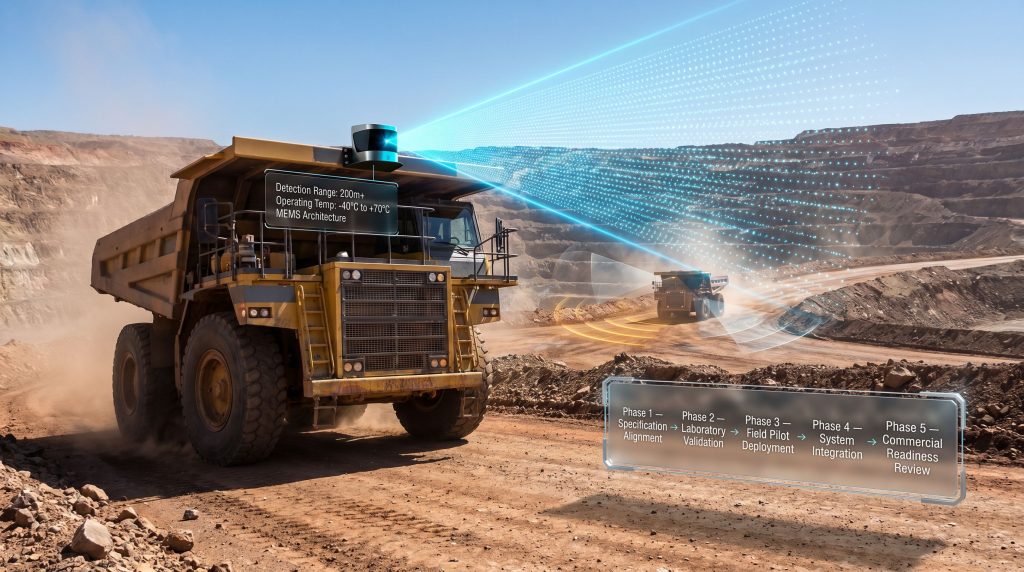
- Detection range exceeding 200 metres (haul road intersection clearance requirements)
- Angular resolution fine enough to distinguish a pedestrian from a rock at distance
- Point cloud density sufficient for real-time terrain classification
- Shock and vibration tolerance far beyond standard automotive ratings
- Operational continuity across temperature ranges from -40°C to +70°C
In autonomous hauling applications, lidar systems must process and classify environmental data within milliseconds while operating under continuous vibration loads, temperature extremes, and sustained dust exposure levels that would render standard optical systems non-functional within hours of deployment.
Why Heavy Equipment Has Lagged Behind Automotive Autonomy
The passenger vehicle sector has been the proving ground for lidar commercialisation, attracting the majority of development capital and validation infrastructure. Heavy equipment autonomy, while operationally more achievable in some controlled mine site settings, faces compounding technical challenges. Furthermore, automation has transformed mining technology in recent years, yet sensor limitations continue to constrain full deployment.
The challenges include:
- Unstructured terrain with no lane markings, kerbs, or road geometry conventions
- Mixed traffic zones where light vehicles, pedestrians, and mobile plant operate simultaneously
- Airborne particulate interference from blasting, earthmoving, and unpaved haul roads
- Altitude and humidity extremes across global operation sites
- Extended duty cycles requiring sensor reliability over thousands of operating hours without recalibration
Consequently, perception technology — not compute power or connectivity — remains the primary bottleneck to full autonomy in heavy equipment. A machine can have world-class onboard processing capability, but if its sensors cannot reliably characterise what is in front of it at 200 metres through a dust plume, autonomy fails at the most fundamental level.
MicroVision's Technical Position: The MAVIN Platform and the Luminar Acquisition
MAVIN Architecture and Industrial Relevance
MicroVision's primary lidar platform, MAVIN, is built around a MEMS-based (Micro-Electro-Mechanical Systems) scanning architecture. Unlike spinning mechanical lidar systems, which use rotating components that introduce failure points under sustained vibration, MEMS-based designs use solid-state mirror arrays to steer the laser beam. This architecture delivers durability advantages that are directly relevant to heavy equipment operating environments.
MAVIN incorporates a software-defined perception stack, meaning the sensor's behaviour can be reconfigured through software updates rather than hardware redesign. In a co-development context with an OEM, this allows the lidar system's detection profiles, range priorities, and classification algorithms to be tuned to specific machine types and operational scenarios without manufacturing new hardware variants.
| Performance Dimension | Automotive Lidar Standard | Industrial/Off-Highway Requirement | MicroVision MAVIN |
|---|---|---|---|
| Operational range | ~150-200m | 200m+ | Under OEM field validation |
| Dust/particulate tolerance | Moderate | High | MEMS architecture advantage |
| Vibration resistance | Standard automotive | Heavy-duty rated | Under OEM co-development |
| Software configurability | Limited | High | Software-defined stack |
| Temperature operating range | -40°C to +85°C | -40°C to +70°C+ | Aligned with automotive baseline |
The Luminar Asset Acquisition: January 2026
In January 2026, MicroVision completed the acquisition of assets from Luminar Technologies, including intellectual property, inventory, and existing commercial contracts. This transaction was strategically significant for reasons that extend beyond the balance sheet.
Luminar had built relationships with automotive and industrial OEMs through years of application development work. Acquiring those commercial relationships, alongside the underlying IP, compressed MicroVision's OEM pipeline development timeline. Rather than beginning partnership conversations from a standing start, MicroVision entered 2026 with an inherited set of validated technical relationships that could be accelerated toward formal development agreements.
The construction and mining OEM partnership announced in mid-2026 sits within this context. Whether the relationship originated through the Luminar asset acquisition pipeline or through separate business development activity has not been publicly confirmed, but the timing is consistent with the post-acquisition commercial acceleration thesis.
How a Long-Term Lidar Development Agreement Actually Functions
Development Agreement vs. Production Supply Contract: Why the Distinction Matters
These two agreement types are frequently conflated in market commentary, but they represent fundamentally different stages of commercial maturity.
A development agreement involves joint engineering effort, co-testing against defined performance specifications, and collaborative IP creation. Revenue at this stage typically comprises milestone payments and engineering fees. No production volume commitments are made, and the OEM retains the option to adjust specifications or, in extreme scenarios, terminate the programme before production.
A production supply contract specifies unit volumes, delivery schedules, per-unit pricing, and supply chain obligations. This is where lidar revenue transitions from project-based income to recurring commercial revenue at scale.
Most OEM-supplier lidar relationships follow a structured progression through five phases before production revenue begins:
- Specification Alignment — The OEM defines operational requirements; the supplier configures hardware and software to match
- Laboratory Validation — Controlled environment testing against defined key performance indicators
- Field Pilot Deployment — Real-world testing on active or simulated worksites with actual fleet conditions
- System Integration — The lidar stack is embedded within the OEM's broader autonomy architecture and vehicle control systems
- Commercial Readiness Review — Pre-production evaluation leading to supply agreement negotiation
Long-term development agreements in the heavy equipment sector typically span three to seven years, reflecting the extended validation cycles required before autonomous systems can be deployed at scale in regulated or safety-critical environments. Investors should calibrate expectations accordingly.
What Joint Development, Testing, and Commercialisation Means in Practice
The three operational pillars of MicroVision's announced partnership each carry distinct implications. In addition, AI-powered tools are boosting mining efficiency across the broader sector, creating a technology environment in which lidar co-development partnerships carry amplified strategic value.
- Joint development means shared engineering resources and co-ownership or cross-licensing of IP outcomes. MicroVision gains access to the OEM's application knowledge; the OEM gains access to MicroVision's sensor architecture expertise
- Joint testing provides MicroVision access to the OEM's proprietary proving grounds, active fleet test environments, and real operational data that cannot be replicated in a laboratory setting
- Commercialisation pathway establishes a defined contractual route from prototype to production-ready system, reducing ambiguity around what commercial success looks like at each phase
The confidentiality around the OEM's identity is standard practice. OEMs routinely suppress supplier identification during the development phase to protect competitive intelligence, maintain negotiating leverage, and avoid signalling product roadmap direction to competitors. Public disclosure of the OEM's identity typically occurs when the partnership advances to a production commitment, at which point both parties benefit from the announcement.
The OEM Context: Understanding the Scale of the Partner
Global Construction and Mining Equipment Market Sizing
The global construction equipment market was valued at approximately USD 193 billion in 2023 and is projected to exceed USD 250 billion by 2030, according to multiple industry research sources. The mining equipment segment, which includes autonomous and semi-autonomous haulage systems, represents a substantial portion of this total, driven by ongoing fleet electrification, digitalisation, and safety compliance investment cycles.
The world's five largest construction and mining equipment manufacturers by revenue include Caterpillar, Komatsu, Volvo CE, Liebherr, and Hitachi Construction Machinery. Each operates global fleets numbering in the tens of thousands of active machines. A preferred-supplier designation from any one of these organisations represents an anchor commercial relationship capable of sustaining a lidar company's entire industrial revenue line.
Caterpillar and Komatsu in particular have the most mature existing autonomous haulage programmes. Komatsu's FrontRunner Autonomous Haulage System and Caterpillar's Cat Command for hauling have been deployed across major iron ore, copper, and coal operations globally. Both companies have publicly signalled intentions to expand autonomous capabilities and upgrade sensor architectures in next-generation platforms, which positions them as logical candidates for a long-term lidar co-development partnership of this description.
This should not be read as confirmation of OEM identity. The partner has not been publicly identified, and the above context is provided for market sizing purposes only.
Autonomous Hauling Use Cases: The Operational Problem Being Solved
Current State and Limitations of Autonomous Haulage Systems
Autonomous haulage systems have been commercially deployed in surface mining for over a decade. The most mature deployments — primarily in Western Australian iron ore and South American copper operations — rely heavily on GPS, radar, and computer vision combinations. These systems perform reliably within tightly defined operational parameters: well-maintained haul roads, consistent traffic patterns, and stable environmental conditions.
However, the limitations of current radar-and-GPS-dependent architectures become apparent at the edges of those parameters. For instance, underground copper mining operations face particularly acute sensor constraints that are instructive for understanding why surface autonomy also requires a step-change in perception capability.
- Complex terrain intersections where multiple haul roads converge require higher-resolution spatial awareness than radar can provide
- Mixed-traffic zones combining autonomous trucks, light vehicles, and pedestrian workers demand pedestrian-class detection reliability
- Stockpile and dump point operations require centimetre-level precision for safe material placement
- All-weather continuity in regions with fog, rain, and heavy dust events exceeds camera-based system capabilities
Next-generation autonomous haulage systems are being designed to operate across a broader operational envelope, and this is where higher-resolution lidar becomes a system-level enabler rather than an incremental upgrade.
The Sensor Fusion Architecture for Autonomous Mining Vehicles
Lidar does not operate in isolation in an autonomous mining vehicle. It functions as the spatial truth layer within a multi-sensor fusion architecture:
- Lidar provides high-density point cloud data for obstacle classification and terrain mapping
- Radar contributes velocity data and performs reliably in zero-visibility conditions
- Cameras deliver texture and colour information for sign recognition, machine identification, and human detection
- GPS/GNSS provides absolute positional reference for route navigation
- Edge computing processes sensor data locally in real time, with latency requirements measured in milliseconds
The computing infrastructure required to process continuous lidar point cloud data on a mobile mining vehicle is non-trivial. High-end autonomous mining trucks now carry onboard processing hardware comparable to data centre nodes, managing sensor fusion, path planning, obstacle avoidance, and communication simultaneously.
The next major ASX story will hit our subscribers first
Cross-Sector Autonomy Benchmark: Where Mining Sits in the Industrial Landscape
| Sector | Autonomy Maturity | Primary Lidar Use Case | Deployment Environment Complexity |
|---|---|---|---|
| Surface Mining | Moderate-High | Autonomous haulage, collision avoidance | High (dust, terrain variability) |
| Port Logistics | High | Automated crane and vehicle guidance | Moderate (structured environment) |
| Precision Agriculture | Moderate | Obstacle avoidance, field mapping | Moderate (open terrain) |
| Defence/Security | High | Perimeter surveillance, UGV navigation | Very High |
| Construction Sites | Low-Moderate | Machine control, proximity detection | Very High (dynamic, unstructured) |
Construction sites represent arguably the most complex autonomy environment of any industrial sector. Unlike a mine haul road, which is a defined corridor with relatively predictable traffic, an active construction site reconfigures daily. Excavation zones shift, material stockpiles appear and disappear, and the density of human workers in proximity to machine operation is higher. This is why construction autonomy lags behind mining autonomy despite significant investment, and why a lidar system capable of performing reliably in construction environments would carry substantial cross-sector commercial value.
What This Deal Signals for the Broader Lidar Industry
The OEM Lock-In Dynamic: Why Partnerships Are Being Established Now
The lidar industry is in a consolidation phase. Multiple hardware developers that entered the market during the 2018 to 2022 venture capital wave have since merged, been acquired, or exited. MicroVision's acquisition of Luminar assets is one expression of this trend. The surviving platforms are now being evaluated by major OEMs not just on technical specifications, but on organisational stability, supply chain capability, and the capacity to sustain a multi-year co-development programme.
OEMs are establishing preferred-supplier relationships now because the development timelines for next-generation autonomous equipment platforms mean that sensor selections made in 2025 and 2026 will determine the perception architecture of products reaching market in 2030 and beyond. Furthermore, data-driven mining operations are accelerating this urgency, as operators demand integrated sensor and analytics solutions rather than standalone hardware. Waiting creates the risk of being locked out of an OEM relationship after a competitor has established an entrenched position.
Revenue Timing and Investor Expectations
MicroVision has previously communicated an automotive revenue ramp timeline centred on the 2028 to 2029 period. Industrial partnerships of the type announced may generate earlier development-phase revenue through engineering fees and milestone payments, but production-scale revenue requires progression through the full validation cycle described above.
The key milestones investors should monitor as indicators of genuine commercial progress include:
- Successful completion of field pilot testing phases with the OEM
- Transition from development agreement language to supply agreement language in company disclosures
- Disclosure of the OEM partner's identity (historically coincides with production commitment)
- Expansion of the partnership scope to additional machine categories or geographies
- Growth in engineering headcount or manufacturing capacity that signals production preparation
Development agreements are strategically meaningful but do not constitute confirmed production revenue. Assessments of MicroVision's commercial trajectory should be based on progression through defined validation milestones rather than the existence of the agreement itself. This article does not constitute financial advice.
Frequently Asked Questions: MicroVision's Lidar OEM Deal
What is MicroVision's long-term lidar deal with an OEM?
MicroVision has entered a multi-year development partnership with a major construction and mining equipment manufacturer to jointly develop, test, and commercialise lidar-based perception technology for autonomous heavy equipment applications. The MicroVision long-term lidar deal with an OEM covers the full development-to-commercialisation pathway but does not yet constitute a confirmed production supply contract.
Who is the OEM partner in MicroVision's construction and mining lidar agreement?
The OEM has not been publicly identified. Confidentiality at the development agreement stage is standard industry practice. The partner has been described as the world's leading manufacturer of construction and mining equipment by revenue or fleet scale.
What is the difference between a lidar development agreement and a production supply contract?
A development agreement defines joint engineering, testing, and IP collaboration between a sensor supplier and an OEM. A production supply contract specifies volume commitments, pricing, and delivery schedules. The former represents the beginning of a commercial relationship; the latter represents confirmed revenue at scale.
When will MicroVision's industrial lidar partnerships generate production revenue?
MicroVision has guided toward automotive production revenue commencing in the 2028 to 2029 timeframe. Industrial partnerships may generate earlier milestone-based revenue, but production-scale revenue will follow successful completion of the multi-phase validation cycle, which typically spans three to seven years in heavy equipment applications.
What happened with MicroVision's acquisition of Luminar assets?
In January 2026, MicroVision acquired intellectual property, inventory, and commercial contracts from Luminar Technologies. The transaction accelerated MicroVision's OEM relationship pipeline by providing access to established commercial relationships that Luminar had developed across automotive and industrial applications.
The Road Ahead: Milestones That Will Define Industrial Lidar Progress
The MicroVision long-term lidar deal with an OEM is best understood as a starting position rather than a destination. The genuinely consequential milestones lie ahead: field validation in operating mine environments, safety certification of the autonomous perception stack, hardware ruggedisation confirmation, and ultimately the transition from co-development to commercial supply.
What the agreement does establish is that MicroVision has positioned itself within the evaluation process of a company whose fleet scale means even a single product line adoption could represent hundreds of units annually. In a lidar market still searching for the anchor commercial relationships that justify the decade of development investment the industry has absorbed, that positioning is not trivial.
For the broader industrial autonomy sector, the deeper signal is structural. The merger of advanced lidar sensing with the autonomous haulage ambitions of the world's largest equipment manufacturers reflects a growing recognition that the perception bottleneck in heavy equipment autonomy requires dedicated industrial-grade solutions. Furthermore, AI is transforming drilling and blasting in parallel, underscoring how sensor-driven intelligence is reshaping every dimension of mining operations. Highway-derived sensor specifications are not a shortcut to the mine site. The physics of dust, vibration, and unstructured terrain demand purpose-engineered answers.
Whether MicroVision's MAVIN platform and its unnamed OEM partner produce that answer over the coming development cycle will be determined by milestones, not announcements. The announcement, however, marks the beginning of a technically credible attempt.
Want to Track the Next Major Mineral Discovery Before the Market Moves?
Discovery Alert's proprietary Discovery IQ model delivers real-time alerts on significant ASX mineral discoveries, transforming complex mineral data into actionable insights for investors at every experience level — explore historic discoveries and the returns they generated, then begin a 14-day free trial at Discovery Alert to position yourself ahead of the broader market.