August 6, 2026
The Hidden Architecture of African Sovereign Debt
Sovereign debt markets operate on an assumption of visibility. Investors price risk based on what they can see: bond yields, debt-to-GDP ratios, fiscal deficits, and credit ratings. However, a new class of financing instrument is quietly inserting itself into Africa's sovereign balance sheets, occupying a space that sits between formal debt and contingent liability, between transparency and opacity. Understanding why the IMF warns Nigeria against its $5 billion swap deal requires understanding not just the transaction itself, but the structural logic of the instrument it relies upon. This dynamic sits within a broader context of global financial markets recession fears and shifting sovereign risk appetites worldwide.
When big ASX news breaks, our subscribers know first
What Is a Total Return Swap, and Why Are Sovereigns Using It?
A Total Return Swap (TRS) is a bilateral financial contract in which one party, typically a sovereign borrower, pledges fixed-income securities as collateral to a counterparty financial institution in exchange for upfront cash. The counterparty assumes legal ownership of the pledged securities for the duration of the contract, while the borrower retains the economic obligation to repay principal plus an agreed spread above a benchmark rate.
The structural appeal for sovereign treasuries is straightforward:
- TRS arrangements do not require parliamentary ratification in most jurisdictions, enabling faster execution than conventional bond issuances
- The borrowing cost can be positioned below prevailing Eurobond yields, creating surface-level savings
- The transaction avoids the public pricing process that accompanies open-market debt issuance, reducing reputational exposure during periods of fiscal stress
However, the instrument carries embedded risks that do not appear in standard cost comparisons. Currency depreciation reduces the market value of pledged collateral, triggering margin calls that require additional collateral or early repayment. Rising global interest rates compound this dynamic. Both scenarios are recurring features of emerging market stress cycles, not remote tail risks.
The cost advantage of a TRS over conventional market access can disappear entirely once collateral overcollateralisation, margin call exposure, and potential cash discounts are factored into the true cost of financing.
With the Eurobond market remaining largely inaccessible at viable borrowing costs for most sub-Saharan African issuers since 2022, and with the African Development Bank estimating that the region will require several hundred billion dollars in sovereign financing over the coming decade, TRS structures have emerged as a financing tool of last resort for treasury departments under pressure. Furthermore, the macro environment uncertainty of 2025 has only intensified the structural pressures driving sovereigns towards these instruments.
Nigeria's $5 Billion Deal With First Abu Dhabi Bank: The Core Terms
On 9 June 2026, during an event in Abuja coinciding with the release of its Article IV consultation report for Nigeria, the International Monetary Fund publicly advised the Nigerian authorities against finalising a proposed $5 billion TRS arrangement with First Abu Dhabi Bank (FAB), the largest banking institution in the United Arab Emirates. The IMF's warning to Nigeria over the $5 billion Abu Dhabi bank deal flagged significant opacity risks in the transaction's structure.
The transaction structure is significant in several respects:
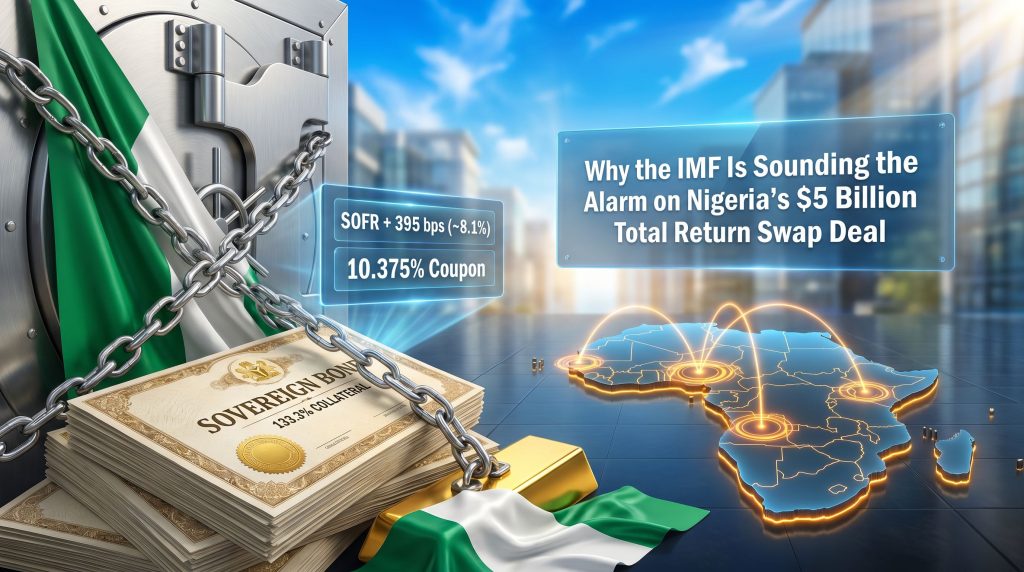
- Nigeria agreed to post naira-denominated federal government bonds as collateral valued at 133.3% of the cash amount borrowed, meaning the collateral pool exceeds the loan principal by one-third
- The Nigerian Senate approved the transaction on 31 March 2026, the same day the presidency submitted it, compressing legislative scrutiny into a single session
- The government stated the primary objective was to refinance existing high-cost debt and support infrastructure spending
How the Borrowing Cost Compares
The government's financial rationale rests largely on cost comparisons with existing instruments. The table below contextualises the TRS pricing against Nigeria's current debt profile:
| Financing Instrument | Borrowing Cost |
|---|---|
| Nigeria-FAB TRS (First Tranche) | SOFR + 395 basis points (~8.1% all-in) |
| Nigeria-FAB TRS (Subsequent Tranches) | SOFR + 400 basis points |
| Nigeria 2034 Eurobond (Secondary Market) | 7.5% to 8.5% yield range |
| Nigeria 10-Year Eurobond (December 2024) | 10.375% coupon |
At approximately 8.1%, the first tranche pricing sits below the December 2024 Eurobond coupon of 10.375%, which the government cites as the primary justification. Nigeria's executive director on the IMF board confirmed that the instrument was designed to secure external financing under competitive conditions, while acknowledging awareness of margin call exposure.
The government has also indicated that Treasury deposits held at the Central Bank of Nigeria, which stood at 4.2% of GDP at end-2025, could be deployed to repurchase outstanding bonds carrying higher coupons. An additional Eurobond issuance remains possible as part of an active liability-management strategy.
The IMF's Specific Objections: Margin Calls, Transparency, and Policy Constraints
The Fund's intervention goes beyond interest rate arithmetic. The IMF's Article IV consultation, published 9 June 2026, identified three distinct categories of risk embedded in the transaction structure. These concerns are compounded by existing inflation and debt pressures rippling through global markets, which have already constrained sovereign fiscal flexibility considerably.
Margin Call Vulnerability
The 133.3% collateral requirement creates a direct exposure to market value fluctuations in the pledged naira-denominated bonds. If the naira weakens against the US dollar, or if domestic interest rates rise and bond prices fall, the market value of the collateral pool declines. The counterparty can then demand additional collateral or accelerated repayment, forcing the Nigerian government into a reactive financing position at precisely the moment when fiscal conditions are most strained.
IMF staff identified in the Article IV consultation that the arrangement exposes the government to margin calls that could give rise to political constraints on monetary or exchange rate policy. This is not a theoretical concern: the interaction between a private financing contract's collateral requirements and a central bank's exchange rate management decisions represents a genuine governance conflict.
Debt Transparency and Reporting Treatment
The IMF confirmed it incorporates the full value of pledged collateral into Nigeria's public debt stock for the duration of the contract. This accounting treatment means the TRS adds to Nigeria's reported debt burden even before any margin call materialises. Christian Ebeke, the IMF's resident representative in Abuja, stated during a 9 June press conference that Nigeria has conventional market access, and that TRS instruments carry risks whose terms are not always transparent when reviewed across different country contexts.
This observation points to a systemic gap: the IMF's own application of collateral accounting has not been uniform across Angola, Senegal, and Nigeria, creating inconsistencies in how the Fund's Debt Sustainability Framework captures these instruments.
Monetary and Exchange Rate Policy Constraints
A margin call scenario forces a binary choice on the borrowing government: liquidate reserves, issue new securities at potentially elevated costs, or accept exchange rate adjustment under contractual pressure. Any of these outcomes compromises the Central Bank of Nigeria's operational independence. The IMF frames this not simply as a financial risk but as a structural governance concern, one that subordinates monetary policy decisions to the obligations embedded in a private bilateral contract.
The Fund recommends conventional Eurobond issuance and concessional financing from multilateral development banks as more appropriate alternatives, citing their standardised disclosure requirements and investor scrutiny as features that reinforce rather than undermine macroeconomic governance.
Angola and Senegal: The African TRS Precedents
Nigeria's proposed transaction does not exist in isolation. Two significant African sovereigns have already completed TRS arrangements, establishing a pattern that the IMF views with increasing concern. Consequently, understanding these precedents is essential to assessing the broader regional implications.
Angola's December 2024 Deal With JP Morgan
Angola became the first major African sovereign to complete a TRS transaction when it finalised a $1 billion, one-year agreement with JP Morgan Securities in December 2024. The transaction proceeded without parliamentary debate. Approximately $1.9 billion of sovereign Eurobonds were pledged as collateral, with full legal ownership transferred to JP Morgan, including the right to sell the securities.
Angola records the financing obligation as external debt while classifying the pledged securities as contingent liabilities until the contract expires, a dual accounting treatment that fragments debt visibility across different reporting categories.
Senegal's Multi-Counterparty Borrowing Programme
Senegal expanded the structure more aggressively, borrowing approximately $1.3 billion across multiple agreements with Africa Finance Corporation (AFC), First Abu Dhabi Bank, and Société Générale. The disclosed terms reveal significant cash discounts:
| Senegal TRS Transaction | Collateral Posted | Cash Received | Effective Discount |
|---|---|---|---|
| Africa Finance Corporation | €150 million (CFA franc bonds) | €105 million | 30% haircut |
| First Abu Dhabi Bank | ~€400 million in bonds | €300 million | 25% haircut |
| Société Générale | Undisclosed | Undisclosed | Not publicly available |
The AFC transaction is particularly stark: Senegal transferred legal ownership of €150 million in bonds and received only €105 million in usable cash, absorbing a 30% value loss at the point of transaction. This is not a contingent future risk but an immediate and certain cost embedded in the deal structure.
The Hidden Seniority Problem: How TRS Reshapes Creditor Hierarchies
Beyond transparency concerns, TRS structures introduce a creditor hierarchy problem that conventional sovereign debt documentation does not anticipate. In addition, the shifting geopolitical landscape has accelerated the fragmentation of traditional creditor relationships between emerging market sovereigns and Western financial institutions.
Under a TRS arrangement, the counterparty bank holds legal ownership of the collateral throughout the contract period. During periods of market stress, margin call protections grant the counterparty priority access to the underlying assets before other creditors can make claims. This creates a de facto seniority structure that does not appear in bond prospectuses, investor presentations, or standard debt sustainability analyses.
Thierry Larose, portfolio manager at Vontobel Asset Management, addressed this dynamic in a note published in April 2026, drawing a distinction between the Colombian TRS model, which functioned as a carry trade instrument, and the African sovereign TRS transactions, which serve as market access substitutes. According to Larose, TRS arrangements create grey areas in creditor hierarchies, and investors increasingly assume that swap lenders occupy a de facto senior position given their legal ownership of collateral and priority margin-call protections during stress periods.
This perception, whether or not it reflects the precise legal documentation in each case, has direct consequences for Africa's broader borrowing costs:
- Conventional bondholders perceive structurally higher risk if TRS lenders are assumed to rank ahead of them in a distress scenario
- Higher perceived risk translates into wider credit spreads on African sovereign bonds
- Wider spreads make Eurobond issuance more expensive, driving further demand for TRS structures as an alternative
- The cycle reinforces itself, progressively elevating African borrowing costs above levels justified by underlying fiscal fundamentals
The next major ASX story will hit our subscribers first
Political Timing and the 2027 Election Dimension
The IMF's risk assessment is not purely financial. Nigeria enters an election cycle ahead of a presidential vote scheduled for January 2027. The Fund's view is that political conditions reduce the probability of major fiscal reforms being implemented during this period, while financing needs remain elevated.
This combination — elevated borrowing requirements and political constraints on reform — creates precisely the conditions under which opaque financing instruments become most attractive to sovereign treasuries. The TRS structure's ability to bypass parliamentary ratification and avoid the public pricing process of conventional bond markets makes it particularly appealing when governments face both fiscal pressure and political scrutiny.
The convergence of election-year politics, elevated financing needs, and restricted Eurobond market access creates conditions in which debt transparency standards are most likely to erode precisely when they are most needed.
Does the IMF's Debt Sustainability Framework Need Updating?
The Nigeria case exposes a structural limitation in the IMF's own analytical architecture. The Debt Sustainability Framework was designed around conventional sovereign debt instruments: bonds, bilateral government loans, and multilateral credit facilities. TRS arrangements, with their collateral pledges, contingent liabilities, cash discounts, and private counterparty relationships, do not map cleanly onto existing DSF categories.
The IMF acknowledged in its Nigeria review that it incorporates the full collateral value into public debt calculations. However, this treatment was not systematically applied to earlier transactions in Angola and Senegal, creating inconsistencies that reduce the comparability of debt sustainability assessments across African sovereigns. Furthermore, the emergence of a multipolar world economy is complicating the IMF's ability to enforce uniform debt reporting standards across divergent geopolitical blocs.
Three systemic risks the IMF has identified for the six-to-twelve month horizon:
- Framework Evasion Risk: TRS structures generate debt that partially escapes standard DSF indicators, undermining the comprehensiveness that the framework depends upon for accurate sustainability assessments
- Political Cycle Interference: Nigeria's 2027 election cycle reduces the likelihood of fiscal reform while financing pressure remains elevated, increasing dependence on instruments that bypass conventional scrutiny
- Normalisation Risk: With Nigeria, Angola, and Senegal all adopting TRS structures within a twelve-month window, several additional West African treasuries are actively monitoring these transactions as potential models
If TRS financing becomes normalised across sub-Saharan Africa, it could permanently alter the continent's sovereign debt architecture by embedding hidden seniority claims, fragmenting debt reporting, and structurally elevating borrowing costs for all African issuers, not just those using the instrument.
Frequently Asked Questions
What is a total return swap in sovereign debt?
A TRS in sovereign debt is a financing arrangement where a government pledges domestic bonds to a financial institution as collateral in exchange for upfront cash. The institution holds legal ownership of the collateral during the contract, while the government retains the obligation to repay principal plus an agreed interest rate.
Why did the IMF warn Nigeria against the $5 billion deal?
The IMF raised three primary concerns: the 133.3% collateral requirement creates margin call exposure if the naira weakens or global rates rise; the structure constrains monetary and exchange rate policy flexibility; and the terms lack the transparency standards associated with conventional sovereign debt instruments. Reuters has reported on the IMF's broader assessment of Nigeria's reform trajectory alongside these specific warnings.
How does Nigeria's TRS compare to Angola's and Senegal's arrangements?
Nigeria's proposed $5 billion deal is the largest African sovereign TRS transaction to date. Angola's December 2024 arrangement with JP Morgan was $1 billion against $1.9 billion in collateral. Senegal borrowed approximately $1.3 billion across multiple counterparties, with disclosed transactions carrying cash discounts as steep as 30%.
What alternatives does the IMF recommend?
The IMF recommends Eurobond issuance and concessional financing from multilateral development banks. Both carry standardised disclosure requirements, subject sovereign borrowing to investor scrutiny, and do not generate the contingent liability structures associated with TRS arrangements.
Could TRS financing become the new normal for African sovereigns?
Given restricted Eurobond market access since 2022 and the African Development Bank's estimate of several hundred billion dollars in financing needs across the coming decade, TRS structures risk becoming a default financing mechanism if multilateral alternatives are not made more accessible and competitively priced. Indeed, the IMF warns Nigeria against the $5 billion swap deal precisely because of this normalisation risk and its potential to reshape the entire continent's debt architecture.
This article draws on reporting from Ecofin Agency and publicly available IMF documentation. It is intended for informational purposes only and does not constitute financial or investment advice. Forecasts and scenario analyses involve inherent uncertainty and should not be relied upon as predictions of future outcomes.
Want To Stay Ahead of Market-Moving Discoveries Before the Crowd Does?
While sovereign debt structures reshape Africa's financial landscape and global macro uncertainty intensifies, Discovery Alert's proprietary Discovery IQ model delivers real-time alerts on significant ASX mineral discoveries, transforming complex data across 30-plus commodities into clear, actionable investment insights — explore Discovery Alert's discoveries page to understand how historic finds have generated substantial returns, and begin your 14-day free trial today to position yourself ahead of the broader market.