
June 11, 2026
The Structural Vulnerability Hidden Inside the World's Biggest Bulk Export Terminal
Every major commodity supply chain has a single point of failure, a node so embedded in the architecture of global trade that its disruption sends shockwaves far beyond the immediate parties involved. For iron ore, that node is Port Hedland. And right now, the workers who keep it running have voted to stop — making BHP Port Hedland strike action one of the most closely watched industrial disputes in the global resources sector.
Understanding why this matters requires looking beyond the headline figures and examining the mechanical reality of how iron ore moves from the Pilbara to Chinese steel mills, and what happens when that movement stalls.
When big ASX news breaks, our subscribers know first
Why Port Hedland Cannot Simply Be Replaced
Port Hedland is not just Australia's largest bulk export terminal. It is the world's largest by total tonnage throughput, processing hundreds of millions of tonnes of iron ore annually. Every tonne of iron ore that BHP extracts from its Pilbara mining network, spanning operations including Mining Area C, South Flank, and Newman, funnels through a single export corridor that terminates at Port Hedland.
This lack of redundancy is not an oversight. It reflects decades of infrastructure investment decisions tied to the port's natural deep-water harbour capacity, its proximity to the Pilbara ore bodies, and the economics of building dedicated rail corridors across hundreds of kilometres of remote Western Australia. Furthermore, BHP's purpose-built rail network connects directly to Port Hedland's loading facilities, meaning there is no practical alternative export pathway in the short to medium term. Pilbara iron ore logistics remain entirely dependent on this single corridor.
For investors and market observers, this structural reality transforms what might otherwise be a routine labour dispute into a genuine supply chain risk event. A strike at a port with alternative routing options carries limited systemic consequence. A strike at Port Hedland carries no such cushion.
Two Unions, One Dispute: Understanding the Dual-Union Dynamic
The BHP Port Hedland strike action that crystallised in June 2026 is distinctive because it involves coordinated, though independently conducted, ballots across two separate unions representing different trade classifications.
The Electrical Trades Union (ETU) represents approximately 200 electrical workers at the port. In the ballot, around 100 ETU members who participated voted unanimously in favour of protected work stoppages ranging from 15 minutes to 24 hours in duration. The ETU's central grievance centres on pay parity. Workers performing identical roles with equivalent qualifications were engaged on materially different individual contracts, creating internal wage inequality that the union describes as a structural failure of BHP's hiring practices.
ETU Western Australia State Secretary Adam Woodage indicated that after more than six months of bargaining attempts, the union had been unable to identify a genuine decision-making counterpart within BHP's management structure, effectively rendering negotiations circular and unproductive.
The Australian Manufacturing Workers' Union (AMWU) represents a separate cohort of port workers, with more than 100 members participating in its ballot. Of those, 89.4% voted in favour of protected industrial action, a strong mandate that signals broad membership consensus rather than a marginal or divisive outcome. AMWU Western Australia State Secretary Steve McCartney framed the dispute as workers demanding recognition during a period of genuine cost-of-living pressure, with seven months of unsuccessful enterprise bargaining preceding the ballot.
The dual-union structure creates compounding operational risk. Electrical disruptions and mechanical stoppages do not occur in isolation. At a port where conveyor systems, ship loaders, and power infrastructure are deeply interdependent, simultaneous or overlapping stoppages across trade classifications can produce cascading failures that exceed the sum of their individual parts.
What Does Protected Industrial Action Actually Mean?
For those unfamiliar with Australia's industrial relations framework, the legal architecture governing this dispute is worth understanding in detail.
| Term | Practical Meaning |
|---|---|
| Protected Industrial Action | Strike or work ban activity conducted during enterprise bargaining, shielding participants from civil liability under the Fair Work Act 2009 |
| Notice Period | Workers must provide a minimum of five days' written notice to the employer before any stoppage can legally commence |
| Scope | Can include full work stoppages, rolling bans, or partial stoppages of defined duration |
| Employer Responses | May include lockouts, Fair Work Commission applications to suspend or terminate action, or improved offers |
| FWC Intervention | The Fair Work Commission can suspend protected action if it poses a significant threat to the broader economy or public welfare |
The notice requirement is strategically significant. It means BHP receives advance warning before any stoppage begins, allowing time to pre-position vessels, buffer stockyard inventory, and deploy contingency labour arrangements. However, this same notice window also allows unions to time stoppages for maximum operational impact — for instance, coinciding with scheduled vessel arrivals or high-tide loading windows.
The Financial Stakes: Revenue at Risk Per Day
Iron ore is BHP's single largest earnings contributor. It consistently generates higher margins than BHP's copper, coal, or petroleum operations, and Port Hedland is the exclusive conduit for all of BHP's Western Australian iron ore exports. Consequently, iron ore price trends are being watched especially closely against the backdrop of this dispute.
Reports indicate that a complete operational shutdown at Port Hedland could cost BHP in excess of A$120 million per day in lost export revenue. Even if short rolling stoppages do not produce a full shutdown, the cumulative financial impact of repeated disruptions, vessel demurrage charges, scheduling delays, and potential contractual penalties accumulates rapidly.
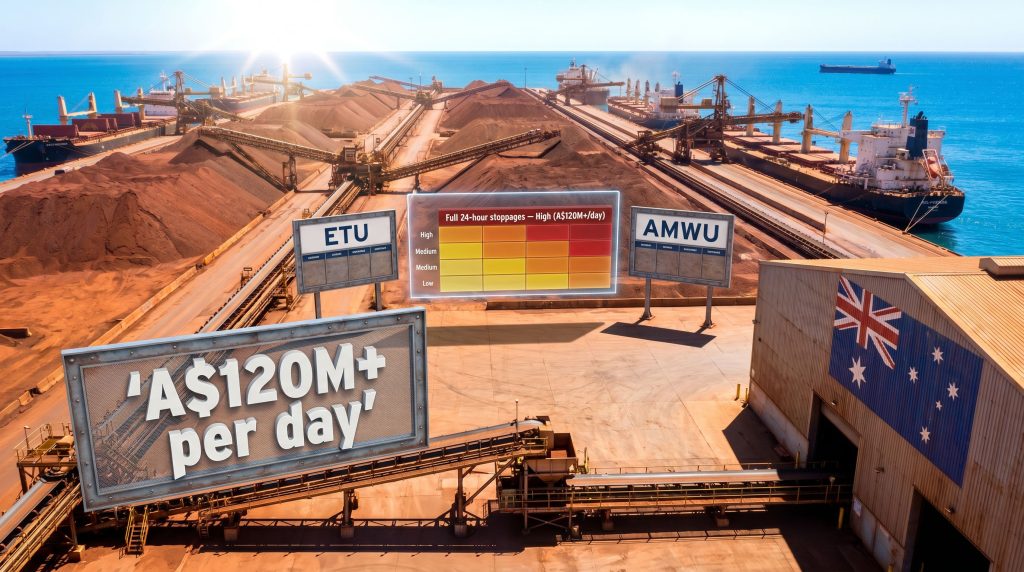
The scenario risk matrix below illustrates how different strike intensities translate into operational and financial consequences:
| Scenario | Estimated Duration | Operational Impact | Revenue Risk |
|---|---|---|---|
| Short rolling stoppages | 15 to 60 minutes daily | Minor vessel delays, limited tonnage loss | Low to Moderate |
| Multi-hour recurring stoppages | 4 to 8 hours per event | Material loading disruption, demurrage exposure | Moderate to High |
| Full-day stoppages | 24-hour events | Significant throughput loss, stockyard congestion | High (A$120M+/day) |
| Extended industrial campaign | One to two weeks | Structural supply gap, spot price signal | Severe |
How Iron Ore Pricing Responds to Supply Disruptions
The downstream market implications of sustained BHP Port Hedland strike action extend well beyond BHP's own income statement. China steel demand absorbs the overwhelming majority of iron ore exported through Port Hedland, and Chinese steel mills operate procurement models that are highly sensitive to seaborne supply disruptions.
Unlike oil markets, where strategic reserves provide a meaningful buffer against short-term supply shocks, iron ore port inventories at Chinese facilities tend to fluctuate within relatively narrow bands. When those inventories are already lean, even a brief interruption to seaborne supply from a major exporter can produce a disproportionate price response in the spot market.
Several factors amplify this sensitivity:
- Chinese steel production schedules are planned weeks in advance, creating procurement commitments that cannot easily be deferred.
- Alternative supply sources, including Brazilian operations run by Vale, face their own logistical constraints and cannot rapidly substitute for Australian tonnage.
- Freight markets respond quickly to supply concentration risk, meaning shipping costs can spike even before physical disruptions materialise.
- Iron ore futures on the Singapore Exchange and the Dalian Commodity Exchange often front-run physical supply concerns, meaning price movements can precede actual stoppages.
For investors monitoring BHP's share price alongside iron ore spot prices, the period between a formal notice filing and the commencement of stoppages is likely to be the window of maximum uncertainty and price volatility.
The Enterprise Bargaining Timeline: Seven Months and Counting
The scale of worker frustration reflected in these ballot results is better understood when viewed against the timeline of failed negotiations.
| Period | Development |
|---|---|
| Late 2025 | Enterprise bargaining negotiations commence |
| Early 2026 | Talks stall with no meaningful progress reported |
| Mid-2026 | ETU declares BHP's conduct obstructive; AMWU members report exhaustion |
| June 2026 | Both unions conduct formal protected action ballots |
| Post-ballot | Five-day notice period before legal stoppages can commence |
The ETU's specific allegation that BHP's conduct prevented identification of a genuine negotiating counterpart is not a minor procedural complaint. Under Australian industrial law, bargaining in good faith is a legal obligation enforceable through the Fair Work Commission. If substantiated, this allegation could form the basis of a separate legal application by the union, adding a further layer of complexity to the dispute.
The next major ASX story will hit our subscribers first
The Pay Parity Problem: A Systemic Issue Across Australian Mining
The ETU's core grievance — that workers with equivalent skills and experience were hired on materially different individual contracts — reflects a structural dynamic that emerged in Australian mining following the dismantling of the WorkChoices legislative framework and the subsequent transition to enterprise bargaining under the Fair Work Act.
During periods of rapid labour demand growth in the Pilbara, mining companies including BHP hired workers through a combination of enterprise agreement roles and individual Australian Workplace Agreements, or through labour hire arrangements operating under separate instruments. When workforce demand later stabilised, the legacy of these varied hiring mechanisms persisted in the form of significant pay dispersion within the same operational site.
Enterprise bargaining is the primary legal tool available to unions to address this dispersion. Furthermore, the failure to reach agreement after seven months suggests the gap between BHP's offered terms and workers' minimum acceptable outcomes remains material, contributing directly to iron ore market disruptions that global traders are now pricing in.
BHP's Response: Contingency Plans and Constructive Language
BHP's public position has emphasised continued commitment to constructive engagement while simultaneously confirming that contingency plans are active. The company stated its objective as reaching an outcome that maintains industry-leading pay and conditions while supporting safe, productive, and sustainable operations.
This dual messaging — openness to negotiation alongside operational resilience signalling — is a standard enterprise bargaining posture for large resource companies. By publicly affirming contingency readiness, BHP signals to unions that short stoppages will not automatically produce an improved offer. The implicit message is that workers bear a share of the cost of escalation.
Typical contingency measures deployed during resources sector industrial disputes include:
- Supervisory and management staff substituting for trade-classified roles during short stoppages.
- Pre-positioning of ore carrier vessels to minimise scheduling disruption.
- Stockyard inventory buffering to absorb brief loading gaps.
- Engagement of alternate labour hire contractors for non-protected work.
The effectiveness of these measures declines sharply as stoppage duration extends beyond a few hours or as stoppages become more frequent. A coordinated multi-day campaign across two trade classifications would likely exceed BHP's practical contingency capacity at current staffing levels.
Resolution Pathways: From Negotiation to FWC Arbitration
Three principal resolution scenarios are available to the parties:
1. Negotiated Enterprise Agreement: The most efficient outcome involves BHP making a materially improved wage offer that addresses the pay parity dispersion identified by the ETU and the cost-of-living concerns raised by the AMWU. This would require satisfying both unions under their separate bargaining tracks, which adds complexity but is not unprecedented.
2. Fair Work Commission Intervention: Either party may apply to the FWC to conciliate the dispute, suspend protected action on public interest grounds, or arbitrate outstanding terms with consent. Given the economic significance of Port Hedland, an FWC application to suspend action would carry reasonable prospects of success if stoppages escalate and iron ore market disruption becomes demonstrable.
3. Escalation: If BHP's contingency positioning holds and no improved offer is forthcoming, unions may escalate to longer and more frequent stoppages. Historical precedent from Australian resources sector disputes suggests this path typically ends in either significant employer concessions or FWC intervention, rarely in full union capitulation without a substantive offer improvement.
What Investors and Market Observers Should Watch
For those monitoring the BHP Port Hedland strike action and its market implications, the following indicators carry the highest signal value:
- Formal notice filings: The five-day notice period is the key trigger. Once filed, stoppages are imminent and market pricing should adjust accordingly.
- Stoppage frequency and duration: Single short stoppages are containable. Repeated multi-hour stoppages across both unions simultaneously represent a qualitatively different risk level.
- Iron ore spot price movements: Watch Singapore Exchange and Dalian Commodity Exchange iron ore futures for early pricing of supply risk.
- Chinese port inventory levels: Low inventory amplifies the price sensitivity of any supply disruption.
- FWC application filings: A BHP application to the Fair Work Commission to suspend action would signal that contingency measures are being tested.
- BHP earnings guidance revisions: Any material throughput reduction at Port Hedland would carry direct earnings per share implications for BHP, potentially triggering formal guidance updates to the ASX.
The broader precedent dimension should also not be underestimated. An enterprise agreement outcome at Port Hedland, whether resolved through concession or compulsion, will inform bargaining expectations at other Pilbara operations and across the Australian resources sector more widely. Australia's iron ore dominance in global markets means the cost-of-living framing adopted by both unions resonates beyond this specific workplace. A favourable outcome for workers here could, consequently, catalyse similar bargaining postures at competing operations. As reported by BHP's Australia president, even a full port shutdown has not been ruled out — underscoring just how elevated the stakes have become.
Disclaimer: This article contains analysis and forward-looking assessments that involve uncertainty. Iron ore price projections, revenue impact estimates, and resolution scenario assessments are analytical frameworks, not financial advice. Investors should conduct independent research and consult qualified financial advisers before making investment decisions. Revenue impact figures referenced are reported estimates and have not been independently verified.
Want to Stay Ahead of the Next Major ASX Mineral Discovery?
While industrial disruptions at Port Hedland reshape iron ore supply chains, Discovery Alert's proprietary Discovery IQ model scans ASX announcements in real time, instantly alerting subscribers to significant mineral discoveries across more than 30 commodities — explore historic examples of exceptional discovery returns or begin your 14-day free trial today to position yourself ahead of the broader market.