July 17, 2026
Why Alumina Refining Is Far More Vulnerable Than the Market Prices In
Energy-intensive industrial processes sit at the intersection of two compounding risks: geography and infrastructure dependency. Most commodity investors focus on ore grades, reserve life, and metal price cycles when assessing mining company risk. What receives far less attention is the brittle nature of the thermal processing infrastructure that sits between a raw ore body and a tradeable commodity. When that infrastructure is clustered in a single region, the consequences of a localised disruption radiate far beyond the refinery fence line.
This is precisely the dynamic that played out when Alcoa cyclone cuts alumina output became the defining corporate event of Q2 2026. Cyclone Narelle made landfall in Western Australia in late March 2026, triggering a cascade of events that forced Alcoa to revise its full-year production guidance and absorb tens of millions of dollars in unplanned costs. The story of how a regional weather event translated into a global supply signal is, in many ways, a masterclass in understanding how commodity chains fail.
When big ASX news breaks, our subscribers know first
Understanding Alumina's Unique Position in the Aluminum Supply Chain
Alumina, or aluminum oxide, is the refined intermediate that bridges raw bauxite ore and finished aluminum metal. The production ratio is significant: approximately 4 to 5 tonnes of bauxite are required to yield 2 tonnes of alumina, which in turn produces roughly 1 tonne of aluminum metal. Consequently, any disruption at the refining stage is amplified in its downstream impact relative to equivalent disruptions at either end of the chain.
What makes alumina refining distinctly vulnerable compared to conventional mining is its dependence on continuous thermal energy input. The Bayer Process, the dominant industrial method for refining alumina from bauxite, requires sustained high-temperature digestion of bauxite in caustic soda solution, followed by calcination at temperatures exceeding 1,000 degrees Celsius. Unlike an open-cut mine that can suspend operations and restart with limited mechanical consequence, an alumina refinery that loses its energy supply mid-cycle faces process instability that can take weeks or months to fully stabilise.
"Alumina refineries do not simply pause and resume. Interruptions to the thermal processing cycle create chemical and operational complications that extend far beyond the duration of the original energy disruption itself."
Western Australia hosts a disproportionate share of global alumina refining capacity. The aluminum and alumina markets are therefore acutely sensitive to regional disruptions. Alcoa alone operates multiple large-scale refineries in the state, including Pinjarra, Wagerup, and Kwinana, collectively representing a substantial portion of seaborne alumina supply. When a single weather event can threaten gas supply infrastructure across that region simultaneously, the concentration risk embedded in global alumina markets becomes very real.
The Cyclone Narelle Disruption: A Sequence of Compounding Failures
How a Gas Supply Shock Became a Production Crisis
Cyclone Narelle's impact on Alcoa's operations was not instantaneous or clean. The system made landfall in Western Australia in late March 2026, knocking major liquefied natural gas processing infrastructure offline across the region. The loss of gas supply hit Alcoa's Pinjarra refinery particularly hard, given the facility's reliance on continuous gas-fired thermal processing to maintain throughput.
Critically, operational instability at the Pinjarra site had already been developing before the cyclone arrived. The compounding of pre-existing process challenges with the sudden gas supply shock transformed what might have been a manageable disruption into a multi-quarter production deficit. The Wagerup refinery also recorded temporary operational reductions during the same period, though Pinjarra bore the primary impact.
Pinjarra Refinery: Scale and Impact
| Metric | Detail |
|---|---|
| Refinery Location | Pinjarra, Western Australia |
| Annual Nameplate Capacity | 4.7 million metric tonnes |
| Q2 2026 Shipment Decline | ~120,000 tonnes vs. Q1 2026 |
| Additional Q2 Production Cost | $30 million |
| Operational Status | Reduced process flow rates |
The Pinjarra refinery is one of Alcoa's most significant single-site alumina production assets globally. The disruption did not result in a complete shutdown. Instead, the facility operated at materially reduced process flow rates, meaning fixed overhead costs continued to accumulate against a lower volume of output, which dramatically elevated the per-tonne cost of production during the affected period.
Breaking Down the $45 Million Cost Burden
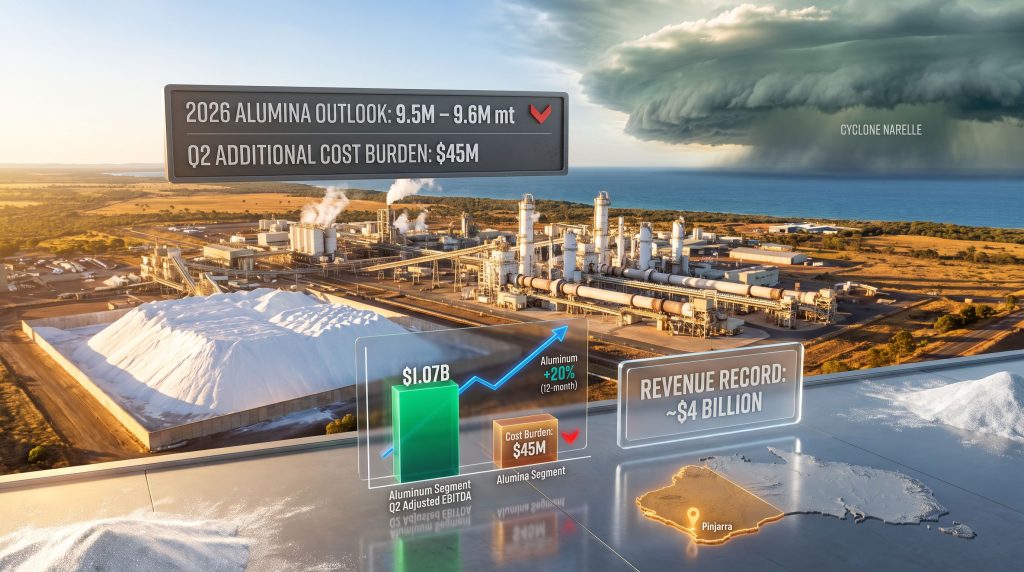
The financial impact of the Cyclone Narelle disruption extended beyond Pinjarra alone. Alcoa absorbed a combined $45 million in additional costs within its alumina segment during Q2 2026, structured as follows:
- $30 million in elevated production costs at the Pinjarra refinery attributable to reduced throughput efficiency and process recovery expenses
- $15 million in higher fuel costs at Alcoa's Sao Luis refinery in Brazil, reflecting secondary knock-on effects from tightened regional energy markets
The Brazil component is particularly instructive. It illustrates how a geographically isolated weather event in Western Australia can transmit cost pressures to assets on the other side of the world through interconnected energy and commodity markets. This is a dimension of single-event risk that is rarely modelled explicitly in analyst estimates.
Quantifying the Production Guidance Downgrade
Full-Year Alumina Outlook: Before and After
| Guidance Metric | Previous Outlook | Revised Outlook | Change |
|---|---|---|---|
| 2026 Alumina Production | 9.7M to 9.9M metric tonnes | 9.5M to 9.6M metric tonnes | Down ~200,000 to 300,000 tonnes |
| Alumina Shipments | Prior guidance | Revised downward | Decline noted |
| Aluminum Production | Unchanged | Unchanged | No impact |
| Aluminum Shipments | Unchanged | Unchanged | No impact |
Total alumina production in Q1 2026 had already declined approximately 5% sequentially to around 2.4 million metric tonnes, reflecting the early-stage impact of the cyclone combined with scheduled seasonal maintenance. The revised full-year range signals that Pinjarra will not fully recover to pre-cyclone throughput levels within the 2026 production year, which is a meaningful forward signal for supply-side market participants.
Beyond the Cyclone: Structural Cost Pressures at Australian Refineries
The Alcoa cyclone cuts alumina output narrative is more nuanced than a weather event story alone. Alcoa's Australian refinery network has been navigating compounding operational headwinds that predate Cyclone Narelle. Furthermore, Australia's resource export challenges add another layer of complexity to the operational environment for large-scale processors. The structural pressures include:
- Declining bauxite ore quality from maturing mine areas in Western Australia's Darling Range, which independently elevates the volume of bauxite required per tonne of alumina produced and increases caustic soda consumption in the digestion circuit
- Structurally elevated gas costs in Western Australia's domestic gas market, driven by a tight supply-demand balance between LNG export obligations and domestic industrial users
- Aging refinery infrastructure at some Western Australian sites that requires increased maintenance expenditure relative to more recently constructed facilities
"When a weather event hits an operation already under cost pressure, the financial damage tends to exceed what a simple volume-reduction model would predict. Fixed costs do not compress in proportion to throughput losses."
This layered cost environment means that even after Pinjarra stabilises operationally, the refinery may not return to historical margin performance without structural improvements to either energy supply arrangements or processing efficiency. In addition, Australia's resource export challenges suggest that these pressures are unlikely to ease significantly in the near term.
Record Revenue and a Guidance Cut in the Same Quarter
How Aluminum Price Strength Offset Alumina Weakness
Despite the alumina segment headwinds, Alcoa reported quarterly revenue of approximately $4 billion, marking a company record. The driver was a sustained rally in aluminum metal prices, which climbed roughly 20% over the preceding 12 months. Multiple forces underpinned this price strength:
- Supply disruptions linked to geopolitical tensions in the Middle East, which affected energy availability for aluminum smelting operations in the region
- Structural demand growth from power grid infrastructure buildout, which is consuming increasing volumes of aluminum for transmission cables and transformer housings
- Data centre construction activity, which uses aluminum extensively in cooling systems and structural components
- Expectations that new smelting capacity additions will lag demand growth through at least the latter part of the decade
The aluminum segment generated $1.07 billion in adjusted EBITDA for the quarter, exceeding analyst consensus. The restart of previously idled smelter capacity contributed meaningfully to this result, demonstrating that Alcoa's upstream metal production assets were performing strongly even as its alumina refining segment absorbed unplanned costs.
Segment Divergence: A Pattern Specific to Vertically Integrated Producers
| Segment | Q2 2026 Adjusted EBITDA | Performance vs. Estimates |
|---|---|---|
| Aluminum | $1.07 billion | Beat analyst consensus |
| Alumina | Impacted by $45M cost burden | Below prior guidance trajectory |
This kind of divergence is structurally possible in vertically integrated commodity producers but is often misinterpreted by market participants. The refinery is not simply a cost centre within the Alcoa system. It is a margin-generating asset in its own right, and its underperformance during a period of strong metal prices represents a real reduction in total value capture from the commodity chain, even if headline revenue remains robust.
Share Price Reaction: Does Guidance Outweigh Revenue in Commodity Equities?
Alcoa shares fell more than 7% in after-market trading following the earnings announcement before partially recovering. The magnitude of the reaction relative to the revenue record is instructive. In commodity equity markets, investors consistently weight forward production guidance more heavily than current-period revenue because production volume drives future cash flow modelling. A guidance downgrade signals that analysts must reduce their forward estimates, which compresses price targets even when current earnings appear strong.
This pattern reflects a well-documented tendency in resource sector investing: the market prices commodity equities on a forward-looking production and cost basis rather than on trailing revenue multiples. When a company cuts volume guidance and simultaneously flags elevated costs, the mathematical impact on discounted cash flow models is immediate and often disproportionate to the absolute dollar quantum of the revision.
The South32 Acquisition: Strategic Conviction Amid Operational Turbulence
In the weeks preceding the earnings announcement, Alcoa agreed to acquire South32 Ltd.'s alumina, aluminum, and bauxite business for up to $5.6 billion. The timing is strategically significant. By committing this capital while simultaneously absorbing a major operational disruption at its existing Australian assets, Alcoa is signalling that it views the Pinjarra production shortfall as a cyclical setback rather than a structural indictment of the alumina business.
The South32 transaction adds diversified alumina and bauxite production to Alcoa's portfolio, with assets across geographically distinct operating environments. This diversification has practical risk management value, as a broader asset base reduces the probability that any single regional weather event can simultaneously affect a majority of the company's alumina production capacity. Leading aluminium mining companies are increasingly pursuing this kind of geographic diversification as a structural hedge against climate-related disruption.
The long-term demand thesis supporting the acquisition centres on several converging trends:
- Energy transition infrastructure requiring large volumes of aluminum for solar frames, wind turbine components, and high-voltage transmission systems
- Automotive lightweighting driven by electric vehicle adoption, where aluminum alloys reduce vehicle mass and extend battery range
- Grid modernisation in North America, Europe, and Asia creating sustained demand pipelines for aluminum conductors and structural components
- Data centre densification accelerating demand for aluminum in thermal management and structural applications
The next major ASX story will hit our subscribers first
Climate Risk, Refinery Concentration, and What Investors Are Still Underpricing
The Market Consequences of Geographic Refining Concentration
Western Australia's dominance in seaborne alumina supply means that regional weather events carry market consequences that extend well beyond Alcoa's balance sheet. Alumina buyers, primarily aluminum smelters operating on lean inventory models, face immediate spot market tightening when a Pinjarra-scale facility reduces throughput. The price transmission from alumina supply tightness to aluminum production costs typically operates with a lag of four to eight weeks, meaning the full market effect of the cyclone disruption continued to ripple through the supply chain well into Q2 2026.
Disruption Scenarios: Recovery Timelines Compared
| Disruption Type | Typical Recovery Timeline | Cost Impact Profile |
|---|---|---|
| Gas supply interruption (cyclone) | 2 to 4 quarters | High fixed cost absorption, reduced throughput |
| Scheduled maintenance shutdown | 2 to 6 weeks | Planned and provisioned in guidance |
| Bauxite quality degradation | Multi-year | Gradual cost creep, difficult to isolate |
| Full refinery outage (unplanned) | 6 to 18 months | Severe, partially insurance-dependent |
Is Physical Climate Risk a Material Valuation Factor?
The Alcoa cyclone cuts alumina output episode is part of a broader pattern of climate-driven operational disruptions affecting resource sector infrastructure in northern and western Australia. Tropical cyclone intensity and frequency in the region is an increasingly tracked variable among institutional investors applying physical climate risk frameworks to commodity equity portfolios.
The $45 million single-quarter cost impact from one weather event illustrates that climate risk at the asset level is not an abstract ESG disclosure consideration. It is a quantifiable earnings variable with direct implications for production guidance, segment margins, and investor return expectations. The push towards low-carbon metals production is gaining momentum partly in response to exactly these kinds of structural vulnerabilities in conventional refining infrastructure.
Furthermore, the global reliance on concentrated bauxite production leaders means that supply chain disruptions in key refining regions can ripple through markets with remarkable speed. As refiners and miners in cyclone-exposed regions face more frequent or intense weather events, the probability-weighted cost of these disruptions should logically be reflected in long-run required return expectations for assets in those geographies.
Frequently Asked Questions
What caused Alcoa to cut its 2026 alumina production guidance?
Alcoa reduced its full-year alumina production forecast following disruptions at its Pinjarra refinery in Western Australia. Cyclone Narelle forced major LNG energy plants offline in late March 2026, cutting gas supply to the refinery and forcing reduced process flow rates. Pre-existing operational instability at the site amplified the impact, preventing a rapid recovery to normal throughput.
By how much was the alumina production outlook reduced?
The revised 2026 alumina production guidance range of 9.5 to 9.6 million metric tonnes compares to a prior outlook of 9.7 to 9.9 million metric tonnes, representing a reduction of approximately 200,000 to 300,000 tonnes for the full year.
What was the total financial cost of the disruption?
Alcoa absorbed approximately $45 million in additional costs within its alumina segment during Q2 2026. This comprised $30 million in elevated Pinjarra production costs and $15 million in higher fuel costs at its Sao Luis refinery in Brazil.
Did the disruption affect aluminum production guidance?
No. Alcoa's 2026 aluminum production and shipment guidance remained unchanged. The operational and financial impact was confined to the alumina refining segment.
Why did the share price fall despite record revenue?
Alcoa reported approximately $4 billion in quarterly revenue, a company record, yet shares declined more than 7% in after-market trading. Commodity equity markets characteristically assign greater weight to forward production guidance than to current-period revenue, as volume trajectory is the primary driver of forward cash flow modelling and price target derivation.
What is Alcoa's broader strategic response?
Beyond operational recovery efforts at Pinjarra and Wagerup, Alcoa has committed to acquiring South32's alumina, aluminum, and bauxite business for up to $5.6 billion, a transaction that diversifies its alumina asset base and reinforces long-term conviction in aluminum demand growth driven by energy transition and infrastructure investment.
Want to Know When Major Mineral Discoveries Hit the ASX Before the Broader Market Does?
Discovery Alert's proprietary Discovery IQ model scans ASX announcements in real time, delivering instant alerts on significant mineral discoveries — including those across the aluminium and bauxite supply chain — so subscribers can identify actionable opportunities the moment they emerge; explore historic examples of exceptional discovery returns to understand what's possible, then begin your 14-day free trial at Discovery Alert to position yourself ahead of the market.