
July 17, 2026
The Shrinking Map of Permian Basin Opportunity
When the history of U.S. shale consolidation is eventually written, the years between 2022 and 2026 will stand out as the period when large-scale, privately-held Permian Basin operators effectively became endangered species. Mega-mergers, bolt-on acquisitions, and relentless capital recycling compressed what was once a fragmented landscape of independent producers into a much smaller number of dominant players. That structural shift is now creating an unusual set of conditions: a market where quality acreage is genuinely scarce, where remaining private operators command outsized premiums, and where the Vitol sale of VTX Energy has become one of the most closely watched upstream transactions of 2026.
Understanding why this deal matters requires looking beyond the headline valuation. At roughly $2.3 billion in equity value and potentially up to $3 billion including debt, the proposed transaction tells a layered story about commodity trader strategy, private equity re-engagement with U.S. shale, and the compounding effects of Permian Basin acreage scarcity on asset pricing. Furthermore, broader oil price trends and shifting geopolitical dynamics have made the timing of this deal particularly significant.
When big ASX news breaks, our subscribers know first
VTX Energy: Anatomy of a Purpose-Built Upstream Venture
From $1 Billion Seed Capital to a 46,000-Boepd Producer
VTX Energy Partners did not emerge organically. It was architected. In February 2022, Vitol Group committed an initial $1 billion to establish the venture alongside the management team previously associated with ATX Energy Partners. The mandate was deliberate and narrow: acquire producing assets in the Delaware Basin, build scale efficiently, and create an asset that would be monetisable within a defined timeframe.
The result, four years later, is a producer generating approximately 46,000 barrels of oil equivalent per day (boepd) across a 46,000 net acre position in the Texas portion of the Southern Delaware Basin. The asset package also includes an ancillary water treatment business, a meaningful operational addition given the intensifying water management challenges that characterise high-volume shale production in the Permian.
Water handling in the Delaware Basin has become an increasingly valuable business line as produced water volumes scale alongside drilling intensity. Including a water treatment operation in the VTX sale package adds both revenue diversification and operational utility for prospective buyers.
The LandBridge Surface Acreage Sale: Pre-Sale Asset Optimisation
One detail that deserves closer attention is the November 2024 transaction in which VTX divested approximately 46,000 surface acres in the Southern Delaware Basin to LandBridge for $245 million in cash. Crucially, VTX retained its subsurface production rights and operational infrastructure.
This is a recognised pre-sale optimisation technique. By separating surface rights from subsurface production value, VTX effectively cleaned up its balance sheet complexity, crystallised value from non-core real estate, and made the remaining upstream production package far more legible to prospective acquirers. Buyers evaluating upstream assets prefer clarity: clean production metrics, defined acreage positions, and unencumbered operational assets. The LandBridge deal delivered exactly that.
Deal Structure: Who Is Buying and Why a Consortium?
The Carnelian and EnCap Consortium Explained
The proposed buyers, Carnelian Energy Capital and EnCap Investments, represent two of Houston's most established private equity platforms focused on upstream oil and gas. EnCap in particular has an extraordinarily deep track record across the Permian Basin, having seeded and scaled dozens of operators through full commodity price cycles over more than three decades. Carnelian brings complementary operational expertise and a focused onshore U.S. mandate.
The consortium structure itself carries strategic logic. A $2.3 billion equity ticket is a significant commitment even for large energy-focused PE firms. By co-investing, both parties reduce their individual capital concentration risk while pooling the operational and financial capabilities needed to run a production platform of VTX's scale. It also broadens the combined network for future asset acquisitions or talent recruitment.
| Parameter | Detail |
|---|---|
| Reported Equity Valuation | ~$2.3 billion |
| Total Enterprise Value (incl. debt) | Up to ~$3 billion |
| Production Rate | ~46,000 boepd |
| Net Acreage | ~46,000 net acres |
| Basin | Texas portion of the Southern Delaware Basin |
| Financial Adviser | Jefferies |
| Proposed Buyers | Carnelian Energy Capital and EnCap Investments |
| Ancillary Asset | Water treatment operation |
| Deal Status | Late-stage negotiations as of July 2026 |
What Happens Next Under PE Ownership?
Private equity ownership of upstream oil and gas assets follows a fairly predictable operational playbook. Expect the following phases if the Carnelian and EnCap consortium completes the acquisition:
- Operational assessment: Reviewing VTX's existing well inventory, completion designs, and infrastructure efficiency against current best practices in Southern Delaware Basin operations.
- Drilling acceleration: PE-backed operators typically move quickly to deploy capital into high-return drilling locations, particularly when oil prices support strong well-level economics.
- Water infrastructure optimisation: The included water treatment business will likely be evaluated for both cost reduction and potential third-party revenue generation.
- Exit pathway planning: Within a 3 to 5 year horizon, the consortium will assess whether to pursue a strategic sale to a major or large independent, or prepare the platform for a public market listing.
Disclaimer: The above represents an analytical projection based on historical PE behaviour in similar upstream acquisitions. It does not constitute financial advice, and actual outcomes will depend on commodity prices, regulatory conditions, and buyer strategy.
Vitol's Deliberate Retreat from U.S. Upstream Equity
Two Exits in Two Years: A Pattern, Not a Coincidence
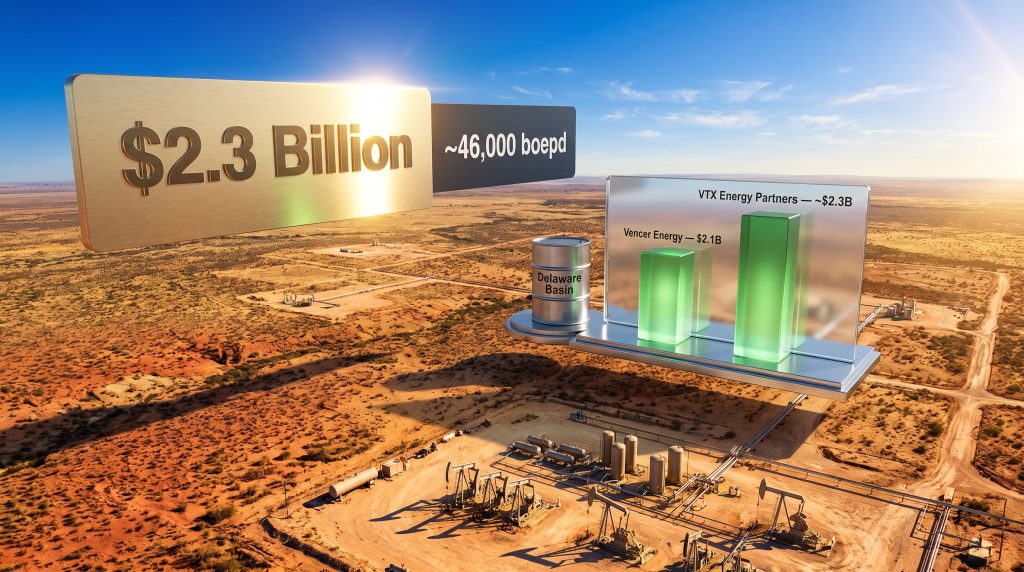
The Vitol sale of VTX Energy is not an isolated event. It is the second exit from a U.S. shale upstream venture within approximately two years, following the $2.1 billion sale of Vencer Energy to Civitas Resources which closed in 2024. That two-exit sequence, both generating multi-billion dollar proceeds, strongly suggests a deliberate strategic reallocation rather than opportunistic selling. Indeed, the commodity price impact on asset valuations has played a meaningful role in the favourable timing of both transactions.
| Asset | Buyer | Sale Value | Approximate Year |
|---|---|---|---|
| Vencer Energy | Civitas Resources | $2.1 billion | 2024 |
| VTX Energy Partners | Carnelian/EnCap consortium | ~$2.3 billion | 2026 (pending) |
Where Is Vitol's Capital Going Instead?
Vitol has been actively redeploying the substantial cash reserves it accumulated during a period of exceptional trading profitability. The destinations are revealing:
- Acquisition of Saras SpA, an Italian downstream refiner, expanding Vitol's European processing footprint.
- Purchase of Noble Resources Trading Ltd, broadening its commodity trading capabilities into coal markets.
- A $1.65 billion agreement announced in 2025 to acquire oil and LNG projects from Eni SpA in Ivory Coast and the Republic of Congo, shifting upstream exposure toward African frontier assets.
The pattern is coherent. Vitol is rotating out of a highly competitive, consolidation-saturated U.S. shale market and directing capital toward geographies and asset types where its trading infrastructure and commodity expertise create differentiated value. Commodity trading giants such as Vitol have increasingly demonstrated this behaviour, with African upstream and European downstream assets offering both strategic fit and less crowded competitive dynamics than the Permian Basin in 2026.
The "Build-to-Sell" Model: How Commodity Traders Use Upstream Equity
One of the less widely understood dynamics in global energy markets is the role that major commodity trading houses play as temporary capital allocators to upstream oil and gas ventures. Vitol is not an outlier; it is an exemplar of a broader pattern.
The lifecycle of VTX Energy illustrates this model with precision:
- Vitol commits $1 billion to seed VTX in February 2022 alongside an experienced management team.
- VTX executes an acquisition-led growth strategy, assembling a 46,000 boepd production base and significant acreage.
- Non-core surface assets are divested to LandBridge for $245 million, optimising the remaining package.
- Vitol sells the refined asset to a PE consortium at approximately $2.3 billion, recycling capital into the next strategic priority.
This is capital deployment as a structured discipline, not long-term industrial ownership. Trading houses have balance sheet scale, commodity market intelligence, and risk management capabilities that allow them to move faster than most PE firms in seeding upstream ventures. However, their competitive advantage in producing oil is weaker than in trading it, which is why exits are built into the strategy from the outset.
Why the Delaware Basin Commands a Premium in 2026
Scarcity, Geology, and the Post-Consolidation Premium
The Delaware Basin, the western sub-basin of the broader Permian Basin, has emerged as arguably the most sought-after onshore oil and gas real estate in North America. Its geological characteristics justify the premium: thick, stacked pay zones across multiple formations including the Wolfcamp, Bone Spring, and Delaware Mountain Group allow operators to drill multiple horizontal wells from single pad locations, dramatically improving capital efficiency.
However, geology alone does not explain the current pricing environment. The post-consolidation landscape has dramatically reduced the number of quality, privately-held operators of meaningful scale. Major M&A transactions between 2022 and 2025 absorbed most mid-size independents into larger public companies. What remains is a very short list of platforms like VTX that offer:
- Scaled production generating defensible cash flows at current oil prices.
- Contiguous acreage that cannot be easily replicated through piecemeal land purchases.
- Operational infrastructure including midstream and water handling assets already in place.
- Experienced management teams with track records of efficient capital deployment.
VTX checks all four boxes, which explains why Jefferies was engaged to run a structured sale process and why a consortium of two established PE firms is reportedly at the table.
Geopolitical Oil Price Support: The Macro Tailwind
Conditions in global oil markets have also contributed to the timing and achievable valuation of this transaction. Conflict in the Middle East and disruptions to crude oil flows through the Strait of Hormuz created supply uncertainty that kept oil prices elevated above what most analysts had forecast for 2026. Consequently, oil market disruption stemming from geopolitical tensions has meaningfully influenced both seller expectations and buyer willingness to transact at premium valuations.
For sellers of producing upstream assets, a higher oil price backdrop directly improves the cash flow metrics against which buyers apply valuation multiples. Higher prices also change buyer psychology. When oil trades well above breakeven thresholds for Delaware Basin wells, acquisition economics tighten in favour of sellers, and competition among prospective buyers intensifies. Both factors support the approximately $2.3 billion valuation under discussion.
Readers should note that oil price forecasts are inherently uncertain. Geopolitical conditions that have supported elevated prices can shift rapidly, and any transaction of this scale carries commodity price risk for the acquiring parties.
Private Equity's Renewed Appetite for U.S. Shale
ESG Headwinds Have Eased, Capital Is Returning
For several years following the ESG-driven capital reallocation wave, private equity energy funds faced headwinds in raising and deploying capital into fossil fuel upstream assets. That environment has shifted materially. Institutional investors, recognising the durability of hydrocarbon demand and the cash flow generative nature of well-run upstream operators, have re-engaged with energy-focused PE vehicles.
EnCap's participation in this consortium is itself a signal. As one of the sector's most experienced upstream sponsors, EnCap's willingness to commit to a multi-billion dollar Permian Basin acquisition in 2026 reflects both institutional confidence in U.S. shale economics and a calculated view that remaining quality assets command valuations that will hold across a reasonable investment horizon. In addition, the US oil production decline narrative has paradoxically strengthened the case for acquiring high-quality producing assets rather than pursuing greenfield development.
Frequently Asked Questions: Vitol Sale of VTX Energy
What is VTX Energy Partners?
VTX Energy Partners is a Delaware Basin shale oil producer established in February 2022 through a partnership between Vitol Group and the management team from ATX Energy Partners. Backed by an initial $1 billion commitment from Vitol, VTX grew to produce approximately 46,000 boepd across roughly 46,000 net acres in the Texas portion of the Southern Delaware Basin.
What valuation is being discussed for VTX Energy?
Negotiations are reportedly centred on approximately $2.3 billion in equity value, with total enterprise value including debt estimated at up to $3 billion. Reuters has reported that Vitol is eyeing this valuation as it seeks to exit its U.S. shale position.
Who is buying VTX Energy?
A private equity consortium comprising Carnelian Energy Capital and EnCap Investments is reported to be in late-stage negotiations to acquire the asset.
Has the deal been completed?
As of the time of reporting, no definitive agreement has been signed. The parties are in advanced discussions, with a potential signing expected in the near term. No transaction is guaranteed until formal closing documentation is executed.
Is this Vitol's first U.S. shale exit?
No. Vitol previously sold Vencer Energy to Civitas Resources for $2.1 billion in 2024. The Vitol sale of VTX Energy would represent its second U.S. shale divestment within approximately two years.
What happened to VTX's surface acreage?
In November 2024, VTX sold approximately 46,000 surface acres to LandBridge for $245 million in cash, retaining its subsurface production rights and core operational assets.
The next major ASX story will hit our subscribers first
Key Takeaways for Investors and Industry Observers
The proposed Vitol sale of VTX Energy concentrates several important signals into a single transaction. Taken together, they offer a coherent picture of where U.S. upstream M&A is heading:
- Acreage scarcity is pricing-in rapidly. The post-consolidation Permian Basin offers very few remaining privately-held operators of VTX's scale, and buyers are paying accordingly.
- Commodity trader capital is not permanent upstream capital. Vitol's two-exit record confirms that trading houses use upstream equity as a structured capital deployment tool with a defined monetisation horizon.
- Private equity is back at scale. The Carnelian and EnCap consortium bid signals that energy-focused PE firms have re-engaged with U.S. shale at the multi-billion dollar level.
- Macro conditions are tilting toward sellers. Geopolitically-driven oil price support has improved deal economics for sellers and increased buyer competition for quality producing assets.
- The build-to-sell model remains viable. VTX's progression from a $1 billion seed commitment to a reported ~$2.3 billion exit validates the continued commercial logic of PE-backed upstream build-and-monetise cycles in U.S. shale.
This article is for informational purposes only and does not constitute investment advice. All figures related to the VTX Energy transaction are based on reported information from sources familiar with ongoing negotiations. No transaction is confirmed until definitive agreements are executed and publicly disclosed.
Want to Spot the Next Major Mineral Discovery Before the Market Does?
While commodity traders like Vitol strategically recycle capital across global energy assets, Discovery Alert's proprietary Discovery IQ model delivers real-time alerts on significant ASX mineral discoveries — instantly translating complex geological data into actionable investment insights for both short-term traders and long-term investors. Explore how historic discoveries have generated substantial returns on Discovery Alert's dedicated discoveries page, and begin your 14-day free trial today to position yourself ahead of the broader market.