
July 17, 2026
The Inflation Hedge Myth That Keeps Costing Investors Money
Decades of financial folklore have embedded a stubborn assumption into mainstream investment thinking: when inflation rises, buy gold. It sounds intuitive. It gets repeated by commentators, financial advisors, and retail investors alike. But a closer examination of the empirical record, combined with a rigorous understanding of monetary mechanics, reveals that this belief is not only oversimplified — it can actively damage portfolio performance when acted upon without nuance.
The reality is that gold is not an inflation hedge in any reliable, mechanistic sense. Understanding why this is the case, and what actually drives gold prices, is one of the most practically valuable things an investor can learn.
When big ASX news breaks, our subscribers know first
The Historical Narrative That Misleads Modern Investors
Why Gold's 1970s Performance Is Frequently Misread
The gold-inflation narrative draws most of its credibility from a single historical episode: the 1970s. During that decade, the United States experienced surging consumer price inflation alongside a dramatic rise in gold prices. Many observers concluded that one caused the other. However, this interpretation conflates correlation with causation in a way that distorts the real mechanism.
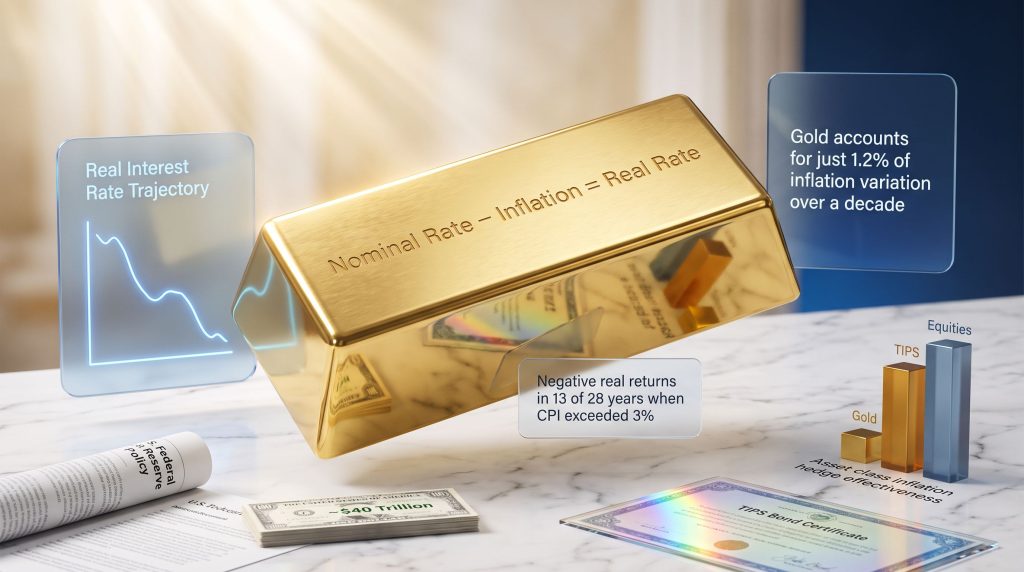
What was actually happening in the 1970s was that inflation was rising faster than interest rates were being raised in response. That gap, where nominal rates lagged inflation, meant that real interest rates were effectively falling throughout much of the decade. It was the declining real rate environment, not the rising CPI itself, that powered gold's ascent. For further context, the gold market outlook for 2025 sheds light on how these historical dynamics continue to shape modern positioning.
When inflation rises faster than nominal interest rates, real interest rates fall. That is the actual condition under which gold thrives, and it is not equivalent to inflation itself.
This distinction matters enormously because in a modern environment where central banks respond aggressively to inflation by raising nominal rates faster than prices rise, the environment for gold can become actively hostile — even as headline inflation remains elevated.
Currency Devaluation vs. Inflation: Two Different Phenomena
Another source of conceptual confusion is the conflation of currency devaluation with consumer price inflation. Gold has historically served as a store of value against the long-run erosion of fiat currency purchasing power. That is a structural role tied to monetary confidence. It is categorically different from a short-run CPI hedge, where gold would need to reliably track monthly or annual changes in consumer prices. The empirical data makes clear that gold does not perform this latter function with any consistency. According to Investopedia's definition of an inflation hedge, a true hedge must preserve purchasing power reliably — a standard gold frequently fails to meet in practice.
What the Academic Research Actually Says
Empirical Evidence on Gold as an Inflation Hedge
The academic literature on gold as an inflation hedge is considerably more sceptical than popular financial media suggests. A range of empirical studies using nonlinear analysis across major economies has produced findings that challenge the consensus view.
| Research Finding | Detail |
|---|---|
| Long-run hedge effectiveness | Not supported by nonlinear analysis across major economies |
| Short-run hedge (selective) | Limited evidence in the UK, USA, and India only |
| Correlation with inflation | Statistically near zero in modern datasets |
| Post-1980 hedging performance | No meaningful hedging function identified |
| Inflation sensitivity (beta) | Highly unstable; frequently switches between positive and negative |
| Inflation threshold for effectiveness | Only activates above approximately 0.55% monthly (~6.8% annualised) |
| 10-year return variance | Gold accounts for just 1.2% of inflation variation over a decade |
| Negative return frequency | Gold delivered negative real returns in 13 of 28 years when CPI exceeded 3% |
Why Gold's Inflation Beta Is Structurally Unstable
One of the most damaging findings for the gold-as-inflation-hedge narrative is that gold's sensitivity to inflation — what analysts call its inflation beta — is not a stable, reliable figure. It shifts between positive and negative across different time periods and economic regimes. This instability means that even when the directional relationship appears to hold, it cannot be counted upon to repeat.
The research also identifies a meaningful inflation threshold. Gold's hedging function appears to activate only when annualised inflation exceeds approximately 6.8% — a level that most developed economies rarely sustain for extended periods. In moderate inflationary environments of 2% to 4%, the relationship essentially breaks down.
Furthermore, the finding that gold explains just 1.2% of inflation variation over a ten-year horizon is statistically devastating to the conventional argument. Over the time frames that matter most to long-term investors, CPI movements and gold price movements are almost entirely disconnected. Indeed, research published by the CFA Institute describes this as an inherently unstable relationship, reinforcing the empirical case against simplistic assumptions.
What Actually Drives Gold Prices: The Real Interest Rate Framework
The Formula Investors Need to Understand
If gold is not an inflation hedge, then what is it? The answer lies in the relationship between nominal interest rates and inflation, expressed through the concept of real interest rates.
Real Interest Rate = Nominal Interest Rate minus Inflation Rate
When this calculation produces a negative or falling result, gold tends to perform strongly. When real rates are rising, gold tends to underperform. This framework is far more predictive of gold's behaviour than headline CPI data alone, and it reframes the entire debate around monetary policy cycles rather than inflation readings in isolation.
Gold prices rise when real interest rates fall. This happens when nominal rates are either declining or are rising more slowly than inflation. This relationship is structurally more reliable than any direct link between gold and the Consumer Price Index.
How Different Economic Conditions Shape the Gold Outlook
| Economic Condition | Nominal Rates | Inflation | Real Rate | Gold Outlook |
|---|---|---|---|---|
| Recession with rate cuts | Falling | Stable/Falling | Falling | Bullish |
| High inflation + rate hikes lagging | Rising slowly | Rising fast | Falling | Bullish |
| High inflation + aggressive hikes | Rising faster | Rising | Rising | Bearish |
| Disinflation with stable rates | Stable | Falling | Rising | Bearish |
| Yield curve control scenario | Capped | Rising | Plunging | Strongly Bullish |
This table illustrates why geopolitical crises, which often trigger inflationary expectations, do not automatically translate into gold price gains. The critical variable is what central banks do in response to that inflation. The strategic case for gold explored in the context of 2025's geopolitical environment makes this point particularly clear.
Why Geopolitical Crises Don't Reliably Boost Gold Prices
The Counterintuitive Reality of Gold and Conflict
Many investors assume that geopolitical instability is inherently bullish for gold. The logic seems sound on the surface: uncertainty drives safe-haven demand. However, the actual mechanism is more complex and frequently works in the opposite direction.
When military conflict drives energy prices higher, the resulting inflationary pressure can compel central banks to maintain or increase interest rates. That rate environment, in turn, creates rising real yields, which is structurally negative for gold. The metal does not love war or crisis for its own sake. It loves falling costs of money.
When geopolitical conflict drives oil prices sharply higher, the inflationary consequences can force central banks to keep rates elevated, creating a headwind for gold that overrides any safe-haven sentiment.
Oil Price Spikes and the Negative Feedback Loop for Precious Metals
Consider a scenario where conflict in a major oil-producing region sends crude prices from $67 per barrel to above $80. The immediate market instinct is to buy gold. But if that oil price spike feeds into CPI data and delays rate cuts that were otherwise anticipated, the environment for gold deteriorates rather than improves. Rate cut expectations priced into futures markets get unwound, real rates stabilise or rise, and gold reverses.
This is not a theoretical construct. It reflects the actual market dynamic that plays out repeatedly when geopolitical risk intersects with monetary policy expectations.
The Structural Long-Term Case for Gold
Why the U.S. Fiscal Position Changes the Long-Term Equation
While the short-term case for gold is highly conditional and cycle-dependent, the long-term structural argument rests on a far more durable foundation: the deteriorating fiscal position of the United States and the limited options available to policymakers as a result.
| Fiscal Indicator | Current Scale |
|---|---|
| Weekly interest payments on national debt | Approximately $24 billion |
| Monthly federal deficit additions | Approximately $155 billion |
| Total national debt | Approaching $40 trillion |
| National debt as a percentage of GDP | Approximately 125% |
| Comparison: 1970s debt-to-GDP ratio | Approximately 30% |
These figures represent a qualitatively different fiscal environment than any previous period in U.S. history. The sheer scale of outstanding debt relative to economic output creates a structural constraint on monetary policy that has no modern precedent.
Monetisation of Sovereign Debt and Yield Curve Control
As the debt burden grows, the Federal Reserve faces an increasingly uncomfortable position. The volume of Treasury issuance required to fund ongoing deficits, combined with interest payments that compound at the current scale, creates a scenario where organic market demand for government bonds may prove insufficient to absorb supply without yields rising to economically damaging levels.
In that environment, the policy tool historically deployed is yield curve control: a central bank commitment to cap long-term interest rates by purchasing whatever quantity of bonds is necessary to hold yields at a target level. Japan has employed this framework for extended periods. The implications for gold are profound.
If nominal rates are capped through policy while inflation rises due to the monetary expansion required to execute that capping, real interest rates would fall sharply and potentially deeply into negative territory. That is historically the most powerful environment for gold appreciation. The interplay between gold and bonds in such a regime is a critical dimension of this structural argument.
Why the Next Recession Could Be the Inflection Point
The convergence of several forces points toward an eventual inflection: a recessionary contraction that triggers automatic fiscal stabilisers, amplifying deficits further; a Federal Reserve constrained from raising rates by debt servicing costs; and a balance sheet expansion cycle that dwarfs previous quantitative easing programmes. Equity market valuations trading at historically extreme multiples relative to GDP and earnings — a ratio sometimes described as exceeding 230% of GDP — increase the severity of any mean-reversion event.
When that correction occurs, capital seeking safety may not find adequate refuge in bonds yielding negative real returns. Gold, as the asset with no counterparty risk and no liability attached to it, becomes a logical destination. The driver in that scenario is not inflation in isolation. It is systemic monetary stress.
The next major ASX story will hit our subscribers first
Gold vs. Other Inflation Hedges: A Comparative Analysis
How Gold Stacks Up Against Alternatives
| Asset Class | Inflation Hedge Effectiveness | Key Conditions for Outperformance | Key Risk |
|---|---|---|---|
| Gold | Weak to moderate (short-term only) | Falling real rates, recession, monetary expansion | Performs poorly during rate hike cycles |
| TIPS (Inflation-Protected Bonds) | Strong and direct | Any inflationary environment | Duration risk if real rates rise |
| Equities (broad market) | Strong over 50-year horizon | Revenue growth exceeds CPI | Cyclical drawdown risk |
| Real Estate | Moderate to strong | Supply-constrained markets | Illiquidity, leverage risk |
| Commodities (broad basket) | Strong during supply-driven inflation | Energy and agricultural shocks | High volatility, no yield |
| Silver | Correlated with gold but more volatile | Industrial demand and monetary demand convergence | Highly sensitive to growth slowdowns |
Treasury Inflation-Protected Securities (TIPS) offer a more structurally reliable hedge against consumer price inflation because their principal value adjusts directly with CPI movements. Broad equity portfolios have outpaced both gold and inflation over 50-year horizons, though with significant cyclical volatility. Commodities baskets perform well during supply-shock inflation but carry high volatility and generate no income.
Silver's Dual Identity
Silver's dual role as both an industrial metal and a monetary asset places it in an interesting position. Its behaviour is correlated with gold but amplified, often moving more sharply in both directions. During periods where industrial demand contracts alongside a growth slowdown, silver can underperform gold significantly despite sharing the same monetary characteristics. This dual role makes silver a more complex instrument for investors seeking either inflation protection or monetary hedge exposure.
The K-Shaped Economy and Its Distorting Effect on Macro Data
What Nominal GDP Growth Hides About Actual Economic Conditions
One of the more underappreciated analytical points for gold investors is the growing divergence between aggregate macroeconomic data and the lived economic experience of the majority of consumers. Nominal GDP growth figures can be significantly inflated by large-scale capital expenditure concentrated in specific sectors — including the current wave of artificial intelligence infrastructure spending — while the majority of households experience conditions more consistent with a recessionary environment.
Retail sales figures, being nominal rather than inflation-adjusted, can register apparent strength simply because consumers are paying higher prices for the same or fewer goods. This creates a situation where headline economic data looks resilient while underlying demand is contracting in real terms. Investors who take nominal data at face value may systematically misjudge the actual stage of the economic cycle and, by extension, the appropriate positioning for gold.
Asset bubble wealth effects concentrated in the upper income quintile can further distort consumption data, creating an illusion of broad economic health when the majority of the population is experiencing genuine financial stress. Understanding this structural divide is essential for interpreting economic signals relevant to precious metals positioning.
How Sophisticated Investors Actually Position Around Gold
Active vs. Passive Approaches
A static, permanent allocation to gold — regardless of the economic cycle — is likely to produce significant periods of underperformance. The empirical evidence and the real rate framework both point toward a cyclical, actively managed approach as more effective than a buy-and-hold posture.
The optimal entry point for increased gold exposure is when economic data begins to deteriorate, nominal interest rates are expected to fall faster than inflation, and real rates are trending into negative territory. This is typically confirmed by a combination of weakening labour market data, declining CPI momentum, and clear central bank signalling toward policy easing.
12 Data Points Sophisticated Investors Monitor for Gold Timing
- Yield curve shape and dynamics
- Break-even inflation spreads (nominal vs. TIPS yields)
- Commodity Research Bureau (CRB) Index trends
- Central bank balance sheet expansion or contraction
- Real interest rate trajectory (not nominal)
- Credit market stress indicators
- Equity market valuation multiples (CAPE ratio, price-to-sales)
- Non-farm payroll trends
- CPI month-over-month momentum
- Retail sales adjusted for inflation
- Energy price trajectory and geopolitical risk premium
- Federal Reserve policy signalling and forward guidance
This type of multi-variable economic cycle model — tracking the second derivative of inflation and growth simultaneously — allows investors to anticipate shifts in the macro regime rather than react to them after the fact. The objective is to understand not just current conditions but the direction and rate of change of the key variables that determine gold's environment.
The Danger of a Highly Stochastic Investment Environment
Contemporary markets are characterised by an unusually wide range of potential macro outcomes. The spectrum from deflation through disinflation, stasis, inflation, and potential hyperinflation represents scenarios that each require substantially different portfolio positioning across equities, bonds, currencies, and commodities. A static allocation strategy that performs well in one regime can produce severe losses in another. Active management calibrated to the economic cycle is not a preference in this environment; for many investors, it may be the only viable approach.
Frequently Asked Questions: Gold and Inflation
Is gold a good hedge against inflation?
Gold is not a reliable inflation hedge in the short to medium term. Academic research shows near-zero statistical correlation with CPI in modern datasets and negative real returns in a significant number of years when inflation exceeded 3%. Its hedging function only becomes meaningful at annualised inflation rates above approximately 6.8%.
When does gold perform best historically?
Gold performs best during recessions accompanied by falling nominal interest rates, when stock prices are declining and the opportunity cost of holding gold is low, and when central bank balance sheets are expanding in ways that suppress real yields.
Why did gold rise in the 1970s if it isn't an inflation hedge?
Gold rose in the 1970s because inflation was increasing faster than interest rates, meaning real interest rates were actually declining throughout much of that decade. The driver was falling real rates, not inflation per se.
What is a real interest rate and why does it matter for gold?
A real interest rate is the nominal interest rate minus the inflation rate. When real rates fall or turn negative, gold becomes more attractive because the opportunity cost of holding a non-yielding asset diminishes relative to other stores of value.
Should I buy gold during a recession?
Recessions are historically among the most favourable environments for gold, provided the central bank responds by cutting rates and expanding its balance sheet. The combination of falling nominal rates, declining equity prices, and monetary expansion tends to produce strongly negative real rates.
What assets actually protect against inflation?
TIPS offer the most direct structural protection against consumer price inflation. Broad commodity baskets perform well during supply-shock inflation. Equities have outpaced inflation over very long horizons. Gold is better understood as a monetary confidence and systemic stress asset rather than a CPI tracker.
How does the Federal Reserve's balance sheet affect gold prices?
Balance sheet expansion, or quantitative easing, increases the money supply and typically suppresses real yields, both of which are bullish for gold. Contraction of the balance sheet, or quantitative tightening, has the opposite effect.
Is silver a better inflation hedge than gold?
Silver shares gold's monetary characteristics but adds industrial demand sensitivity, making it more volatile. It tends to amplify gold's moves in both directions and is more vulnerable to growth slowdowns due to its industrial applications.
What is yield curve control and how does it affect precious metals?
Yield curve control is a central bank policy of capping long-term interest rates by committing to purchase unlimited quantities of bonds to maintain a yield target. If this is deployed while inflation is rising, real rates would fall sharply, creating one of the most bullish possible environments for gold and silver.
How much gold should I hold in a diversified portfolio?
There is no universally correct allocation. The appropriate weighting depends heavily on where the economy is in the interest rate and credit cycle. A cyclically aware, actively managed approach that increases gold exposure when real rates are falling and reduces it when they are rising is likely to outperform any static allocation.
Reframing Gold as a Monetary Confidence Asset, Not an Inflation Proxy
The Long-Term Structural Bull Case
The most durable case for gold over a multi-year horizon does not rest on inflation projections alone. It rests on the structural trajectory of sovereign debt, the constraints this places on monetary policy independence, and the increasing probability that real interest rates will be deliberately suppressed to manage debt servicing costs at a national scale.
With U.S. national debt approaching $40 trillion, debt-to-GDP at approximately 125% compared to roughly 30% in the 1970s, and weekly interest payments running at approximately $24 billion, the arithmetic of sustainable debt management is increasingly difficult to reconcile with orthodox monetary policy. The supply of fixed income instruments competing for global capital is simply overwhelming at current scales.
The long-term bull case for gold is therefore not about CPI prints. It is about the inevitable tension between fiscal necessity and monetary credibility, and the historical precedent that when those two forces collide, monetary credibility tends to yield.
Practical Takeaways for Investors
- Do not buy gold simply because inflation is reported to be rising. The relevant question is whether real interest rates are falling.
- Monitor the second derivative of economic data: not just where inflation and growth are, but where they are heading.
- Recognise that a highly stochastic macro environment requires dynamic, not static, portfolio management.
- Be aware of the distinction between nominal economic strength and real underlying conditions, particularly in a K-shaped economy where aggregate data masks deteriorating conditions for the majority of consumers.
- Understand that the long-term structural case for gold is rooted in fiscal and monetary dynamics that are likely to reassert themselves through the next major recession, regardless of when that materialises.
For investors seeking broader context on how monetary conditions shape precious metals markets and where portfolio managers are positioning across different economic cycle scenarios, additional educational discussion on these themes is available through the Wall Street Bullion YouTube channel*, featuring active portfolio managers providing complementary perspectives on cycle-driven investing.*
Disclaimer: This article is intended for educational and informational purposes only. It does not constitute financial advice or a recommendation to buy or sell any asset. All forecasts, projections, and cycle analyses discussed involve uncertainty and are inherently speculative. Past performance of any asset class is not indicative of future results. Investors should conduct their own due diligence and consult a qualified financial adviser before making investment decisions.
Want to Know Which ASX Mineral Discoveries Are Moving Markets Right Now?
Discovery Alert's proprietary Discovery IQ model delivers real-time alerts on significant ASX mineral discoveries, cutting through complex data to surface actionable opportunities the moment they're announced — explore the historic returns major discoveries have generated and begin your 14-day free trial to position yourself ahead of the market.