
May 11, 2026
The Dormant Giant: How Alumina Supply Chain Realignment Is Reshaping Industrial Acquisition Logic
When global commodity supply chains fracture, industrial assets rarely retain their pre-disruption valuations. The economic logic that supported a billion-dollar alumina refinery in peacetime becomes something entirely different under conflict conditions, and it is precisely within that gap between intrinsic long-term value and current war-risk pricing where some of the most consequential industrial acquisitions take shape. Understanding why Alcoa eyes Mykolaiv Alumina Plant privatization requires looking beyond the headline numbers and into the structural forces reordering global alumina supply.
When big ASX news breaks, our subscribers know first
What Makes the Mykolaiv Alumina Plant a Strategically Irreplaceable Asset
Alumina, the refined intermediate product derived from bauxite ore, is the essential feedstock for aluminium smelting. Every tonne of primary aluminium requires approximately two tonnes of alumina to produce, making refining capacity a critical bottleneck in the entire aluminium value chain. Ukraine's Mykolaiv Alumina Plant (MAP), located in southern Ukraine, was before 2022 one of Eastern Europe's most significant alumina refining nodes, employing approximately 5,000 workers and supplying alumina directly into the production network of RUSAL, Russia's dominant aluminium producer.
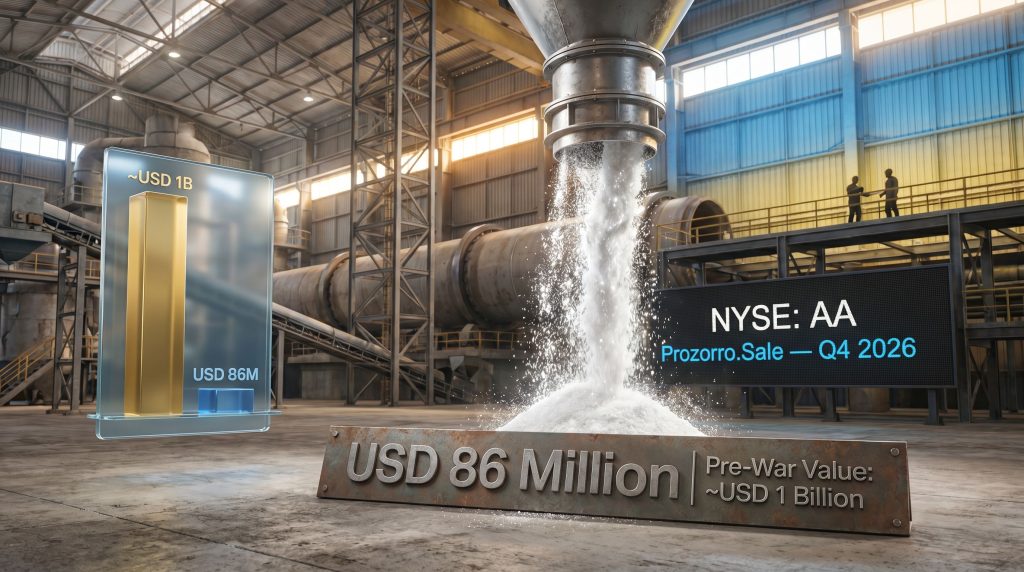
The plant's pre-war estimated valuation sat at approximately USD 1 billion, a figure that reflected not just physical infrastructure but an established position within a high-throughput, vertically integrated supply chain. Since the outbreak of full-scale conflict, commercial production has been suspended, and the workforce has contracted to roughly 400 employees engaged in infrastructure preservation, environmental compliance, and the continuous management of red mud disposal areas.
The Red Mud Problem: Why 400 Workers Cannot Simply Walk Away
Red mud, the caustic residue generated during the Bayer process of alumina refining, accumulates in large containment areas and requires permanent environmental oversight regardless of whether the refinery is producing. The material contains elevated concentrations of alkaline compounds, heavy metals, and radioactive traces from naturally occurring elements in bauxite ore. Without active management, containment structures can degrade, creating risks of toxic leakage into soil and water systems that can persist for generations.
This is not merely a caretaker arrangement. The 400-person skeleton crew at MAP represents a non-negotiable environmental liability management function. Any prospective acquirer would need to account for this baseline operational cost as a perpetual obligation, irrespective of restart timelines. It also means the physical asset is not simply sitting idle — it is actively being maintained against deterioration, which preserves some of its long-term recovery value.
Furthermore, the significance of global bauxite supply chains becomes particularly relevant here, as MAP's long-term viability depends directly on securing consistent upstream feedstock access once operations resume.
How MAP Passed from Oligarch Control to Ukrainian State Ownership
The plant's transition from private to state ownership unfolded across nearly two years of legal and administrative proceedings directly tied to Russia's invasion of Ukraine. The sequence of key milestones illustrates the complexity of war-era asset confiscation:
| Milestone | Date |
|---|---|
| Corporate rights transferred to ARMA (Asset Recovery and Management Agency) | July 2022 |
| High Anti-Corruption Court upholds confiscation of linked assets | June 2023 |
| Nationalisation completed, 100% transferred to State Property Fund of Ukraine | March 2024 |
| Privatisation announced by SPFU | April 2026 |
| Auction starting price set at USD 86 million | April 2026 |
| Auction target window | Q4 2026 (November-December) |
Before the conflict escalated into full-scale war, MAP operated within a business network linked to Oleg Deripaska, the Russian billionaire closely associated with RUSAL's industrial ecosystem. The plant's role as a primary alumina supplier to Russia's dominant aluminium producer made it a strategically significant asset whose control carried geopolitical as well as commercial implications. Ukrainian courts determined that the confiscation of these assets was legally justified, and by March 2024, the State Property Fund of Ukraine (SPFU) held full ownership.
Ukraine's 2026 Privatisation Strategy: The USD 300 Million Asset Sale Program
MAP sits within a far broader Ukrainian government initiative to convert seized war-related assets into productive, investor-managed enterprises. The SPFU's 2026 privatisation program encompasses more than 26 sanctioned properties, organised into approximately 170 asset groupings, with a combined estimated value of roughly USD 300 million.
The program is being conducted through Prozorro.Sale, Ukraine's transparent digital public auction platform, which was originally developed to reduce corruption in government procurement and has since been adapted for large-scale asset sales. The platform's open, competitive architecture is designed to attract international participation and maximise price discovery.
Other notable assets in the 2026 privatisation cohort include the Odesa Portside Plant and the Ocean Plaza commercial complex. However, MAP stands apart from most of the pipeline assets due to its industrial scale, its potential role in European alumina supply chains, and its pre-war valuation that dwarfs its current auction starting price. Reports from Ukrainian industry sources confirm the significant international interest this process has already generated.
The SPFU has publicly indicated a preference for strategic foreign investors from countries including the United States and India, distinguishing between buyers capable of restarting and managing industrial-scale alumina refining versus purely financial acquirers seeking asset appreciation plays.
Alcoa Eyes Mykolaiv Alumina Plant: What the Preliminary Talks Signal
In May 2026, the Head of Ukraine's State Property Fund, Dmytro Natalukha, confirmed that a major publicly listed aluminium company had entered preliminary discussions with SPFU representatives, with the talks taking place in London. While the company was not officially identified by name, Natalukha described the interested party as a prominent public enterprise specialising specifically in the aluminium industry and listed on the New York Stock Exchange.
Market analysis points strongly toward Alcoa Corporation (NYSE: AA) as the most probable candidate. Among NYSE-listed entities with direct relevance to alumina refining operations, Alcoa is the dominant vertically integrated player, with a business model spanning bauxite mining, alumina refining, and primary aluminium smelting. No other NYSE-listed entity closely matches the operational profile described.
For Alcoa, MAP would represent a strategically logical upstream acquisition target. Alumina refining is central to Alcoa's industrial identity, and access to a large-scale European refinery at a fraction of pre-war replacement cost could materially alter its upstream cost structure if the asset were eventually restarted. The plant's existing infrastructure, while currently suspended, avoids the multi-year development timeline and capital intensity associated with greenfield refinery construction.
Additionally, the current Alcoa market outlook suggests the company is actively navigating shifting commodity dynamics, which further contextualises why upstream European assets may hold growing strategic appeal.
The Deep-Value Arithmetic: USD 86 Million vs. USD 1 Billion
The valuation gap between MAP's pre-war assessment and its current auction starting price is one of the most striking features of this transaction:
| Metric | Value |
|---|---|
| Pre-war estimated valuation | ~USD 1 billion |
| 2026 auction starting price | USD 86 million |
| Implied discount to pre-war value | ~91% |
| Pre-war workforce | ~5,000 employees |
| Current maintenance workforce | ~400 employees |
| Auction platform | Prozorro.Sale |
| Preferred investor origin countries | United States, India |
An approximately 91% discount to pre-war valuation is not a reflection of permanent asset destruction. It is war-risk pricing applied to an operating industrial facility with intact physical infrastructure and active environmental management. For an investor with a credible long-term reconstruction thesis, sufficient risk capital, and the operational expertise to restart an alumina refinery, this discount represents an asymmetric return profile contingent on a single macro variable: conflict resolution.
The Public vs. Private Buyer Divide: Why Governance Structure Changes Everything
One of the most analytically important dimensions of MAP's privatisation is the structural difference between how public companies and private investors approach war-zone acquisitions. Natalukha's own assessment made this explicit: the probability that a major public company would ultimately decide to invest in Ukraine under current geopolitical conditions is substantially lower than for private buyers.
This is not a commentary on strategic interest — it is a governance reality. Large publicly listed corporations carry obligations that private entities do not:
| Risk Category | Public Buyer (e.g., NYSE-listed) | Private Buyer |
|---|---|---|
| Shareholder governance requirements | High, board approval and ESG scrutiny required | Low, internal decision-making |
| War-risk insurance complexity | Elevated premiums, limited coverage | Negotiable through bespoke structures |
| Regulatory compliance (OFAC, sanctions) | Stringent U.S. regulatory oversight | Variable by jurisdiction |
| Operational restart flexibility | Dependent on conflict resolution timeline | Flexible, long-horizon management |
| Reputational risk exposure | High, public market disclosure obligations | Lower, limited public reporting requirements |
This structural distinction is not merely academic. It explains why the SPFU has openly acknowledged that private investors may ultimately prove more likely to complete this transaction than a household-name aluminium major, regardless of how strategically compelling the asset appears on paper.
In addition, aluminium tariff impacts on Western producers are increasingly reshaping capital allocation decisions, adding another layer of complexity for any publicly listed bidder weighing regulatory exposure against acquisition upside.
The next major ASX story will hit our subscribers first
Three Scenarios for MAP's Privatisation Outcome
The trajectory of MAP's Q4 2026 auction can be modelled across three plausible scenarios:
Scenario 1: A Major Aluminium Producer Completes Acquisition
A vertically integrated Western aluminium company proceeds with a formal bid at or above the USD 86 million starting price. Post-conflict reconstruction timelines allow for a phased operational restart. MAP is reintegrated into Western European alumina supply chains. This scenario carries the highest long-term value creation potential but faces the steepest near-term governance hurdles for any publicly listed bidder.
Scenario 2: Private Capital or Strategic Non-Listed Buyer Emerges
A private investment vehicle, family office, or non-listed industrial group with lower governance constraints and a longer capital horizon acquires MAP. The asset enters a holding and maintenance phase, with restart planned contingent on conflict resolution. The SPFU's own commentary suggests this pathway faces "significantly lower" structural barriers to completion.
Scenario 3: Auction Delayed or Unsuccessful
Ongoing conflict escalation deters all qualified bidders from registering for the Q4 2026 auction. The SPFU extends the privatisation timeline, restructures the offering, or adjusts the starting bid to attract interest. MAP's 400-person maintenance crew continues environmental operations under state ownership.
The SPFU has explicitly identified geopolitical risk as the primary obstacle to MAP's successful privatisation, with asset debt levels considered a secondary concern by comparison.
What MAP's Potential Sale Means for Global Alumina Supply Chains
The broader context for this transaction extends well beyond a single refinery auction. Russia's invasion of Ukraine in 2022 fractured established Eastern European alumina logistics networks that had historically connected Ukrainian refining capacity with Russian smelting demand. The disruption created a structural gap in regional supply that Western aluminium producers are still navigating.
MAP's reactivation under Western ownership would contribute meaningfully to European alumina supply diversification, reducing dependence on imports from politically sensitive or geographically concentrated supply corridors. The plant's former role as a major RUSAL supplier illustrates the scale of dormant capacity that could, under the right ownership and conditions, be redirected toward Western industrial demand.
Notably, top aluminium producers globally are already reconfiguring their upstream strategies in response to these disruptions, making MAP's privatisation outcome an important signal for the industry more broadly.
For the global aluminium industry, the outcome of this privatisation process carries signal value beyond its direct commercial impact. It will serve as an early indicator of whether Western industrial capital is prepared to deploy serious capital into Ukraine's reconstruction economy while active conflict persists, and under what structural conditions that deployment becomes viable. Alcoa's joint venture activities elsewhere also suggest the company is actively pursuing upstream diversification strategies that could align with MAP's long-term potential.
Furthermore, broader government support initiatives for Alcoa's strategic materials operations signal that public policy backing could play a meaningful role in shaping whether a major acquisition of this nature ultimately proceeds.
Key Milestones to Track Before the Q4 2026 Auction
Investors and industry observers monitoring this transaction should watch for the following developments:
- Formal bidder registration confirmations published by the SPFU ahead of the November-December auction window
- Alcoa investor relations disclosures referencing European upstream expansion or capital allocation decisions
- Geopolitical developments in the Ukraine-Russia conflict that materially shift investor risk appetite
- Entry of competing bidders from India or private equity into the registered participant pool
- SPFU adjustments to auction terms, starting price, or timeline that may signal weak initial bidder interest
- U.S. policy statements regarding American industrial investment in Ukraine's reconstruction economy, which could influence governance considerations for NYSE-listed bidders
Disclaimer: This article is intended for informational purposes only and does not constitute financial or investment advice. The privatisation of the Mykolaiv Alumina Plant involves significant geopolitical, operational, and financial risks. All valuations, probability assessments, and scenario projections referenced in this article are analytical frameworks, not guaranteed outcomes. Readers should conduct independent due diligence before making any investment decisions. Company identification as a potential bidder is based on publicly available market analysis and has not been officially confirmed.
Want to Track the Next Major Mineral Discovery Before the Broader Market Does?
Discovery Alert's proprietary Discovery IQ model delivers real-time alerts on significant ASX mineral discoveries, transforming complex commodity data into actionable investment insights for both short-term traders and long-term investors — explore Discovery Alert's discoveries page to understand how historic finds have generated substantial returns, and begin your 14-day free trial to position yourself ahead of the market.

