July 17, 2026
When Scale Becomes Strategy: Understanding the Logic of Upstream Aluminium Consolidation
The aluminium industry has long operated under a fundamental tension: the raw material chain from bauxite to finished metal is among the most capital-intensive and energy-dependent in global manufacturing, yet the commodity itself trades in highly cyclical markets where price discovery is largely outside any single producer's control. For decades, the rational response to this tension was diversification, spreading risk across multiple metals and geographies. What is now emerging, however, is a counter-movement, where the largest Western-aligned producers are doubling down on scale and vertical integration rather than spreading capital thin across unrelated commodities.
The Alcoa South32 acquisition, valued at up to US$5.6 billion in total potential enterprise value, is the most visible expression of this strategic shift. It is not simply a large transaction; it is a deliberate repositioning of one of the world's oldest aluminium companies into a role of undisputed upstream dominance at a moment when supply chain security, decarbonisation economics, and geopolitical fragmentation are all conspiring to reward exactly that kind of scale.
When big ASX news breaks, our subscribers know first
Breaking Down the Deal Structure: Financial Architecture and Risk Allocation
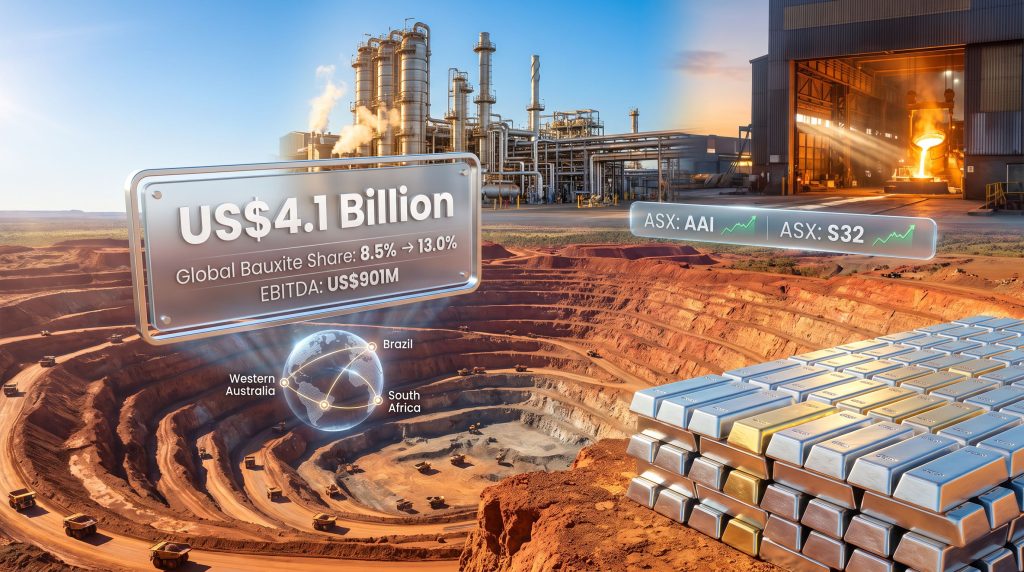
Understanding what Alcoa is actually paying, and how, is essential to evaluating whether the transaction creates or destroys shareholder value. The headline figure of US$4.1 billion in upfront consideration masks a considerably more complex financial arrangement. Alcoa's official press release outlines the full terms of the deal in detail.
| Deal Component | Value / Details |
|---|---|
| Upfront Cash Payment | US$3.1 billion |
| Alcoa Shares Issued | |
| Net Debt and Lease Liabilities Assumed | ~US$750 million |
| Contingent Value Right (CVR) | Up to US$750 million (price-linked, 2026-2030) |
| Total Upfront Consideration | ~US$4.1 billion |
| Maximum Potential Enterprise Value | ~US$5.6 billion |
The cash component is being funded through a US$3.1 billion bridge financing commitment arranged through Goldman Sachs, which Alcoa intends to refinance using a combination of existing balance sheet cash and permanent debt instruments. The share issuance, representing approximately 6% dilution on a post-issuance basis, serves a dual purpose: it reduces the immediate cash outlay while simultaneously aligning South32 as a stakeholder in Alcoa's post-deal performance trajectory.
What Is the Contingent Value Right and Why Does It Matter?
The CVR is one of the more structurally sophisticated elements of this transaction, and it deserves careful attention from investors on both sides of the deal.
- The mechanism ties up to US$750 million in additional payments to the performance of alumina and aluminium prices over four annual measurement periods
- Measurement runs from 1 July 2026 through to 2030, capturing a full commodity cycle window
- If prices outperform defined strike thresholds during any measurement period, Alcoa is obligated to make incremental payments to South32
- In a sustained bull market for aluminium, the CVR could materially increase the effective acquisition cost toward the US$5.6 billion ceiling
- Conversely, if prices remain subdued, the CVR provides Alcoa with meaningful cost relief, functioning as a natural hedge against overpaying at a cyclical peak
This structure reflects a mature approach to commodity M&A, where neither buyer nor seller has reliable price visibility across a multi-year horizon. Rather than arguing over a fixed valuation, the parties have effectively agreed to share whatever upside or downside the commodity market delivers. For Alcoa shareholders, the CVR limits downside acquisition risk. For South32, it preserves participation in the aluminium cycle even after divestiture.
The CVR mechanism is increasingly common in resource sector M&A precisely because commodity price uncertainty makes fixed valuations at transaction signing inherently speculative. By linking contingent payments to actual market outcomes, both parties reduce the adversarial nature of price negotiation.
The transaction is expected to close in the first half of 2027, subject to shareholder approvals from both companies and regulatory clearances across multiple jurisdictions including Australia, Brazil, and South Africa.
Asset Geography: What Alcoa Is Actually Acquiring
South32's aluminium-related assets, collectively referred to as the AliGroup portfolio, span three continents and represent a meaningfully diversified production base across the full upstream value chain.
| Geography | Asset | Type |
|---|---|---|
| Western Australia | Boddington Bauxite Mine | Bauxite extraction |
| Western Australia | Worsley Alumina Refinery | Alumina refining |
| South Africa | Hillside Aluminium Smelter | Primary aluminium production |
| South Africa | Bayside Smelter (idled) | Smelter property |
| Brazil | Mineração Rio do Norte (MRN) | Bauxite extraction |
| Brazil | Alumar Refinery and Smelter | Alumina refining and smelting |
The Deliberate Exclusion of Mozal: A Signal of Capital Discipline
One of the more revealing aspects of the deal is what Alcoa chose not to acquire. South32's Mozal aluminium smelter in Mozambique was explicitly excluded from the transaction scope, currently sitting on care and maintenance due to chronic power supply constraints in the region.
This exclusion carries strategic significance beyond the individual asset. It signals that Alcoa's acquisition rationale is anchored in operational viability and near-term cash generation, not asset accumulation for its own sake. Frontier-market energy infrastructure risk, particularly in a country where grid reliability remains unpredictable, sits outside Alcoa's strategic tolerance at this stage of its growth cycle. The Mozal exclusion is therefore a useful marker for understanding where management's capital allocation discipline begins and ends.
How the Alcoa South32 Acquisition Reshapes Global Market Structure
The scale implications of this deal extend well beyond Alcoa's own balance sheet. By absorbing South32's bauxite, refining, and smelting capacity, Alcoa fundamentally alters the competitive hierarchy among the top aluminium producers in the Western-aligned industry.
| Metric | Pre-Acquisition | Post-Acquisition |
|---|---|---|
| Global Bauxite Market Share (equity basis) | 8.5% | 13.0% |
| Attributable Bauxite Volume Added | – | +18 million tonnes |
| Attributable Alumina Volume Added | – | +5 million tonnes |
| Aluminium Smelting Capacity Increase | – | ~26% |
| Expected NPV Synergies | – | US$900 million |
Lifting equity-attributable bauxite market share from 8.5% to 13.0% establishes Alcoa as the world's largest bauxite miner on that basis, a designation with real operational consequences. Greater throughput across the bauxite-to-alumina-to-aluminium chain allows for procurement scale advantages, shared logistics infrastructure, and refining efficiencies that smaller or less integrated operators simply cannot replicate.
The US$900 million in net present value synergies identified by management reflects these operational leverage points, though investors should treat synergy estimates in major acquisitions with appropriate scepticism until integration execution demonstrates tangible delivery.
Pure-Play Upstream Positioning: What It Means for Investment Exposure
Alcoa's identity as a pure-play upstream aluminium company is central to understanding how this deal affects the investment thesis. Unlike diversified miners such as BHP or Rio Tinto, Alcoa concentrates its capital entirely within the bauxite-alumina-aluminium production chain. This creates several distinct dynamics for shareholders:
- Amplified commodity cycle exposure: When aluminium prices rise, Alcoa's earnings leverage is significantly higher than a diversified miner whose aluminium division might represent only a fraction of group earnings
- Reduced earnings diversification: The flip side is that Alcoa has no copper, iron ore, or coal earnings to offset aluminium downturns, making it a higher-beta play on base metals sentiment
- Vertical integration as a cost moat: Controlling captive bauxite supply reduces Alcoa's exposure to third-party feedstock pricing, which can compress refinery margins when spot bauxite prices spike
- Scale-driven green aluminium credentials: Larger operators have greater capacity to invest in low-carbon smelting technologies, an increasingly important consideration for downstream buyers with scope 3 emissions commitments
Alcoa's Q2 2026 Financial Performance: The Balance Sheet Behind the Bold Move
A transaction of this magnitude requires a credible financial foundation. Alcoa's second quarter 2026 results provided precisely that, delivering record revenue alongside a dramatic sequential improvement in earnings quality.
| Financial Metric | Q2 2026 Result |
|---|---|
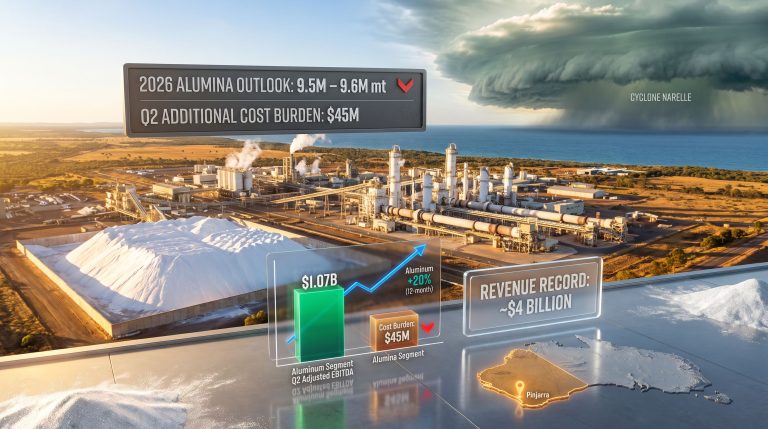
| Total Revenue | US$4.0 billion (record quarterly result) |
| Revenue Growth (quarter-on-quarter) | +24% |
| Net Income (attributable to Alcoa) | US$407 million (US$1.53 per share) |
| Adjusted Net Income | US$562 million (US$2.12 per share) |
| Adjusted EBITDA (excl. special items) | US$901 million |
| Adjusted EBITDA Growth (sequential) | +51% |
| Free Cash Flow | US$422 million |
| Cash Position (end of quarter) | US$1.4 billion |
Several operational factors converged to produce these results. Favourable aluminium pricing across the quarter was the primary top-line driver, but the production-side contribution should not be underestimated. Successful smelter restarts across Spain, Brazil, Norway, and Australia added meaningful volume, while new year-to-date production records established at four aluminium smelters and one alumina refinery reflected genuine operational momentum rather than purely price-driven earnings improvement.
Completed collective bargaining agreements with unions across Australia, the United States, and Canada also removed a meaningful source of operational uncertainty. This provided workforce stability at precisely the moment when management attention was being directed toward the South32 integration planning process.
Alcoa (ASX: AAI) shares appreciated approximately 49% over the 12 months to July 2026, dramatically outpacing the S&P/ASX 200 Index, which returned approximately 2% over the same period. This gap reflects the market's recognition of both improving earnings fundamentals and strategic execution credibility.
The Pinjarra Disruption: Understanding Guidance Revision Context
Not all operational news from the quarter was positive. Cyclone Narelle caused disruptions at Alcoa's Pinjarra alumina refinery in Western Australia, prompting a downward revision to the company's 2026 alumina production and shipment guidance. Critically, aluminium production and shipment targets were left unchanged, limiting the financial impact of the weather event.
The Pinjarra revision is worth contextualising for investors assessing Alcoa's production reliability. Western Australian alumina refinery operations are periodically exposed to severe weather events, and the Pinjarra facility has historically demonstrated a capacity to restore throughput within manageable timeframes following disruptions. Management indicated that recovery is expected to be gradual, supported by improving energy market conditions and planned maintenance scheduling. Furthermore, the broader context of Alcoa's Gladstone aluminium operations illustrates how weather and energy risks are an industry-wide consideration across Australian refining assets.
South32's Strategic Pivot: Reading the Portfolio Rationalisation
The Alcoa South32 acquisition is as much a story about South32's future direction as it is about Alcoa's expansion. South32's divestiture announcement confirms that the sale of aluminium and bauxite assets represents a deliberate portfolio rationalisation toward what South32's leadership evidently views as higher-growth commodity categories.
Following transaction completion, South32 intends to:
- Return approximately US$500 million to shareholders through a special dividend, providing near-term income support for S32 holders
- Sharpen its strategic focus on copper, manganese, and zinc, each of which carries stronger demand narratives tied to electrification and grid infrastructure build-out
- Reduce exposure to energy-intensive aluminium smelting economics, where electricity cost inflation has materially compressed margins for standalone operators globally
- Improve its positioning under ESG-focused capital allocation frameworks, where energy-intensive industrial assets increasingly attract higher cost-of-capital penalties from institutional investors
The strategic logic is coherent. Aluminium smelting is among the most electricity-intensive industrial processes in existence, consuming roughly 13 to 15 megawatt-hours per tonne of primary aluminium produced. In an environment of structurally higher energy costs, operators without captive hydropower or long-term fixed-price power agreements face permanent margin compression that scale alone cannot fully offset.
For South32, exiting this exposure in exchange for a substantial capital return and a cleaner exposure to battery-related metals is a defensible capital allocation decision, particularly given that Alcoa's greater scale and refining integration makes it a structurally better owner of these assets.
The next major ASX story will hit our subscribers first
Industry Consolidation Forces: Why This Deal Reflects a Broader Structural Shift
The Alcoa South32 acquisition does not exist in isolation. It is the product of several converging structural forces that have been reshaping the global aluminium industry for the better part of a decade. Indeed, broader mining industry consolidation trends across base metals have been building toward precisely this kind of large-scale realignment.
Energy cost inflation and smelter economics: Rising electricity prices across Europe, South Africa, and parts of Asia have rendered standalone smelter operations economically marginal without either captive power or scale-driven procurement advantages. This has accelerated consolidation pressure, pushing assets toward larger operators with greater capital to invest in energy solutions.
Geopolitical disruption to Russian supply: Sanctions and export restrictions affecting Russian aluminium producer Rusal, which historically accounted for a significant share of Western-market supply, have elevated the strategic premium on non-Russian, Western-aligned aluminium production capacity. Alcoa's expanded portfolio directly addresses this supply security concern for downstream buyers across automotive, aerospace, and packaging sectors.
Chinese state-owned producer dominance: Chinese producers, primarily state-owned enterprises, account for the majority of global primary aluminium output. Western downstream manufacturers have become increasingly motivated to secure long-term supply agreements with reliable, large-scale non-Chinese producers, creating commercial tailwinds for operators of Alcoa's scale. Furthermore, US aluminium tariffs have added another layer of complexity to global trade flows, reinforcing the value of Western-aligned, integrated production capacity.
Decarbonisation-driven capital allocation: Institutional investors and downstream customers are increasingly prioritising low-carbon aluminium sourcing. This creates both premium pricing opportunities for producers investing in green metals technology and higher cost-of-capital penalties for operators unable to demonstrate credible decarbonisation pathways. Scale is a prerequisite for the capital investment required to pursue low-carbon smelting technologies, further favouring consolidation.
Where Rio Tinto and BHP Fit in the Post-Deal Landscape
Rio Tinto's aluminium division remains the most direct competitive benchmark for the enlarged Alcoa. Rio Tinto's Canadian operations, largely powered by hydroelectricity, carry a significant low-carbon differentiation that commands premium pricing from sustainability-focused customers. Alcoa will need to accelerate its own green aluminium credentials to compete effectively in premium market segments.
BHP's continued absence from the aluminium sector leaves Alcoa and Rio Tinto as the dominant Western-aligned, ASX-listed aluminium majors post-transaction, reducing the competitive pool and potentially supporting stronger pricing discipline among major non-Chinese producers over time.
Key Risks Investors Should Monitor Through to 2027 and Beyond
No acquisition of this scale is without execution risk, and investors considering exposure to either Alcoa (ASX: AAI) or South32 (ASX: S32) should maintain a clear-eyed view of the primary risk factors.
Integration complexity across three continents: Managing workforce integration, regulatory compliance, and operational continuity across Australian, Brazilian, and South African jurisdictions simultaneously introduces significant management bandwidth demands. South African energy infrastructure constraints, already evidenced by the Mozal exclusion decision, remain a monitoring point for the Hillside smelter specifically.
CVR contingent liability in a bull market: If aluminium and alumina prices outperform strike thresholds across multiple measurement periods through 2030, the effective acquisition cost could approach US$5.6 billion, materially above the headline figure. Investors bullish on aluminium prices should factor this contingent liability into their total cost basis assessment.
Bridge financing refinancing execution: The US$3.1 billion Goldman Sachs bridge facility needs to be refinanced into permanent capital structures before transaction close. Credit market conditions prevailing in 2026-2027 will determine the ultimate cost of permanent debt, introducing interest rate sensitivity into the acquisition economics.
Regulatory clearance timelines: Multi-jurisdictional regulatory approval processes across Australia, Brazil, and South Africa introduce timeline uncertainty. Any material delays beyond the anticipated first-half 2027 close could affect integration scheduling and synergy delivery timelines.
Frequently Asked Questions: Alcoa South32 Acquisition
What exactly is Alcoa acquiring from South32?
Alcoa is acquiring South32's full portfolio of bauxite mining, alumina refining, and aluminium smelting assets located across Western Australia, Brazil, and South Africa. The Mozal smelter in Mozambique has been deliberately excluded from the transaction scope due to persistent power supply constraints placing it on care and maintenance.
How much is Alcoa paying in total?
The upfront consideration is approximately US$4.1 billion, comprising US$3.1 billion in cash and roughly US$1.0 billion in Alcoa shares. When accounting for assumed net debt and lease liabilities of approximately US$750 million, plus the maximum contingent value right of US$750 million, the ceiling total enterprise value reaches approximately US$5.6 billion.
When is the deal expected to close?
Completion is anticipated in the first half of 2027, subject to shareholder approval from both Alcoa and South32 investors, as well as regulatory clearances across the relevant jurisdictions.
What will South32 do with the sale proceeds?
South32 has indicated its intention to return approximately US$500 million to shareholders via a special dividend following transaction completion, while redirecting its strategic portfolio focus toward copper, manganese, and zinc assets better aligned with electrification demand themes.
How does this change Alcoa's global competitive standing?
Post-acquisition, Alcoa is projected to hold approximately 13.0% of global bauxite supply on an equity-attributable basis, up from 8.5%, establishing it as the world's largest bauxite miner. Aluminium smelting capacity rises by approximately 26%, and the deal is expected to generate US$900 million in net present value synergies over time.
What the Alcoa South32 Acquisition Means for ASX Investors
Assessed in full, the Alcoa South32 acquisition represents one of the most consequential structural shifts in the Western aluminium industry in recent memory. For investors evaluating either stock, the key considerations can be distilled as follows:
- Alcoa's post-deal identity as the world's leading pure-play upstream aluminium company creates concentrated commodity cycle exposure, amplifying both upside and downside relative to diversified miners
- Record Q2 2026 results including US$4.0 billion in revenue, US$901 million in adjusted EBITDA, and US$422 million in free cash flow confirm the operational foundation supporting this expansion
- A 49% share price gain over the prior 12 months positions Alcoa shares at a higher starting valuation relative to the pre-rally period, meaning investors entering today are paying for a degree of strategic and earnings improvement that is already partially priced in
- The CVR structure, bridge financing refinancing, and cross-continental integration complexity represent the primary risk factors warranting ongoing monitoring through 2027 and into the synergy delivery phase
- South32 shareholders receive a US$500 million capital return as a near-term income catalyst alongside a strategically cleaner exposure to copper and manganese growth narratives
Investor Consideration: This article contains general information only and does not constitute personal financial advice. Past share price performance is not indicative of future returns. Investors should consider their own financial circumstances and risk tolerance, and seek independent financial advice before making investment decisions. Investments in equity markets can rise and fall, and capital is not guaranteed.
For additional context on global aluminium market dynamics and ASX resources sector M&A activity, financial analysis covering Australian and international equity markets is available through Motley Fool Australia at fool.com.au.
Want to Track the Next Major ASX Resource Discovery Before the Market Moves?
Discovery Alert's proprietary Discovery IQ model delivers real-time alerts on significant ASX mineral discoveries, transforming complex resource data into clear, actionable investment insights — explore the historic returns major discoveries have generated or begin your 14-day free trial today to position yourself ahead of the broader market.