July 17, 2026
When Scale Becomes Strategy: Alcoa's Upstream Consolidation and What It Signals for Global Aluminium
The aluminium industry has long operated on a simple but demanding principle: those who control the upstream supply chain control their own destiny. Bauxite reserves, refinery throughput, and smelting capacity are not interchangeable commodities. They are structural moats, and building them takes decades. Against this backdrop, the Alcoa South32 deal and record Q2 revenue stand as the most consequential developments in the company's modern history, combining record financial performance with the largest acquisition Alcoa has undertaken since becoming an independent entity in 2016.
Understanding what this moment means requires looking beyond the headline numbers and examining the mechanics of how integrated aluminium producers generate durable competitive advantage.
When big ASX news breaks, our subscribers know first
Record Q2 2026 Revenue: More Than a Single Quarter
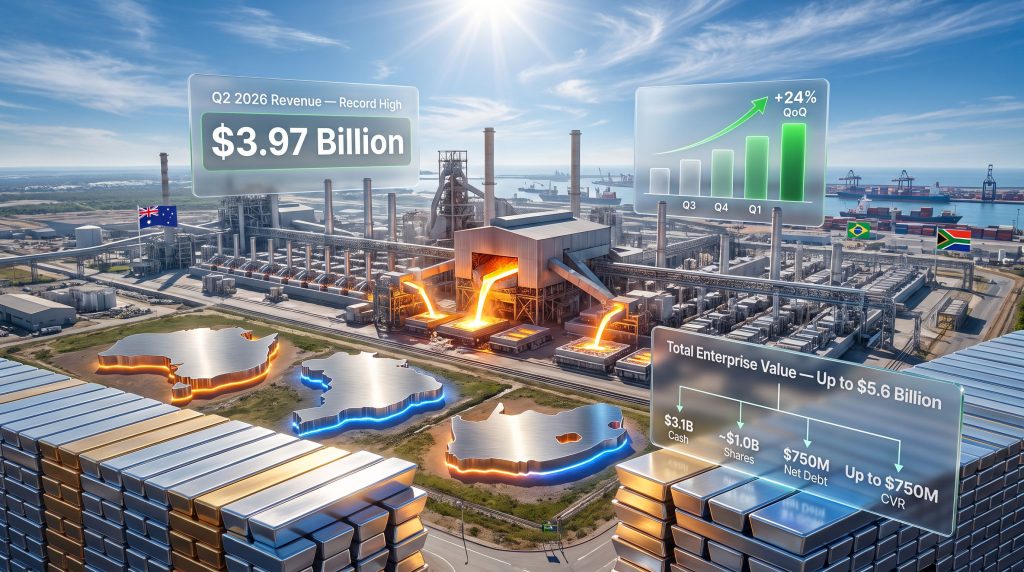
Alcoa's total revenue of $3.97 billion for the second quarter of 2026 represents a 24% sequential increase from the first quarter and the highest quarterly revenue figure in the company's history as a standalone producer. Net income reached $407 million, while adjusted net income climbed 51% quarter-on-quarter to $562 million. Adjusted EBITDA, excluding special items, came in at $901 million, and operating cash flow reached $608 million.
These numbers are significant not simply because of their scale, but because of what produced them. Three distinct forces converged simultaneously:
- London Metal Exchange (LME) aluminium price appreciation, which lifted realised revenue per tonne across the aluminium segment
- Regional premium expansion, where value-added product mix and geographic demand dynamics amplified the headline price benefit beyond what LME benchmarks alone would suggest
- Shipment volume recovery, with total aluminium shipments rising 18% quarter-on-quarter as four separate smelter restart programs reached completion
The operating leverage embedded in Alcoa's cost structure becomes visible when these factors align. Fixed costs are absorbed across a larger production base, and margin per tonne expands disproportionately when prices and volumes rise together. This is the mechanism behind the 51% jump in adjusted net income on a revenue increase of 24%.
"The simultaneous alignment of price, volume, and operational recovery across four smelter restart programs created a compounding revenue effect that is rare within any single reporting period for a producer of this scale."
Segment-by-Segment: Where the Growth Came From
Aluminium: The Engine Behind the Numbers
Primary aluminium production rose 5% sequentially to 636,000 tonnes in Q2 2026. The completions driving this included the San Ciprián smelter restart in Spain — particularly significant given its restoration of European capacity that had been idled during the prolonged energy cost crisis — alongside progress at the Alumar facility in Brazil and completed restarts at Lista in Norway and Portland in Australia.
Third-party aluminium revenue surged 31% quarter-on-quarter, driven by the combined effect of higher shipment volumes, a stronger mix of value-added products, and elevated realised prices. Value-added products, which include specialised alloys and semi-fabricated forms, typically command premiums above standard LME-grade metal and provide a more stable revenue floor during periods of spot price volatility.
Alcoa maintained full-year 2026 aluminium guidance at 2.4 to 2.6 million tonnes of production and 2.6 to 2.8 million tonnes of shipments, signalling confidence that the operational recovery is sustainable rather than front-loaded. Furthermore, these figures position Alcoa favourably among the top aluminium producers competing at a global scale.
Alumina: External Disruption Introduces Risk
Alumina production fell 6% quarter-on-quarter to 2.2 million tonnes, with the decline centred on operational instability at the Pinjarra refinery in Western Australia. The Pinjarra situation originated in late March 2026 and was subsequently worsened by gas supply disruptions caused by Cyclone Narelle, an external force majeure event that exposed the vulnerability of Australian refinery operations to regional infrastructure constraints.
Third-party alumina shipments held broadly stable at 1.6 million tonnes, as deferred Q1 Australian cargoes were completed during the quarter, partially masking the production shortfall. However, the underlying disruption was material enough to prompt a revision to full-year guidance, with alumina production guidance reduced to 9.5 to 9.6 million tonnes and shipment guidance adjusted to 11.5 to 11.6 million tonnes.
Investor Alert: The Pinjarra refinery represents a persistent near-term operational risk. Gas supply restoration timelines in Western Australia will be a key variable for alumina segment margins through Q3 2026, and market participants should monitor this closely.
Bauxite: Quarterly Dip, Long-Term Expansion
Bauxite production contracted from 9.1 million tonnes in Q1 to 8.3 million tonnes in Q2, with third-party shipments declining on both lower volumes and softer offtake pricing. This is largely attributable to scheduling and operational variability rather than any structural deterioration in capacity. Consequently, shifts in global bauxite supply remain a critical consideration for understanding Alcoa's longer-term upstream positioning.
What matters more for the bauxite segment is not the quarterly fluctuation but the transformative change coming through the South32 acquisition, which will fundamentally redefine Alcoa's bauxite footprint across three continents.
The Alcoa South32 Deal: Anatomy of a Landmark Transaction
The Alcoa South32 deal and record Q2 revenue together mark a pivotal inflection point for the company. According to Alcoa's official press release, the transaction structure carries an upfront consideration of $4.1 billion, comprising $3.1 billion in cash and approximately $1 billion in newly issued Alcoa shares (roughly 17 million shares). On top of this, Alcoa assumes $750 million in net debt and has agreed to contingent value rights of up to $750 million, linked to future commodity price performance. The total enterprise value therefore reaches up to $5.6 billion if commodity thresholds are met.
| Component | Value |
|---|---|
| Cash Consideration | $3.1 billion |
| Share Issuance (~17 million shares) | ~$1.0 billion |
| Assumed Net Debt | $750 million |
| Contingent Value Rights | Up to $750 million |
| Total Enterprise Value | Up to $5.6 billion |
| Upfront Consideration | $4.1 billion |
The contingent value rights structure is notable because it aligns seller and buyer incentives post-close. If aluminium and alumina prices remain elevated or strengthen further, South32 participates in the upside through the contingent payment mechanism. This reduces the risk of Alcoa overpaying in a cyclical peak scenario.
Assets Being Acquired
The asset package spans three countries across two continents:
Australia:
- Boddington Bauxite Mine (Western Australia)
- Worsley Alumina Refinery (high-capacity refinery providing direct feedstock integration)
Brazil:
- MRN Bauxite Mine (one of the largest bauxite operations in South America)
- Alumar Refinery and Smelter (dual-function asset adding both alumina and primary aluminium output)
South Africa:
- Hillside Aluminium Smelter (operating primary aluminium facility)
- Bayside Property (currently idled, representing optionality for future restart or redevelopment)
Capacity Transformation in Numbers
| Capacity Metric | Pre-Acquisition | Post-Acquisition | Change |
|---|---|---|---|
| Annual Alumina Capacity | ~9.8 Mt | ~15.0 Mt | +53% |
| Primary Aluminium Capacity | ~2.4 Mt | ~3.3 Mt | +37% |
| Additional Alumina Added | 5.2 Mt | ||
| Additional Aluminium Added | 900 kt |
A 53% increase in alumina refining capacity in a single transaction is structurally significant. Alumina is the intermediate product between bauxite ore and primary aluminium metal, produced through the Bayer process. Controlling large-scale refinery capacity provides pricing influence in both the merchant alumina market and the captive supply chain.
Strategic Rationale: Why Upstream Integration Matters Now
Vertical Integration as a Structural Moat
The Bayer process used to refine bauxite into alumina is energy-intensive and technically demanding. Refineries built around specific bauxite ore chemistries cannot be easily reconfigured for different feedstocks. This creates a natural lock-in between bauxite mine and alumina refinery that rewards integrated producers over those reliant on third-party supply.
By securing captive bauxite across Australia, Brazil, and South Africa, Alcoa reduces its exposure to spot market pricing for one of its most critical input materials. In periods of bauxite supply tightness — which have occurred multiple times over the past decade due to Indonesian and Malaysian export restrictions — integrated producers with captive mines are insulated from the price spikes that pressure independent refiners.
Geographic Diversification
Post-close, Alcoa's production base will span six countries, meaningfully reducing the concentration of operational and regulatory risk in any single jurisdiction. The South African Hillside smelter, in particular, adds exposure to a distinct energy cost structure and export positioning that differs from Alcoa's existing European and North American footprint. South Africa's electricity pricing dynamics and proximity to growing Asian and Middle Eastern aluminium markets provide a differentiated commercial profile, reflecting broader industrial demand trends reshaping metals markets globally.
The Gallium Dimension: A Critical Minerals Optionality
During Q2 2026, Alcoa approved a final investment decision for a gallium production plant in Australia. This is a detail that deserves more attention than it typically receives. Gallium is a byproduct of aluminium refining, extracted from the Bayer process liquor during alumina production. It is a critical mineral with growing demand in semiconductor manufacturing, compound semiconductors used in 5G infrastructure, and certain defence applications.
Gallium's strategic importance has grown considerably as China currently dominates global gallium production, accounting for the substantial majority of refined output. The development of gallium recovery capacity within an Australian alumina refinery creates non-trivial strategic optionality for Alcoa, positioning the company in the critical minerals space without requiring a separate mining operation. This is an example of value extraction from existing process chemistry that is not widely understood by generalist investors.
Competitive Repositioning: Where Does Alcoa Stand Post-Acquisition?
| Producer | Annual Alumina Capacity (Approx.) | Annual Aluminium Capacity (Approx.) |
|---|---|---|
| Alcoa (Post-Acquisition) | ~15.0 Mt | ~3.3 Mt |
| Rio Tinto Aluminium | ~8–9 Mt | ~3.2 Mt |
| Alcoa (Pre-Acquisition) | ~9.8 Mt | ~2.4 Mt |
| Rusal | ~7.5 Mt | ~3.9 Mt |
Note: Figures are approximate equity-share capacity estimates. Readers should verify current capacity against company disclosures.
The post-acquisition Alcoa emerges as one of the largest alumina producers among publicly listed non-state-owned companies globally. The combined bauxite footprint across the Darling Range in Western Australia, Boddington, and Brazil's MRN creates one of the most geographically diversified captive bauxite supply bases in the industry. In addition, Alcoa's Ignis EQT joint venture further illustrates the company's broader commitment to portfolio expansion and strategic partnership development.
The next major ASX story will hit our subscribers first
Why Did the Share Price Fall on Record Results?
Alcoa shares declined approximately 5% following the announcement despite the record revenue and strategic acquisition. This apparent contradiction reflects several layers of investor concern that are worth unpacking. As reported by The Motley Fool Australia, market participants weighed the transformative opportunity against material execution risks:
- Dilution from share issuance: The ~17 million new shares issued as deal consideration represent a meaningful increase in shares outstanding, mechanically reducing earnings per share even if total earnings grow
- Acquisition scale relative to market capitalisation: Large acquisitions relative to a company's existing size introduce integration complexity risk that markets price conservatively
- Commodity-linked contingent payments: The up-to-$750 million contingent value rights introduce earnings uncertainty that is difficult to model with precision
- Financing costs: The $3.1 billion cash component carries borrowing costs in a higher interest rate environment, pressuring near-term free cash flow generation
- Integration timeline: With deal close targeted in the first half of 2027, there is approximately 12 months during which commodity markets, regulatory environments, and operational conditions could shift materially
This type of market reaction is not unusual for large transformative acquisitions. The initial share price response often reflects the market's uncertainty about execution rather than a rejection of the strategic logic.
Key Risks and Variables for the Period Ahead
Pinjarra Refinery Recovery
The restoration of full operational capacity at Pinjarra is the most immediate operational variable for Alcoa's alumina segment. The refinery's gas supply disruption, compounded by Cyclone Narelle, represents the kind of infrastructure dependency risk that is structurally embedded in Western Australian alumina operations. The Worsley refinery, which Alcoa will acquire through the South32 deal, uses a different gas supply arrangement, but the broader lesson about infrastructure concentration risk in the region applies across the portfolio.
Regulatory Clearance Across Multiple Jurisdictions
The transaction requires shareholder approval from both Alcoa and South32 investors, as well as regulatory clearance in Australia, Brazil, and South Africa. Each jurisdiction presents its own competition review framework and timeline. Brazil, in particular, has a well-developed merger review process through CADE (the Administrative Council for Economic Defence) that involves substantive analysis of market concentration in upstream mining and refining.
LME Aluminium Price Sensitivity
Alcoa's financial performance is materially sensitive to LME aluminium prices. A 10% decline in realised aluminium prices would have a disproportionate negative impact on adjusted EBITDA given the company's largely fixed cost base. Investors should therefore treat the Alcoa South32 deal and record Q2 revenue as reflecting a favourable pricing environment and consider the downside scenario carefully.
A Balance Sheet Built for the Moment
Alcoa ended Q2 2026 with a cash balance of $1.4 billion after redeeming its remaining 2028 senior notes during the quarter. This active liability management, executed simultaneously with announcing the largest acquisition in the company's modern history, demonstrates a management team prioritising balance sheet discipline alongside growth.
The $608 million in operating cash flow generated during the quarter provides a meaningful internal funding contribution toward the $3.1 billion cash component of the South32 transaction. Furthermore, the additional $65 million capital commitment to the Mosjøen smelter in Norway, alongside the gallium plant approval and the new collective bargaining agreements covering operations in Australia, the United States, and Canada, reflect a company investing in operational resilience across its existing portfolio even while pursuing transformative external growth. For further context on the deal's structure and South32's perspective, South32's aluminium value chain sale page provides additional detail on the divested assets.
This article contains forward-looking statements and financial analysis based on publicly available information. Commodity prices, regulatory outcomes, and operational timelines are subject to material change. Nothing in this article constitutes financial or investment advice. Readers should conduct independent research and consult qualified advisors before making investment decisions.
Want to Stay Ahead of the Next Major ASX Mineral Discovery?
Discovery Alert's proprietary Discovery IQ model delivers real-time alerts on significant ASX mineral discoveries, turning complex commodity data into actionable insights for both short-term traders and long-term investors — explore historic discoveries and their exceptional returns to understand what early positioning can mean for your portfolio, then begin your 14-day free trial at Discovery Alert to secure your market-leading edge.