June 5, 2026
The Hidden Economics Behind Aluminium Smelter Restarts
Restarting an idle aluminium smelter potline is rarely as straightforward as flipping a switch. The decision involves a web of interlocking variables that extend far beyond commodity price movements. Capital deterioration during curtailment periods, long-lead equipment procurement cycles, power infrastructure dependencies, and workforce readiness all compound to create restart economics that are fundamentally different from those that applied when a line was first commissioned. Understanding this complexity is essential context for evaluating what the potential Alcoa Warrick operations restart actually entails and why its USD 100 million price tag reflects far more than simple capacity addition.
The aluminium industry has long practised what analysts describe as capacity breathing — the deliberate curtailment and reactivation of production lines in response to price cycles, energy cost pressures, and demand signals. However, each restart carries unique characteristics shaped by how long the curtailment lasted, what condition the idle infrastructure is in, and whether the energy and logistics environment has materially changed in the interim. Warrick's fourth line sits at the intersection of all three of these complicating factors.
When big ASX news breaks, our subscribers know first
Understanding the Warrick Facility: Infrastructure, Scale, and Competitive Position
The Warrick facility in Newburgh, Indiana, near Evansville, occupies a distinct position within North American aluminium manufacturing. Unlike most smelting operations that ship molten or solid metal to separate downstream processors, Warrick integrates aluminium smelting potlines with an on-site rolling mill that converts metal directly into sheet products for food and beverage can packaging. This co-location is not merely an operational convenience. It is the fundamental source of the facility's competitive advantage.
Three production lines are currently active at the site, supporting a workforce of approximately 1,250 employees. Historically, the facility operated a larger multi-line footprint, making the current configuration a reduced version of its peak capacity state.
Why the Integrated Model Changes the Restart Calculus
The smelter-to-rolling-mill integration at Warrick creates a dynamic that standalone smelters do not experience. When molten aluminium produced on-site flows directly into the rolling operation, it displaces the need for externally sourced inputs, whether scrap or primary metal from third parties. This internal supply reduces both raw material costs and the logistical complexity of feeding a high-throughput rolling mill.
The practical implication is significant: restarting a smelting potline at Warrick does not simply add smelting tonnage in isolation. It structurally improves the input cost position of the entire rolling operation that sits downstream. The ratio of internally produced molten metal to externally sourced material is a core driver of the rolling mill's cost competitiveness, which means smelting capacity additions carry compounding economic benefits within the integrated model.
Furthermore, this dynamic also explains why Alcoa's aluminium operations strategy has been guided not only by aluminium price movements but also by the internal economics of keeping the rolling mill optimally supplied with cost-efficient molten metal.
"A potline restart at an integrated facility like Warrick carries a multiplier effect that is absent in standalone smelting operations. The downstream economics improve alongside the upstream capacity addition, changing the return profile of the investment."
What a Fourth Potline Restart Actually Involves
The USD 100 Million Capital Commitment: Unpacking the Cost Drivers
The estimated capital expenditure for restarting the idle fourth production line sits at approximately USD 100 million, a figure that warrants careful contextualisation. This is not a greenfield construction cost; it is a rehabilitation investment for infrastructure that has been idle and has experienced measurable deterioration during its curtailment period.
The cost components driving this figure include:
- Physical rehabilitation of potline infrastructure that has degraded over the curtailment period
- Procurement of long-lead electrical equipment, which faces extended supply chain timelines in the current environment
- Workforce recruitment, training, and safety integration costs required before commissioning can occur
- Safety and stability system upgrades necessary to meet operational prerequisites
The deterioration factor deserves particular attention. Aluminium potlines contain refractory linings, cathode systems, and complex electrical bus infrastructure that do not tolerate extended inactivity well. Thermal cycling, moisture ingress, and structural settling during curtailment periods can render components that appeared serviceable at shutdown far more costly to restore. This is a well-understood but frequently underappreciated aspect of smelter restart economics, as industry coverage of the Warrick restart plan has noted.
Comparing Restart Costs: Then Versus Now
The cost differential between the current fourth-line evaluation and Warrick's most recent restart provides important perspective on how dramatically restart economics can shift over relatively short periods.
| Restart Event | Lines Restarted | Capacity Added | Estimated Cost | Completion |
|---|---|---|---|---|
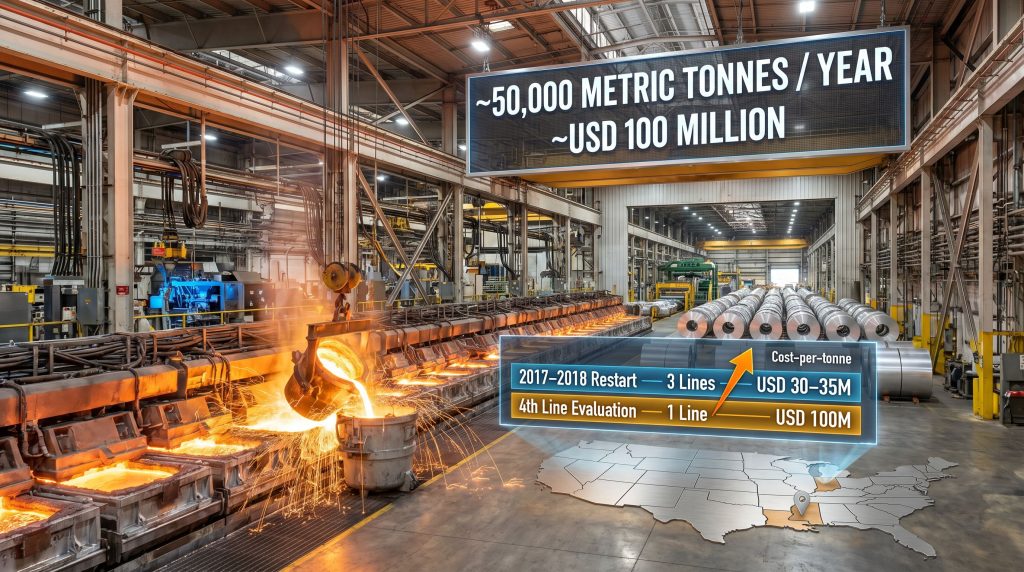
| 2017-2018 Partial Restart | 3 of 5 potlines | ~161,400 metric tonnes/year | USD 30-35M (after-tax) | Q2 2018 |
| Fourth Line Evaluation (Current) | 1 additional line | ~50,000 metric tonnes/year | ~USD 100 million | 1-2 years if approved |
The cost per tonne of additional capacity implied by these figures is dramatically higher for the current evaluation than for the 2017-2018 restart. Three lines adding over 161,000 tonnes for approximately USD 30-35 million after-tax compares starkly to one line adding 50,000 tonnes for USD 100 million. This differential reflects both infrastructure deterioration during a longer idle period and the materially more challenging procurement environment for specialised electrical equipment in the mid-2020s.
How Long Would the Warrick Fourth Line Restart Take?
Timeline Breakdown: From Decision to First Metal
According to Alcoa's chief executive, the restart process would take between one and two years from the point of a final investment decision. This timeline is not arbitrary. It reflects the sequential nature of the rehabilitation process and the real constraints embedded in each phase.
The restart progression follows a broadly sequential structure:
- Engineering and procurement phase: Identifying, ordering, and receiving long-lead electrical equipment represents the primary timeline bottleneck. Specialised smelter components such as rectifier transformers, bus bar systems, and potline control infrastructure cannot be sourced from general industrial suppliers and may carry lead times measured in months rather than weeks.
- Civil and mechanical rehabilitation: Once electrical components are secured, the physical remediation of deteriorated infrastructure can proceed. This includes refractory relining, structural inspection and repair, and safety system integration.
- Commissioning and ramp-up: Potline stabilisation after startup is a technically demanding phase. Aluminium electrolysis cells require careful management during the initial period of operation to establish stable thermal and chemical equilibrium. Premature loading or instability during this phase can damage equipment and extend timelines further.
The 2018 Power Outage: A Historical Lesson in Prerequisite Planning
A power disruption in 2018 forced one of Warrick's potlines, representing approximately 50,000 metric tonnes of annual capacity, offline for safety reasons. This incident is more than historical context. It established a direct precedent that shapes current management thinking about what prerequisites must be in place before committing to a fourth-line restart.
Aluminium smelting is uniquely vulnerable to power interruption. The electrolytic reduction cells that convert alumina into aluminium metal operate at continuous high temperatures and electrical loads. An unexpected power outage does not simply pause production; it can freeze metal within the cells, damage refractory linings, and require extensive remediation before operations can resume. The 2018 incident demonstrated this vulnerability in real terms at Warrick, reinforcing why aluminium power supply security is the first prerequisite rather than a secondary consideration.
The Four Critical Variables Driving the Investment Decision
Alcoa's chief executive has outlined a multi-factor evaluation framework that governs whether the fourth-line restart will ultimately proceed. Each variable is genuinely unresolved at this stage, and the interaction between them adds further complexity.
Electricity Supply Security
Reliable industrial power at both the commissioning phase and across the long-term operational horizon is the most fundamental prerequisite. Historically, Alcoa partnered with utility provider Vectren to structure a long-term energy supply arrangement for Warrick operations extending through 2023. The current state of electricity supply agreements for any expanded operation at the site has not been publicly confirmed.
For context, aluminium smelting is among the most electricity-intensive industrial processes in existence. A single potline consuming approximately 50,000 tonnes of capacity annually requires electrical power on a scale that necessitates dedicated supply infrastructure and long-term contractual commitments from utilities. Securing this for a fourth line is not a routine procurement exercise.
Capital Expenditure Justification
At approximately USD 100 million, the investment requires a sustained aluminium price environment and credible long-term demand visibility to generate acceptable financial returns. In addition, ongoing pressures from US aluminium tariffs are reshaping the domestic competitive landscape, adding further complexity to the capital justification process. Alcoa's management has signalled a deliberately cautious and evidence-based approach to the final decision, reflecting the scale of the commitment relative to the incremental capacity being added.
Infrastructure Condition and Rehabilitation Scope
The deterioration of the idle fourth line during its curtailment period directly affects both cost certainty and timeline confidence. Until comprehensive engineering assessments are completed, the full extent of remediation required remains partially unknown. This uncertainty is itself a risk factor that management must weigh before committing capital.
Operational Safety and Site Stability
Warrick currently maintains strong safety and operational performance metrics across its three active lines. Alcoa's leadership has explicitly framed the preservation of those standards as a non-negotiable condition for any capacity expansion. This reflects a broader industry principle that expansion undertaken at the expense of operational integrity is ultimately self-defeating.
"Alcoa's evaluation framework positions safety and operational stability not as outcomes of a successful restart but as prerequisites that must be demonstrably achievable before a restart is approved."
What 50,000 Additional Tonnes Means for North American Supply
A Structurally Supply-Constrained Market
The North American aluminium can sheet market has faced structural supply constraints relative to demand growth driven by the sustained shift toward aluminium beverage packaging. The domestic integrated smelter-rolling capacity base in the United States is limited, with Warrick representing one of a small number of facilities capable of producing can sheet from domestically smelted metal.
Adding approximately 50,000 metric tonnes of annual smelting capacity would meaningfully improve Alcoa's domestic supply position in this market. The timing is relevant given that Alcoa has separately reported higher order volumes for its North American operations following disruptions to Middle Eastern aluminium supply — a development that demonstrates the sensitivity of regional markets to supply source variability.
Supply Chain Resilience as a Structural Argument
Beyond the direct capacity contribution, a fourth operational potline at Warrick strengthens the facility's role as a domestic supply anchor in a market that is increasingly focused on supply chain resilience. Domestic smelting capacity reduces dependence on imported primary aluminium and provides customers with supply source optionality that becomes valuable during periods of geopolitical supply disruption.
The strategic value of domestic integrated capacity is not captured entirely by commodity price calculations. Consequently, it represents an optionality premium that customers in the food and beverage packaging sector are increasingly willing to consider when evaluating long-term supply arrangements. Among leading aluminium producers, this domestic integration model is increasingly viewed as a structural advantage rather than simply an operational convenience.
The next major ASX story will hit our subscribers first
Alcoa's Historical Restart Strategy at Warrick
A Chronology of Capacity Management
Understanding the Alcoa Warrick operations restart requires placing it within the longer arc of Warrick's capacity management history. The facility's potline configuration has evolved through multiple cycles of curtailment and restart, each shaped by the market conditions and operational realities of the time.
| Period | Event | Capacity Impact |
|---|---|---|
| March 2016 | Three of five potlines curtailed | Significant capacity reduction |
| July 2017 | Three-line restart announced | Market improvement and rolling mill economics cited |
| Q2 2018 | Three-line restart completed | ~275 jobs added through hires, recalls, transfers |
| 2018 | Power-related outage curtails one line | ~50,000 metric tonnes offline |
| Post-2018 to present | Two potlines remain idle | Periodic evaluation of restart options |
| 2026 | Fourth-line formal review underway | USD 100 million investment threshold under assessment |
This chronology reveals a consistent pattern of market-responsive, financially disciplined capacity management. Alcoa has not pursued capacity maximisation as an end in itself at Warrick. Instead, restarts have been initiated when the integrated economics — encompassing rolling mill supply optimisation, market demand, and power cost structures — collectively justify the capital commitment.
State-Level Incentives and Employment Considerations
The 2017 Incentive Precedent
During the 2017 restart, the Indiana Economic Development Corporation offered up to USD 2.4 million in conditional tax credits alongside USD 100,000 in workforce training grants. These incentives were tied to employment outcomes and were conditional rather than guaranteed. Whether a comparable incentive framework might apply to a fourth-line restart would depend on the employment impact projections and the economic development case presented to state authorities.
Employment Impact Modelling
| Scenario | Estimated Job Impact |
|---|---|
| 2017-2018 Three-Line Restart | ~275 jobs (hires, recalls, and transfers) |
| Fourth-Line Restart (Projected) | Proportional to operational scope; formal estimate not yet published |
A single-line addition representing approximately 31% of the capacity added in the 2017-2018 restart would imply a proportionally smaller but still regionally significant employment impact for the Newburgh, Indiana area. The precise figure depends on operational configuration decisions that have not yet been finalised. For broader context on how shifts in aluminum and alumina markets are influencing these decisions, the current pricing environment remains a key variable in Alcoa's assessment.
Frequently Asked Questions: Alcoa Warrick Operations Restart
How Many Potlines Does Warrick Currently Operate?
Three potlines are currently active. The facility has historically operated up to five potlines, with two remaining curtailed or idle.
What Would a Fourth Line Add to Annual Output?
Restarting the fourth production line is estimated to contribute approximately 50,000 metric tonnes of additional annual aluminium smelting capacity.
Why Does This Restart Cost So Much More Than Previous Restarts?
Infrastructure deterioration during the extended curtailment period, combined with challenging procurement conditions for specialised electrical equipment, has significantly elevated the capital requirement to approximately USD 100 million. This represents a materially higher cost per tonne of capacity than the approximately USD 30-35 million after-tax cost of restarting three lines in 2017-2018. Furthermore, analysis of Alcoa's Warrick evaluation highlights how current equipment supply chains have compounded these costs considerably.
What Is the Most Critical Unresolved Variable?
Securing reliable long-term electricity supply is identified as the most critical prerequisite. The 2018 power outage incident that forced a potline offline for safety reasons reinforces the operational significance of this requirement.
Has a Final Investment Decision Been Made?
No final decision has been announced. Management has indicated a thorough, multi-factor evaluation process is underway before any capital commitment is made.
What Does the Rolling Mill at Warrick Produce?
The on-site rolling mill primarily produces aluminium sheet for North American food and beverage can packaging applications.
Key Takeaways: Alcoa Warrick Fourth-Line Restart at a Glance
- Investment threshold: Approximately USD 100 million capital requirement
- Capacity uplift: Approximately 50,000 metric tonnes per year of additional smelting output
- Restart timeline: One to two years from final investment decision
- Primary procurement bottleneck: Long-lead electrical equipment with extended supply chain timelines
- Critical prerequisite: Stable, long-term electricity supply secured before commitment
- Strategic rationale: Strengthening domestic US aluminium supply for the food and beverage packaging sector
- Decision status: Under active evaluation; no final capital commitment announced
- Operational context: The site currently maintains strong safety and stability performance across three active lines
Disclaimer: This article contains forward-looking analysis, projections, and comparisons drawn from publicly available information. Financial figures, timelines, and capacity estimates referenced are based on publicly reported data and should not be construed as investment advice. Final investment decisions, costs, and outcomes may differ materially from current estimates. Readers should conduct independent research before making any investment decisions related to companies or sectors discussed in this article.
Want to Track the Next Major Mineral Discovery Before the Broader Market Does?
Discovery Alert's proprietary Discovery IQ model delivers real-time alerts on significant ASX mineral discoveries, turning complex data across more than 30 commodities into clear, actionable insights for both short-term traders and long-term investors — explore Discovery Alert's dedicated discoveries page to understand why major finds have historically generated substantial returns, and begin your 14-day free trial today to position yourself ahead of the market.