June 4, 2026
Algeria's Strategic Energy Investment Opportunity
The global energy landscape has undergone fundamental restructuring over the past decade, with traditional supply relationships facing unprecedented challenges from geopolitical tensions, climate transition demands, and shifting consumer preferences. Within this complex environment, North African hydrocarbon resources have emerged as increasingly strategic assets for international energy companies seeking portfolio diversification and supply chain resilience. The Algeria oil and gas licensing round represents a pivotal opportunity amidst this transformation, where European energy security concerns and Mediterranean basin resource development have created unique investment opportunities that extend far beyond conventional exploration economics.
Furthermore, regional conflicts and the oil price trade war dynamics have intensified the focus on reliable energy suppliers. Additionally, US-China trade impacts continue to reshape global energy partnerships and investment flows.
When big ASX news breaks, our subscribers know first
Understanding Algeria's Strategic Position in Global Energy Markets
Algeria's hydrocarbon sector operates within a complex geopolitical landscape where North African energy resources have gained substantial importance for European markets pursuing supply diversification strategies. The country's advantageous positioning along Mediterranean shipping routes, combined with established pipeline infrastructure connections to Europe, creates distinctive competitive advantages for international energy companies evaluating investment opportunities across the region.
The Algeria oil and gas licensing round launched on April 20, 2026, represents a significant milestone in the country's upstream sector development strategy. Branded as "Algeria Bid Round 2026," this initiative was announced during a ceremony attended by representatives from international energy companies in Algiers, signalling the government's commitment to attracting foreign investment and technical expertise.
As a gas-rich OPEC member, Algeria has been actively working to strengthen its upstream sector and sustain its role in global energy markets. The current licensing round offers seven exploration blocks estimated to contain hundreds of millions of barrels of oil and significant volumes of natural gas, distributed across strategically selected geographic zones that leverage existing infrastructure and geological knowledge.
The government has positioned this new bidding round as instrumental for strengthening global energy security and reinforcing Algeria's role as a regional energy hub. This strategic framing indicates Algeria's intent to establish itself as a reliable energy supplier during a period characterised by global energy market uncertainty and supply chain disruptions.
Moreover, ongoing developments in OPEC oil production impact strategies influence Algeria's positioning within global energy markets. Similarly, Saudi exploration licenses create competitive pressures that enhance Algeria's attractiveness to international investors.
Key Geographic Zones in the 2026 Licensing Round
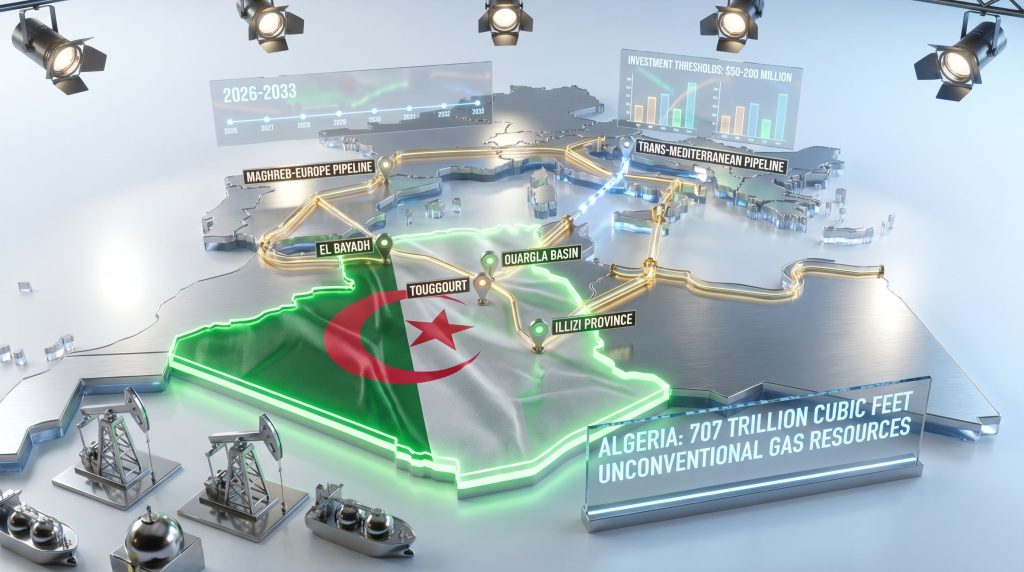
The Algeria oil and gas licensing round encompasses four distinct geographic regions, each offering unique geological characteristics and infrastructure advantages. The offered exploration blocks are strategically located in Ouargla, Illizi, Touggourt, and El Bayadh, representing a diverse mix of oil and gas prospects designed to attract companies with varying technical capabilities and investment profiles.
Ouargla Basin Opportunities
The Ouargla region represents one of Algeria's most established hydrocarbon provinces, offering exploration blocks with proven geological formations and extensive infrastructure connectivity. This area provides international operators with access to decades of regional production data, enabling more accurate risk assessment and development timeline projections.
The existing road networks, pipeline connections, and processing facilities in Ouargla create immediate operational synergies for companies seeking integrated development strategies. Consequently, this region attracts companies prioritising lower-risk opportunities with predictable development pathways.
Illizi Province Potential
Located in southeastern Algeria, the Illizi blocks provide access to both conventional and unconventional resource plays, creating opportunities for companies with diverse technical expertise. The region's proximity to existing export facilities and transportation networks enables cost-effective development scenarios and reduced infrastructure investment requirements.
Illizi's geological formations have demonstrated significant potential for both oil and natural gas accumulations. Furthermore, the area's existing seismic database provides valuable insights for exploration planning and risk mitigation strategies.
Touggourt and El Bayadh Prospects
These emerging exploration areas offer first-mover advantages for companies willing to invest in frontier geology and innovative exploration techniques. The blocks contain mixed oil and gas prospects that could diversify production portfolios and provide natural hedging against commodity price volatility.
While requiring higher initial investment in infrastructure development, these areas present opportunities for substantial resource discoveries in underexplored geological formations. For instance, companies with advanced exploration technologies may identify significant unconventional resources in these frontier regions.
The technical phase of the bidding process begins on June 1, 2026, providing access to tender documents and online presentations. Data sessions and clarifications will run until October 31, 2026, followed by bid submissions due on November 26, 2026. Hydrocarbon contracts with state-owned Sonatrach are scheduled to be signed on January 31, 2027, under production-sharing or participation agreements depending on the specific block characteristics.
International Energy Company Evaluation Framework for North African Investments
International energy companies approach Algerian opportunities through comprehensive risk assessment frameworks that incorporate multiple analytical dimensions: regulatory stability, fiscal competitiveness, operational security parameters, and infrastructure accessibility metrics. The 2026 Algeria oil and gas licensing round incorporates lessons learned from previous bidding cycles, particularly addressing concerns about competitive dynamics and contract transparency that emerged from earlier rounds.
Risk Assessment Framework for Algerian Operations
Modern energy investment decisions require sophisticated evaluation methodologies that account for both technical and commercial risk factors. Companies typically analyse Algerian opportunities through multiple risk assessment lenses, including geological prospectivity, regulatory predictability, fiscal term competitiveness, and long-term political stability indicators.
Key Evaluation Metrics include:
• Minimum investment thresholds and work programme commitment structures
• Production sharing versus participation agreement mechanisms
• Local content requirements and technology transfer obligations
• Export route security and pipeline capacity constraints
• Environmental compliance standards and permitting procedures
The 2024 licensing round revealed important insights about international company preferences and competitive dynamics, with only one exploration block receiving multiple bids. This outcome indicated that companies were highly selective about their investment commitments, prompting regulatory improvements designed to encourage broader participation in subsequent rounds.
Algeria's response included introducing a nomination process allowing companies to express interest in specific blocks before the formal bidding phase, representing a structural innovation aimed at reducing bid preparation costs and encouraging more comprehensive opportunity evaluation.
Timeline Analysis: From Bid Submission to First Production
The structured timeline for the Algeria oil and gas licensing round provides transparency and enables international operators to conduct comprehensive due diligence before committing to bid submissions. However, companies must consider how regional developments, including US policy and PDVSA changes, might influence competitive dynamics and market positioning.
| Phase | Duration | Key Milestones |
|---|---|---|
| Technical Evaluation | June-October 2026 | Data room access, geological assessments, reservoir modelling |
| Bid Preparation | October-November 2026 | Commercial terms finalisation, partnership negotiations |
| Contract Award | January 2027 | Sonatrach partnership agreements, regulatory approvals |
| Exploration Phase | 2027-2030 | Seismic surveys, exploratory drilling, resource evaluation |
| Development Phase | 2030-2033 | Field development planning, infrastructure construction |
This timeline represents a five-month technical evaluation period, allowing companies sufficient time to analyse geological data, assess commercial viability, and structure appropriate partnership arrangements with Sonatrach. The compressed bid preparation phase requires companies to have established relationships and pre-negotiated framework agreements to meet submission deadlines effectively.
The exploration phase duration of three years aligns with international best practices for comprehensive resource evaluation, while the development phase timeline reflects Algeria's commitment to accelerated production growth and revenue generation from successful discoveries.
Strategic Advantages Algeria Offers to International Energy Investors
Algeria's value proposition for international energy investors extends beyond geological prospectivity to encompass strategic positioning, infrastructure connectivity, and market access advantages that distinguish the country from regional competitors. The Algeria oil and gas licensing round occurs within a broader context of European energy security concerns and Mediterranean basin resource development initiatives.
European Energy Security Context
Algeria's role as a reliable energy supplier to European markets has expanded significantly since 2022, when geopolitical tensions disrupted traditional supply chains and highlighted the importance of diversified energy import strategies. The country's established pipeline capacity to Italy and Spain, combined with modern LNG export capabilities, positions Algerian hydrocarbon resources as critical components of European energy security frameworks.
According to Reuters, Algeria's strategic importance in global energy markets continues to grow as international companies seek alternative supply sources. Additionally, the African Energy Council emphasises Algeria's growing significance in continental energy development strategies.
The Trans-Mediterranean Pipeline system and Maghreb-Europe Pipeline provide direct access to European markets, while the Skikda and Arzew LNG terminals enable global market participation and pricing optimisation. These infrastructure advantages create immediate market access for successful bidders in the Algeria oil and gas licensing round, reducing the typical commercialisation timelines associated with frontier exploration projects.
European energy transition strategies increasingly recognise natural gas as a crucial bridge fuel supporting renewable energy integration and grid stability requirements. Algeria's gas reserves and production capabilities align with this transition narrative, providing long-term demand visibility for investment planning and project financing decisions.
Competitive Positioning Against Regional Producers
Algeria competes directly with Libya, Egypt, and Eastern Mediterranean producers for European market share, with several distinctive advantages that international companies factor into long-term investment decisions. Political stability relative to regional competitors provides operational predictability and reduces force majeure risks that can impact project economics and financing arrangements.
Strategic Infrastructure Analysis: Algeria's established pipeline network and LNG export facilities provide immediate market access advantages compared to competitors requiring significant infrastructure development or relying on third-party transportation systems.
Infrastructure Connectivity Advantages
Algeria's comprehensive energy infrastructure network includes:
• Trans-Mediterranean Pipeline (TME) providing direct access to Italian markets
• Maghreb-Europe Pipeline (GME) connecting through Morocco to Spanish distribution networks
• Skikda and Arzew LNG terminals enabling flexible global market participation
• Established road and rail networks supporting efficient logistics and supply chain operations
• Deep-water port facilities accommodating large-scale equipment transportation and service vessel operations
These infrastructure elements create operational synergies and cost advantages that enhance project economics across the exploration and development lifecycle. Companies participating in the Algeria oil and gas licensing round can leverage existing infrastructure to reduce capital expenditure requirements and accelerate revenue generation timelines.
Regulatory Framework Evolution and Investment Attraction Strategies
Algeria's regulatory approach has evolved substantially based on feedback from international energy companies and lessons learned from previous licensing rounds. The 2026 Algeria oil and gas licensing round incorporates specific improvements designed to address competitive concerns and enhance investment attractiveness while maintaining appropriate fiscal terms for the host government.
What Lessons Were Learned from the 2024 Licensing Round?
The limited competitive response to the 2024 bidding cycle, where only one exploration block received multiple bids, prompted comprehensive review of bidding procedures and regulatory frameworks. International companies provided feedback indicating concerns about bid preparation costs, competitive transparency, and contract term flexibility that influenced the design of subsequent licensing rounds.
Regulatory Enhancements for 2026 include:
• Streamlined approval processes for exploration activities and environmental permits
• Enhanced tax incentive structures specifically designed for frontier exploration investments
• Flexible contract models accommodating different company profiles and investment capabilities
• Improved dispute resolution mechanisms incorporating international arbitration procedures
• Nomination process implementation allowing preliminary interest expression and bid preparation cost reduction
The introduction of the nomination process represents a significant procedural innovation, enabling companies to express interest in specific blocks before formal bidding commences. This approach reduces speculative bid preparation costs and encourages more comprehensive evaluation of geological and commercial opportunities.
Production Sharing vs. Participation Agreement Models
The Algeria oil and gas licensing round offers contract flexibility through two primary agreement structures, each designed to accommodate different company preferences and risk tolerances. Understanding these contractual mechanisms is essential for effective bid preparation and partnership strategy development.
| Contract Type | Operator Control | Revenue Structure | Risk Profile |
|---|---|---|---|
| Production Sharing | High operational autonomy | Variable splits based on production levels | Moderate to high risk exposure |
| Participation | Shared control with Sonatrach | Fixed percentage arrangements | Lower risk with guaranteed returns |
Production Sharing Agreements provide international operators with higher degrees of operational control and decision-making authority, while carrying moderate risk profiles and variable revenue splits tied to production performance and commodity pricing. These arrangements typically appeal to companies with strong technical capabilities and risk management systems.
Participation Agreements feature shared operational control with Sonatrach, fixed percentage revenue arrangements, and lower overall risk exposure. This structure often attracts companies seeking predictable returns and reduced operational complexity, particularly for companies with limited North African experience.
Long-Term Strategic Implications for Global Energy Markets
The Algeria oil and gas licensing round represents more than a traditional exploration opportunity, forming part of broader North African energy corridor development initiatives that could reshape Mediterranean energy flows and European supply security frameworks. International companies must evaluate these investments within the context of evolving regional energy integration and infrastructure development programmes.
North African Energy Corridor Development
Algeria's licensing strategy operates within a comprehensive regional framework that includes coordination with neighbouring countries and multinational infrastructure development projects. The concept of a North African energy corridor envisions integrated production, transportation, and marketing systems that optimise resource development across multiple jurisdictions.
This regional approach creates opportunities for economies of scale in infrastructure development, shared technical expertise, and coordinated market access strategies. Companies successful in the Algeria oil and gas licensing round may benefit from preferential access to regional infrastructure projects and cross-border development opportunities.
International companies evaluating Algerian opportunities must consider how these investments integrate with larger Mediterranean energy networks and potential future expansion into adjacent markets. The strategic value of Algerian assets may extend beyond standalone project economics to encompass regional platform development and market positioning advantages.
Technology Transfer and Local Capacity Building
The 2026 Algeria oil and gas licensing round emphasises comprehensive technology transfer requirements designed to accelerate domestic energy sector capabilities and create lasting economic benefits beyond hydrocarbon revenue generation. Successful bidders must demonstrate concrete implementation plans across multiple technology domains.
Required Technology Transfer Elements:
• Advanced exploration and production technologies including digital reservoir management and enhanced recovery techniques
• Local workforce development programmes providing technical training and career advancement pathways
• Environmental management systems incorporating international best practices and monitoring technologies
• Digital transformation initiatives supporting data management, automation, and remote operations capabilities
• Research and development partnerships with Algerian academic institutions and technical organisations
These requirements reflect Algeria's long-term strategy to develop indigenous technical capabilities and reduce dependence on foreign expertise for future energy sector development. Companies must factor technology transfer costs and implementation timelines into their overall investment calculations and bid preparation strategies.
The next major ASX story will hit our subscribers first
Strategic Investment Scenarios and Market Analysis
How Could European Energy Transition Affect Algerian Opportunities?
Accelerated European renewable energy deployment could paradoxically increase demand for Algerian gas resources as grid stabilisation and industrial transition fuel requirements expand. This scenario favours companies with integrated gas-to-power strategies, carbon capture technologies, and flexible production profiles capable of supporting renewable energy integration.
Natural gas demand for power generation balancing intermittent renewable sources may increase substantially, creating premium pricing opportunities for flexible, reliable suppliers. Companies participating in the Algeria oil and gas licensing round should consider how their assets could support European energy transition objectives while generating attractive investment returns.
What Role Could Algeria Play as a Mediterranean Energy Hub?
Algeria could emerge as a central hub for North African energy exports, requiring significant infrastructure investments in pipeline capacity expansion, LNG facility development, and regional interconnection projects. This scenario favours companies prioritising blocks with proximity to existing or planned export infrastructure.
Hub development would create opportunities for value-added services, regional trading operations, and integrated energy project development extending beyond traditional exploration and production activities. Companies with experience in energy infrastructure development and regional market integration may find particularly attractive opportunities.
How Significant Are Algeria's Unconventional Resources?
Algeria's estimated 707 trillion cubic feet of unconventional gas resources represent potential transformation of the country's long-term production profile and international market positioning. Companies with shale gas expertise and unconventional development experience could identify significant opportunities, particularly in blocks with favourable geological characteristics.
Unconventional resource development would require substantial technology transfer, environmental management capabilities, and local community engagement programmes. The Algeria oil and gas licensing round may provide early access to unconventional prospects that could become increasingly valuable as conventional reserves decline.
Investment Decision Framework for International Operators
Due Diligence Checklist for International Operators
Comprehensive evaluation of Algeria oil and gas licensing round opportunities requires systematic assessment across multiple dimensions to ensure informed investment decisions and appropriate risk management strategies.
Essential Due Diligence Elements:
• Geological Assessment: Comprehensive review of seismic data, regional production history, and reservoir characteristics
• Regulatory Analysis: Detailed understanding of local content requirements, environmental regulations, and permit procedures
• Infrastructure Evaluation: Assessment of transportation options, export route accessibility, and processing facility availability
• Partnership Strategy: Evaluation of Sonatrach's technical capabilities, joint venture preferences, and operational track record
• Market Access Analysis: Review of long-term offtake agreements, pricing mechanisms, and commercial contract structures
• Financial Modelling: Comprehensive economic analysis incorporating fiscal terms, operational costs, and infrastructure requirements
• Technology Transfer Planning: Development of concrete programmes addressing regulatory requirements and capability building objectives
Risk Mitigation Strategies
International companies typically employ multiple risk mitigation approaches when entering Algerian energy markets, recognising the importance of comprehensive risk management for long-term project success.
Primary Risk Mitigation Approaches:
-
Portfolio Diversification: Balancing high-risk exploration blocks with lower-risk development opportunities across different geological formations
-
Strategic Local Partnerships: Leveraging Sonatrach's regional expertise, government relationships, and operational infrastructure
-
Staged Investment Strategies: Phased capital deployment tied to exploration milestones and regulatory approval achievements
-
Political Risk Insurance: Third-party coverage for regulatory changes, contract modifications, and political instability impacts
-
Technology Transfer Compliance: Proactive implementation of capacity building programmes to maintain regulatory good standing
-
Environmental Management Excellence: Implementation of international best practices to prevent operational disruptions and maintain social licence
The Algeria oil and gas licensing round represents a significant opportunity for international energy companies seeking exposure to North African hydrocarbon resources within a structured, transparent competitive process. Success requires comprehensive technical evaluation, strategic partnership development, and long-term commitment to technology transfer and local capacity building initiatives.
Companies must balance geological prospectivity with regulatory requirements, infrastructure advantages with investment obligations, and short-term returns with long-term strategic positioning in an evolving regional energy landscape. The bidding process timeline requires early preparation and decisive commitment to capitalise on Algeria's energy sector development potential.
Investment Disclaimer: This analysis is for informational purposes only and should not be considered investment advice. Potential investors should conduct independent due diligence and consult qualified financial and legal advisors before making investment decisions related to Algerian energy sector opportunities.
Ready to Capitalise on Global Energy Market Opportunities?
Discovery Alert's proprietary Discovery IQ model delivers real-time alerts on significant ASX mineral discoveries, including energy and critical metals companies positioned to benefit from global energy transitions and resource demand shifts. Stay ahead of market movements by exploring Discovery Alert's dedicated discoveries page, showcasing historic examples of exceptional outcomes, and begin your 14-day free trial today to position yourself advantageously in rapidly evolving energy markets.