June 15, 2026
Algeria's recent completion of a transformative railway project marks a significant milestone in global mineral access, as the nation Algeria opens 600-mile railway to tap vast iron ore deposit at Gara Djebilet. This massive infrastructure investment demonstrates how strategic transport development can unlock previously inaccessible resources, potentially reshaping North African commodity markets while addressing growing international demand for mineral diversification.
Infrastructure Investment Unlocks Dormant Mineral Resources
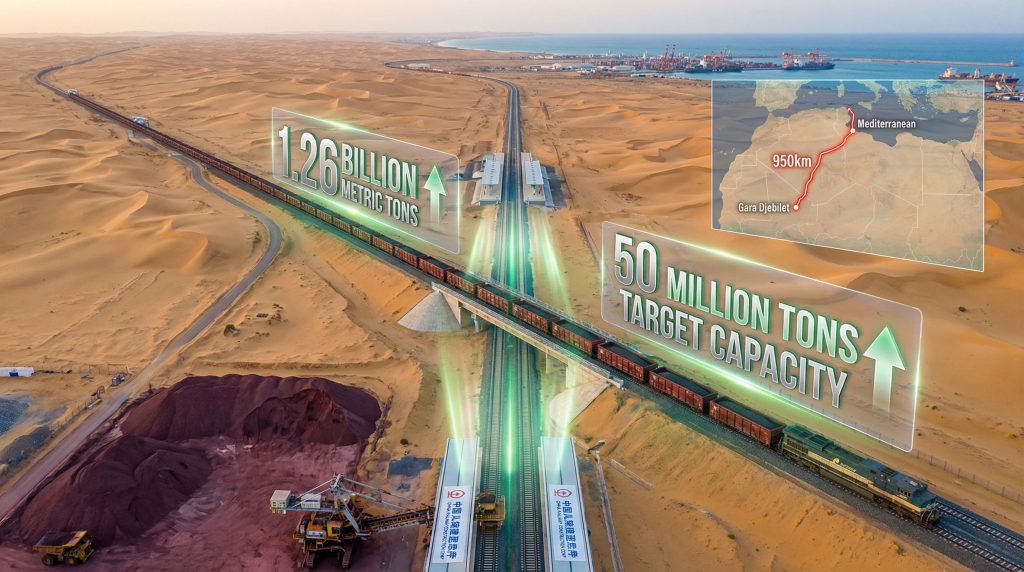
Algeria's recent completion of an extensive railway network connecting remote southwestern deposits to Mediterranean export terminals exemplifies how targeted infrastructure development can activate stranded mineral assets. The 950-kilometer heavy-haul railway system, inaugurated in February 2026, establishes direct transport links from the Gara Djebilet iron ore deposits to processing facilities and international shipping terminals.
This infrastructure achievement required collaboration between Algerian state enterprises ANESRIF and COSIDER alongside China Railway Construction Corporation, demonstrating the technical expertise necessary for desert railway construction. Furthermore, the project connects the previously isolated mining industry evolution region near the Moroccan border to existing rail networks that reach Mediterranean ports, fundamentally changing the economics of resource extraction in North Africa.
Technical Specifications and Capacity Planning
The railway system incorporates several key technical elements designed for long-term mineral transport operations:
• Heavy-haul track design capable of supporting multi-million ton annual throughput
• Desert-adapted infrastructure engineered for extreme temperature variations and sand exposure
• Integrated logistics coordination connecting mine sites to processing facilities and export terminals
• Strategic connection points linking Tindouf and Béchar to established Mediterranean shipping routes
When big ASX news breaks, our subscribers know first
Geological Significance of Gara Djebilet Deposits
The mineral reserves at Gara Djebilet represent one of the world's largest undeveloped iron ore deposits, with geological surveys indicating substantial magnetite and maghemite concentrations suitable for modern steel production processes. Conservative estimates suggest 1.26 billion metric tons of recoverable ore, while optimistic projections extend to 3.5 billion metric tons of total resource potential.
Ore Quality and Processing Characteristics
| Quality Metric | Specification | Processing Advantage |
|---|---|---|
| Iron content | 35-60% Fe | Direct reduction capability |
| Magnetite composition | High-grade concentrate potential | Magnetic separation efficiency |
| Impurity levels | Low phosphorus and sulfur | Premium steel production |
| Particle distribution | Suitable for pelletization | Enhanced blast furnace performance |
The geological characteristics of these deposits provide advantages for international steel producers seeking consistent ore quality. The magnetite composition enables efficient magnetic separation processes, while low impurity levels reduce downstream processing requirements and improve final steel product quality. Consequently, this positions Algeria favourably within current iron ore price trends affecting global markets.
Economic Diversification Strategy and Resource Diplomacy
Algeria's mineral sector development forms part of a broader economic diversification initiative aimed at reducing dependency on hydrocarbon exports, which currently account for more than three-quarters of national export revenues. This concentrated economic structure creates vulnerability to volatile energy prices and limits fiscal flexibility during market downturns.
The iron ore project offers multiple strategic benefits:
• Import substitution potential addressing $1.2 billion in annual iron ore imports
• New revenue streams independent of oil and gas market cycles
• Industrial development catalyst supporting downstream steel processing expansion
• Employment generation in mining, logistics, and related service sectors
Regional Supply Chain Positioning
Algeria's geographical position provides competitive advantages for accessing European steel markets compared to traditional suppliers from Australia and Brazil. Mediterranean shipping routes offer shorter transit times and lower transport costs for European buyers, potentially enabling premium pricing for Algerian iron ore despite higher initial production costs.
However, the project must navigate challenges related to iron ore price decline scenarios that could impact long-term viability. China's involvement in Algerian iron ore mining demonstrates the strategic importance of this development.
The railway enables Algeria to transition from iron ore importer to potential major exporter, fundamentally altering North African mineral trade dynamics while providing European steel producers with supply chain diversification options.
Chinese Infrastructure Partnership and Technology Transfer
The collaboration with China Railway Construction Corporation extends beyond basic construction services to include comprehensive technology transfer and operational expertise. This partnership aligns with China's Belt and Road Initiative objectives while providing Algeria access to proven heavy-haul railway technologies developed for similar mining operations in Australia and Brazil.
Operational Model and Capacity Development
The project structure involves multiple phases designed to optimise production scaling:
Phase 1 (2026-2027): Initial Operations
• Target annual production: 4 million tons
• Focus on direct shipping ore grades
• Quality optimisation and customer development
• Logistics system refinement
Phase 2 (2028-2030): Capacity Expansion
• Target annual production: 12 million tons
• Enhanced processing and concentration facilities
• Pelletisation capabilities development
• International market penetration
Phase 3 (Post-2030): Full Development
• Potential annual production: 50 million tons
• Integration with regional steel production
• Advanced processing technologies
• Supply chain optimisation
Global Iron Ore Market Context and Competitive Positioning
The timing of Algeria's market entry coincides with ongoing supply chain diversification efforts among international steel producers seeking alternatives to established Australian and Brazilian suppliers. This diversification imperative stems from geopolitical considerations, logistics cost management, and quality specification requirements. Moreover, the project aligns with surging iron ore demand projections for the coming years.
Comparative Infrastructure Investment Analysis
| Mining Region | Infrastructure Investment | Annual Capacity | Transport Distance |
|---|---|---|---|
| Algeria Gara Djebilet | Multi-billion USD | 50M tons (target) | 950km railway |
| Australia Pilbara | $10B+ annually | 300M+ tons | 400km average |
| Brazil Vale operations | $15B+ investments | 400M+ tons | 800km railways |
| Guinea Simandou | $20B+ estimated | 100M+ tons | 650km railway |
Algeria's investment scale aligns with other major iron ore development projects, though the target capacity remains modest compared to established operations. In contrast to australian iron ore advantages, this positioning may enable premium pricing strategies focused on quality rather than volume competition.
Operational Risk Assessment and Market Challenges
Several factors could influence the long-term success of Algeria's iron ore development strategy. Understanding these risk elements provides insight into project viability and potential market impact.
Technical and Operational Risks
• Desert infrastructure maintenance requiring specialised equipment and expertise
• Quality consistency challenges in maintaining international ore grade standards
• Logistics optimisation achieving cost competitiveness with established sea-based transport
• Environmental compliance meeting evolving international sustainability requirements
Market Positioning Challenges
The cyclical nature of iron ore markets creates pricing volatility that affects project economics. Historical price ranges from $50-200 per ton demonstrate the importance of cost structure optimisation and operational flexibility. Algeria's success depends partly on achieving production costs that remain profitable during market downturns.
The next major ASX story will hit our subscribers first
Integration with Existing Industrial Infrastructure
The railway connection to Oran provides access to existing steel processing capabilities through Turkey's Tosyali Holding operations. This integration offers opportunities for value-added processing rather than simple raw material export, potentially improving project economics through downstream value capture.
Furthermore, Algeria's first iron ore shipment marks a crucial milestone in operational readiness.
Logistics Flow Optimisation
The transport system design incorporates multiple processing and quality control checkpoints:
- Mine extraction and primary processing at Gara Djebilet site
- Secondary processing and concentration at Béchar facilities
- Quality certification and logistics coordination prior to export
- Mediterranean port access through Oran terminals for international shipments
Long-Term Strategic Implications for Resource Economics
Algeria opens 600-mile railway to tap vast iron ore deposit represents broader trends in resource-rich nations seeking to monetise previously inaccessible mineral deposits through strategic infrastructure development. This approach requires substantial upfront capital but can fundamentally alter a nation's position in global commodity markets.
Economic Transformation Timeline
The project's success metrics extend beyond simple production targets to encompass broader economic development objectives:
• 2026-2027: Proof of concept and initial market penetration
• 2028-2030: Capacity scaling and operational optimisation
• 2031-2035: Full market integration and economic impact assessment
• Post-2035: Potential expansion and replication for other mineral deposits
Investment analysts view the Gara Djebilet railway as a transformative infrastructure project that could establish Algeria as a significant player in global iron ore markets while providing a development model for other resource-rich nations seeking economic diversification through strategic transport investments.
Future Outlook and Industry Implications
The successful implementation of Algeria opens 600-mile railway to tap vast iron ore deposit could influence similar projects across Africa and other regions with stranded mineral assets. The collaboration model between state enterprises and international construction firms provides a template for future resource development partnerships.
This project also demonstrates how geological advantages combined with strategic infrastructure investment can reshape regional supply chains and create new competitive dynamics in established commodity markets. As global steel production continues evolving toward more sustainable practices, suppliers offering consistent quality and reliable logistics will likely gain market share regardless of traditional volume-based competition.
In addition, the broader implications extend to resource diplomacy, where nations can leverage infrastructure investments to build strategic partnerships and reduce economic dependency on single commodity sectors. Algeria's approach offers insights for other mineral-rich nations seeking to transform geological endowments into sustainable economic development through targeted infrastructure development. Finally, the project's success where Algeria opens 600-mile railway to tap vast iron ore deposit will likely serve as a benchmark for similar initiatives across the developing world.
Want to Profit from the Next Major Mineral Discovery?
Algeria's massive infrastructure investment to unlock iron ore deposits demonstrates how strategic projects can transform commodity markets overnight. Discovery Alert's proprietary Discovery IQ model provides instant notifications when significant ASX mineral discoveries are announced, helping investors capitalise on major discoveries before the broader market reacts.