June 13, 2026
The Engineering Journey of a Steel Giant: How Offshore Jacket Structures Define Platform Foundations
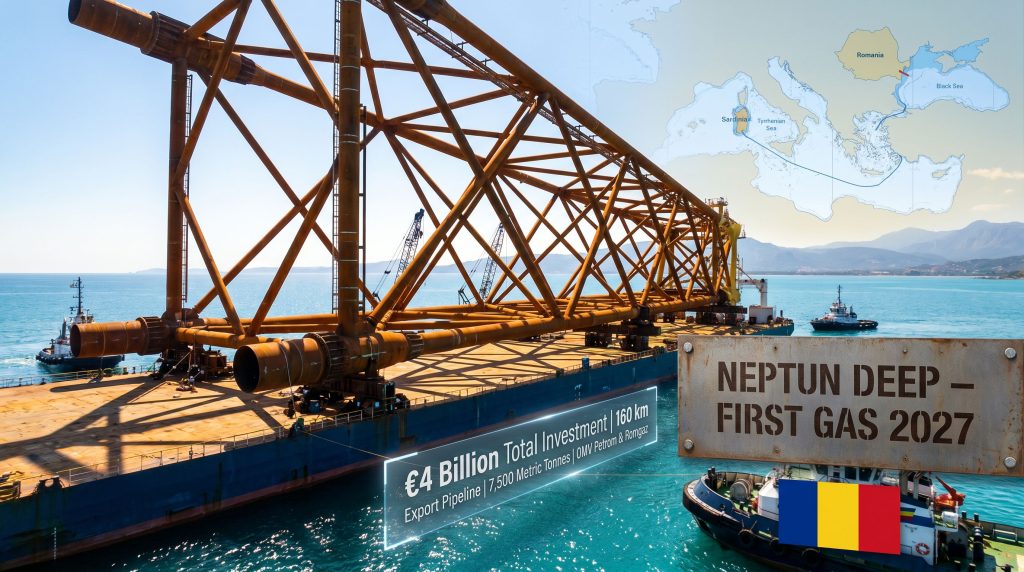
Offshore energy infrastructure operates on timescales and physical dimensions that most industries rarely approach. Before a single cubic metre of natural gas can flow from beneath the seabed to a continental pipeline network, years of fabrication, logistics coordination, and precision marine engineering must unfold in sequence. The departure of a major offshore jacket structure from a Mediterranean shipyard is not simply a logistics event. It represents the culmination of an intricate engineering programme and the beginning of an equally complex marine installation campaign. For the Neptun Deep project in the Romanian Black Sea, the Neptun Deep jacket sails away from Saipem Sardinia shipyard moment in June 2026 marks a turning point in what is currently the largest offshore gas development under active construction within the European Union.
When big ASX news breaks, our subscribers know first
What a Fixed Jacket Foundation Actually Does Beneath the Water Surface
A jacket structure is the steel lattice framework that sits permanently on the seabed and supports the entire weight of an offshore production platform's topsides above it. Think of it as the building's skeleton, engineered to resist not just vertical compressive loads from the topsides equipment above, but also lateral forces generated by wave action, storm surge, current drag, and seismic loading over a design life that typically spans 25 to 30 years.
For mid-water Black Sea conditions, fixed jacket platforms remain technically superior to floating alternatives because the basin's relatively shallow shelf areas allow pile-driven foundations that deliver exceptional stability. The Black Sea also presents unique environmental characteristics, including lower salinity than the open ocean and distinct storm seasonality, which influence the corrosion protection systems and structural fatigue calculations built into the jacket's design from the outset.
The jacket's complexity scales directly with the water depth it must span, the seabed geotechnical conditions at the installation site, and the topsides weight it will ultimately carry. Structures designed for 100 to 150 metres of water, like the Neptun Deep jacket targeting the Pelican field platform position, represent some of the more demanding fixed-structure engineering challenges in offshore construction.
Technical Specifications: Understanding the Scale of the Neptun Deep Jacket
The physical dimensions of the Neptun Deep jacket place it among the most substantial structures ever fabricated at Saipem's Arbatax facility in Sardinia. Understanding the numbers contextualises why this structure commands attention across the offshore engineering sector.
| Parameter | Specification |
|---|---|
| Approximate height | ~135 metres |
| Base footprint | ~50 m x 50 m |
| Total fabricated weight | ~7,500 metric tonnes |
| Seabed anchor piles | 8 steel piles, 2.5 m diameter each |
| Fabrication commencement | October 2024 |
| Fabrication location | Saipem Arbatax Yard, Sardinia, Italy |
| Transport orientation | Horizontal (sea transport) |
| Installation vessel | Saipem 7000 crane vessel |
At roughly 135 metres tall, the jacket's height exceeds that of many prominent urban skyscrapers in European capital cities. The base footprint of approximately 50 metres by 50 metres reflects the load distribution requirements imposed by the topsides mass above and the pile resistance calculations derived from the seabed soil profile at the installation location.
The eight foundation piles, each 2.5 metres in diameter, are driven deep into the seabed using hydraulic impact hammers operated from the installation vessel. This pile-driving process is not merely an anchoring exercise. It is a precision geotechnical operation in which pile penetration depth, driving resistance, and set measurements are continuously monitored to confirm that each pile has achieved its design bearing capacity. The entire production platform's operational integrity rests on the integrity of these eight connections to the seabed.
The Arbatax Fabrication Yard and the Multi-Continent Construction Strategy
Saipem's Arbatax facility on the eastern coast of Sardinia has historically served as one of Europe's most capable offshore fabrication yards, handling large-scale structural steel work for the upstream oil and gas sector. Constructing a 7,500-tonne jacket over approximately 18 months at this yard required sustained workforce mobilisation, a continuous supply chain of high-grade structural steel, and rigorous non-destructive testing and weld quality assurance protocols throughout the fabrication sequence.
What makes the Neptun Deep construction programme particularly interesting from a project execution standpoint is the deliberate splitting of fabrication work across two continents. The jacket was built in Sardinia, while the platform topsides are being fabricated at Saipem's Karimun yard in Indonesia. This multi-yard strategy is common practice on large EPCI contracts for several reasons:
- Yard availability and crane capacity often dictate which facility handles structural versus module fabrication work.
- Labour cost differentials between European and Asian fabrication markets can generate significant savings on topsides module construction, which is highly labour-intensive.
- Parallel fabrication at two geographically separate yards compresses the overall project schedule compared to sequential construction at a single facility.
- Each yard's equipment and workforce specialisations can be optimally matched to the structural characteristics of the component being built.
The coordination challenge inherent in this approach should not be underestimated. Engineering teams must manage interface alignment between jacket and topsides designs in real time, ensuring that structural connection points, utility penetrations, and equipment access arrangements remain fully compatible as both components evolve during fabrication. Any dimensional inconsistency discovered at installation would be extraordinarily costly to resolve offshore.
The Marine Transport and Installation Sequence Explained
Once load-out operations at Arbatax were completed, the jacket was positioned horizontally on a heavy-lift transport vessel for the voyage from the Tyrrhenian Sea, through the Strait of Messina or around Sicily, across the Mediterranean, through the Bosphorus Strait, and into the Black Sea. This routing alone is operationally complex. The Bosphorus transit imposes strict vessel dimension and passage scheduling constraints managed by Turkish maritime authorities, adding logistical coordination layers that smaller transport operations never encounter.
"Transporting a 135-metre steel structure horizontally across two seas and through one of the world's busiest maritime straits requires pre-voyage route surveys, meteorological window planning, and coastal authority coordination spanning multiple national jurisdictions."
Upon arrival at the Neptun Deep installation site in the Black Sea, the Saipem 7000 takes over. This vessel is among the most capable heavy-lift crane ships in global offshore operations, equipped with dual revolving cranes that together can handle lifts exceeding 14,000 metric tonnes. The installation sequence involves:
- Positioning the transport vessel and the Saipem 7000 in a pre-planned arrangement relative to each other and the installation coordinates.
- Attaching the Saipem 7000's crane rigging to the jacket's pre-engineered lifting points.
- Upending the jacket from its horizontal transport orientation to a vertical position in a controlled, multi-crane lift.
- Lowering the vertical jacket onto the seabed target position with centimetre-level accuracy using dynamic positioning and real-time survey feedback.
- Sequentially driving all eight foundation piles to their specified penetration depths.
- Conducting post-installation surveys to verify vertical alignment tolerances before topsides mating operations are planned.
The Two Fields: Domino and Pelican Compared
Neptun Deep is not a single-reservoir development. The project encompasses two distinct gas fields that differ significantly in their water depth, development architecture, and infrastructure requirements.
| Field | Water Depth | Development Type | Key Infrastructure Challenge |
|---|---|---|---|
| Domino | ~1,000 m | Deepwater subsea tieback | Deepwater flowlines, subsea trees, umbilicals |
| Pelican | ~125 m | Shallow water subsea | Separate subsea scope, different installation methods |
The Domino field, sitting in approximately 1,000 metres of water, requires a full deepwater subsea development approach. Subsea production trees, manifolds, flexible flowlines, and electrohydraulic umbilicals must all function reliably at water depths where hydrostatic pressure exceeds 100 bar and where intervention costs are substantial. This deepwater infrastructure ties back production to the central platform structure positioned at a shallower installation depth.
The Pelican field, at around 125 metres, falls within the conventional shallow-water subsea development range but still requires dedicated subsea infrastructure and installation campaigns. Managing these two technically distinct development scopes within a single EPCI contract represents a significant programme management undertaking for Saipem.
Beyond the wells and subsea systems, Saipem's scope also includes installation of a 160-kilometre, 30-inch diameter export pipeline connecting the platform to the Romanian coast, accompanied by a fibre-optic cable that provides the real-time communications link between offshore control systems and onshore operations infrastructure. A 160-kilometre pipeline of this diameter represents a substantial pipelay campaign by any measure, requiring dedicated pipelay vessels and extensive pre-installation seabed preparation along the route.
The next major ASX story will hit our subscribers first
Romania's Black Sea Ambitions and What Neptun Deep Means for Regional Supply
Romania was historically one of continental Europe's most significant onshore gas producers, with production from the Transylvanian Basin forming the backbone of domestic supply for decades. However, sustained depletion of mature onshore fields without equivalent replacement volumes has placed Romania on a declining production trajectory that Neptun Deep is specifically designed to reverse.
The project's total capital commitment of up to €4 billion, shared between joint venture partners OMV Petrom and Romgaz, represents the largest single offshore investment in Romanian energy history. With first gas currently targeted for 2027, Neptun Deep is expected to materially increase Romania's domestic gas production and potentially position the country as a net gas exporter to neighbouring Central and Eastern European markets.
This matters beyond Romanian borders. Central and Eastern European gas markets have historically been exposed to supply concentration risks from pipeline routes originating outside the EU. Additional indigenous EU gas production from the Black Sea shelf reduces this exposure and introduces a new price-competitive supply source into regional spot and forward markets. Furthermore, the broader LNG supply outlook for Europe suggests that domestically produced pipeline gas from sources like Neptun Deep will complement, rather than compete with, import diversification strategies already underway across the continent.
Whether Neptun Deep ultimately influences spot gas pricing in hubs like the Virtual Trading Point in Austria or the Czech PRISMA platform will depend on volumes delivered, infrastructure interconnection capacity, and prevailing demand cycles at first gas. In addition, shifting European gas prices and evolving natural gas price trends suggest the market environment at first production could look markedly different from today's conditions.
The regional strategic implications of new Black Sea gas supply extend beyond simple pricing dynamics. Energy security considerations, infrastructure investment signals, and the broader LNG import tax structure debates in Asian markets collectively shape the global context within which Neptun Deep's commercial performance will ultimately be measured.
Project Milestones at a Glance
| Milestone | Status / Detail |
|---|---|
| Jacket fabrication | Completed, sailed from Sardinia June 2026 |
| Topsides fabrication | Underway at Karimun, Indonesia |
| EPCI contractor | Saipem (contract awarded August 2023) |
| Installation vessel | Saipem 7000 heavy-lift crane vessel |
| Export pipeline | 160 km, 30-inch diameter |
| First gas target | 2027 |
| Total project investment | Up to €4 billion |
| Project developers | OMV Petrom and Romgaz |
Frequently Asked Questions About the Neptun Deep Jacket
What does the jacket sail-away milestone actually signify for the project?
The departure of the jacket from Arbatax confirms that the most structurally complex and time-critical fabrication component of the platform has been completed on schedule. The jacket is the foundation of the entire production system, and its successful sail-away keeps the 2027 first gas target achievable.
Why was the jacket transported horizontally rather than upright?
A 135-metre vertical structure cannot safely transit open sea conditions without exceeding vessel stability limits. Horizontal orientation dramatically lowers the combined centre of gravity of vessel and cargo, consequently reducing roll and pitch-induced structural stresses during the voyage.
How does the Saipem 7000 physically upend a horizontal jacket?
The crane vessel uses its dual-crane configuration to attach rigging to engineered lifting points at specific positions along the jacket's length. By applying differential crane tensions in a controlled sequence, the structure is rotated from horizontal to vertical in a carefully managed upending operation before being lowered to the seabed.
What risks exist during the Black Sea installation campaign?
Black Sea weather windows, particularly autumn storm seasonality, constrain the available operational days for heavy-lift and pipelay operations. Installation campaign scheduling must, however, account for wave height and current thresholds that define safe working limits for the Saipem 7000 and associated marine spread vessels.
Is Neptun Deep the only major offshore gas development currently active within the EU?
It is the largest currently under active construction within EU jurisdiction, reflecting both the scale of the Black Sea resource base and the investment appetite of OMV Petrom and Romgaz relative to other potential EU offshore developments that remain at earlier project maturity stages.
Disclaimer: This article contains forward-looking statements relating to project timelines, production targets, and investment figures. These are subject to operational, technical, regulatory, and market risks that could cause actual outcomes to differ materially from current expectations. Readers should not rely on forward-looking statements as the basis for investment decisions.
Want to Stay Ahead of the Next Major Resource Discovery?
Discovery Alert's proprietary Discovery IQ model scans ASX announcements in real time, instantly identifying significant mineral discoveries across more than 30 commodities — from the kind of large-scale energy and resource projects reshaping regional supply, to the early-stage exploration breakthroughs that can deliver transformative returns. Explore how historic discoveries have generated substantial market returns on Discovery Alert's dedicated discoveries page, then begin your 14-day free trial to position yourself ahead of the broader market.