June 15, 2026
Ancient Water, Modern Extraction: The Policy Battle Beneath Olympic Dam
Few natural systems on Earth carry the geological weight of the Great Artesian Basin. Spanning roughly one-fifth of the Australian continent, it holds groundwater that infiltrated surface rock millions of years ago, making it one of the largest and deepest freshwater reservoirs in the world. Recharge occurs at an almost imperceptibly slow pace, meaning any water extracted today is, at human timescales, effectively gone for good. Against this backdrop, the BHP Great Artesian Basin water extraction agreement now being codified through South Australian legislation represents far more than a corporate water licence renewal. It is a stress test for how Australia balances industrial ambition against irreplaceable natural and cultural heritage.
When big ASX news breaks, our subscribers know first
The Olympic Dam Indenture: A Legislated Commercial Relationship
The Olympic Dam indenture is not a conventional mining permit. It is a legislated contract between BHP and the South Australian government, given the force of law through specific state legislation tracing back to the Roxby Downs (Indenture Ratification) Act 1982. This architectural feature matters enormously: because the indenture is embedded in statute, amendments require parliamentary passage rather than administrative revision, giving the instrument unusual durability and, critics argue, unusual insulation from ordinary environmental accountability.
The South Australian government announced in May 2026 that it would introduce a bill to modernise this instrument, with passage targeted for the parliamentary sitting week of 15 June 2026. The stated purpose was to update a framework that had governed operations for more than four decades. However, the changes inside the bill extend well beyond housekeeping. The revised indenture removes previous caps on copper production volume and broadens BHP's mining lease footprint, structurally enabling a potential large-scale expansion of the mine that would carry substantially higher long-term water demand than current operations.
What Makes Olympic Dam Exceptional in the Global Mining Landscape
Olympic Dam is not simply a copper mine. It hosts one of the largest known deposits of copper, uranium, gold, and silver in the world, sitting beneath the arid rangelands of northern South Australia. The orebody's scale means that any expansion scenario transforms the site into a tier-one global asset capable of materially influencing commodity supply chains. Furthermore, copper and uranium investment has attracted renewed policy attention as a foundational driver of electrical infrastructure and grid expansion. The mine's long-term strategic relevance is therefore tied to trajectories that extend well beyond South Australia's borders.
Wellfield A vs Wellfield B: Understanding the Extraction Profile
The BHP Great Artesian Basin water extraction agreement governs two distinct wellfields, and understanding their differences is essential to interpreting what the updated indenture actually delivers environmentally.
| Wellfield | Daily Extraction Volume | Proximity to Mound Springs | Phase-Out Timeline |
|---|---|---|---|
| Wellfield A | ~4 million litres/day | Higher impact zone | Ceases by 2036 |
| Wellfield B | ~29 million litres/day | Lower pressure impact | Conditional on Northern Water |
| Combined FY24 Average | ~49.4 ML/day | Basin-wide drawdown | Under review |
Wellfield A, which draws approximately 4 million litres per day, sits in closer proximity to the mound spring systems and exerts greater pressure influence on those ecosystems. The revised indenture requires this wellfield to cease operations by 2036, a deadline environmentalists argue is far too distant given the documented degradation already underway.
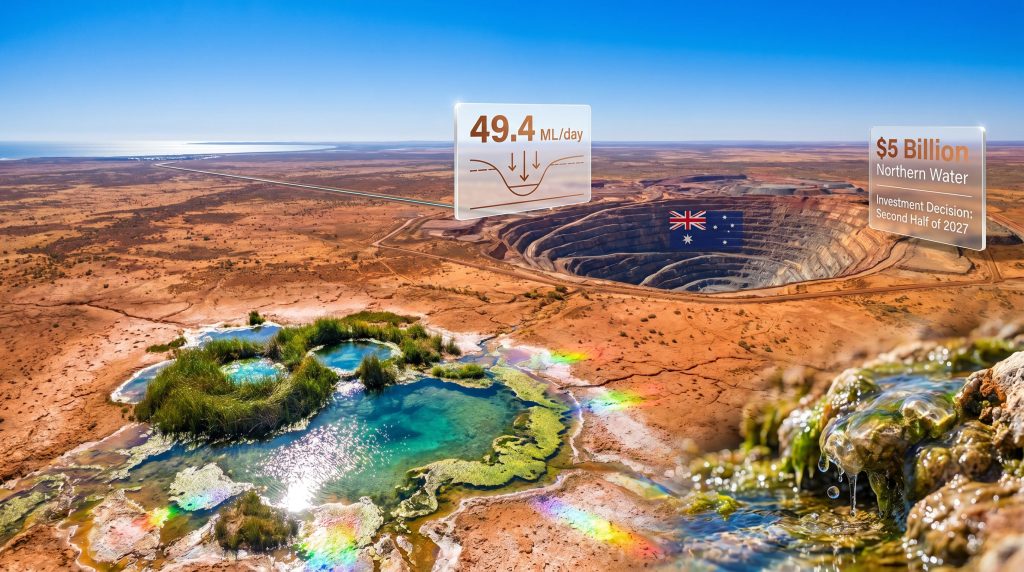
Wellfield B is the operation's primary water source, extracting approximately 29 million litres per day. Officials from the Department for Environment and Water and BHP have characterised this wellfield as having a comparatively lower impact on mound spring pressure dynamics. However, the cumulative combined abstraction average for FY24 reached approximately 49.4 megalitres per day, a figure that illustrates the basin's total burden across both sources and signals the scale of dependency that a future expansion scenario would need to address.
What 49.4 Megalitres Per Day Actually Represents
To contextualise this volume: 49.4 megalitres is equivalent to roughly 20 Olympic-sized swimming pools of water drawn from a fossil aquifer every single day. Unlike river systems that receive seasonal rainfall recharge, Great Artesian Basin groundwater replenishes on geological timescales measured in thousands to tens of thousands of years. The practical consequence is that extraction at current volumes constitutes a permanent reduction in stored groundwater, not a temporary depletion that nature will reverse in a generation.
Groundwater Pressure and the Mound Spring Mechanism
Mound springs are surface expressions of artesian pressure: water that has been compressed underground rises naturally to the surface where geological faults or weaknesses allow upward flow. They are, in essence, pressure release valves for a continent-scale aquifer. When extraction activities reduce basin pressure, the hydraulic gradient that drives this upwelling weakens, and springs that have flowed continuously for thousands of years can slow, diminish, or cease entirely. Once a spring stops flowing, the biological community and the physical spring mound that developed around its outflow may never recover, even if pressure is partially restored decades later.
The Northern Water Project: A $5 Billion Gamble on Alternative Supply
The central logic underpinning the government's defence of continued Wellfield B extraction is that a large-scale desalination project will eventually replace basin groundwater as Olympic Dam's primary water source. The Northern Water project proposes constructing a desalination plant near Mullaquana Station on the Eyre Peninsula, drawing seawater from Spencer Gulf and pumping treated water through a pipeline corridor stretching hundreds of kilometres into the mining region.
Project Status Snapshot as of June 2026:
- Estimated total cost: $5 billion
- Feasibility study budget allocated: $200 million
- Proposed plant site: Near Mullaquana Station, Eyre Peninsula
- Investment decision timeline: Second half of 2027
- Private backer financing status: Previously withdrawn; structure under review
The feasibility study's $200 million budget signals that the project is taken seriously at an engineering level. However, a critical detail often overlooked in coverage of this project is that private backers previously withdrew from the financing structure, leaving the pathway to funding unresolved. The investment decision has also been pushed back, with BHP not expected to make a final call until the second half of 2027. This creates a meaningful gap between the regulatory commitment embedded in the new indenture and the commercial reality that basin extraction will continue in full for the foreseeable future.
Three Scenarios: What Happens to the Basin Depending on Northern Water's Fate
| Scenario | Northern Water Status | Wellfield B Outcome | Basin Impact |
|---|---|---|---|
| Scenario A | Approved and operational | Reduced to backup only | Significant pressure relief |
| Scenario B | Delayed beyond 2030 | Continued full extraction | Ongoing ecological stress |
| Scenario C | Cancelled entirely | Retained under stricter conditions | Long-term adverse spring impact |
Environmentalist David Noonan argued publicly that the bill effectively entrenches BHP's extraction rights rather than providing a credible pathway to ending them. His concern centred on the reality that even if Northern Water proceeds, Wellfield B retains its status as an ongoing water source for the mine, potentially for decades. The indenture does not impose a hard closure date on Wellfield B equivalent to the 2036 deadline applied to Wellfield A.
Cultural Dimensions: The Arabana People and the Mound Springs
Any analysis of the BHP Great Artesian Basin water extraction agreement that treats this dispute as a purely hydrological or regulatory matter will miss its most profound dimension. The mound springs scattered across the basin are not simply ecological features of scientific interest. For the Arabana people, whose country encompasses the spring systems and the Olympic Dam mine site, these waters hold ancestral story, ceremonial significance, and the living fabric of cultural identity.
Arabana woman Janette Milera expressed publicly that the springs carry ancestors and stories for her community, and that Arabana people hold deep concern about where the bill's provisions might lead for the survival of those springs. Her position was not one of categorical opposition to the legislation, but of insistence on a genuine, substantive consultation process that has not yet materialised. In addition, Indigenous rights in mining contexts globally demonstrate that meaningful participation requires more than procedural acknowledgement.
The Gap Between Consultation and Participation
The distinction between consultation and meaningful participation is central to understanding First Nations concerns in this process. Native title rights in Australia are assigned through Commonwealth legislation and cannot be modified or resolved through state indenture instruments, a jurisdictional boundary that Energy and Mining Minister Tom Koutsantonis acknowledged explicitly. However, critics argue that using this jurisdictional limitation as grounds for excluding native title concerns from the committee inquiry effectively removes the most fundamental stakeholder interest from the one parliamentary process where it might have received structured engagement.
BHP has stated it remains committed to constructive engagement with traditional owners and has provided updates throughout the indenture process. The company has also indicated that native title holders had provided approval for the expanded mining lease, and that further negotiations are expected before subsequent steps under the indenture proceed.
The Parliamentary Process: Speed, Urgency, and Democratic Legitimacy
The committee process established to review the indenture bill drew pointed criticism from multiple quarters. The inquiry allowed a 10-day public submission window, and received more than 20 submissions covering a range of concerns:
- Long-term environmental consequences of continued and potentially expanded basin extraction
- The adequacy of the consultation framework for traditional owners
- Native title implications not addressed within the indenture's scope
- Absence of enforceable commitments linking Wellfield B continuity to Northern Water outcomes
- Structural concerns that the bill consolidates BHP's extraction rights without adequate time-limited conditions
Despite the volume and seriousness of submissions, none of the concerns raised were directly addressed in the committee's final report, which was tabled in parliament the morning after the public submission deadline closed. Greens MLC Melanie Selwood publicly characterised the committee's conduct as a sham, arguing that submitters were denied the opportunity to appear before the committee and have their concerns engaged substantively.
Minister Koutsantonis rejected claims that the process was rushed, while simultaneously acknowledging the government treated the bill with urgency. The stated rationale was competitive: South Australia is in a contest for BHP's capital allocation, and the company has been accelerating early works on a copper project in Argentina. With a decision on Olympic Dam's future deferred until the second half of 2027, the government assessed that passing the indenture update before the parliamentary winter recess was a prerequisite for keeping Olympic Dam competitive in BHP's global portfolio.
This tension between investment retention and environmental due diligence is not unique to South Australia. Across resource-producing jurisdictions globally, governments routinely face the structural pressure of competing for mobile capital against lower-regulatory environments. The Olympic Dam case is a high-profile example of how that pressure can compress democratic deliberation.
The next major ASX story will hit our subscribers first
Regulatory Architecture: Who Oversees BHP's Water Use Under the New Framework
One of the substantive changes introduced by the updated indenture is an enhanced oversight role for South Australian regulators. Under the new framework, both the Department for Environment and Water and the Environment Protection Authority must sign off on BHP's water licence renewals. This represents a structural shift from the previous arrangement, where the indenture itself provided a more self-contained governance mechanism.
Minister Koutsantonis characterised this as a fundamental difference: BHP's ongoing water access will now be assessed against the environmental health of the mound spring systems, rather than operating under fixed entitlements insulated from ecological outcomes. Whether this conditional renewal mechanism will translate into meaningful extraction reductions in practice depends entirely on how regulators define acceptable environmental thresholds and whether they have the institutional capacity and political support to enforce them.
The State vs. Commonwealth Jurisdictional Divide
A recurring complexity in this dispute is the jurisdictional boundary between state and Commonwealth authority. The original Roxby Downs indenture was crafted at a time when the native title framework that now defines the rights of traditional owners across large parts of Australia did not exist in its current form. The contemporary legal landscape requires BHP to engage with native title holders through processes governed by Commonwealth legislation, processes that sit entirely outside the indenture framework and cannot be resolved or pre-empted by state parliamentary action.
This creates a structural tension: the indenture governs the commercial and operational parameters of mining, but the most contested questions about land rights, cultural heritage, and First Nations authority over country require separate and ongoing processes under a different legislative regime. Critics argue this jurisdictional split allows each process to disclaim responsibility for the concerns that fall within the other's remit. Furthermore, the consideration of natural capital in mining decisions is increasingly recognised as essential to sustainable resource governance.
Key Data Points: Summary of the BHP–South Australia Water Agreement
| Metric | Detail |
|---|---|
| Wellfield A daily extraction | ~4 million litres |
| Wellfield B daily extraction | ~29 million litres |
| FY24 combined abstraction average | ~49.4 ML/day |
| Wellfield A closure deadline | 2036 |
| Northern Water estimated cost | $5 billion |
| Feasibility study budget | $200 million |
| BHP investment decision date | Second half of 2027 |
| Public submissions received | More than 20 |
| Submission window | 10 days |
Frequently Asked Questions: BHP Great Artesian Basin Water Extraction
What is the Great Artesian Basin?
The Great Artesian Basin is one of the largest and deepest freshwater aquifer systems on Earth, covering approximately one-fifth of Australia. It contains groundwater deposited over millions of years, making it effectively a non-renewable resource at human timescales.
What is the Olympic Dam indenture?
It is a legislated contract between BHP and the South Australian government, ratified through state parliament, that governs the operational, environmental, and commercial conditions of mining at Olympic Dam. It has been in place since 1982 and has been amended periodically.
When will BHP stop extracting from Wellfield A?
The updated indenture requires Wellfield A extraction to cease by 2036. Environmental critics argue this timeline is insufficient given existing damage to mound spring systems. For context, concerns about mound spring decline have been raised by environmental groups for many years.
Will BHP ever fully exit the Great Artesian Basin?
Not under the current agreement. Wellfield B's continued use is conditional on Northern Water's outcomes but lacks a binding closure deadline equivalent to Wellfield A's 2036 requirement. Full basin exit remains a scenario rather than a commitment.
What is the Northern Water project?
It is a proposed $5 billion desalination plant near Mullaquana Station on the Eyre Peninsula, designed to supply Olympic Dam with treated seawater via a long-distance pipeline. A final investment decision is expected in the second half of 2027.
What role do the Arabana people have in basin decisions?
The Arabana are the traditional owners of country encompassing the mound springs and the Olympic Dam mine site. Their rights are governed by Commonwealth native title legislation, which sits outside the indenture framework. Critics argue this creates a gap in cultural authority over water decisions that relates directly to the broader challenge of critical minerals and energy transition governance.
What environmental conditions apply to water licence renewals?
Under the revised indenture, both the Department for Environment and Water and the EPA must approve BHP's water licence renewals, with assessments linked to the environmental health of the mound springs. This is a new addition to the framework.
Three Policy Gaps That Remain Unresolved
Despite the indenture update, several structural issues remain without adequate resolution:
-
No binding Wellfield B closure date: The absence of a hard deadline for Wellfield B equivalent to Wellfield A's 2036 cutoff means continued extraction could extend indefinitely if Northern Water stalls or is cancelled.
-
Cultural authority is structurally excluded: The jurisdictional separation between state indenture legislation and Commonwealth native title law means First Nations communities cannot resolve their most fundamental concerns through the only parliamentary process available to them.
-
Northern Water financing remains unresolved: With private backers previously withdrawn and a final investment decision not expected until late 2027, the project that underpins the entire environmental rationale for allowing Wellfield B to continue is itself deeply uncertain.
What a Best-Practice Framework Would Look Like
A more robust regulatory agreement governing the BHP Great Artesian Basin water extraction relationship would likely incorporate several elements absent from the current instrument:
- Enforceable extraction reduction schedules tied to measurable mound spring pressure recovery targets, not calendar dates
- Binding linkage between Northern Water outcomes and Wellfield B continuity, so that failure or cancellation of the desalination project triggers automatic escalation of extraction reduction requirements
- Independent environmental monitoring conducted by a body with no institutional interest in project approval, reporting publicly on spring health metrics on a defined schedule
- Structured First Nations co-governance of water decisions affecting country, separate from and in addition to native title agreement processes
- Transparent water accounting that discloses extraction volumes, pressure impacts, and spring health data in real time, accessible to both regulators and the public
The Olympic Dam case will likely be studied for years as a reference point in Australian resource governance debates. Its ultimate legacy will depend not on the language of the indenture itself, but on whether the regulatory conditions it introduces are enforced with genuine rigour when commercial pressures push in the opposite direction.
Want to Track the Next Major ASX Mineral Discovery Before the Market Does?
Discovery Alert's proprietary Discovery IQ model scans ASX announcements in real time, instantly identifying significant mineral discoveries across copper, uranium, gold, and more — the very commodities at the centre of projects like Olympic Dam — and delivering actionable alerts directly to subscribers. Explore historic discoveries and their remarkable returns, then begin your 14-day free trial at Discovery Alert to position yourself ahead of the broader market.