May 11, 2026
When Geography Becomes Destiny: The Structural Logic Behind Refining Windfalls
Every few years, a single geographic feature reminds global energy markets how fragile interconnected supply chains truly are. Maritime chokepoints concentrate enormous volumes of economic activity into narrow corridors, and when those corridors are threatened, consequences radiate outward with remarkable speed. The Aliko Dangote Strait of Hormuz closure refinery profits story exemplifies this dynamic precisely. The Strait of Hormuz, barely 21 miles wide at its navigable minimum, sits at the intersection of geopolitics and energy economics in a way no other geographic feature can match. Approximately one-fifth of all petroleum liquids traded globally transit this single passage every day, according to the U.S. Energy Information Administration.
The 2026 disruption triggered by Iran's blockade represents one of the most consequential chokepoint events in over a decade, and its effects have not distributed evenly. Some market participants are absorbing severe costs. Others, positioned by geography and timing in ways that could not have been perfectly planned, are capturing margin expansion on a scale rarely seen outside of wartime supply shocks. Understanding which category a refinery falls into requires grasping what energy analysts call geographic arbitrage: the structural pricing advantage accruing to producers operating outside a disrupted supply zone when competing supply chains fracture.
The Dangote Refinery in Lagos, Nigeria, sits firmly in the beneficiary column, and the numbers attached to that position are reshaping the African energy landscape in real time.
When big ASX news breaks, our subscribers know first
Why the Hormuz Closure Creates Asymmetric Winners and Losers
The Mechanics of a Chokepoint-Driven Market Shock
When access through the Strait of Hormuz is restricted, cascading effects move through global energy markets within days, not weeks. Freight costs for alternative routing surge immediately as vessel operators calculate longer transit distances around the Cape of Good Hope. Refined product prices in Middle Eastern export markets become unavailable or unreliable for buyers across East Africa, South Asia, and Europe. Simultaneously, refiners operating outside the Persian Gulf find their products carrying elevated premiums because competing Middle Eastern supply has been removed from the accessible market.
This is the fundamental mechanism of a crack spread expansion during a supply disruption — widening when product supply tightens faster than crude supply. This kind of crude oil price volatility produces a cascading effect across global markets that is difficult to contain. In practical terms:
- Crude oil sourced from West African fields remains largely unaffected by Hormuz disruptions
- The refinery processes that crude into petrol, diesel, jet fuel, and fertiliser feedstocks
- Finished product prices rise as Middle Eastern competing supply disappears from the market
- Input crude costs remain comparatively stable, since West African production flows continue normally
- The margin between input cost and output value widens substantially, directly increasing refinery profitability without any operational changes
The result is a structurally rare scenario in which geopolitical instability in one region directly benefits a well-positioned competitor in another, simply because of where that facility sits on a map.
Who Absorbs the Cost and Who Captures the Windfall
The Hormuz disruption has distributed its consequences in sharply asymmetric ways. Broader oil market disruption patterns from 2025 foreshadowed exactly this kind of regional divergence. The table below illustrates the exposure gradient shaping each stakeholder's current position:
| Region or Sector | Hormuz Exposure Level | Primary Risk or Benefit |
|---|---|---|
| East Africa (fuel imports) | Very High | Supply shortfall and price escalation |
| Southern Africa (fuel imports) | High | Cost inflation and rationing risk |
| Nigeria (domestic refining) | Low to Positive | Marginal feedstock cost shift, margin windfall |
| Global airlines | High | Jet fuel margin expansion, fare pressure |
| Sub-Saharan fertiliser buyers | High | Price doubling, food security threat |
| Atlantic Basin refiners | Low to Positive | Structural margin windfall |
For East and Southern African economies, the exposure is acute. Approximately 75% of refined petroleum products consumed across these regions originate from Middle Eastern supply chains, according to Business Insider Africa reporting. This level of import dependency means that a disruption to Persian Gulf export routes translates directly into pump price spikes and, in severe cases, physical product shortages within weeks of the disruption commencing.
Nigeria, by contrast, sits in an entirely different position — one that its largest refining asset is now fully equipped to exploit.
The Dangote Refinery: Scale, Timing, and Structural Advantage
What Makes the Lagos Facility Genuinely Unprecedented
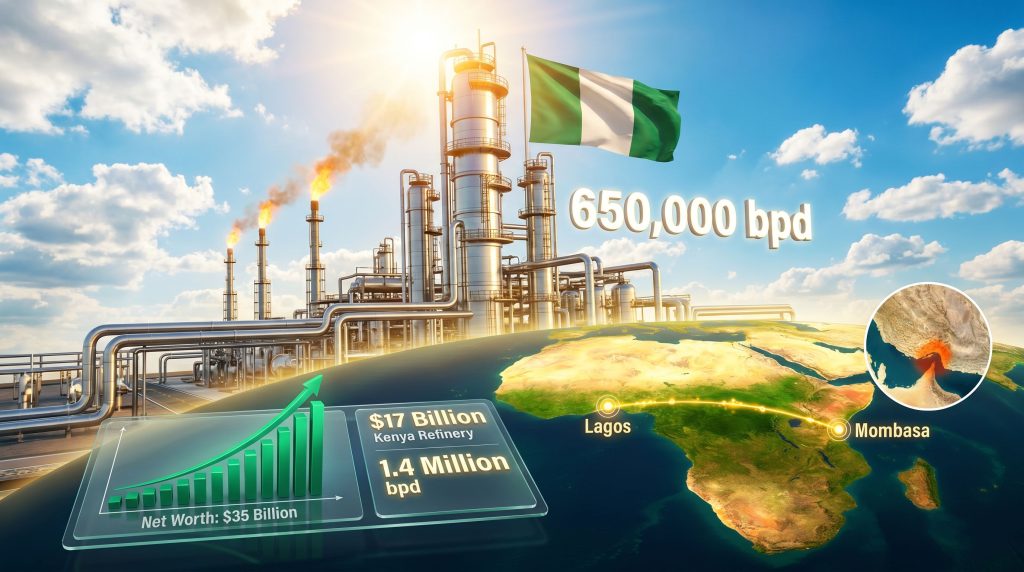
Located in Lekki, Lagos, the Dangote Refinery operates as the world's largest single-train refining facility at a nameplate capacity of 650,000 barrels per day. The distinction between single-train and multi-train architecture matters considerably for understanding its economic profile. A single-train configuration routes all crude throughput through a unified sequence of processing units, maximising per-barrel efficiency and minimising intermediate handling losses.
The refinery reached full operational capacity at precisely the moment global petroleum markets entered acute supply stress in 2026. This timing convergence — between maximum operational readiness and maximum market disruption — represents the kind of structural positioning that generates outsized financial returns. Furthermore, the facility produces a full product slate including petrol, diesel, jet fuel, kerosene, liquefied petroleum gas, and petrochemical feedstocks, and every single product category is experiencing elevated pricing during the current disruption environment.
The Fertiliser Dimension: A Second Profit Engine Running in Parallel
Beyond petroleum refining, the Dangote Group's fertiliser operations have emerged as a simultaneous beneficiary of the same geopolitical shock. Iran and the broader Persian Gulf region are among the world's most significant producers of urea and ammonia-based fertilisers. With Middle Eastern fertiliser export routes constrained, a senior Dangote Group executive confirmed that fertiliser prices have approximately doubled in the current supply environment, as reported by Business Insider Africa.
This dual-profit dynamic represents a structurally rare convergence: the same geopolitical event has simultaneously expanded margins across both the refinery's petroleum product slate and the group's fertiliser production business. For agricultural economies across Sub-Saharan Africa that rely heavily on imported fertiliser inputs, the price doubling carries severe food security implications. For the Dangote Group, however, it represents compounding profitability from a single market disruption event.
"The simultaneous expansion of refining margins and fertiliser prices from a single chokepoint closure illustrates how vertically adjacent businesses within an energy and petrochemical group can capture correlated windfalls during geopolitical supply shocks, producing a multiplier effect on group-level profitability that neither business could achieve independently."
Aliko Dangote's Net Worth and the Financial Translation of Energy Volatility
Crossing $35 Billion: The Wealth Trajectory in Context
Aliko Dangote's personal net worth has surpassed $35 billion during the current period of global energy disruption, recovering sharply from a period in which his fortune had briefly dipped below the $30 billion threshold. The wealth expansion reflects three compounding financial drivers operating simultaneously:
- Elevated petroleum refining margins as crack spreads widen from disruption-driven product scarcity
- Doubled fertiliser prices increasing the valuation and earnings capacity of Dangote Fertilizer operations
- Widening jet fuel margins adding incremental profitability to the refinery's aviation fuel product stream
Dangote himself addressed the margin environment directly in an interview with the Financial Times, observing that since profitability had doubled across other major oil companies during the disruption period, comparable performance from his operations was a natural expectation rather than an exceptional outcome. This framing positions the wealth expansion not as idiosyncratic success but as participation in a sector-wide profitability surge, validating the structural argument that geographic positioning — not operational superiority alone — is driving the windfall.
Why Pure-Play Refiners Outperform Integrated Majors During Disruptions
A less commonly understood dynamic in energy economics is that integrated oil majors — those companies that produce crude oil upstream and refine it downstream — often capture a smaller proportional benefit from refining margin expansion than pure-play or primarily downstream refiners. The reason is that rising crude prices simultaneously inflate their input costs even as product prices rise. Patterns from the oil price rally earlier in 2025 illustrated this asymmetry clearly across the sector.
The Dangote Refinery, operating primarily as a downstream refining and processing business rather than an upstream crude producer, does not carry this internal offset. When product prices rise faster than crude input costs during a disruption, the refinery captures the full margin expansion without an upstream segment absorbing part of the benefit. Consequently, relative to integrated global oil majors reporting elevated downstream earnings, the Dangote facility's per-barrel margin improvement during the current disruption may be proportionally larger.
This is a critical detail for understanding why the Aliko Dangote Strait of Hormuz closure refinery profits story has been so pronounced: the facility's business model is structurally optimised to capture exactly this type of supply-shock-driven margin windfall.
Africa's Strategic Energy Anchor: From Import Dependency to Regional Supplier
Nigeria's Refining Paradox and Its Resolution
For decades, Nigeria occupied a paradoxical position in global energy markets: a major crude oil producer that nonetheless imported the majority of its refined petroleum products. This structural anomaly left Africa's most populous nation exposed to global price volatility at both ends of the supply chain. The Dangote Refinery has materially altered this dynamic, with domestic supply conditions in Nigeria improving even as global markets tighten around the Hormuz disruption.
The downstream consequence of this transformation extends beyond Nigeria's borders. South Africa has entered discussions for a 12-month supply agreement with Nigeria, according to Business Insider Africa reporting — a development that repositions Nigeria as a regional energy exporter rather than a net product importer. This represents a significant geopolitical realignment in African energy trade flows, with implications extending well beyond the current disruption period. In addition, these resource export vulnerabilities mirror challenges being confronted by energy-exporting nations globally as supply chains restructure.
African Governments Competing for Supply Access
Business Insider Africa has reported that the Dangote Refinery has been receiving a surge of inquiries from African governments seeking to secure fuel supply arrangements as Middle Eastern product flows tighten. With roughly three-quarters of East and Southern African refined product imports originating from Persian Gulf supply chains, the Hormuz disruption has exposed a continent-wide vulnerability that multiple governments are now urgently attempting to address.
This dynamic transforms the Lagos refinery from a purely commercial asset into something approaching a strategic infrastructure node for African energy sovereignty. The commercial demand for its products, driven by geopolitical necessity rather than policy preference, is creating de facto strategic importance through market forces alone.
"Africa's historical dependence on Middle Eastern refined product imports has meant that every Persian Gulf conflict or disruption event carries direct economic consequences for African consumers and governments. The emergence of large-scale indigenous refining capacity in West Africa represents the most significant structural shift in African downstream energy in a generation."
How the Dangote Refinery Compares to Africa's Existing Refining Infrastructure
| Metric | Dangote Refinery (Lagos) | Next Largest African Refinery | Africa Top 10 Average |
|---|---|---|---|
| Capacity (bpd) | 650,000 | ~110,000 | ~80,000 |
| Configuration | Single-train | Multi-train | Multi-train |
| Full Product Slate | Yes | Partial | Partial |
| Regional Export Capability | Yes | Minimal | Minimal |
| Hormuz Supply Chain Exposure | Low (benefits from disruption) | High | High |
The capacity gap between the Dangote facility and the next largest African refinery is not incremental; it is transformational. At roughly six times the capacity of Africa's second-largest refining operation, the Lagos facility operates in a different strategic category entirely — one where it can meaningfully influence regional product pricing, supply security, and trade relationships.
Expansion Plans: Building a Continental Refining Architecture
Doubling Lagos Capacity to 1.4 Million Barrels Per Day
Dangote has publicly outlined plans to more than double the Lagos refinery's throughput capacity to 1.4 million barrels per day, with an indicative timeline of approximately 30 months from current planning stages. At 1.4 million bpd, the expanded facility would represent approximately 10% of total U.S. refining capacity, according to Dangote's own benchmarking statements. He has also cited India's Reliance Industries Jamnagar complex as the operational peer his expanded facility would match in output scale — a comparison that places the Lagos expansion project among the most ambitious single-site refining investments in contemporary energy history.
The expansion is being planned alongside a $40 billion IPO structured across multiple exchanges, which would represent one of the largest listing events in African corporate history. The capital raise is intended to fund both the Lagos capacity doubling and the quadrupling of fertiliser production, simultaneously accelerating multiple business lines within the Dangote Group.
The $17 Billion Kenya Refinery: Extending the Continental Footprint
Beyond the Lagos expansion, Dangote is advancing plans for a $17 billion, 650,000-barrel-per-day refinery in Kenya, with Mombasa's port identified as the preferred logistics hub. LNG supply implications from broader East African energy development further underscore the strategic logic of anchoring a major refining hub in the region. Dangote cited Mombasa's superior port infrastructure and broader East African market access as the primary factors favouring Kenya over alternative locations including Mozambique and Tanzania.
If constructed, the Kenya facility would effectively replicate the Lagos model in East Africa, creating a two-node continental refining architecture with combined theoretical capacity approaching 1.3 million barrels per day before the Lagos expansion is even completed. Adding the planned Lagos expansion to this footprint produces a combined continental capacity scenario that would place Dangote among the top refining groups globally by throughput volume.
Scenario Modelling: The Dangote Refining Empire by 2032
| Scenario | Capacity (bpd) | Indicative Timeline | Capital Program | Global Comparable |
|---|---|---|---|---|
| Current Operations | 650,000 | Operational now | Existing | Top 10 global single-site refineries |
| Lagos Expansion Phase 1 | 1,400,000 | ~30 months | Part of $40B IPO | Reliance Jamnagar (India) |
| Kenya Greenfield Refinery | 650,000 | Multi-year development | $17 billion | Replicates Lagos model |
| Combined Continental Footprint | 2,050,000 | 5 to 7 year horizon | $40B+ total program | Comparable to top 3 to 5 global refining groups |
Disclaimer: Expansion scenarios, timelines, and capacity figures represent publicly stated ambitions from Dangote Group leadership. Actual outcomes depend on capital markets conditions, regulatory approvals, construction timelines, and crude supply availability. These projections should not be interpreted as confirmed operational commitments.
The next major ASX story will hit our subscribers first
Africa's Structural Energy Vulnerabilities: What the Hormuz Disruption Reveals
The 75% Import Dependency Problem
The statistic that approximately three-quarters of refined petroleum products consumed across East and Southern Africa originate from Middle Eastern supply chains is not merely a data point. It is a description of systemic fragility that the 2026 Hormuz disruption has rendered impossible to ignore at the policy level. This dependency manifests across three distinct vulnerability channels:
- Price transmission: Supply shocks in the Persian Gulf translate into African pump prices within weeks, with consumers absorbing the full cost of disruptions in which their governments have no leverage
- Physical availability: Shipping route disruptions can create actual product shortages independent of price, as no amount of local purchasing power can substitute for unavailable supply
- Food security linkage: Fertiliser supply disruptions flow directly through to agricultural input costs, threatening food price stability across import-dependent African economies at a time of already elevated global food inflation
Each of these channels represents a distinct policy failure: the failure to develop indigenous refining capacity adequate to reduce import dependency to manageable levels. The current crisis provides the most compelling real-world argument yet for why African governments should treat domestic refining infrastructure as a strategic priority rather than a commercial afterthought.
The Cape of Good Hope Rerouting Effect
One underappreciated consequence of the Hormuz disruption is the surge in maritime traffic rerouting around the Cape of Good Hope as vessel operators avoid the Persian Gulf. South Africa, positioned along this rerouted shipping corridor, has experienced a significant increase in vessel traffic. However, as Business Insider Africa has reported, structural port capacity constraints have limited South Africa's ability to fully monetise this transit opportunity, with the country reportedly missing out on billions in potential shipping revenue as a result.
This dynamic illustrates a broader principle: geopolitical disruptions create asymmetric winners and losers even within the same geographic region, depending on pre-existing infrastructure, institutional capacity, and economic positioning. Proximity to an opportunity does not automatically translate into the ability to capture it.
Frequently Asked Questions: Dangote Refinery, Hormuz Closure, and African Energy Markets
What is the Strait of Hormuz and why does its closure affect African fuel prices?
The Strait of Hormuz is a narrow maritime passage between Iran and Oman through which approximately one-fifth of the world's daily petroleum supply transits. When access is restricted, global refined product supply tightens, pushing up prices in markets that depend on Middle Eastern exports. East and Southern Africa, which source roughly 75% of refined fuel imports from the Persian Gulf region, face direct price escalation and potential supply shortfalls within weeks of a disruption commencing.
How does the Aliko Dangote Strait of Hormuz closure situation directly increase refinery profitability?
When Middle Eastern refined product exports are disrupted, global market prices for petrol, diesel, jet fuel, and petrochemical feedstocks rise. The Dangote Refinery, sourcing crude primarily from West African fields unaffected by the Hormuz disruption, captures these elevated product prices while input crude costs remain comparatively stable. The resulting widening of the crack spread directly increases per-barrel profitability across every product the facility produces.
How large is the Dangote Refinery compared to other global facilities?
At 650,000 barrels per day in a single-train configuration, the Lagos refinery is the world's largest single-train refining facility. The planned expansion to 1.4 million bpd would place it among the top three to five largest refining complexes globally, comparable in scale to India's Reliance Industries Jamnagar complex — which Dangote has explicitly cited as his operational benchmark.
Which African countries are most vulnerable to the Hormuz disruption?
East African nations including Kenya, Tanzania, and Ethiopia, alongside Southern African economies such as South Africa, Zimbabwe, and Zambia, face the highest exposure given their dependence on Middle Eastern refined product imports. Nations closer to West African supply chains, or with supply agreements in place with Nigerian producers, carry meaningfully lower vulnerability.
What is the $17 billion Kenya refinery project?
Dangote is advancing plans for a 650,000-barrel-per-day refinery in Kenya, anchored at the port of Mombasa, at an estimated capital cost of $17 billion. Mombasa was selected over alternative East African locations based on its superior port infrastructure and broader regional market access. The project would extend Dangote's continental refining footprint into East Africa and serve as a regional supply hub for eastern African fuel markets.
What does the planned $40 billion IPO involve?
The proposed IPO — which would rank among the largest listing events in African corporate history — is intended to fund the doubling of Lagos refinery capacity to 1.4 million barrels per day and the quadrupling of fertiliser production. The structure spans multiple exchanges, reflecting the international investor base required to underwrite a capital programme of this magnitude.
Key Takeaways: The Geopolitical-Commercial Convergence Reshaping African Energy
The Aliko Dangote Strait of Hormuz closure refinery profits dynamic represents more than a temporary margin windfall for a single African billionaire. It exposes the structural vulnerabilities of a continent whose energy security remains overwhelmingly dependent on supply chains rooted in one of the world's most geopolitically volatile regions. The core analytical findings from this analysis are as follows:
- The Hormuz disruption has created a structural refining margin windfall for Atlantic Basin and West African refiners, with the Dangote Lagos facility positioned as the primary African beneficiary by virtue of geography, capacity, and timing
- Fertiliser price doubling and jet fuel margin expansion represent compounding profit drivers beyond petroleum refining alone, creating a rare multi-business-line windfall from a single geopolitical event
- Dangote's net worth surpassing $35 billion reflects the direct financial translation of geopolitical energy disruption into wealth accumulation, amplified by the fact that a pure-play downstream refiner captures proportionally more margin expansion than an integrated oil major with upstream cost offsets
- Africa's 75% refined product import dependency from the Middle East represents a continent-wide strategic vulnerability that the current crisis has made structurally impossible to ignore at the government policy level
- Planned expansion to 1.4 million bpd in Lagos and the $17 billion Kenya greenfield refinery signal a long-term ambition to position Dangote's operations as the structural backbone of African energy supply across two continental sub-regions simultaneously
- South Africa's discussions for a 12-month supply agreement with Nigeria mark the beginning of a significant geopolitical realignment in African energy trade flows — one that may prove durable well beyond the current disruption period
- The Cape of Good Hope rerouting dynamic illustrates that geographic proximity to a disruption-driven opportunity does not automatically translate into the ability to capture it, underscoring the importance of pre-existing infrastructure investment
Disclaimer: This article contains forward-looking statements, financial projections, and wealth estimates that are subject to change based on market conditions, geopolitical developments, and business execution. Nothing in this article constitutes investment advice. Readers should conduct independent research and seek professional financial guidance before making any investment decisions related to companies, sectors, or markets discussed herein.
Want to Stay Ahead of the Next Major Resource Discovery Before the Market Moves?
Discovery Alert's proprietary Discovery IQ model delivers real-time alerts on significant ASX mineral discoveries, transforming complex resource data into actionable investment insights — exactly the kind of structural advantage that separates informed investors from the rest. Explore Discovery Alert's dedicated discoveries page to understand how historic mineral finds have generated substantial returns, and begin your 14-day free trial to position yourself ahead of the next major market-moving discovery.