May 16, 2026
When the Cost Floor Becomes a Profit Launchpad: Understanding Gold Producer Economics in a High-Price Era
There is a structural phenomenon in gold mining that rarely receives attention until price cycles expose it with startling clarity. When the gap between a producer's all-in sustaining cost and the prevailing gold price widens significantly, the financial results do not simply improve proportionally. They accelerate. The mathematics of operating leverage in commodity extraction means that a 15% rise in gold price, against a fixed cost base, can translate into a 40%, 60%, or even 80% surge in free cash flow per ounce. This mechanism sits at the heart of what Australian mid-tier gold producers are currently experiencing, and it explains why Alkane Resources record profit on surging gold prices represents something more meaningful than a single strong quarter.
The episode illustrates how macro commodity conditions, operational architecture, and multi-asset diversification can converge to produce financial outcomes that fundamentally reposition a company's strategic capacity. Understanding how this happens, and what it implies for future capital deployment, requires looking well beyond the headline number.
When big ASX news breaks, our subscribers know first
The Mechanics of Margin Expansion: Why Gold Price Surges Disproportionately Reward Mid-Tier Producers
Australian gold producers occupy an unusual competitive position in global commodity markets. Their cost base is denominated in Australian dollars, their labour contracts are priced in AUD, and their sustaining capital expenditure is largely incurred domestically. Yet the gold they extract is sold at prices benchmarked to international spot markets, typically denominated in US dollars and then converted at the prevailing exchange rate.
This creates a natural amplification effect. When the AUD weakens against the USD, or when global gold prices rise sharply in USD terms, Australian producers capture a compounded benefit: more USD revenue per ounce, converted into a higher AUD figure against a cost base that has not moved in proportion. Furthermore, the relationship between the gold price and mining equities demonstrates how this dynamic can dramatically shift a company's financial trajectory.
The operating leverage mechanics work as follows:
- Fixed costs (mine development, processing infrastructure, site administration) remain relatively stable regardless of the gold price.
- Revenue per ounce sold increases in near-direct proportion to the spot price.
- Every incremental dollar of revenue above the cost floor flows almost entirely to operating profit.
- Free cash flow compounds rapidly because capital recycling can be funded from operations rather than equity.
At a realized gold price of AUD $6,330 per ounce against an all-in sustaining cost (AISC) of AUD $2,600 to $2,900 per ounce, the implied cash margin per ounce sold exceeds AUD $3,400. This is not a marginal business. At those margins, a producer extracting and selling tens of thousands of ounces per quarter enters genuinely transformative financial territory.
What Is All-In Sustaining Cost and Why Does It Matter?
The gold industry standardised the AISC metric following its introduction by the World Gold Council in 2013. Before this, producers used varying definitions of "cash cost" that excluded significant categories of spending, making comparisons across companies unreliable. AISC is designed to represent the full cost of maintaining gold production at current levels, incorporating:
- Direct mining and processing costs
- Site administration and overhead
- Sustaining capital expenditure (equipment replacement, ground support, ventilation)
- Royalties
- Corporate-level general and administrative costs
It deliberately excludes growth capital, acquisition costs, and financing expenses. This makes AISC the most reliable measure of a producer's operational efficiency and the appropriate denominator against which to measure price-driven margin expansion.
| Producer Category | Typical AISC Range (AUD/oz) | Margin at AUD $6,330 Spot |
|---|---|---|
| Global low-cost tier (top quartile) | Below AUD $2,200 | AUD $4,130+ |
| Mid-tier Australian producers | AUD $2,400 to $3,200 | AUD $3,130 to $3,930 |
| High-cost operations | Above AUD $3,500 | Below AUD $2,830 |
Note: All margin figures are illustrative based on the Q3 FY26 realized price of AUD $6,330/oz as reported in company disclosures. Actual margins vary by quarter and by asset-specific cost performance.
Alkane's Three-Asset Production Platform: Geographic Diversification as Operational Insurance
Few mid-tier ASX-listed gold producers operate across three separate jurisdictions simultaneously. Most concentrate production in a single region, accepting concentration risk in exchange for operational simplicity. Alkane Resources has structured its asset base differently, and the Q3 FY26 results demonstrate why that architecture provides meaningful resilience.
The three operating assets are:
- Tomingley (New South Wales, Australia): The company's primary gold production hub, operating as an underground mine following the transition from open pit operations. Tomingley accounted for the bulk of the company's historical production profile and remains central to the overall output base.
- Costerfield (Victoria, Australia): A gold-antimony operation producing two separate revenue streams. Costerfield's geological character differs materially from Tomingley, as the ore body contains commercially meaningful antimony concentrations alongside gold, creating a dual-commodity revenue profile unique among ASX gold miners.
- Björkdal (Sweden): A European gold operation providing geographic separation from Australian regulatory, labour, and cost environments. Sweden's established mining jurisdiction offers stable permitting frameworks and access to skilled workforce pools developed through the country's long mining heritage.
In Q3 FY26, production increases were recorded at both Björkdal and Costerfield, partially counterbalancing a period of softer output at Tomingley. This is precisely the portfolio benefit that multi-asset structures are designed to deliver.
The Stope Performance Problem: An Underground Mining Challenge Explained
Tomingley's Q3 FY26 output dip stemmed from what mining engineers term stope performance issues. Understanding this requires a brief explanation of how underground gold mines extract ore.
In underground mining, a stope is the cavity created when ore is extracted from the host rock. A stoping sequence involves drilling, blasting, mucking (removing broken rock), and then backfilling the void to maintain ground stability. When engineers design a stoping sequence, they build a production plan around expected tonnages and grades from each stope.
Stope performance underperformance occurs when actual tonnage extracted, or the grade achieved, falls below plan. This can result from:
- Geological variability in ore body geometry (the ore zone narrows unexpectedly)
- Ground control challenges requiring more conservative blasting parameters
- Stope dilution (waste rock mixing with ore, reducing average grade)
- Sequencing constraints where stopes cannot be accessed simultaneously due to ground support requirements
The compensating mechanism Alkane employed at Tomingley was increasing development ore tonnages. Development ore refers to the rock removed during the construction of access tunnels, drives, and ramps within the mine. This material, while lower grade than stope ore on average, can still contain economically meaningful gold content and contribute to the mill feed. By accelerating development activity, Alkane partially offset the stope shortfall without compromising the longer-term mining sequence.
Critically, the company's Q3 FY26 record production outcome demonstrates that Tomingley's temporary underperformance was absorbed at the portfolio level without materially impairing overall results. Indeed, Alkane Resources posted record production as cash built to $374 million on the back of these strong gold prices.
Antimony: The Secondary Revenue Stream That Most Analysts Overlook
The Costerfield operation introduces a commodity into Alkane's revenue profile that receives far less investor attention than gold. Antimony is a metalloid element with industrial applications that include flame retardant manufacturing, lead-acid battery alloys, semiconductor production, and, increasingly, defence-related applications in ammunition and military-grade fire suppression systems. Understanding antimony's critical mineral role across these sectors helps clarify why this revenue stream carries genuine strategic weight.
At an average realized price of AUD $34,394 per tonne in Q3 FY26, antimony was contributing meaningful revenue per tonne produced. The conversion of antimony production into gold equivalent ounces (GEOs) for reporting purposes follows a straightforward methodology: antimony tonnes multiplied by the antimony price per tonne, divided by the prevailing gold price per ounce, yields a GEO equivalent that can be aggregated with physical gold production for apples-to-apples quarterly comparisons.
Dual-commodity production is structurally underappreciated by gold-focused equity investors who screen purely on gold output. At high antimony prices, the Costerfield contribution to total GEOs becomes material enough to shift full-year production metrics by a meaningful margin.
The strategic value of antimony as a secondary revenue stream lies not just in its price but in its partial decorrelation from gold price movements. However, it is also worth noting that antimony shortage risks on a global scale have increasingly supported elevated pricing, further amplifying Costerfield's margin contribution. During periods when gold prices consolidate, antimony pricing driven by its own supply-demand dynamics can maintain or strengthen overall revenue.
Q3 FY26 Performance Summary: Record Output Meets Record Prices
The combination of a record production quarter and a strong realized gold price produced financial results that management confirmed as the highest quarterly profit in the company's history. Consequently, Alkane Resources record profit on surging gold prices has drawn significant attention from analysts and investors alike.
| Metric | Q3 FY26 Result |
|---|---|
| Net Profit After Tax | AUD $93 million (record) |
| Gold Equivalent Ounces Produced | 45,776 GEOs (record) |
| Gold Ounces Produced | 44,669 oz |
| Antimony Produced | 377 tonnes |
| Revenue | AUD $275 million |
| Average Realized Gold Price | AUD $6,330/oz |
| Average Antimony Price | AUD $34,394/tonne |
| Mine Operating Cash Flow | AUD $189 million |
| Underlying Post-Tax Free Cash Flow | AUD $130 million |
| Cash, Bullion and Investments | AUD $362 million* |
| FY26 Production Guidance | 160,000 to 175,000 GEOs |
| FY26 AISC Guidance | AUD $2,600 to $2,900/oz |
Cash, bullion, and investments figure sourced from Canadian Mining Journal reporting dated May 15, 2026. The outline provided to this analysis references AUD $374 million; readers should refer to Alkane's official ASX announcement to confirm the precise figure, as the variance may reflect differing categorisation of investment instruments.
Year-to-date through the first three quarters of FY26, the company had produced 119,950 GEOs. Against a full-year guidance range of 160,000 to 175,000 GEOs, this implies a Q4 FY26 requirement of approximately 40,000 to 55,000 GEOs, a range the company has indicated is achievable within existing cost guidance.
Production Guidance Trajectory
| Metric | FY26 Guidance | Q1 to Q3 Actual | Implied Q4 Requirement |
|---|---|---|---|
| Gold Equivalent Ounces | 160,000 to 175,000 | 119,950 | ~40,050 to 55,050 |
| AISC (AUD/oz) | AUD $2,600 to $2,900 | Within range | Maintained |
Capital Allocation Optionality: What AUD $362 Million in Liquid Assets Enables
The transformation of a mid-tier gold producer's balance sheet during a high-price cycle is one of the most consequential but least-discussed dynamics in mining equity analysis. When quarterly free cash flow generation reaches AUD $130 million, a company accumulates the kind of liquid asset base that fundamentally expands its strategic options.
Alkane's management confirmed that the company's cash and bullion position supports its growth plans, signalling that capital will be directed toward value-creating activity rather than purely toward debt reduction or dividend return. The principal deployment pathways available at this scale of liquidity include:
- Organic mine development: Accelerating underground development at Tomingley and extending mine life at Björkdal through additional capital investment in infrastructure
- Exploration drilling: Converting strong operational cash flows into multi-year exploration drilling programs across NSW and Swedish tenement packages without requiring equity dilution
- Inorganic acquisition: Pursuing complementary asset acquisitions in jurisdictions where the company already has operational competence, potentially adding a fourth production asset to the portfolio
- Shareholder distributions: Initiating or expanding dividend programs as the cash position matures beyond what organic investment can efficiently absorb
The exploration reinvestment pathway deserves particular emphasis. Mid-tier gold producers face a structural challenge common to all extractive industries: current production depletes finite ore reserves. Unless exploration activity consistently replaces and ideally grows the reserve base, a high-profit period simply accelerates the depletion of the underlying asset.
Why Exploration Capital Is Most Efficiently Deployed During High-Price Cycles
There is a counterintuitive logic to exploration investment that investor psychology often resists. When gold prices are high and cash generation is strong, some investors pressure companies to maximise shareholder returns rather than reinvest in exploration. However, the economics of exploration investment are most favourable precisely during high-price periods:
- Cash flow covers exploration costs without dilutive equity issuance
- Marginal ore bodies that would be uneconomic at lower prices become valuable resources at higher prices, expanding the definition of what constitutes a worthwhile exploration target
- The same geological discovery has a higher net present value when discounted against elevated long-term price assumptions
- Drilling contractors and technical personnel are more readily retained when a company can fund multi-year programs with certainty
In addition, undervalued gold mining stocks often benefit most from this dynamic, as sustained exploration investment during high-price cycles builds the reserve base that future valuations depend upon.
The next major ASX story will hit our subscribers first
Operational and Jurisdictional Risk Considerations
Multi-jurisdictional operations provide diversification benefits but also introduce complexity that single-jurisdiction producers avoid. Alkane's Swedish operations at Björkdal are subject to European regulatory frameworks, Swedish labour law, and export logistics that differ materially from its Australian assets.
Sweden has a well-established mining sector with a long regulatory history, but its permitting processes involve environmental impact assessments and community consultation requirements that can extend mine development timelines. The regulatory environment is generally considered stable and transparent, but it operates on different timescales and procedural pathways than Australian state-level mining approvals in NSW or Victoria.
Currency exposure also differs. Australian operations generate and spend AUD, creating a natural hedge. Swedish operations involve Swedish krona (SEK) revenues and expenses, adding a currency translation layer when consolidating into AUD-reported group accounts. Furthermore, Alkane's record H1 profit as gold and antimony prices surged underscores how effectively the company has managed these complexities to date.
This article contains forward-looking statements and financial projections based on Alkane Resources' publicly disclosed guidance and third-party reporting. Actual results may differ materially from projections due to commodity price movements, production variability, geopolitical factors, and other risks inherent to the mining sector. This content is intended for informational purposes and does not constitute financial advice. Readers should conduct independent due diligence before making investment decisions.
FAQ: Alkane Resources Record Profit and the Gold Market in 2026
What record did Alkane Resources set in Q3 FY26?
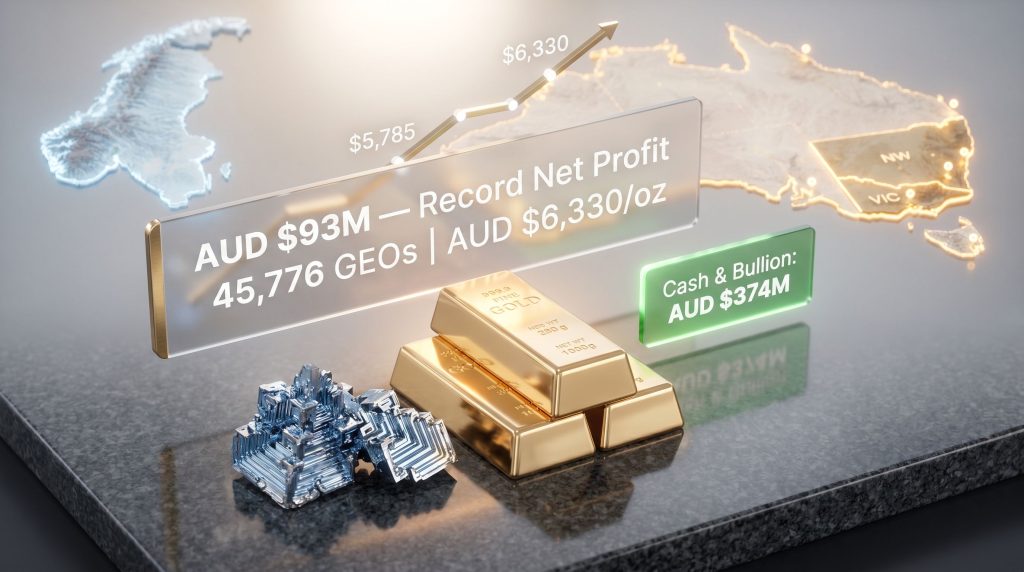
The company reported a net profit after tax of AUD $93 million in the third quarter of FY26, the highest quarterly profit in its history. This coincided with record quarterly production of 45,776 gold equivalent ounces and a realized gold price of AUD $6,330 per ounce.
Why does Alkane report production in gold equivalent ounces rather than gold ounces alone?
Alkane's Costerfield operation produces both gold and antimony. To create a unified production metric across the company's multi-commodity asset base, antimony output is mathematically converted into a gold-equivalent figure using prevailing commodity prices. This allows consistent quarter-on-quarter comparison of total production across all three operating assets.
What caused Tomingley's production shortfall in Q3 FY26?
Tomingley experienced stope performance variability, a common underground mining challenge where ore extraction from individual excavation chambers underperforms the engineered production plan. The company compensated by increasing development ore tonnages, partially mitigating the impact on overall quarterly output.
What is Alkane's full-year production guidance for FY26?
The company is targeting 160,000 to 175,000 gold equivalent ounces for the full FY26 financial year at an AISC of AUD $2,600 to $2,900 per ounce. With 119,950 GEOs produced across the first three quarters, the guidance range remains achievable through Q4.
How does a rising gold price affect Alkane's profitability disproportionately?
Because Alkane's cost base remains relatively fixed, each incremental increase in the gold price above the AISC threshold flows almost entirely to operating profit and free cash flow. This is a key reason why Alkane Resources record profit on surging gold prices has been so pronounced. At an implied margin of over AUD $3,400 per ounce, a modest gold price increase produces a far larger percentage improvement in earnings than the price move itself would suggest.
What does Alkane intend to do with its strong cash position?
Management has indicated the liquid asset position supports the company's growth plans, which may include organic mine development, exploration drilling, potential acquisitions, and shareholder return mechanisms. No specific capital allocation commitment has been disclosed beyond this directional guidance.
Want to Catch the Next Major ASX Gold Discovery Before the Market Does?
Discovery Alert's proprietary Discovery IQ model scans ASX announcements in real time, instantly identifying high-potential mineral discoveries across gold and critical commodities like antimony — translating complex data into actionable insights for investors at every level. Explore how historic discoveries have generated extraordinary returns on Discovery Alert's dedicated discoveries page, and begin your 14-day free trial today to position yourself ahead of the market.