
May 15, 2026
Why Metallurgical Confirmation Is the True Gating Factor for Large-Scale Gold-Copper Projects
In the world of large-scale gold-copper development, the gap between a mineral resource and a viable mine is often not geological. It is metallurgical. Tonnage figures, grade estimates, and resource classifications can be compelling on paper, yet none of those numbers translate into revenue unless the ore can be processed efficiently and the resulting concentrates can actually be sold. For deposits measured in hundreds of millions of tonnes, even a modest shortfall in processing recovery can erase billions of dollars in projected net present value before a single shovel breaks ground.
This is precisely why the Tudor Gold Goldstorm metallurgical test results released in May 2026 represent a qualitatively different category of news than a standard drill result or resource update. They resolve a specific technical uncertainty that Tudor Gold (TSXV: TUD) had itself identified as a forward-looking risk in prior corporate disclosures, and they do so across all three mineralised zones of the Goldstorm Deposit at the Treaty Creek Project in British Columbia's Golden Triangle.
When big ASX news breaks, our subscribers know first
The Risk That Needed to Be Resolved Before the PEA Could Proceed
Tudor Gold's own disclosures had previously acknowledged that the metallurgical characteristics of Goldstorm mineralisation were not yet fully determined, and that this represented a potential risk to the project's economic case. That level of transparency is important for investors to understand. When a company identifies a specific technical variable as unresolved in its own forward-looking risk disclosures, closing that gap through empirical testing is a categorically more significant milestone than addressing a concern raised externally by analysts or commentators.
The distinction matters because Fuse Advisors Inc., the firm advancing the Preliminary Economic Assessment (PEA) targeting completion in Q3 2026, required a tested and validated flowsheet before it could construct an economic model on anything other than assumptions. A PEA populated with unvalidated processing parameters would produce NPV and IRR projections of limited credibility, and institutional investors would rightly discount them accordingly.
Furthermore, understanding cut-off grade economics becomes especially critical here, as recovery rates directly influence which tonnes remain economically viable to process at any given commodity price.
Scale creates amplified sensitivity: At 912.3 million tonnes grading 0.85 g/t gold in the Indicated category, even a 5% swing in gold recovery across the full resource envelope represents a difference of hundreds of thousands of ounces in projected lifetime production. At current gold prices above US$3,200 per ounce, the revenue implications are enormous.
With the locked-cycle results now in hand, Fuse Advisors can build the PEA on empirically derived recovery rates, concentration ratios, and flowsheet configurations, not modelled assumptions. That is the core significance of the May 2026 release.
What Is the Goldstorm Deposit and Why Does Its Three-Zone Structure Create Both Complexity and Optionality?
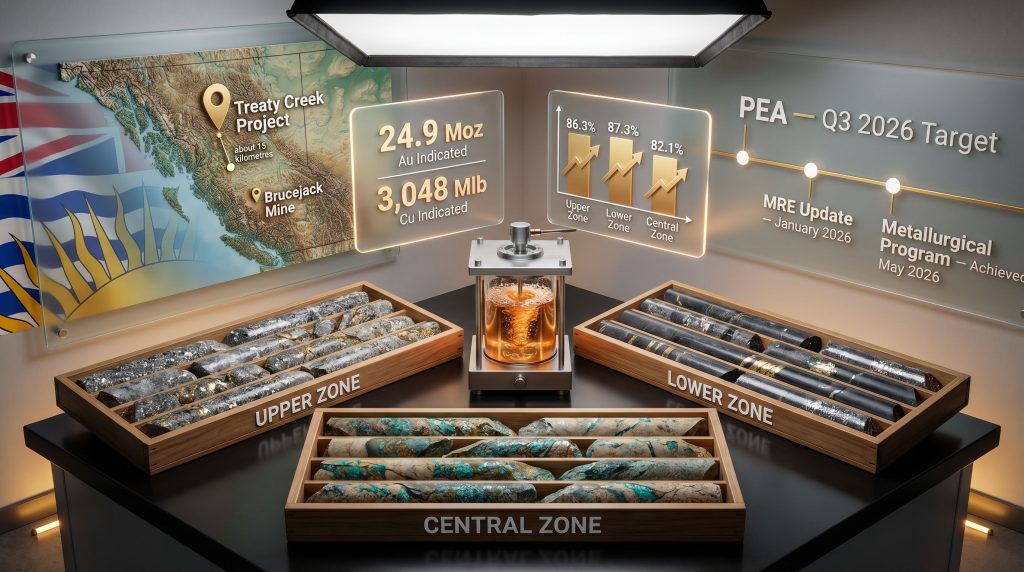
The Treaty Creek Project sits in British Columbia's Golden Triangle, approximately 15 kilometres north of the producing Brucejack Mine. The Golden Triangle is one of the most mineralised corridors in North America, hosting a concentration of gold and copper deposits that has attracted sustained exploration and development investment for decades.
The Goldstorm Deposit is divided into three distinct mineralised domains, each with differing grade profiles, commodity compositions, and, as the metallurgical results now confirm, distinct processing requirements.
Goldstorm Mineral Resource Summary (January 2026 Estimate)
| Zone | Category | Gold (Moz) | Grade (g/t Au) | Copper (Mlb) | Silver (Moz) |
|---|---|---|---|---|---|
| Upper Zone | Indicated | 7.8 | 0.96 | — | — |
| Lower Zone | Indicated | 6.9 | 1.03 | — | — |
| Lower Zone | Inferred | 1.1 | 2.33 | — | — |
| Central Zone | Indicated | 10.3 | 0.71 | 2,887.5 | — |
| Total Deposit | Indicated | 24.9 | — | 3,048 | 148.7 |
| Total Deposit | Inferred | 4.0 | — | 327.7 | 18.6 |
A critical detail that frequently goes underappreciated in broad resource summaries is the high-grade subset embedded within the Goldstorm total. At a US$175 per tonne NSR cut-off, the Indicated resource grades 2.33 g/t gold across 45.1 million tonnes, representing approximately 3.4 million ounces. Management has consistently identified this 2 to 3 g/t material as the primary focus for initial underground mine development, and the PEA is expected to model this higher-grade starter scenario alongside the broader bulk tonnage option.
The three-zone architecture creates genuine strategic optionality for mine planners. Sequential campaigns, processing one zone at a time, would allow the mill to be configured for each zone's specific metallurgical characteristics. Concurrent campaigns using blended feed would simplify logistics but require a more complex dual-concentrate processing circuit from the outset. The metallurgical results now confirm that both approaches are technically viable.
How Locked-Cycle Testing Works and Why It Is the Foundation of a Credible Flowsheet
Understanding the difference between test types is essential context for evaluating what these results actually confirm.
Locked-cycle testing uses composite samples drawn from a mineralised zone to simulate the continuous recirculation of process streams within a flotation circuit. By repeatedly passing material through the same circuit stages and returning intermediate streams, the test approximates the steady-state conditions of a real processing plant. The results are far more predictive of actual plant performance than single-pass or batch flotation tests, which tend to overstate recovery by not accounting for the buildup of penalty elements or the behaviour of recirculating loads.
Variability testing, the next sequential step now underway at Tudor Gold, evaluates the same proven flowsheet against individual drill-hole samples from across the deposit to confirm that recovery performance is spatially consistent. This is a critical input for building a year-by-year production schedule in the mine plan, because a mill that performs well on a composite but poorly on certain parts of the orebody will deliver lower annual production in years when those zones are being processed.
The fact that Tudor Gold used a uniform primary grind target of 120 microns across all four test composites — the Upper Zone, Lower Zone, Central Zone, and blended composite — is a technically significant design choice. A 120-micron grind is considered a conventional, cost-effective target widely used in sulphide flotation operations globally. It avoids the capital and energy cost penalties associated with fine and ultra-fine grinding circuits, which can add substantially to both the initial capital expenditure and the ongoing operating cost per tonne processed.
Zone-by-Zone Metallurgical Performance: What the Data Shows
Upper Zone: Conventional Sulphide Flotation Delivers Above-Threshold Gold Recovery
| Metric | Upper Zone Result |
|---|---|
| Head Grade | 3.57 g/t Au |
| Gold Recovery | 86.3% |
| Concentrate Grade (Au) | 26.1 g/t Au |
| Silver Recovery | 85.1% |
| Concentrate Grade (Ag) | 43.5 g/t Ag |
| Copper Recovery | 90.4% |
| Mass Pull | 11.8% |
The Upper Zone flowsheet follows a straightforward sequence: primary grind to 120 microns, sulphide rougher flotation, regrind of the rougher concentrate, followed by two stages of cleaner flotation. The 26.1 g/t gold concentrate grade sits within the range that smelting and offtake buyers typically require for commercially acceptable feed. A mass pull of 11.8% means that only 11.8% of the total feed weight ends up in the concentrate, which is a reasonable dilution profile for a sulphide system and keeps transportation and smelting logistics manageable. The 90.4% copper recovery also generates meaningful copper credits that improve the concentrate's overall net smelter return profile.
Lower Zone: Matching Performance with Elevated Silver and Sulphur Grades
| Metric | Lower Zone Result |
|---|---|
| Head Grade | 3.06 g/t Au |
| Gold Recovery | 87.3% |
| Concentrate Grade (Au) | 19.0 g/t Au |
| Silver Recovery | 86.5% |
| Concentrate Grade (Ag) | 68.2 g/t Ag |
| Copper Recovery | 90.6% |
| Copper in Concentrate | 0.3% Cu |
| Mass Pull | 14.0% |
| Sulphur Grade in Concentrate | >45% |
The Lower Zone used an identical flowsheet to the Upper Zone, which is a commercially important finding. A single mill circuit design can service both zones without modification, simplifying the capital cost estimate in the PEA considerably.
Two aspects of the Lower Zone results merit particular attention from investors. First, the 68.2 g/t silver in concentrate is materially higher than the Upper Zone's 43.5 g/t silver, representing a meaningfully larger silver credit contribution to revenue per tonne of concentrate. Second, the concentrate's sulphur grade exceeding 45% is a marketability advantage: high-sulphur concentrates are preferred by copper smelters as a self-fluxing feed because they reduce the need for externally sourced sulphur additions, making these concentrates easier to place and frequently attracting better treatment charge terms.
Central Zone: Two Concentrates, Higher Complexity, and Outstanding Copper Recovery
| Metric | Copper Concentrate | Sulphide Gold Concentrate | Combined |
|---|---|---|---|
| Gold Recovery | 55.1% | 27.0% | 82.1% |
| Silver Recovery | 68.7% | ~20% | 88.7% |
| Copper Recovery | 85.5% | — | 94.1% |
| Mass Pull | 0.9% | 3.1% | 4.0% |
| Copper Grade in Conc. | 28.9% Cu | — | — |
The Central Zone's elevated copper content, at 0.29% Cu across 2,887.5 million pounds of Indicated copper, required a modified approach. After the initial 120-micron grind, a dedicated copper flotation stage is run first, with the copper tails then passing to sulphide rougher flotation to capture the remaining gold and silver. The result is two distinct concentrate streams rather than one.
The 94.1% combined copper recovery is a commercially strong outcome for any porphyry-style copper-gold system. According to Tudor Gold's official announcement, a copper concentrate grading 28.9% Cu falls within the standard feed range accepted by major global smelting facilities. The two-concentrate output does introduce additional cost complexity, including separate handling, storage, and potentially separate offtake arrangements, but the scale of the copper resource means the revenue contribution is substantial enough to absorb that incremental cost.
Analytical note: The Central Zone holds the largest individual gold resource at 10.3 million ounces Indicated, but its lower gold grade of 0.71 g/t Au and the more complex flowsheet mean it will likely carry a higher unit cost per ounce than the Upper or Lower Zones. The PEA's mine sequencing assumptions will determine how the Central Zone is integrated into the overall production schedule to optimise the project's economics.
The Blended Feed Scenario: Why 80% Recovery Across All Metals Matters for Mine Planning
The blended composite test drew equal proportions from all three zones and ran them through the two-concentrate flowsheet. Combined recoveries of 80.3% gold, 81.6% silver, and 89.1% copper confirm that concurrent processing of all three zones is technically viable without a fundamental breakdown in metallurgical performance.
Tudor Gold noted that minor further optimisation is required to reduce copper losses to the sulphide gold concentrate in the blended scenario. This is a routine flowsheet refinement rather than a fundamental problem. In commercial flotation operations, the interaction between copper and gold mineralogy in blended feeds is a well-understood phenomenon that responds to reagent chemistry adjustments and selective depression techniques during cleaner flotation.
The practical significance is that the PEA now has genuine flexibility in its production schedule design:
- Sequential campaigns maximise per-zone recoveries by running dedicated flowsheet configurations but require careful stockpile management and transition periods between campaigns.
- Concurrent blended processing reduces operational complexity and stockpile management costs but requires the two-concentrate circuit to be active from day one of production.
- Hybrid approaches could blend certain zones while processing others sequentially, optimising the economics year by year as the orebody is developed.
The next major ASX story will hit our subscribers first
Comparing May 2026 Results to Prior Metallurgical Work at Treaty Creek
The Goldstorm Deposit is not metallurgically uncharted territory. The May 2026 locked-cycle programme builds on a multi-year sequence of metallurgical investigations.
| Test Program | Zone / Domain | Gold Recovery | Flowsheet |
|---|---|---|---|
| Prior Gold-Copper Zone testing | Gold-Copper Zone | 80.2% | Flotation + leach of flotation tails |
| Prior Gold-Copper Zone testing | Gold-Copper Zone | 85.8% Cu recovery | Flotation |
| SC-1 High-Grade Zone testing | Supercell-One | 85.1% | Flotation at 33.6 g/t Au head grade |
| Prior Goldstorm testing (Oct. 2024) | Multiple domains | Up to >90% Au (select domains) | Flotation; POX and Albion tested |
| May 2026 locked-cycle program | Upper Zone | 86.3% | Conventional sulphide flotation |
| May 2026 locked-cycle program | Lower Zone | 87.3% | Conventional sulphide flotation |
| May 2026 locked-cycle program | Central Zone | 82.1% combined Au | Two-concentrate flotation |
A particularly important finding embedded in the historical data is that prior testing had evaluated both pressure oxidation (POX) and Albion process routes for certain Goldstorm domains. These more technically advanced and capital-intensive leach-based processing routes were explored because some gold in complex sulphide systems is refractory, meaning it is locked within sulphide mineral lattices in a way that prevents cyanide or flotation-based recovery from accessing it efficiently.
The confirmation through May 2026 locked-cycle testing that conventional flotation alone achieves commercially viable recoveries across all three zones eliminates the requirement for POX or Albion circuits. For investors and mine planners, this is significant: POX plants in particular are among the most capital-intensive components a gold processing facility can incorporate, typically adding hundreds of millions of dollars to construction budgets and introducing additional operational complexity and environmental management requirements. Their absence from the required flowsheet reduces both capital cost estimates and project risk materially.
What Conventional Flotation Means for the PEA's Cost Assumptions
Flotation circuits are the most widely deployed processing technology in the global gold-copper mining industry. Their engineering parameters are well understood, equipment procurement lead times are established, and contractor familiarity is high. All of this benefits the capital cost estimate in the PEA in several ways.
Capital cost benchmarking becomes more straightforward because Fuse Advisors can reference dozens of comparable operating flotation plants to set capital intensity assumptions per tonne of annual throughput.
Operating cost assumptions are more reliable because reagent consumption, maintenance requirements, and energy intensity for conventional flotation circuits can be drawn from a large base of operational data.
Financing conversations with project-level lenders and equity partners become more straightforward when the processing technology is proven and commercially familiar rather than novel or complex.
The uniform 120-micron primary grind across all zones also means the PEA can design a single comminution circuit serving the entire deposit. This avoids the capital cost of parallel grinding infrastructure and the operational complexity of running different grind targets depending on which zone is being processed.
The Central Zone's two-concentrate flowsheet does add incremental cost. A separate copper flotation bank, additional reagent consumption, and two distinct concentrate handling and storage systems all carry cost implications. However, the 94.1% combined copper recovery generating a high-grade 28.9% Cu concentrate means the incremental cost is offset by a high-value copper revenue stream that the Upper and Lower Zones do not produce in comparable quantity.
The Path to Q3 2026: What Still Needs to Happen Before the PEA Is Complete
The metallurgical programme completion and the January 2026 mineral resource estimate update represent two major milestones achieved. The following steps remain on the critical path to PEA completion:
- Variability testing completion: Evaluating the validated flowsheet against individual drill-hole samples from each zone to confirm that recovery performance is spatially consistent across the deposit footprint.
- Annual production schedule development: Fuse Advisors is constructing the mine plan, determining zone sequencing, throughput rates, and the resulting annual production profile that will drive the economic model.
- Additional blended composite testing (if required): Based on the production schedule, specific blended composites aligned with particular production years may be tested to validate year-by-year recovery assumptions.
- Economic model population: Capital cost estimates, operating cost estimates, NSR assumptions, revenue projections, and tax modelling will be integrated to produce NPV, IRR, and payback period outputs.
Investors should understand that a PEA provides a preliminary economic framework at a lower level of engineering confidence than a definitive feasibility study. It is a necessary and important first step in the pathway from resource to mine, but it carries broader uncertainty ranges on cost and recovery assumptions than subsequent study stages.
In addition, it is worth noting how grade versus permitting considerations interact at this stage of development, particularly for the SC-1 Zone underground ramp permit currently under review.
2026 Milestones: A Complete Tracker for Treaty Creek Investors
| Milestone | Status / Target |
|---|---|
| Mineral Resource Estimate update | Achieved (January 2026) |
| Metallurgical program completion | Achieved (May 2026) |
| Variability testing | Currently underway |
| Preliminary Economic Assessment | Q3 2026 target |
| Underground ramp permit (SC-1 Zone) | Application submitted; decision pending |
| Treaty Creek Project ownership consolidation | In progress |
| 2026 exploration drill program (10,000m+) | Underway; targeting CBS, Eureka, Perfectstorm zones |
| Resource estimate for additional deposit | Planned for 2026 |
The underground ramp permit for the SC-1 Zone is a permitting milestone that, if approved, would enable underground access for bulk sampling and advanced resource definition drilling, accelerating the timeline for converting higher-confidence resource data at the high-grade zones.
The exploration drill programme targeting the CBS, Eureka, and Perfectstorm zones carries potential to expand the overall resource envelope beyond current Goldstorm boundaries, adding longer-term upside to the project's scale narrative beyond the already substantial 24.9 million ounce Indicated gold resource. Consequently, interpreting drill results from these new zones will be an important analytical task for investors following the project throughout the remainder of 2026.
What Investors Should Take Away from the Tudor Gold Goldstorm Metallurgical Test Results
The Tudor Gold Goldstorm metallurgical test results close a specific, company-identified technical risk that had the potential to undermine the credibility of the upcoming PEA if it had not been resolved. Drill result interpretation remains valuable context here, as understanding how geological data translates into metallurgical conclusions is central to evaluating what these results actually mean in practice.
The locked-cycle results confirm:
- All three Goldstorm zones can produce saleable gold and copper concentrates at commercially viable recovery rates using conventional sulphide flotation circuits.
- Recovery rates exceed 80% for gold, silver, and copper across all four test composites, including the blended three-zone scenario.
- A uniform 120-micron primary grind is sufficient across all zones, enabling a single comminution circuit design and avoiding more capital-intensive fine grinding requirements.
- Complex refractory processing routes such as POX or Albion circuits are not required, materially simplifying and reducing the capital cost profile relative to prior uncertainty.
- Minor optimisation of the blended flowsheet copper losses to the gold concentrate is all that remains, a routine refinement well within normal engineering practice.
Furthermore, independent reporting from Geneonline highlights that select composites within the programme achieved gold recoveries of up to 95.6%, underscoring the deposit's strong metallurgical potential at the higher end of the grade spectrum.
Disclaimer: This article is intended for informational purposes only and does not constitute financial or investment advice. The Preliminary Economic Assessment referenced herein is preliminary in nature and includes inferred mineral resources that are considered too speculative geologically to have economic considerations applied to them. There is no certainty that the PEA results will be realised. Readers should conduct their own due diligence and consult a qualified financial adviser before making investment decisions.
Want to Stay Ahead of the Next Major Mineral Discovery on the ASX?
Discovery Alert's proprietary Discovery IQ model delivers real-time alerts the moment significant ASX mineral discoveries are announced, turning complex resource and metallurgical data into clear, actionable insights for both short-term traders and long-term investors — explore historic discoveries and their returns to understand the scale of opportunity, then begin your 14-day free trial at Discovery Alert to position yourself ahead of the market.