June 7, 2026
The Sleeping Giant: Why Venezuela's Most Contested Gold Project Is Back in Play
Across the global mining industry, few forces reshape investment landscapes as dramatically as regulatory reform in resource-rich but politically volatile jurisdictions. When a country possessing world-class mineral endowments loosens the structural barriers that kept foreign capital at bay for decades, the signal reverberates far beyond its borders. Venezuela's April 2026 mining law amendments represent exactly this kind of inflection point, and the speed with which sophisticated private capital has responded tells its own story about how long institutional investors have been watching and waiting. Richard Warke Siembra Minera Venezuela is now central to that conversation.
The Siembra Minera project, situated in Venezuela's Bolívar State, has spent the better part of two decades as one of the mining world's most tantalising paradoxes: a resource of genuinely continental scale, frozen in legal and political limbo, unable to attract the development capital its geology clearly warrants. That dynamic may now be shifting in ways that carry significant implications for global gold markets, Latin American investment flows, and the accelerating contest over critical mineral supply chains.
When big ASX news breaks, our subscribers know first
Understanding the Scale of What Siembra Minera Actually Represents
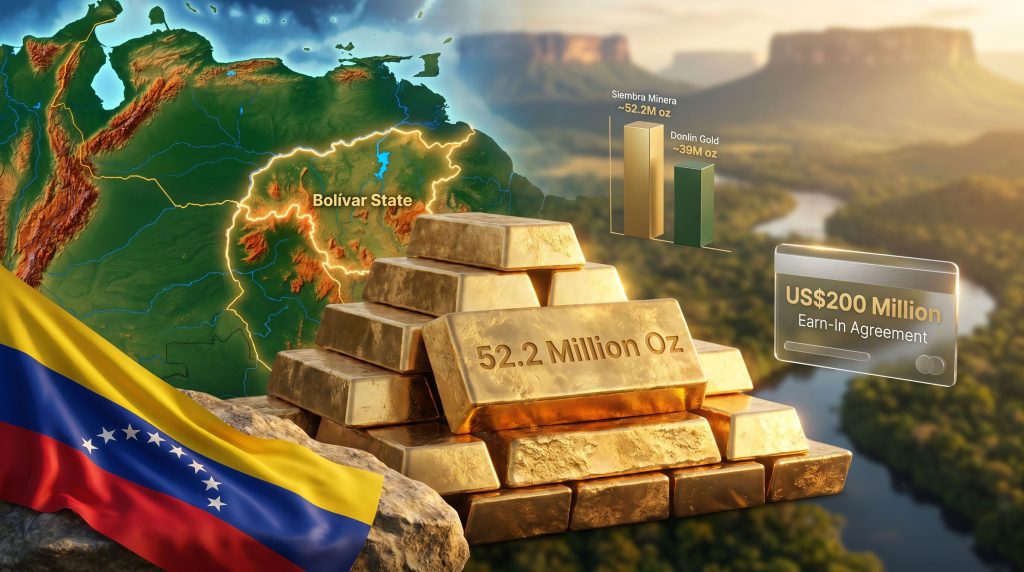
To appreciate why this project commands attention, the numbers need to be understood in their proper context. Gold Reserve Ltd. estimates the area associated with Siembra Minera contains approximately 52.2 million ounces of gold, according to reporting by Reporte Minero in May 2026. That figure places this asset in extraordinarily rare company among undeveloped gold deposits anywhere in the world.
The table below contextualises just how exceptional this resource base is relative to other prominent undeveloped gold projects:
| Project | Location | Estimated Gold Resource | Current Status |
|---|---|---|---|
| Siembra Minera | Venezuela | ~52.2 million oz | Pre-development / stalled |
| Donlin Gold | Alaska, USA | ~39 million oz | Advanced feasibility |
| Pascua-Lama | Chile/Argentina | ~18 million oz | Suspended |
| Pebble | Alaska, USA | ~107 million oz (AuEq.) | Permitting blocked |
Note: Resource estimates reflect publicly available figures and are subject to revision. Investors should not interpret resource estimates as reserves, and resource size alone does not guarantee economic viability or development feasibility.
The Bolívar State setting is geologically significant in its own right. This region of southeastern Venezuela sits within the Guiana Shield, one of the oldest and most mineralised geological formations in South America. The shield extends across Venezuela, Guyana, Suriname, and northern Brazil, and its gold-bearing greenstone belts have been recognised by geologists for well over a century as among the most prospective terranes on the continent. Projects of Siembra Minera's scale in this geological setting are not common discoveries; they are generational assets that attract attention precisely because equivalent new discoveries are becoming increasingly rare.
The 2008 Expropriation and Its Long Shadow
The project's modern history is inseparable from Venezuela's 2008 expropriation of the asset from Gold Reserve Ltd. under Hugo Chávez's administration. This event became a widely studied case in sovereign resource nationalism, illustrating how state intervention in the mining sector can simultaneously generate short-term political capital and impose long-term economic costs by deterring the very foreign investment needed to monetise underground assets.
What makes the Siembra Minera story structurally unusual is that Gold Reserve did not disappear from the picture following expropriation. The company retained approximately 45% participation in the project structure, according to Reporte Minero. This retained interest transformed Gold Reserve from a dispossessed operator into a minority stakeholder in an asset that could not be developed without either reconciliation with Venezuelan authorities or a fundamental change in the country's investment framework. For over fifteen years, neither condition was met.
Richard Warke, Augusta Capital, and the Architecture of the Deal
The arrival of Richard Warke's Augusta Capital Corporation as the project's prospective development partner is not a random occurrence. Warke has spent decades building a reputation in Canadian mining circles as an operator capable of identifying, financing, and scaling large-format mineral assets in jurisdictions where complexity deters less experienced capital.
His most recent high-profile involvement centres on Equinox Gold Corp., which announced the acquisition of Orla Mining in a transaction reported by Reporte Minero as valued at approximately US$5.1 billion. This kind of transaction scale establishes a credibility baseline that matters enormously when entering negotiations in a frontier jurisdiction like Venezuela, where counterparties assess not just the capital on offer but the track record and institutional weight of the party bringing it. Furthermore, the broader gold M&A activity occurring across global markets provides important context for understanding why sophisticated operators are pursuing ambitious frontier deals of this nature.
Beyond his mining career, Warke maintains investment positions across international sports assets, with Reporte Minero confirming connections to entities including the Boston Celtics, Fenway Sports Group, and the PGA Tour. This reflects a capital deployment philosophy that extends well beyond extractive industries, though his professional reputation remains anchored in mining.
How the Earn-In Structure Works
The commercial mechanism underpinning this transaction is a binding earn-in agreement, a structure that experienced mining investors will recognise as particularly well-suited to high-uncertainty jurisdictions. Rather than paying an upfront acquisition premium, Augusta Capital acquires equity by committing and deploying capital against defined expenditure thresholds.
The key parameters, as reported by Reporte Minero and sourced originally via Bloomberg, are as follows:
| Deal Parameter | Detail |
|---|---|
| Agreement Type | Binding Earn-In |
| Maximum Equity Acquirable | 50% of Gold Reserve's interest in Siembra Minera |
| Total Investment Commitment | Up to US$200 million over four years |
| Year One Minimum Expenditure | US$25 million |
| Formal Vehicle | GR Mining (Barbados) Inc. |
| Joint Negotiation Requirement | Venezuelan government authorities |
The equity arithmetic here deserves careful attention. Gold Reserve holds approximately 45% participation in Siembra Minera. Augusta Capital's option to acquire 50% of that interest means the firm is targeting an ultimate direct economic exposure of roughly 22.5% of the overall project. This is not a controlling position in the asset as a whole, but it represents a meaningful economic stake in a deposit of this scale, and the earn-in structure means Augusta can calibrate its capital deployment against evolving political and technical conditions on the ground.
The earn-in format also provides an important risk management mechanism. In frontier jurisdictions, the ability to stage investment rather than committing full capital upfront is not merely a financial preference; it is a structurally necessary risk control. Should conditions deteriorate materially, Augusta retains the ability to curtail further deployment without having already committed the full US$200 million. For Gold Reserve, the arrangement delivers a well-resourced development partner without requiring a full divestment, preserving the company's ongoing participation in any eventual upside.
'Important disclaimer: This article discusses a mining transaction in a high-risk political jurisdiction. Nothing in this article constitutes financial advice. Investors should conduct independent due diligence and consult qualified financial advisers before making any investment decisions. Resource estimates are not equivalent to reserves and do not guarantee economic outcomes.'
Venezuela's April 2026 Mining Law: What Actually Changed
The structural enabling condition for this transaction is Venezuela's new mining legislation, passed in April 2026 under the administration headed by Delcy Rodríguez, as confirmed by Reporte Minero. The most consequential provision is the one that received the least fanfare internationally: the removal of mandatory majority state ownership requirements in mining projects.
Under the previous framework, the Venezuelan state was legally required to hold a controlling stake in all significant mineral developments. This single requirement functioned as a near-absolute barrier to large-scale foreign investment, because it meant that no incoming capital, regardless of quantity or quality, could acquire the ownership position needed to make project financing viable. International project lenders do not typically extend capital to entities that cannot demonstrate sufficient equity control over the underlying asset.
The April 2026 reform removes this barrier, at least on paper. For the first time since the 2008 expropriation era, foreign entities have a legal pathway to hold controlling economic interests in Venezuelan mineral developments. This is what makes the Augusta Capital earn-in structurally viable in a way it would not have been twelve months earlier.
The Durability Question: A Framework for Assessing Legislative Risk
The more difficult analytical question is whether this reform will prove durable. Venezuela's regulatory history gives investors legitimate reasons for caution. The following factors are relevant to any honest assessment:
- Legislative reforms in Venezuela have historically been subject to reversal under shifting political conditions
- The reform was enacted under an acting administration, raising institutional continuity questions
- International sanctions frameworks, particularly those administered by the United States, remain an active variable affecting the operational capacity of US-connected entities
- Gold Reserve's dual listing on the TSX Venture Exchange and Bermuda Stock Exchange provides some structural diversification but does not eliminate jurisdictional exposure
- The joint negotiation requirement with Venezuelan authorities means the deal's ultimate economics remain contingent on ongoing governmental engagement
The timing of the Augusta Capital agreement, announced shortly after the April 2026 legislative reform as reported by Reporte Minero, suggests this transaction was structured in close awareness of the regulatory shift. However, whether the new framework represents a durable institutional change or a temporary political opening is a question that only time and the trajectory of Venezuelan governance can resolve. In addition, the geopolitical mining risks associated with frontier jurisdictions like Venezuela remain a critical variable that investors must continuously monitor alongside legislative developments.
Scenario Analysis: Three Paths Forward for Siembra Minera
Given the genuine uncertainty surrounding this transaction, a structured scenario framework helps clarify the range of possible outcomes. These scenarios are analytical constructs, not forecasts, and should not be interpreted as predictions.
Scenario 1: Accelerated Development (Bull Case)
- Legislative reforms prove durable and are reinforced by subsequent political stability
- Augusta Capital deploys the full US$200 million over the four-year earn-in period
- Joint negotiations with Venezuelan authorities produce a bankable development agreement
- Siembra Minera advances through feasibility study toward construction planning
- Venezuela re-establishes itself as a credible destination for large-scale foreign mining capital
- International sanctions frameworks are progressively relaxed in parallel
Scenario 2: Staged Progress with Material Setbacks (Base Case)
- Year one US$25 million commitment is deployed, generating geological and technical data
- Negotiations with Venezuelan authorities progress but encounter bureaucratic and political friction
- Additional foreign investors begin evaluating Venezuelan assets, creating incremental market signals
- Full US$200 million deployment remains contingent on demonstrated political continuity and sanctions clarity
- Progress is real but non-linear, with extended timelines
Scenario 3: Regulatory Reversal (Bear Case)
- Political transition in Venezuela reverses or undermines the April 2026 mining law reforms
- Sanctions frameworks are tightened, constraining the operational capacity of relevant entities
- Augusta Capital curtails further deployment before completing the full earn-in investment
- Siembra Minera re-enters legal and commercial limbo, extending its development freeze
Industry observers tracking frontier mining deals in Latin America will note that the base case scenario is historically the most common outcome in jurisdictions undergoing resource sector liberalisation. Full bull-case realisation typically requires sustained political continuity over a period well exceeding the initial deal horizon.
Venezuela's Broader Mineral Inventory and the Supply Chain Dimension
Understanding why international capital is looking at Venezuela requires a perspective that extends beyond gold. The country's subsoil contains a remarkably diverse mineral portfolio that has become strategically significant in the context of global supply chain restructuring.
| Mineral | Primary Strategic Application |
|---|---|
| Gold | Monetary reserves, electronics, jewellery manufacturing |
| Diamonds | Industrial tooling, gemstone markets |
| Copper | Electrical infrastructure, EV drivetrain systems |
| Bauxite | Primary aluminium production feedstock |
| Coltan (Columbite-Tantalite) | Defence electronics, capacitors, mobile technology |
| Battery-relevant minerals | EV supply chains, grid-scale energy storage |
Coltan deserves particular attention in the current supply chain discussion. This mineral, a combination of columbite and tantalite, is essential for manufacturing the capacitors found in virtually every electronic device, as well as the specialised electronics used in defence applications. Global supply of tantalum, the refined product of tantalite, is highly concentrated, and Venezuela's coltan reserves represent a potential alternative source at a time when supply chain concentration is drawing intense scrutiny from Western governments and defence planners.
Reporte Minero noted that the potential reactivation of projects like Siembra Minera is occurring in parallel with efforts by various governments to reduce dependence on Chinese-controlled sources for critical mineral supply. This is an important structural observation that aligns directly with the growing critical minerals demand driven by the global energy transition. However, it is worth being precise: policy interest in supply chain diversification creates a favourable macro backdrop for Venezuelan mineral development, but it does not translate automatically into project-specific support or accelerated approvals for any particular transaction.
The US-Venezuela Thaw and What It Means for Mining Capital
Reporte Minero identified an important contextual dimension: the Augusta Capital transaction is occurring against a backdrop of gradually improving relations between US-connected enterprises and Venezuela following a prolonged period of sanctions-driven economic isolation. This thaw, if it continues, has implications beyond any single project.
A more permissive regulatory environment for US-connected entities operating in Venezuela would expand the pool of capable development capital available to the country's mining sector. Projects of Siembra Minera's scale require not just equity capital but also the kind of project finance infrastructure, equipment supply chains, and technical expertise that flow more readily when sanctions-related compliance concerns are reduced.
The next major ASX story will hit our subscribers first
What Full Development Would Actually Require
For investors assessing the Richard Warke Siembra Minera Venezuela opportunity in long-term perspective, it is essential to understand the gap between the current earn-in transaction and eventual production. The US$200 million earn-in commitment represents an early-stage development and feasibility phase, not a construction decision.
Projects of this resource scale in frontier jurisdictions typically require:
- Total capital expenditure in the range of US$3 to US$6 billion to reach commercial production, based on comparable large-scale gold project developments globally
- 8 to 15 years from a standing start to first gold pour, depending on permitting velocity, infrastructure availability, and financing conditions
- Extensive pre-feasibility and feasibility work before any construction decision can be made
- Multi-party financing structures involving equity, project debt, streaming arrangements, and potentially offtake agreements
The Year One minimum of US$25 million will likely fund geological verification work, resource modelling, infrastructure assessment, and the joint negotiation process with Venezuelan authorities. This phase is fundamentally about converting the theoretical resource into a foundation for a bankable feasibility study, a process that in complex jurisdictions can take several years even under favourable conditions.
Frequently Asked Questions
What is the Siembra Minera project?
Siembra Minera is a large-scale gold development project in Bolívar State, southeastern Venezuela, within the Guiana Shield geological formation. Gold Reserve Ltd. estimates the associated area contains approximately 52.2 million ounces of gold, positioning it as one of the largest undeveloped gold resources in Latin America.
Who is Richard Warke and what is his role here?
Richard Warke is a Vancouver-based mining entrepreneur with a multi-decade track record of building and exiting large-scale mineral companies. He is advancing the Siembra Minera transaction through Augusta Capital Corporation, his private investment vehicle, which has entered a binding earn-in agreement with Gold Reserve.
How much is Augusta Capital committing to invest?
Augusta Capital has committed to spending up to US$200 million over four years, with a minimum of US$25 million in the first year, to earn a 50% interest in Gold Reserve's participation in Siembra Minera, as reported by Reporte Minero citing Bloomberg.
What did Venezuela's April 2026 mining law actually change?
The legislation removed the previous requirement for mandatory majority state ownership in mining projects, creating a legal pathway for foreign entities to hold controlling interests in Venezuelan mineral developments for the first time in many years.
What are the primary risks in this transaction?
Key risk factors include potential legislative reversal under future political transitions, ongoing international sanctions affecting US-connected entities, infrastructure deficits in Bolívar State, the historical precedent of sovereign expropriation established in 2008, and the contingent nature of the deal on successful joint negotiations with Venezuelan government authorities.
Is Gold Reserve Ltd. a major mining company?
Gold Reserve is classified as one of the junior mining companies listed on the TSX Venture Exchange and the Bermuda Stock Exchange. It operates primarily through its subsidiary GR Mining (Barbados) Inc., with Siembra Minera representing its primary asset.
The Bigger Picture: What This Transaction Signals
The Richard Warke Siembra Minera Venezuela deal represents something more than a single bilateral transaction between a junior mining company and a private capital vehicle. It functions as a leading indicator for the broader trajectory of foreign investment in Venezuela's mineral sector and, by extension, for the competitive dynamics of critical mineral supply chains in the Western Hemisphere.
Several dimensions of this deal deserve ongoing attention:
- The pace and character of Year One expenditure will establish whether the earn-in is substantive or merely exploratory
- The outcome of joint negotiations with Venezuelan authorities will determine whether the April 2026 legislative framework translates into actionable development rights
- The durability of the political conditions that produced the mining law reform will be the single most important variable over the four-year earn-in period
- The broader trajectory of US-Venezuela relations will shape the operational environment for any entities with American connections involved in the project
- Global gold market conditions will influence the economics of any eventual development decision, and the current gold price outlook at elevated levels enhances the theoretical attractiveness of large undeveloped resources
For mining investors, the Siembra Minera situation illustrates a principle that experienced frontier capital allocators understand intuitively: the most consequential opportunities frequently emerge not from new geological discoveries, but from the unlocking of known resources that were previously stranded by political, regulatory, or structural barriers. The question in Venezuela is not whether the gold exists. It is whether the conditions to develop it can be sustained long enough for that gold to become economically accessible.
This article is for informational purposes only and does not constitute financial, investment, or legal advice. All references to resource estimates, financial projections, and deal parameters are drawn from publicly available reporting. Readers should conduct independent research and seek professional advice before making any investment decisions. Past performance of individuals or entities mentioned is not indicative of future results.
Want to Stay Ahead of the Next Major Mineral Discovery?
Discovery Alert's proprietary Discovery IQ model delivers real-time alerts the moment significant ASX mineral discoveries are announced, transforming complex geological and market data into actionable investment insights for both short-term traders and long-term investors — explore historic discovery returns on Discovery Alert's discoveries page to understand the scale of opportunity, then begin your 14-day free trial to position yourself ahead of the broader market.