June 9, 2026
When Governments Fear Their Own Currency: The Anatomy of India's Gold Tariff Reversal
Throughout monetary history, one of the clearest signals of macroeconomic distress is when a government moves to restrict its own citizens' access to gold. From wartime rationing to balance-of-payments crises, the impulse to limit gold ownership or importation has consistently preceded periods of serious currency deterioration. India hikes gold and silver import duties to support rupee stability, and this May 2026 decision reverses nearly two years of precious metals trade liberalisation. Understanding why the policy was reversed tells a more important story than the tariff change itself.
When big ASX news breaks, our subscribers know first
The Macroeconomic Pressure Behind the Policy Reversal
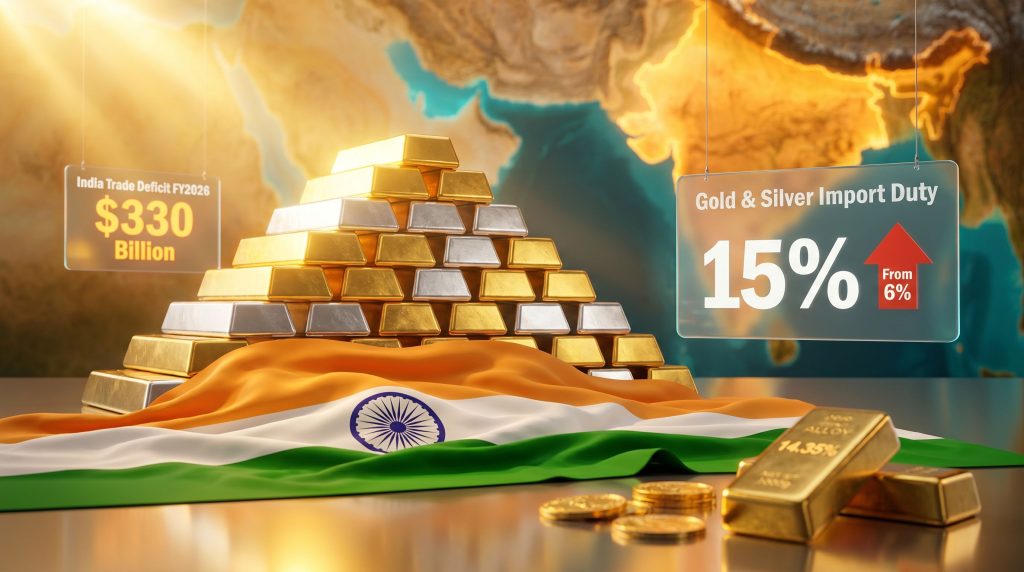
India's merchandise trade deficit crossing $330 billion in the financial year ending March 2026 represents more than a statistical milestone. That figure, up 17.9% from the prior year's $280+ billion, reflects a confluence of pressures that no single policy instrument can easily resolve. Two import categories sit at the heart of the problem: oil and precious metals.
Oil accounts for roughly 22% of India's total imports, and the country relies on overseas supply for approximately 85% of its fuel requirements. With around half of its crude imports transiting the Strait of Hormuz, India's energy import bill is acutely sensitive to geopolitical disruption in the Middle East. When oil prices spike, the impact on India's current account is immediate and severe.
Gold and silver compound the pressure. Together, they account for approximately 11% of India's total import volume by value, making them the second largest commodity import category and a meaningful lever in trade deficit management. Unlike oil, where demand is largely non-discretionary, precious metals carry some degree of price elasticity, particularly in the jewellery segment, making them an attractive target for demand suppression policy.
The combination of elevated global gold prices and surging crude costs created a dual commodity shock that overwhelmed the government's capacity to absorb the deficit through conventional monetary or fiscal tools. The import duty hike is best understood as an emergency pressure-release valve rather than a considered structural reform.
Understanding the Scale of the Duty Change
How Large Is This Tariff Shift?
The magnitude of this policy shift is significant. India initially cut gold and silver import duties from 15% to 6% in July 2024, a move widely welcomed by the jewellery sector and credited with collapsing unofficial import flows by making legal channels economically competitive. The May 2026 reversal reinstates the full pre-2024 tariff structure in a single adjustment, representing a 9 percentage point increase described by industry observers as the largest single customs duty hike on record for precious metals in India.
The new 15% levy is structured as a composite rate:
- 10% basic customs duty
- 5% Agriculture Infrastructure and Development Cess (AIDC)
The tariff changes break down as follows:
| Category | Previous Duty | New Duty | Change |
|---|---|---|---|
| Refined Gold and Silver | 6% | 15% | +9 percentage points |
| Doré (Unrefined Alloy) | 5.35% | 14.35% | +9 percentage points |
| Differential (Refined vs. Doré) | 0.65% | 0.65% | Unchanged |
The preservation of the 0.65 percentage point differential between refined and doré tariffs is a deliberate design choice. Doré, an unrefined alloy typically containing 80 to 90% precious metal content, feeds India's domestic refining operations. By maintaining the relative cost advantage of importing unrefined material over refined product, the government has consciously protected the economics of the domestic refining sector while still pursuing the broader demand suppression objective.
Furthermore, the AIDC structure is worth noting from a trade policy perspective. Separating the levy between basic customs duty and a development cess may carry implications for India's bound tariff commitments under WTO schedules and bilateral trade agreements, though the practical effect on landed gold costs is identical regardless of how the rate is apportioned.
The Rupee Mechanics: Why Gold Imports Matter for Currency Stability
How Does Gold Drive Rupee Weakness?
The connection between gold imports and rupee stability operates through a straightforward but powerful foreign exchange mechanism. When Indian importers purchase gold and silver on international markets, they must first convert rupees into US dollars to settle transactions denominated in the global reserve currency. This conversion increases dollar demand relative to rupee supply in foreign exchange markets, placing sustained downward pressure on the rupee's exchange rate.
The resulting depreciation then triggers a feedback loop that worsens the original problem. A weaker rupee increases the local-currency cost of all dollar-denominated imports, including crude oil, making India's already-strained energy import bill even more expensive in rupee terms. This amplifies the trade deficit, which in turn generates further currency pressure.
By suppressing gold and silver import volumes through higher tariffs, the government aims to interrupt this cycle at its source. According to Reuters reporting on India's tariff decision, the rupee recorded a modest rebound immediately following the duty announcement, reflecting short-term market confidence in the policy signal, though the durability of that relief will depend on whether the underlying commodity price environment moderates.
India's Historical Relationship with Precious Metal Tariffs
India's deployment of precious metal import duties as a current account management tool is not new. In the previous decade, as the trade deficit expanded through the 2010s, the government systematically raised customs duties on gold and silver from a flat ₹300 per kilogram to 15% by 2022. The 2024 liberalisation to 6% represented a deliberate attempt to break this cycle by making formal import channels competitive with smuggling networks, reducing the fiscal cost of informal trade.
The 2026 reversal suggests that the macroeconomic deterioration has overwhelmed the benefits of that liberalisation strategy. What is emerging is a recognisable cyclical pattern:
- Trade deficit widens under commodity price pressure
- Government raises precious metal import duties to suppress non-essential imports
- Formal demand contracts and informal channels revive
- Deficit pressures ease and duties are eventually reduced
- Legal imports recover and informal trade collapses
- Rising commodity prices or currency pressure triggers the next cycle
India's approach stands in stark contrast to most major economies. The United States and European Union apply zero tariffs on gold imports, treating precious metals as neutral trade flows. China operates a state-managed allocation system with low effective duties. The UAE maintains a modest 5% rate as a regional trade hub. India's willingness to use tariffs as an active macroeconomic stabilisation lever is structurally distinctive and reflects a fundamentally different policy philosophy toward precious metals.
Gold Demand Implications: Suppression, Smuggling, and Structural Resilience
Will Higher Duties Simply Redirect Demand Underground?
The near-term demand implications of the duty hike are relatively clear. Gold jewellery demand in India had already contracted by 22% in 2025 as elevated global prices squeezed affordability, particularly in price-sensitive consumer segments. The additional 9 percentage point tariff burden will amplify this pressure by raising landed costs further in rupee terms.
Investment demand in coins and bars had partially offset the jewellery decline, however higher all-in prices may slow this momentum as well. Metals Focus data notes that India typically imports approximately 800 tonnes of gold annually, a figure that fell to 640 tonnes in 2025 despite elevated prices. Significantly, the total value of gold imports still rose during this period because global price gains outpaced the volume contraction, illustrating the limitations of tariff-based demand suppression when commodity prices are rising faster than policy can counteract.
The smuggling risk represents perhaps the most critical structural concern with the policy. The 2024 duty reduction to 6% had been credited with dismantling much of India's informal gold trade by eliminating the arbitrage incentive for unofficial import channels. Reinstating a 15% tariff recreates that arbitrage, particularly across land borders and coastal entry points where enforcement is difficult. As CNBC's coverage of India's bullion duty hike notes, elevated duties historically correlate with recovery in unofficial flows. If informal trade resurges, the policy may fail to deliver either the fiscal revenue or the current account improvement the government is targeting.
A tariff-driven suppression of legal import demand does not necessarily reduce total gold consumption in India. It may simply redirect flows from formal to informal channels, undermining both the fiscal objectives and the currency stabilisation rationale simultaneously.
Over longer time horizons, Indian gold demand has demonstrated remarkable structural resilience through multiple duty cycles. The cultural depth of precious metals consumption, spanning weddings, religious ceremonies, festival gifting, and multigenerational wealth preservation, creates a price-inelastic demand floor that tariffs cannot fully penetrate. Consumers typically delay purchases initially when prices spike but adjust their spending patterns and normalise behaviour over time as new price levels become familiar.
There is also a paradoxical dynamic at work. As the rupee depreciates, gold as a safe-haven becomes more compelling for Indian savers, not less. The very currency weakness driving the import duty hike simultaneously increases gold's attractiveness as a domestic hedge, creating a demand floor that policy measures may be unable to fully suppress.
The next major ASX story will hit our subscribers first
The Dual-Signal Problem: Is the Duty Hike Bearish or Bullish for Gold?
One of the most analytically interesting dimensions of this policy is that it simultaneously generates bearish and bullish signals for gold markets, and resolving the tension between them requires thinking carefully about time horizons and signal quality.
The bearish case rests on straightforward mechanics: higher tariffs raise costs for one of the world's largest gold-consuming nations, reducing the volume of physical metal entering a market that typically absorbs 800 tonnes annually. Suppressed jewellery demand removes a significant source of physical offtake, and short-term price discovery in Indian domestic markets diverges from global benchmarks as the tariff premium is priced into local spot rates.
The bullish case is more subtle but arguably more significant for medium-term investors. Ross Norman of Metals Daily has argued that the policy sends a distress signal that ultimately reinforces gold's fundamental appeal rather than undermining it. The reasoning is that a government imposing emergency tariffs and a sitting prime minister publicly urging citizens to stop buying gold for a year are exhibiting behaviours characteristic of acute financial crisis rather than routine macroeconomic management.
Furthermore, central bank gold demand and institutional buying patterns suggest that gold's role as a crisis asset becomes most relevant precisely when governments attempt to restrict access to it.
Norman has further noted that Indian consumers are already exhibiting a behavioural shift consistent with this interpretation, rotating away from jewellery and toward investment-grade formats such as coins and bars, indicating a change in the nature of gold demand rather than its disappearance. This shift from decorative to monetary demand is historically associated with periods of elevated financial stress and represents a more durable form of buying.
Prime Minister Modi's public appeal to citizens to refrain from gold purchases carries the tone of wartime economic appeals for restraint and sacrifice. Historically, governments have made such appeals during periods when currency debasement or external account crises have created conditions that are precisely those in which gold ownership becomes most rational, creating an inherent contradiction between the message and the underlying economic reality.
The Broader Fiscal Arithmetic and What It Reveals
The structural arithmetic of India's import problem illustrates why tariff-based solutions face inherent limitations. Oil and precious metals together account for approximately one-third of India's entire import bill, with oil at roughly 22% and gold and silver at approximately 11%. Addressing one category through demand suppression while the other remains exposed to global commodity prices and geopolitical disruption creates an asymmetric policy response.
The 2025 data on gold imports makes this limitation concrete. Volume fell from the typical 800 tonne baseline to approximately 640 tonnes, a meaningful reduction of 20%. Yet the total import value still increased because global gold prices rose faster than volumes contracted. This is the central challenge of tariff-based trade deficit management during commodity bull markets. In this context, tariff-driven supply chain stress can intensify value-based current account pressure even when physical volumes decline.
Economist Trinh Nguyen has raised a related concern about the government's simultaneous pressure on fuel retailers to avoid passing price increases to consumers. While intended to prevent inflation from eroding household purchasing power, this approach risks creating demand distortions in the energy sector and represents a broader retreat from the market liberalisation framework that had attracted considerable foreign investor confidence in India over the preceding decade.
Considering gold in trade wars more broadly, India's experience illustrates how precious metals become both a symptom and a tool of adjustment when external account pressures intensify. Moreover, gold in the monetary system continues to play a structural role that governments find difficult to suppress through tariff mechanisms alone.
Key Variables for Investors to Monitor
For market participants tracking the implications of India hikes gold and silver import duties to support rupee stability, several data points will be critical in determining whether the policy achieves its objectives or triggers the unintended consequences its critics anticipate:
- Rupee exchange rate trajectory: Whether the modest post-announcement rebound is sustained or reverses as commodity price pressures continue
- Informal import flow data: Any resurgence in smuggling activity, particularly through land border corridors and coastal entry points, would signal policy failure
- Quarterly Indian gold demand data: Metals Focus and World Gold Council reporting will reveal whether demand suppression is temporary or structural
- Coin and bar demand vs. jewellery split: A continued rotation toward investment formats would reinforce the bullish distress-signal interpretation
- Crude oil price trajectory: Easing geopolitical premium on crude would reduce one of the two major sources of import bill pressure and could create conditions for another future duty reversal
- Global gold price direction: Continued price appreciation would undermine the value-reduction objective of the tariff even if volumes respond as intended
FAQ: India's Gold Import Duty Hike Explained
What is the new gold import duty in India as of 2026?
India's gold and silver import duty has been raised to 15%, comprising a 10% basic customs duty and a 5% Agriculture Infrastructure and Development Cess, effective May 2026.
Why did India cut gold import duties in 2024 and then reverse the decision?
The 2024 reduction to 6% was designed to stimulate the jewellery sector and reduce smuggling by making formal import channels economically competitive. The 2026 reversal reflects a deteriorating trade deficit that surpassed $330 billion, rupee weakness, and surging oil import costs driven by geopolitical disruption, which collectively worsened India's current account position beyond what the liberalised tariff structure could accommodate.
How much gold does India import each year?
India typically imports approximately 800 tonnes of gold annually, though this fell to around 640 tonnes in 2025 due to elevated global prices. India is consistently one of the world's two largest gold-consuming nations alongside China.
Will the duty hike reduce gold smuggling into India?
The historical pattern suggests the opposite is more likely. Higher duties restore the arbitrage incentive for informal import channels that the 2024 reduction had largely eliminated. Consequently, the 2026 reversal may undo those gains, redirecting demand from formal to informal markets.
What does India's gold duty hike mean for global gold prices?
The direct short-term impact on global prices is limited, as reduced Indian demand may be offset by buying elsewhere. However, the policy signals significant macroeconomic stress in one of the world's most important gold-consuming markets, which carries medium-term implications for gold as a crisis and safe-haven asset that experienced investors view as net bullish over longer time horizons.
How does the doré duty compare to refined gold?
Doré is taxed at 14.35% versus 15% for refined gold, maintaining a 0.65 percentage point differential that has been deliberately preserved to protect the economics of India's domestic gold refining operations.
This article contains forward-looking analysis and market commentary. References to commodity prices, trade data, and currency movements reflect information available at the time of publication. Past policy cycles are not necessarily indicative of future outcomes. This content is intended for informational purposes only and does not constitute financial advice.
Want to Track the Next Major Mineral Discovery Before the Market Moves?
Discovery Alert's proprietary Discovery IQ model delivers real-time alerts on significant ASX mineral discoveries, turning complex commodity data into actionable investment insights — explore historic discoveries and their returns to understand what's possible, then begin your 14-day free trial at Discovery Alert to position yourself ahead of the broader market.