
May 16, 2026
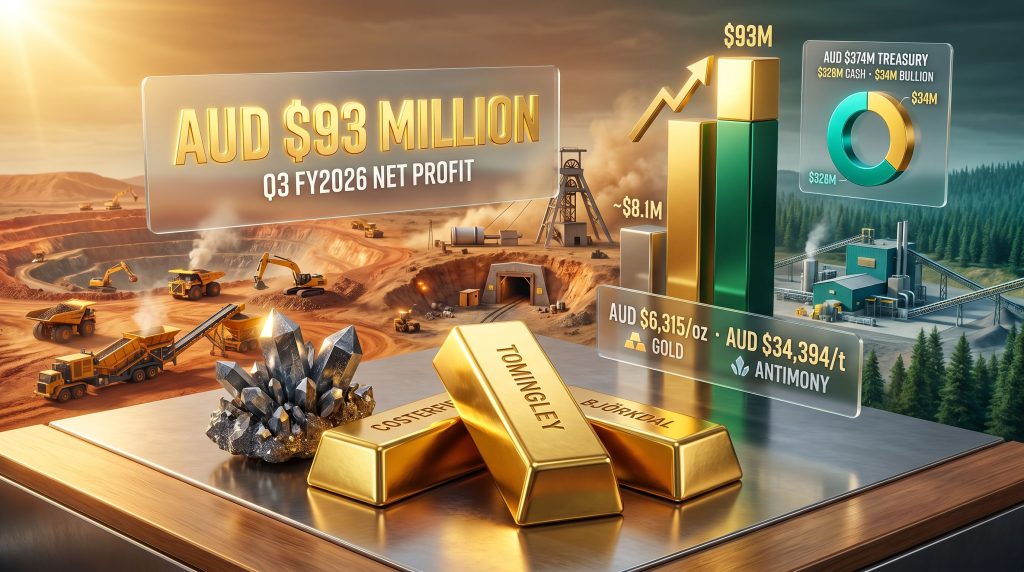
When a Mining Company Rewrites Its Own Financial History
The Australian mid-tier gold sector has long been characterised by a small group of operators caught between the production scale needed to attract institutional capital and the cost discipline required to survive commodity downturns. For most of the past decade, breaking through that ceiling has demanded either a transformative acquisition or an exceptionally favourable pricing cycle. Rarely does a company experience both simultaneously. Yet that is precisely the scenario unfolding in real time for Alkane Resources (ASX: ALK), whose March 2026 quarterly result delivered the Alkane Resources record quarterly profit that fundamentally repositioned the company's identity within the Australian gold landscape.
Understanding why this result happened requires looking beyond the headline numbers. The AUD $93 million net profit and AUD $274.37 million revenue figures are outcomes, not causes. The causes are structural, operational, and geological, rooted in a corporate transformation that began before gold prices reached their current elevated levels.
When big ASX news breaks, our subscribers know first
From Single Asset to Three-Mine Architecture: The Structural Shift That Made It Possible
The merger with Mandalay Resources completed in 2025 was the single most consequential corporate decision in Alkane's recent history. Before that transaction, Alkane operated one producing mine, Tomingley in New South Wales, with quarterly gold-equivalent production hovering around 17,657 ounces. The merger introduced two additional producing assets: the Costerfield gold-antimony operation in Victoria and the Björkdal gold mine in Sweden.
The March 2026 quarter represents the first complete financial year of operating this three-mine structure concurrently. The compounding effect is stark:
| Metric | Q3 FY2025 (Pre-Merger Scale) | Q3 FY2026 (Three-Mine Portfolio) | Change |
|---|---|---|---|
| Net Profit After Tax | AUD $8.1 million | AUD $93 million | +1,048% |
| Quarterly Revenue | AUD $63.2 million | AUD $274.37 million | +334% |
| GEO Production | 17,657 oz | 45,776 oz | +159% |
| GEO Sold | ~17,657 oz | 43,373 oz | +146% |
| EBITDA | Not reported as record | AUD $161 million | Record |
| Operating Cash Flow | Not reported as record | AUD $161 million | Record |
This is not a commodity price story dressed up as an operational achievement. The volume of gold-equivalent ounces produced nearly tripled year-on-year, driven entirely by the addition of two operating mines. Price was an amplifier, not the engine.
The nine-month cumulative financial performance reinforces this point: AUD $678.32 million in revenue and AUD $157.89 million in net income across the first three quarters of FY2026. With AUD $93 million of that profit arriving in the March quarter alone, approximately 59% of the year-to-date profit was concentrated in the most recent quarter, pointing to accelerating operational momentum rather than a linear trend.
Mine-by-Mine Breakdown: What Each Operation Contributed
Tomingley: The Anchor Asset Punching Above Its Weight
Tomingley contributed 21,652 ounces of gold during the quarter, representing approximately 47% of consolidated group gold output. This performance was supported by several operational improvements: deployment of a mobile crusher to increase throughput capacity, commissioning of process plant upgrades, and continued development of the underground mine below existing open pit areas.
A lesser-known element underpinning Tomingley's long-term outlook is the confirmation of gold-bearing structures beneath the Roswell zone, identified through deep drilling during the period. This geological finding is significant because it suggests the Tomingley system extends at depth beyond currently defined resources, potentially adding years to the mine's productive life. Most investor attention focuses on the Newell Highway realignment project as the key infrastructure enabler, but subsurface geological continuity may prove equally important to the asset's valuation over time.
The Newell Highway realignment itself remains on schedule for completion in H1 2027, and its completion is a prerequisite for expanding open pit operations at Tomingley. Until then, the operation is managing around current constraints with above-plan throughput.
Costerfield: The Antimony Wildcard
Costerfield produced 11,691 gold-equivalent ounces, incorporating 377 tonnes of antimony for the quarter. Mining and milling rates exceeded plan, though some grade variability was noted, which is characteristic of the narrow, high-grade vein systems that define this style of Victorian gold-antimony mineralisation.
Costerfield's geological style deserves specific attention. The deposit exploits mesothermal vein systems within Ordovician sediments, a geological setting that produces exceptionally high-grade but geometrically complex ore bodies. Grade control in these environments is challenging, which explains the periodic grade variability noted in quarterly reports. However, when grades perform to plan, the cash margin contribution is disproportionately high relative to the tonnes processed.
The antimony contribution from Costerfield is a structural differentiator that is frequently underappreciated by investors focused purely on gold metrics. At an average realised price of AUD $34,394 per tonne, antimony generated meaningful supplementary revenue during a quarter when global antimony supply remained constrained. Furthermore, antimony supply risks have intensified considerably, as China has historically supplied the majority of global antimony output and export restrictions introduced in 2024 tightened the market considerably — a dynamic that continues to support elevated pricing for Western producers with established antimony operations.
Industry Context: Antimony's critical mineral role is recognised by multiple Western governments due to its applications in flame retardants, lead-acid batteries, and increasingly in defence-related technologies. Its supply concentration in China makes Western-producing assets strategically significant to industrial buyers seeking supply chain diversification, independent of any formal government support for specific projects.
Björkdal: The Swedish Operation Delivering Improving Returns
Björkdal contributed 12,433 ounces of gold during the quarter and showed meaningful improvement in both recovery rates and cost performance compared to the prior quarter. This is noteworthy because the Swedish operation was arguably the most scrutinised asset post-merger, given the challenges Mandalay Resources faced at Björkdal in the years preceding the transaction.
Improving metallurgical recoveries at Björkdal signal that operational focus and investment in processing efficiency are beginning to translate into tangible output gains. Sweden's mature mining regulatory environment and highly skilled workforce provide a stable operating backdrop, and the jurisdiction carries relatively low sovereign risk for an Australian-listed producer with international exposure.
The Commodity Price Environment: Amplifier, Not Driver
With an average realised gold price of AUD $6,315 per ounce and antimony averaging AUD $34,394 per tonne, the pricing environment was exceptionally favourable. The cash margin implied by these figures is substantial:
| Metric | Value |
|---|---|
| Average Realised Gold Price | AUD $6,315/oz |
| All-In Sustaining Cost (AISC) | AUD $2,928/oz |
| Implied Cash Margin per Ounce | ~AUD $3,387/oz |
| Cash Operating Cost | AUD $2,037/oz GEO |
The AISC increase from AUD $2,590 to AUD $2,928 per ounce year-on-year represents approximately 13% cost inflation. This warrants context: the company is now running three mines simultaneously, each requiring sustaining capital investment, and is actively spending on growth projects at Tomingley. Rising AISC in this scenario is not symptomatic of operational deterioration; it reflects deliberate reinvestment at a time when commodity prices make that investment highly accretive.
Capital Allocation: Where the Cash Is Going
Total capital expenditure for the quarter reached AUD $46.9 million, allocated across sustaining operations, growth projects, and exploration:
| Category | Amount | Purpose |
|---|---|---|
| Growth Projects (Tomingley) | ~AUD $10 million | Newell Highway realignment; plant upgrades |
| Exploration (Total) | AUD $12.5 million | Resource extension across all three sites |
| Costerfield Exploration | AUD $6.6 million | Underground resource definition |
| Björkdal Exploration | AUD $2.8 million | Orebody extension drilling |
| NSW Non-Operational Drilling | AUD $3.0 million | Greenfields exploration in New South Wales |
| Remaining Sustaining Capex | ~AUD $24.4 million | Sustaining capital across three operations |
The AUD $12.5 million quarterly exploration budget is a signal that management is not content to harvest cash from current reserves. The Nagambie earn-in agreement in Victoria represents an additional strategic lever, potentially adding further gold-antimony exposure in a proven geological province.
At quarter end, Alkane held AUD $374 million in combined cash, bullion, and listed investments, including AUD $328 million in cash and AUD $34 million in bullion. This treasury position provides a degree of strategic flexibility rarely available to companies of Alkane's market capitalisation tier.
Why Did the Share Price Soften Despite Record Numbers?
The paradox of record profits coinciding with a modest share price decline is a well-documented phenomenon in gold equities and price moves. Several dynamics likely contributed:
-
Expectations compression: When gold prices are publicly known and high, sophisticated investors often price in strong results before the announcement. The actual numbers must exceed already-elevated expectations to drive further appreciation.
-
AISC trajectory scrutiny: The year-on-year increase in all-in sustaining costs, even if operationally justified, invites questions about what margins would look like if gold retreated from current levels.
-
Sustainability questions: Investors assessing FY2027 guidance may be discounting the possibility that current gold and antimony prices represent a cyclical peak rather than a new normal.
-
Post-merger re-rating ceiling: Following significant valuation appreciation tied to the Mandalay merger and subsequent operational integration, the market may be entering a consolidation phase where incremental positive news carries diminishing marginal impact.
Indeed, undervalued mining stocks remain a persistent theme in the Australian gold sector, where record profits do not always translate immediately into share price appreciation.
This article does not constitute financial advice. All investment decisions should be made following independent research and consultation with a licensed financial adviser.
The next major ASX story will hit our subscribers first
The Competitive Positioning Argument: Why Multi-Commodity Matters
Pure-play gold producers in the Australian mid-tier space have benefited from the current gold price cycle, but their earnings are entirely exposed to a single commodity's price trajectory. Alkane's dual-commodity structure, combining gold with antimony, creates a natural revenue diversification that most peers cannot replicate. In addition, Australian gold M&A activity has intensified considerably, making well-capitalised, multi-asset operators increasingly attractive to potential acquirers and institutional investors alike.
The strategic value of this positioning extends beyond current prices. As Western industrial buyers increasingly seek to diversify away from Chinese-dominated antimony supply chains, producers with established Western jurisdiction output and existing customer relationships may command a pricing premium over spot market benchmarks. This dynamic is speculative in terms of magnitude but structurally credible given observable shifts in procurement behaviour among defence and electronics manufacturers.
Key competitive differentiators in the Australian mid-tier gold sector:
- Dual-commodity revenue from gold and antimony, structurally unavailable to single-metal peers
- AUD $374 million treasury providing M&A optionality and capital return capacity
- Three-jurisdiction production base reducing single-country concentration risk
- Active exploration investment of AUD $12.5 million per quarter supporting future resource growth
- Demonstrated ability to integrate and optimise an acquired three-mine portfolio within a single financial year
According to Alkane's official quarterly report, the company confirmed it remains on track to meet full-year FY2026 production and cost guidance, further reinforcing confidence in the sustainability of this performance. Broader coverage of the Alkane Resources record quarterly profit result, including analysis of how record gold prices and antimony production converged to create an exceptional quarter, has emerged across multiple financial and industry publications.
Frequently Asked Questions
What was the Alkane Resources record quarterly profit for March 2026?
Alkane Resources reported net profit after tax of AUD $93 million for the March 2026 quarter, the highest in the company's history. This compares to approximately AUD $8.1 million in the same quarter of the prior year, representing a more than tenfold increase.
What drove the record quarterly revenue of AUD $274 million?
Three concurrent factors underpinned the revenue result: the addition of two producing mines through the Mandalay Resources merger, a record average realised gold price of AUD $6,315 per ounce, and elevated antimony prices averaging AUD $34,394 per tonne.
How much cash does Alkane Resources hold after the March 2026 quarter?
Alkane Resources held AUD $374 million in combined cash, bullion, and listed investments at quarter end, including AUD $328 million in cash and AUD $34 million in bullion.
What is Alkane Resources' all-in sustaining cost per ounce?
The AISC for the March 2026 quarter was AUD $2,928 per gold-equivalent ounce, up from AUD $2,590 in the prior corresponding period, reflecting increased sustaining and growth capital investment across three operating sites.
Is Alkane Resources on track to meet FY2026 guidance?
The company confirmed following the March 2026 quarterly report that it remains on track to meet full-year FY2026 production and cost guidance.
What is the Newell Highway realignment project?
The Newell Highway realignment is an enabling infrastructure project associated with the Tomingley gold operation in New South Wales, required to support expanded mining activities. It is currently on schedule for completion in the first half of 2027.
Want To Be First When the Next Major ASX Discovery Is Announced?
Discovery Alert's proprietary Discovery IQ model scans ASX announcements in real time, instantly identifying significant mineral discoveries and delivering actionable alerts to subscribers before the broader market reacts — the same edge that has historically preceded extraordinary returns like those documented on Discovery Alert's dedicated discoveries page. Begin your 14-day free trial at Discovery Alert and position yourself ahead of the next major opportunity.