July 29, 2026
Europe's Gold Renaissance: Why Precambrian Geology Is Rewriting the Exploration Playbook
For decades, the dominant narrative in gold exploration trends pointed firmly toward Western Australia's Yilgarn Craton, the Canadian Shield, and West Africa's Birimian greenstone belts. Yet a quieter geological story has been unfolding beneath the boreal forests of northern Sweden, one that is beginning to command serious attention from exploration capital. The Skellefte Arc, a Precambrian volcanic belt running through northern Sweden, shares many of the same structural hallmarks that produced tier-one gold systems elsewhere in the world. Orogenic gold deposits hosted within these ancient terranes are now emerging as credible exploration targets, and the Alkane Resources Storheden gold intercepts in Sweden have placed this region firmly in the spotlight.
Understanding why this matters requires looking beyond any single drill result. Orogenic gold systems form during major tectonic events when gold-bearing hydrothermal fluids migrate along deep crustal fault zones, precipitating in structurally controlled quartz vein networks. These systems can persist across enormous strike lengths and depths, often exceeding several kilometres in both dimensions. When a deposit within such a system returns bonanza-grade intervals alongside open mineralisation at depth, it signals geological conditions that routinely underpin large, long-life underground operations.
When big ASX news breaks, our subscribers know first
The Geological Architecture Behind Storheden's High-Grade Potential
Structural Controls and the Skellefte Arc Setting
The Björkdal mining district sits within the Skellefte Arc, a Paleoproterozoic volcanic-sedimentary sequence that formed approximately 1.88 to 1.87 billion years ago. This belt has long been recognised as Sweden's primary host for volcanogenic massive sulphide deposits, but its prospectivity for structurally controlled orogenic gold has historically been underappreciated. The Storheden deposit, located 700 m north of the existing Björkdal processing infrastructure, represents a separate but genetically related gold system hosted within quartz vein networks that exploit regional structural corridors.
What distinguishes Storheden geologically is the nature of its gold-bearing architecture. Unlike bulk-tonnage, disseminated gold systems where grade is spread relatively evenly through altered rock, Storheden's gold is concentrated within discrete, structurally controlled quartz veins. This type of mineralisation is characteristic of orogenic systems and carries specific implications for both exploration methodology and mining strategy.
Key geological characteristics of the Storheden system include:
- Gold mineralisation is hosted within quartz vein networks exploiting lithostructural discontinuities
- The vein system shows consistent orientation across confirmed strike lengths, suggesting a coherent structural control
- Bonanza-grade intervals exceeding 100 g/t Au appear at multiple depth levels, indicating repeated pulses of gold-bearing fluid rather than a single mineralising event
- Mineralisation remains open along strike, down-dip, and at depth, with no barren drill intersections defining the system's boundaries
Geological Insight: When bonanza-grade gold intervals appear at multiple depth levels within the same structural corridor, this is widely interpreted as evidence of successive mineralising pulses driven by episodic fault reactivation. These systems frequently grow in resource scale as depth drilling advances, a characteristic that distinguishes them from shallower, grade-diffuse deposits.
What Open Mineralisation Actually Means in Practice
The phrase "open in all directions" carries precise technical meaning in resource geology. It indicates that every drill hole defining the current resource boundary intersected mineralisation rather than waste, meaning no geometric limit to the system has been established by drilling. For investors and geologists alike, this is a meaningful distinction.
An open deposit presents a dual profile: genuine resource growth potential alongside geological uncertainty. The upside is that continued drilling can extend resources in multiple dimensions simultaneously. The uncertainty is that the grade distribution, vein geometry, and structural continuity across untested areas remain unconfirmed. Experienced investors in junior and mid-tier mining companies will recognise this asymmetry as a defining feature of exploration-stage value creation. Furthermore, understanding mineral deposit tiers can help contextualise where Storheden sits within the broader resource classification landscape.
Breaking Down the 2026 Storheden Resource Update
From Inferred to Indicated: A Classification Milestone
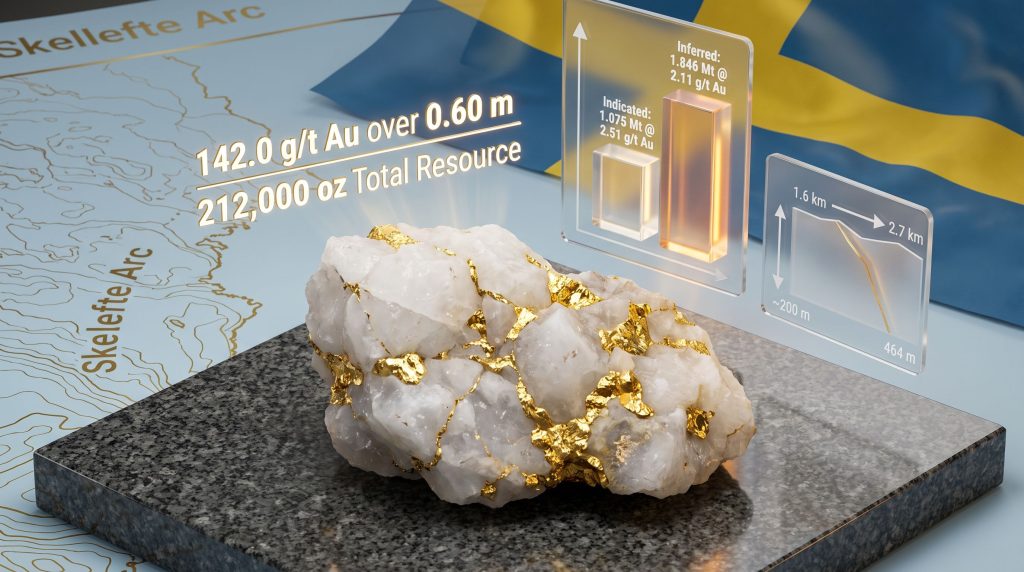
The January to March 2026 extensional drilling campaign delivered a material step-change in both the scale and confidence of the Storheden resource. Completing 16 extensional drill holes, the program extended confirmed strike continuity from approximately 1.6 km in the 2023 baseline to 2.7 km, while pushing confirmed mineralisation depth from approximately 200 m to 464 m.
These are not incremental improvements. A 69% increase in confirmed strike length and a more than doubling of known depth represent a significant expansion of the geological envelope. More importantly, the increased drill density within portions of the deposit enabled the first classification of Indicated resources at Storheden, a milestone with direct implications for mine planning.
The 2026 Mineral Resource Estimate: A Structured Breakdown
| Resource Category | Tonnage | Grade (g/t Au) | Contained Gold |
|---|---|---|---|
| Indicated Resource | 1.075 Mt | 2.51 g/t | ~87,000 oz |
| Inferred Resource | 1.846 Mt | 2.11 g/t | ~125,000 oz |
| Total Resource | ~2.92 Mt | ~2.26 g/t blended | ~212,000 oz |
The distinction between Indicated and Inferred resources under the JORC Code is not merely administrative. Indicated resources meet a higher threshold of geological confidence, requiring sufficient drill hole density to establish grade and tonnage continuity with reasonable certainty. Only Indicated and Measured resources can underpin the ore reserve estimates necessary for definitive feasibility studies and project financing. The conversion of 87,000 oz to Indicated status therefore represents a concrete de-risking event, not simply a numerical upgrade.
Contextualising Storheden's Grade Against Global Benchmarks
The blended resource grade of approximately 2.26 g/t Au sits in an interesting position relative to global gold mining benchmarks:
| Mining Type | Typical Global Grade Range | Storheden Comparison |
|---|---|---|
| Open-pit gold mining | 0.8 to 1.2 g/t Au | Significantly above average |
| Underground gold mining (global average) | 3.5 to 5.0 g/t Au | Below high-margin underground benchmark |
| High-grade underground operations | 6.0 g/t Au and above | Below tier-one underground grade |
| Storheden blended resource | ~2.26 g/t Au | Competitive for shallow satellite development |
The headline grade of 2.26 g/t Au understates the economic potential of the system in one important respect. Narrow, high-grade quartz vein deposits frequently yield significantly higher recovered grades when selectively mined, because the individual vein intervals carrying the bulk of the gold value are substantially richer than the resource average. Underground operations that target specific high-grade vein corridors, accepting some dilution while extracting the richest ore, can generate unit economics well above what the average resource grade implies.
The Standout Intercepts: What Bonanza-Grade Results Signal
Ranked High-Grade Drill Intercepts at Storheden
| Intercept Grade | Width | Campaign |
|---|---|---|
| 142.0 g/t Au | 0.60 m | 2026 extensional drilling |
| 111.0 g/t Au | 0.50 m | 2026 extensional drilling |
| 107.0 g/t Au | 0.40 m | 2026 resource definition |
| 50.9 g/t Au | 0.95 m | 2026 resource definition |
| 39.2 g/t Au | 0.60 m | 2026 resource definition |
| 36.1 g/t Au | 0.50 m | 2026 resource definition |
| 34.3 g/t Au | 1.60 m | Earlier depth-extension drilling |
| 16.2 g/t Au | 0.70 m | Earlier depth-extension drilling |
Technical Note: Intercepts exceeding 100 g/t Au are classified as bonanza grade in orogenic gold literature. These extreme concentrations typically form within structural dilation zones where rapid pressure drops cause gold precipitation from hydrothermal fluids. Their presence at multiple depth levels at Storheden is geologically significant because it suggests the system has experienced repeated episodes of structural reactivation and fluid focusing, a characteristic associated with larger, more economically substantive orogenic gold systems globally.
Understanding Narrow Vein Width in Resource Context
The narrow widths reported at Storheden, ranging from 0.40 m to 1.60 m across the highest-grade intercepts, are entirely consistent with the nature of orogenic quartz vein deposits. A critical technical nuance here is the distinction between downhole width and true vs apparent width, where the latter represents the actual thickness of the vein perpendicular to its orientation. Depending on drill orientation relative to vein dip, reported downhole widths can overstate or understate true vein thickness.
For resource modelling purposes, geological teams use the structural orientation data from drill core to correct downhole widths to true width estimates. This correction affects tonnage calculations and, by extension, contained metal estimates. Investors should understand that narrow, ultra-high-grade intervals contribute disproportionately to the geological significance of a system while representing a relatively modest proportion of total resource tonnage.
Storheden's Development Trajectory: Mine Access Underway
The Economics of Satellite Underground Development
One of the most compelling aspects of the Storheden story is purely logistical. At 700 m from the existing Björkdal processing plant, Storheden sits within what mine developers would consider an exceptionally favourable capital footprint for an underground satellite operation. Processing infrastructure represents one of the largest capital line items in any gold project development. When that infrastructure already exists and operates at throughput capacity, a nearby satellite deposit can be developed at a fraction of the cost of a standalone project.
Alkane Resources has confirmed the commencement of mine development access works toward Storheden from the existing Björkdal operation. This means decline construction or lateral development is already under way, converting Storheden from a pure exploration target into an active development project. The sequencing of infrastructure development alongside continued resource definition drilling is a capital-efficient approach that preserves optionality while reducing the timeline to first ore.
The economic logic of this approach rests on several pillars:
- Processing plant capital is already sunk; incremental throughput from Storheden carries lower unit costs
- Existing tailings, water, and power infrastructure reduces environmental permitting complexity
- Established workforce and operational management at Björkdal reduces staffing ramp-up requirements
- Storheden ore grade can be blended with Björkdal feed to optimise mill head grade and recovery efficiency
Permitting Considerations Under Sweden's Minerals Act
Sweden's mineral regulatory framework operates under the Minerals Act, which establishes a structured pathway from exploration permits through to exploitation concessions. Underground satellite developments adjacent to existing operations typically benefit from established environmental baselines already assessed during the primary mine's approval process. However, separate extraction concession applications are required for new mining areas, and these involve environmental impact assessments addressing subsurface disturbance, groundwater, and surface land use.
Alkane has confirmed it is progressing permitting requirements for Storheden concurrently with the mine development access works. Running these processes in parallel rather than sequentially is standard practice for experienced operators seeking to minimise the timeline gap between resource definition and production.
Investment Dimensions: Scenarios, Risks, and Comparative Context
Upside Pathways for Resource Growth
Three distinct geological scenarios could materially increase the Storheden resource:
- Strike extension: The 2.7 km confirmed strike has not been closed off at either end. If structural continuity persists for a further 500 m to 1.0 km along known fault corridors, resource tonnage could increase proportionally
- Depth continuity: Extending the 464 m depth profile toward 700 to 800 m would bring Storheden into alignment with comparable Scandinavian underground gold operations and could add significant resource tonnes if grades are maintained
- Grade improvement with depth: A characteristic of many orogenic gold systems is increasing structural dilation at depth, which can concentrate gold more intensely. The appearance of bonanza-grade intercepts in the deeper portions of the current drill pattern is consistent with this possibility
Key Risk Factors Investors Should Weigh
| Risk Category | Specific Consideration |
|---|---|
| Vein geometry variability | Narrow quartz veins can pinch and swell unpredictably, creating grade continuity challenges |
| Mining dilution | Extracting 0.4 to 1.6 m veins underground inevitably incorporates surrounding waste rock |
| Permitting timeline | Sweden's environmental assessment process introduces scheduling uncertainty |
| Currency exposure | An ASX/TSX-listed operator incurs Swedish kronor costs against Australian or Canadian dollar revenues |
| Resource classification | A significant portion of the resource remains Inferred and cannot yet underpin mine plans |
How Storheden Compares to Other Satellite Gold Discoveries
| Metric | Storheden (Björkdal) | Typical Satellite Underground Discovery |
|---|---|---|
| Distance to processing plant | 700 m | 500 m to 5 km |
| Current total resource | ~212,000 oz | 100,000 to 500,000 oz |
| Resource confidence | Indicated and Inferred | Typically Inferred at this stage |
| Mineralisation status | Open all directions | Varies |
| Development stage | Mine access commenced | Typically pre-development |
Disclaimer: The comparative scenarios and projections contained in this article are speculative in nature and should not be construed as financial advice. Resource estimates, development timelines, and mineralisation projections are subject to geological uncertainty, regulatory processes, and market conditions. Investors should conduct independent due diligence before making any investment decisions.
The next major ASX story will hit our subscribers first
What the Storheden Discovery Reveals About Europe's Broader Gold Prospectivity
A Broader Signal for Scandinavian Orogenic Gold Exploration
The Alkane Resources Storheden gold intercepts in Sweden carry implications beyond a single deposit update. The Skellefte Arc hosts numerous structural corridors that share the same lithological and tectonic characteristics as the zones controlling Storheden's mineralisation. Yet systematic, modern exploration targeting orogenic gold specifically within these corridors has only recently begun in earnest.
Historically, exploration in northern Sweden focused heavily on the volcanogenic massive sulphide systems that produce zinc, copper, and silver. Gold was treated as a by-product consideration rather than a primary target. The emergence of high-grade orogenic gold intercepts within the same geological belt suggests that systematic targeting of shear-hosted quartz vein systems could yield additional discoveries across a much broader footprint.
For Alkane Resources specifically, the Björkdal project tenement package encompasses ground beyond the immediate Storheden and main Björkdal ore bodies. The improved lithostructural understanding generated by three years of systematic Storheden drilling provides a geological template that could guide target generation across this broader holding.
Alkane's Dual-Listing and Capital Markets Context
Alkane Resources' dual listing on both the ASX and TSX positions it within two investor communities that are presently receptive to European gold development stories. The current gold price environment, with spot gold trading above $4,000 per ounce as of July 2026, materially improves the economic thresholds for satellite underground development projects that might have appeared marginal at lower price points. At these gold prices, the capital efficiency argument for developing Storheden through existing Björkdal infrastructure becomes increasingly compelling.
The achievement of a first Indicated resource classification at Storheden is a specific milestone that institutional investors track closely. Many resource-focused fund mandates restrict allocation to deposits carrying at least a portion of Indicated resources, meaning this classification upgrade opens Storheden to a wider pool of potential investment interest than a purely Inferred resource would support. In addition, interpreting drill results correctly is essential for investors seeking to distinguish genuine resource growth from routine operational updates.
Frequently Asked Questions: Alkane Resources Storheden Gold Intercepts
What is the Storheden deposit?
Storheden is a structurally controlled, high-grade gold deposit located approximately 700 m north of Alkane Resources' operating Björkdal gold mine in northern Sweden. Gold mineralisation occurs within quartz vein networks hosted in Precambrian basement rocks of the Skellefte Arc. The deposit currently holds a total mineral resource of approximately 212,000 oz across Indicated and Inferred categories under the JORC Code.
What are the highest gold grades reported at Storheden?
The most significant intercepts from recent drilling include 142.0 g/t Au over 0.60 m and 111.0 g/t Au over 0.50 m from the 2026 extensional program, alongside 107.0 g/t Au over 0.40 m from the resource definition campaign. These bonanza-grade results are characteristic of structurally controlled fluid focusing events within orogenic quartz vein systems.
Is Storheden mineralisation still open?
As of the 2026 resource update, mineralisation at Storheden remains open along strike, down-dip, and at depth. No barren drill holes have defined the system's lateral or vertical boundaries, indicating genuine potential for continued resource growth through further drilling.
What is the current total mineral resource estimate?
The 2026 update established an Indicated Resource of 1.075 Mt at 2.51 g/t Au for approximately 87,000 oz, and an Inferred Resource of 1.846 Mt at 2.11 g/t Au for approximately 125,000 oz, yielding a combined total of approximately 212,000 oz at a blended grade of approximately 2.26 g/t Au.
Has mine development toward Storheden started?
Alkane Resources has confirmed the commencement of mine development infrastructure works toward Storheden from the existing Björkdal operation. Permitting requirements for extraction are being advanced concurrently. No formal production commencement date has been publicly confirmed as of July 2026.
Why is Sweden considered a favourable mining jurisdiction?
Sweden operates under a well-established mineral regulatory framework governed by the Minerals Act, supported by mature infrastructure, a skilled technical workforce, and long-term political stability. The country's Precambrian basement geology hosts several significant metal deposits across multiple commodities, and its transparent permitting framework is generally regarded as predictable relative to many emerging market jurisdictions.
Want To Be First When The Next Major ASX Mineral Discovery Is Announced?
Discovery Alert's proprietary Discovery IQ model scans ASX announcements in real time, instantly identifying significant mineral discoveries across more than 30 commodities — so subscribers can act on actionable opportunities before the broader market reacts. Explore historic examples of exceptional discovery returns and begin your 14-day free trial at Discovery Alert to position yourself ahead of the market.