July 29, 2026
The Mechanics Behind Gold's Sensitivity to Monetary Policy
Every asset class carries an implied cost of ownership, and for gold, that cost is defined almost entirely by the interest rate environment. Unlike equities that generate dividends or bonds that pay coupons, gold produces no income stream. This structural characteristic makes it uniquely vulnerable to shifts in monetary policy, because when rates rise, the forgone yield of holding bullion becomes more expensive relative to alternatives that actually pay investors to wait.
This dynamic sits at the heart of why gold prices ahead of Fed decision cycles attract such intense scrutiny from institutional and retail investors alike. The Federal Reserve's rate-setting process does not just affect borrowing costs across the economy. It directly recalibrates the opportunity cost of every non-yielding asset on the planet, with gold sitting at the top of that list.
Understanding this mechanism is the starting point for any serious analysis of where bullion goes from here. Furthermore, the gold price forecast for the remainder of 2026 hinges significantly on how the Fed navigates this delicate balance.
When big ASX news breaks, our subscribers know first
Why Forward Pricing Changes Everything
Markets Act Before the Fed Does
A common misconception among newer investors is that gold responds to what the Fed announces. In practice, sophisticated markets price in probabilities weeks or even months before any formal decision is made. By the time the press conference begins, a significant portion of the market's reaction has already been embedded in spot prices, futures curves, and options positioning.
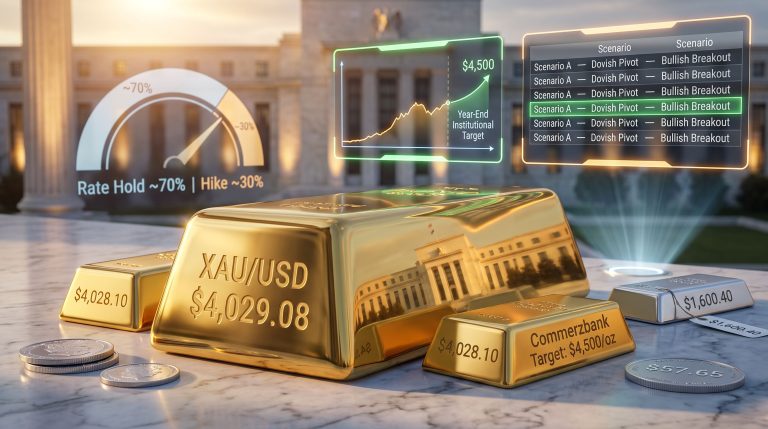
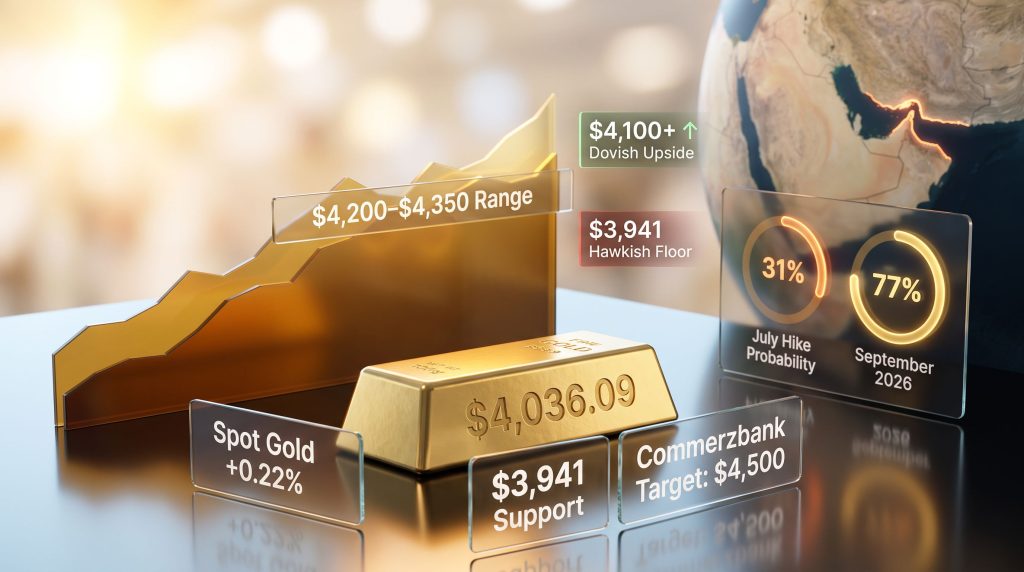
The CME FedWatch Tool, which aggregates expectations from federal funds futures contracts, currently reflects roughly 31% market probability of a 25-basis-point rate hike at the July 2026 meeting. The remaining majority of market participants are positioned for a hold. For the September 2026 meeting, however, approximately 77% of traders are pricing in a rate increase, suggesting the consensus view treats any July pause as a delay rather than a definitive change in direction.
This forward pricing structure creates a nuanced environment for gold traders. A hold at the July meeting will not automatically be bullish for bullion if the accompanying language reinforces the likelihood of a September hike. The tone of the decision frequently matters more than the decision itself.
"The gold market's reaction to a Federal Reserve announcement is rarely binary. It is a function of the gap between what was expected and what was delivered, including every word spoken during the post-decision press conference."
The Role of Real Yields in Framing Gold's Ceiling
Beyond nominal rates, the concept of real yields (inflation-adjusted returns on government bonds) provides a more precise lens for evaluating gold's trajectory. When real yields are deeply negative, gold thrives because the cost of holding it is negligible relative to the erosion of purchasing power elsewhere. When real yields climb into positive territory, the equation reverses, and capital gravitates toward interest-bearing instruments.
The current environment sits in contested territory. Inflation remains elevated enough to support gold's hedge narrative, but interest rates are high enough to impose a meaningful carry cost on bullion holders. Consequently, this tension explains the consolidation pattern that has dominated price action throughout much of 2026. In addition, the interplay between gold and bond dynamics remains a critical framework for understanding these price movements.
Gold's Current Price Position and What It Reveals
Spot Price and Futures Market Snapshot as of July 29, 2026
| Instrument | Price | Movement |
|---|---|---|
| Spot Gold | $4,036.09 per ounce | +0.22% |
| August Gold Futures | $4,037.30 per ounce | Steady |
| 2026 Year-to-Date Low | $3,941.00 per ounce | Key support |
| Dovish Scenario Upside Target | $4,100+ per ounce | Projected |
| Commerzbank Year-End Forecast | $4,500 per troy ounce | Analyst estimate |
Spot gold edged 0.22% higher to $4,036.09 per ounce, with August futures holding steady at $4,037.30. The narrow gap between spot and near-month futures reflects a market in equilibrium rather than one expressing strong directional conviction. According to Reuters, gold's modest gains reflect easing rate hike fears heading into the Fed's upcoming announcement.
The Psychological Significance of the $4,000 Level
Round-number price levels serve a function beyond simple numerology in commodity markets. They concentrate algorithmic activity, attract discretionary dip-buyers, and act as informal anchors for position sizing. The $4,000 per ounce threshold has functioned as an active support zone in recent sessions, with buying interest emerging consistently whenever prices approach it from above.
This dip-buying behaviour reflects a combination of factors: expectations for a Fed hold, technical traders defending a psychologically significant level, and residual safe-haven gold demand from geopolitical uncertainty. However, dip-buying support is inherently conditional. If the Fed delivers a hawkish surprise, algorithmic selling could overwhelm discretionary buyers, exposing the $3,941 per ounce 2026 floor as the next major test.
Mapping the Scenarios: What Each Fed Outcome Means for Bullion
Scenario 1: Hold With Hawkish Tone
This outcome represents the most analytically complex scenario. The Fed keeps rates unchanged but signals through its statement or press conference language that additional tightening remains firmly on the table. Under this pathway:
- Treasury yields across the 2-year and 10-year benchmarks would likely move higher as markets reprice the duration of restrictive policy
- The US dollar index would strengthen, applying mechanical downward pressure on gold priced in USD
- The $3,941 per ounce 2026 low would become the immediate technical target for sellers
- Historical precedent from similar "hold but warn" cycles shows gold can decline 3% to 5% in the sessions following such communication
Scenario 2: Hold With Dovish or Neutral Language
A hold paired with softer inflation commentary or language that opens the door to future easing would be interpreted as a meaningful policy pivot signal. This outcome would likely:
- Weaken the dollar and compress real yields simultaneously, creating a dual tailwind for bullion
- Push spot gold above $4,100 per ounce in the near term, establishing a new technical base
- Strengthen the case for Commerzbank's revised year-end target of $4,500 per troy ounce
- Potentially trigger momentum-driven buying from systematic funds that track rate expectations
Scenario 3: An Unexpected Rate Hike
With only approximately 31% probability currently priced in, an actual hike would represent a genuine surprise to the majority of market participants. Non-yielding assets face maximum pressure when rate expectations shift sharply upward within a single session. Gold would likely:
- Breach the $3,941 support level with conviction
- Trigger stop-loss selling across leveraged long positions in gold futures
- Face sustained pressure as traders reprice the September meeting expectations even higher
The Geopolitical Variables That Are Partially Insulating Gold
Strait of Hormuz and the Risk Premium Floor
Monetary policy does not operate in isolation, and the current geopolitical landscape is providing gold with a partial buffer that it would not otherwise enjoy in a purely rate-driven environment. Iran's rejection of Oman's proposal for joint regional management of the Strait of Hormuz has closed off what many analysts viewed as a viable diplomatic de-escalation pathway.
The Strait of Hormuz carries an estimated 20% of global oil trade, making any potential disruption to that corridor a systemic concern for energy markets and, by extension, inflation expectations globally. Elevated geopolitical tension in this region historically generates safe-haven demand for gold that can partially offset the headwinds from high real yields.
Oil Price Shocks and Inflation Expectations
Oil prices climbed approximately $3 per barrel following joint US-Saudi military strikes in Iraq, introducing fresh inflationary pressure into the macro environment. This matters for gold through an indirect channel: rising energy costs feed into broader consumer price indices, potentially delaying the rate cuts that would most directly benefit bullion.
The paradox here is notable. Rising oil prices can simultaneously support gold through inflation expectations while also constraining gold by giving the Fed justification to maintain restrictive policy for longer. Investors navigating this environment need to hold both dynamics in view rather than defaulting to a simple inflation-equals-gold-upside thesis.
"When oil prices spike for geopolitical rather than demand-driven reasons, the inflation signal they send to central banks is far more complicated to interpret, and so is the resulting impact on gold."
Global Central Bank Posture and What It Means for the Rate Cycle Narrative
Both the Bank of England and the Bank of Japan are widely anticipated to maintain current rate settings this week, with both institutions expected to accompany their decisions with cautionary language on persistent inflation. This coordinated global "hold" posture reinforces a broader narrative that the tightening cycle across major economies has not fully concluded.
For gold investors, central bank gold demand is a two-edged dynamic. On one hand, a synchronised global hold can temporarily reduce rate-driven headwinds. On the other hand, when multiple central banks simultaneously signal inflation vigilance, it reinforces the message that rate cuts remain further away than markets might prefer, keeping the opportunity cost of holding gold relatively elevated.
The interaction between the Fed's forward guidance and the divergent paths of other major central banks creates a complex web of currency and yield relationships that will ultimately determine where real yields settle globally, and with them, the medium-term ceiling for gold.
The next major ASX story will hit our subscribers first
Analyst Forecasts and the Medium-Term Trajectory
Commerzbank's Revised 2026 Precious Metals Outlook
| Metal | Commerzbank Year-End 2026 Forecast | Notes |
|---|---|---|
| Gold | $4,500 per troy ounce | Revised downward from prior estimate |
| Silver | $67 per troy ounce | Elevated gold-to-silver ratio implied |
Commerzbank's decision to revise its gold forecast downward to $4,500 per troy ounce reflects a recalibration of rate cut timing assumptions. The bank's updated model incorporates a more prolonged restrictive policy environment than previously anticipated, meaning the path to $4,500 runs through a more patient timeline rather than an abrupt pivot.
Silver's forecast of $67 per troy ounce carries its own analytical signal. At current gold prices near $4,036, the gold-to-silver ratio implied by these forecasts suggests silver is priced relatively cheaply compared to gold on a historical basis. If risk appetite returns and industrial demand strengthens alongside any easing cycle, silver could offer higher percentage upside from current levels than gold itself.
What the $4,200 to $4,350 Consolidation Range Signals
Gold's tendency to oscillate between $4,200 and $4,350 per ounce across multiple 2026 trading sessions is not a sign of market indifference. It is characteristic of periods where macro uncertainty is high and no single catalyst has been powerful enough to break prices decisively in either direction.
This type of range-bound consolidation typically precedes a significant directional move once a sufficient catalyst arrives. The Federal Reserve's July decision and subsequent press conference represents exactly that kind of catalyst. The market is coiled, and the directional resolution, when it comes, is likely to be sharp rather than gradual.
The Inflation Hedge Paradox in a High-Rate World
Gold's reputation as an inflation hedge is well-established across decades of market history, but this narrative contains an internal contradiction that becomes most visible in environments like the present one. When inflation is elevated and central banks respond aggressively with rate increases, the inflation hedge appeal of gold competes directly with the carry cost headwind of holding a non-yielding asset.
In these conditions, gold tends to outperform its rate-environment peers only when additional factors are present:
- Geopolitical risk at levels sufficient to generate independent safe-haven demand
- Dollar credibility concerns that weaken the relative attractiveness of USD-denominated alternatives
- Systemic financial stress that elevates uncertainty beyond what interest rate differentials can fully compensate for
The current environment contains elements of all three conditions, which explains why gold has managed to hold above $4,000 despite a rate backdrop that would, in a purely mechanical sense, suggest lower prices. This resilience is not irrational exuberance. It reflects the market's assessment that multiple risk premiums are being layered into the gold price simultaneously.
Key Indicators to Monitor Beyond the Rate Decision
For investors tracking gold prices ahead of the Fed decision and into the subsequent trading sessions, several indicators will provide real-time signals about the market's interpretation of the Fed's communication. Analysts at Kitco have similarly highlighted how the post-announcement response often reveals far more than the decision itself.
- Fed Chair press conference tone at 18:30 GMT will carry equal or greater weight than the rate decision itself, particularly any language referencing the September meeting
- US Dollar Index (DXY) movement in the minutes following the announcement will serve as a live proxy for gold's directional bias
- 2-year Treasury yield reaction is the most sensitive indicator of near-term rate repricing and will confirm whether the market interprets the decision as hawkish or dovish
- Gold's ability to hold above $4,000 in the hours following the decision represents the critical technical line between constructive and deteriorating sentiment
- Geopolitical headlines from the Middle East, particularly any development involving the Strait of Hormuz, remain an independent variable capable of overriding rate-driven price action on short notice
Disclaimer: This article is intended for informational and educational purposes only. It does not constitute financial advice, a solicitation, or a recommendation to buy or sell any financial instrument. Gold prices, analyst forecasts, and market probabilities are subject to rapid change. Readers should conduct their own due diligence and consult a qualified financial adviser before making any investment decisions. All forecast figures referenced are third-party analyst estimates and do not represent guaranteed outcomes.
Want to Know When the Next Major ASX Mineral Discovery Hits the Market?
Discovery Alert's proprietary Discovery IQ model scans ASX announcements in real time, instantly translating complex mineral data into actionable opportunities across more than 30 commodities — giving subscribers a decisive edge the moment a significant discovery is announced. Explore historic discoveries and the returns they generated, then begin your 14-day free trial at Discovery Alert to position yourself ahead of the broader market.