August 5, 2026
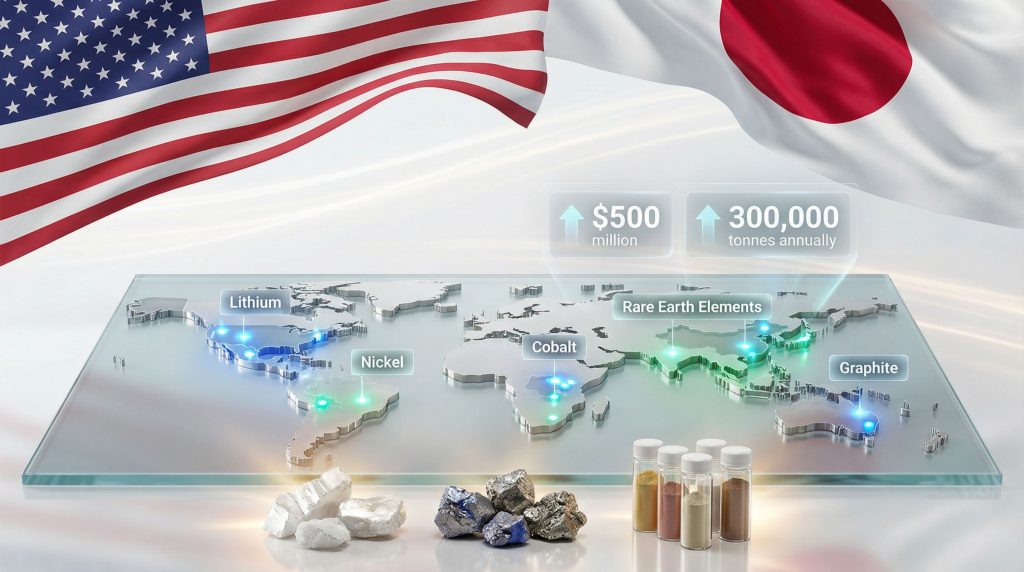
The alliance for critical minerals between United States and Japan represents a transformative approach to resource security, formally established through bilateral cooperation agreements in October 2025. This partnership addresses fundamental vulnerabilities exposed when single-source dependencies create systemic risks across defense, technology, and energy transition sectors. Furthermore, it demonstrates how strategic cooperation can challenge existing resource monopolies while building resilient supply chains.
What Is the U.S.-Japan Critical Minerals Alliance and Why Does It Matter?
Defining the Strategic Partnership Framework
The alliance for critical minerals between United States and Japan represents a paradigm shift in resource diplomacy, targeting three interconnected objectives: supply chain resilience through geographic diversification, technological sovereignty via allied-nation processing capabilities, and economic security through coordinated investment mechanisms. Unlike traditional trade agreements focused primarily on tariff reduction, this alliance emphasises strategic control over materials essential to national security infrastructure.
Central to the partnership's rationale is China's overwhelming dominance in rare earth processing, where a single geopolitical actor controls 85-90% of global separation and refining operations. This concentration creates vulnerability scenarios where diplomatic tensions can instantaneously disrupt supply chains supporting everything from missile guidance systems to smartphone manufacturing. Moreover, Australia lithium innovations demonstrate the potential for allied nations to develop alternative supply sources.
Critical Minerals Scope and Priority Classifications
The alliance targets five priority material categories, each presenting distinct supply chain challenges and strategic importance levels. Additionally, the framework incorporates lessons from existing critical minerals strategy implementations to ensure comprehensive coverage.
| Mineral | Defense Applications | Technology Applications | Current Import Dependency (US) |
|---|---|---|---|
| Lithium | Battery systems, radar equipment | EV batteries, grid storage | 70% |
| Rare Earth Elements | Missile guidance, sonar systems | Permanent magnets, semiconductors | 100% |
| Cobalt | Aerospace alloys, military electronics | High-density batteries, superalloys | 75% |
| Nickel | Naval applications, armour plating | Battery cathodes, stainless steel | 45% |
| Graphite | Nuclear moderators, electrodes | Battery anodes, lubricants | 100% |
Japan's import dependencies mirror these vulnerabilities, with virtually 100% reliance on foreign sources for rare earth elements, lithium, and cobalt. The Democratic Republic of Congo supplies over 70% of global cobalt production, whilst China processes nearly all rare earth oxides regardless of mining location.
Processing complexity represents a critical bottleneck often overlooked in supply chain analysis. Rare earth separation requires sophisticated hydrometallurgical processes where mixed oxides undergo chemical treatment to isolate individual elements. This processing stage, dominated by Chinese facilities, typically represents 40-60% of total production costs and requires 8-15 years to develop from concept to commercial operation.
Geopolitical Context and Timing Analysis
The alliance's formation reflects lessons learned from the 2010 rare earth export restrictions during the Senkaku Islands dispute, when China demonstrated the weaponisation potential of resource dependencies. This historical precedent catalysed Japan's initial diversification efforts and established the strategic rationale underlying current partnership frameworks.
Current market concentration metrics reveal the scale of dependency challenges:
• China's rare earth processing: 85-90% global capacity
• Lithium refining: China controls 60% of global lithium compound production
• Cobalt processing: 80% of cobalt chemicals processed in China
• Graphite production: China supplies 65% of natural graphite globally
Supply chain mapping reveals that even when materials originate from allied nations like Australia or Canada, processing predominantly occurs in Chinese facilities. This creates scenarios where allied-source materials remain vulnerable to geopolitical disruption despite originating from friendly jurisdictions. Consequently, recent developments including Trump's executive order on minerals highlight the urgency of establishing alternative processing capabilities.
The timing coincides with accelerating demand projections for electric vehicle batteries, where lithium requirements are expected to increase by 300-400% through 2030. Simultaneously, defence modernisation programmes in both nations require increasing quantities of rare earth permanent magnets for hypersonic weapons systems and advanced radar installations.
When big ASX news breaks, our subscribers know first
How Does the Alliance Structure Financial Support and Investment Mechanisms?
Bilateral Funding Architecture
The partnership establishes complementary financing mechanisms addressing different stages of the critical minerals value chain. The U.S. Department of Energy has allocated up to $500 million for processing facility development and critical mineral project advancement, whilst Japan expands JOGMEC's mandate to include strategic international investments.
JOGMEC's enhanced investment framework operates through three distinct mechanisms:
• Direct equity participation: Up to 75% funding for exploration-stage projects in allied nations
• Loan financing with government guarantees: Market-rate lending for technically proven developments
• Resource security agreements: Long-term offtake commitments providing revenue certainty
Japan's FY2024 critical minerals budget allocation totals approximately ¥80 billion (~$600 million USD equivalent) across all mineral portfolios, representing a substantial increase from previous years' resource security spending. This expansion reflects recognition that traditional market-based procurement strategies prove inadequate when supply security becomes a national security imperative.
The financial architecture emphasises blended finance approaches where concessional government funding reduces private investor risk during early-stage development. This structure addresses the historical challenge where critical mineral projects often require patient capital due to long development timelines and regulatory complexity. Furthermore, the approach complements European CRM facility initiatives for comprehensive allied-nation coordination.
Project Selection Criteria and Evaluation Process
Alliance funding prioritises projects meeting four essential criteria that distinguish strategic investments from purely commercial ventures. However, the alliance for critical minerals between United States and Japan maintains flexibility to adapt criteria based on emerging strategic requirements.
Geographic diversification requirements mandate that no single jurisdiction control more than 40% of any mineral's allied-nation supply. This prevents recreating dependency scenarios in different geopolitical contexts whilst ensuring supply chain resilience through distributed production networks.
Technical feasibility assessments evaluate metallurgical pathways, processing complexity, and scalability potential. Projects must demonstrate proven separation and refining technologies appropriate for the specific mineral compositions and grade characteristics of their deposits.
Market viability standards require positive net present value calculations and acceptable payback periods, typically under five years for tier-one projects. However, strategic value considerations can justify somewhat longer payback periods when projects contribute significantly to supply chain security objectives.
Partner alignment verification confirms that project ownership and management structures align with allied-nation strategic interests, preventing scenarios where funding inadvertently benefits adversarial entities through complex corporate structures.
Case Study Analysis: Atlas Lithium's Neves Project Selection
Atlas Lithium's Neves project exemplifies the alliance's selection rationale, representing the sole Brazilian lithium development included in the joint fact sheet for potential financing. This singular representation amongst Brazil's numerous lithium prospects reflects specific strategic advantages that align with alliance objectives.
Project Economics and Technical Specifications:
The completed feasibility study reveals exceptional economic metrics that position Neves amongst the world's highest-returning lithium developments:
• After-tax Internal Rate of Return: 145%
• Net Present Value: US$539 million
• Payback Period: 11 months
• Annual Production Capacity: 300,000 tonnes lithium concentrates
These metrics substantially exceed industry benchmarks, where typical lithium project IRRs range from 25-45% for mature operations. The 11-month payback period indicates either exceptional ore grades or processing efficiency advantages that reduce capital intensity relative to production capacity.
Strategic Partnership Validation:
Mitsui & Co.'s US$30 million strategic investment in 2024, coupled with a comprehensive offtake agreement, provides pre-validation of project viability from a committed Japanese partner. This existing relationship demonstrates aligned interests and reduces implementation risks associated with new partnership development.
The project utilises dense media separation (DMS) technology for spodumene ore processing, a proven metallurgical pathway that reduces technical risk compared to experimental extraction methods. The 300,000-tonne annual throughput capacity aligns with both U.S. and Japanese EV battery demand growth projections of 15-20% compound annual growth through 2030.
Market Response and Valuation Impact:
Atlas Lithium's stock price increased approximately 4% following the alliance selection announcement, elevating market capitalisation to US$123.6 million. This positive market response reflects investor recognition of the strategic value represented by inclusion in the bilateral framework, potentially providing access to favourable financing terms and guaranteed offtake arrangements.
What Are the Trade Policy Innovations and Market Protection Strategies?
Border-Adjusted Pricing Mechanisms
The alliance pioneers innovative trade policy tools designed to counter below-market pricing strategies that have historically undermined allied-nation mineral development. Price floor establishments create minimum pricing thresholds that prevent predatory pricing from disrupting emerging supply chains during their vulnerable development phases.
These mechanisms operate through coordinated procurement policies where alliance members commit to purchasing from qualified suppliers at prices that ensure project viability. This approach differs from traditional tariff-based protection by creating positive incentives for allied production rather than simply penalising competitors. Additionally, innovations in battery recycling breakthrough technologies support circular economy principles within the alliance framework.
Coordination with existing suppliers like Australia's Lynas Rare Earths provides precedent for non-Chinese rare earth procurement. Lynas currently operates Mount Weld mine production with Malaysian processing facilities, producing approximately 11,000 tonnes rare earth oxide equivalent annually outside Chinese control.
Implementation timelines target Q3-Q4 2026 for initial pilot programmes, with full deployment contingent on legal framework development and WTO compliance verification. Enforcement protocols emphasise transparency and predictability to encourage private investment whilst maintaining compatibility with international trade obligations.
Plurilateral Trade Framework Development
The bilateral foundation enables expansion to additional partners through structured accession mechanisms that maintain alliance coherence whilst increasing geographic diversity. Mexico, the European Union, and Australia represent priority expansion targets based on complementary mineral endowments and aligned strategic interests.
Existing bilateral frameworks provide integration pathways:
| Country/Region | Primary Mineral Focus | Existing Framework | Integration Timeline |
|---|---|---|---|
| Australia | Rare earths, lithium | AUKUS technology sharing | Q2 2027 |
| Mexico | Lithium, silver | USMCA trade provisions | Q4 2026 |
| European Union | Processing technology | Transatlantic cooperation | Q1 2027 |
| Canada | Rare earths, cobalt | CUSMA frameworks | Q3 2027 |
Extension strategies emphasise technology sharing agreements that accelerate processing capability development in partner nations. This approach addresses the historical bottleneck where mining capacity expansion outpaces processing infrastructure development, creating continued dependency on Chinese facilities.
Plurilateral frameworks also enable burden-sharing arrangements where development costs distribute across multiple alliance members, reducing individual nation fiscal exposure whilst increasing overall resource mobilisation capacity.
Anti-Dumping and Non-Market Practice Countermeasures
The alliance establishes rapid response protocols for identifying and countering subsidised imports that threaten emerging allied supply chains. Legal frameworks define non-market practices to include state subsidies, below-cost pricing, and artificial capacity expansion designed to maintain market control.
Identification mechanisms utilise real-time market monitoring to detect pricing anomalies that indicate predatory behaviour. These systems track production costs, shipping patterns, and pricing trends across multiple markets to establish baseline competitive metrics.
Coordination with existing WTO dispute mechanisms ensures compliance with international trade law whilst providing forums for addressing systematic non-market practices. The alliance emphasises multilateral solutions that strengthen rather than undermine global trade governance structures.
Emergency response procedures enable coordinated action when supply disruptions threaten critical infrastructure. These protocols include strategic reserve releases, alternative sourcing activation, and accelerated project development financing to maintain supply continuity during crisis periods.
How Will Research and Development Accelerate Supply Chain Innovation?
Deep-Sea Mining Technology Advancement
Japan's Minamitorishima Island rare earth mud deposits represent a frontier technology development opportunity that could fundamentally alter global supply dynamics. These deep-sea resources contain rare earth concentrations comparable to terrestrial deposits but require innovative extraction technologies for commercial viability.
Joint research initiatives target extraction efficiency improvements that reduce the energy intensity and environmental impact of deep-sea operations. Current prototype systems achieve extraction rates of approximately 1-2 tonnes per hour, but commercial viability requires scaling to 10-15 tonnes per hour to justify infrastructure investments.
Environmental impact assessment protocols developed through the partnership establish standards for sustainable deep-sea mining that balance resource access with marine ecosystem protection. These frameworks potentially influence international regulations governing deep-sea resource development globally.
Technology transfer agreements ensure that innovations developed through joint research benefit all alliance members, creating shared intellectual property pools that accelerate deployment across multiple jurisdictions.
Geological Mapping and Resource Assessment Expansion
Comprehensive geological surveys identify previously unknown or inadequately characterised mineral deposits within allied nations, expanding the resource base available for strategic development. Moreover, the alliance for critical minerals between United States and Japan facilitates sharing of advanced exploration technologies.
Priority mapping regions include:
• Canadian Shield rare earth prospects: Systematic evaluation of alkaline intrusive complexes
• Australian lithium pegmatite fields: Advanced geophysical surveys in underexplored terranes
• U.S. Western cordillera: Detailed assessment of historic mining districts for critical minerals
• Mexican volcanic arcs: Epithermal systems evaluation for rare metal concentrations
Resource quality assessments utilise advanced analytical techniques to characterise mineral grades, metallurgical properties, and processing requirements. This detailed characterisation enables accurate project economic modelling and technology selection optimisation.
Collaborative mapping initiatives reduce individual nation survey costs whilst creating shared databases that facilitate cross-border project development and resource sharing agreements.
Processing Technology Breakthroughs and Efficiency Gains
Separation and refining innovation targets cost reduction through process intensification and automation. Current rare earth separation requires extensive solvent extraction circuits with high chemical consumption and waste generation.
Research priorities include selective extraction technologies that reduce processing steps and chemical inputs whilst improving product purity. Ion exchange resins, membrane separation, and biotechnology applications show promise for commercial implementation within 3-5 years.
Recycling technology advancement addresses the circular economy integration challenge where end-of-life products contain valuable critical minerals. Permanent magnet recycling, battery material recovery, and electronic waste processing represent immediate commercialisation opportunities.
Cost reduction projections target 20-30% processing cost decreases through technological improvements, making allied-nation production more competitive with subsidised alternatives whilst reducing environmental impacts.
What Are the Operational Implementation Mechanisms and Governance Structure?
U.S.-Japan Critical Minerals Supply Security Rapid Response Group
The operational framework centres on a high-level coordination mechanism led by the U.S. Secretary of Energy and Japan's METI Minister, ensuring direct cabinet-level oversight of supply chain security issues. This leadership structure provides the authority necessary for rapid decision-making during crisis situations. Consequently, the group can implement measures similar to the executive order on minerals for coordinated responses.
Quarterly assessment protocols systematically evaluate supply chain vulnerabilities across all priority minerals, utilising real-time market data and intelligence assessments to identify emerging risks. These evaluations inform proactive policy adjustments and resource allocation decisions.
Emergency response procedures enable coordinated action within 72-96 hours of supply disruption identification. Response options include strategic reserve releases, alternative sourcing activation, emergency procurement protocols, and accelerated project financing for critical developments.
Working-level committees comprising technical experts, industry representatives, and government officials maintain operational continuity between ministerial meetings and provide detailed implementation oversight for specific initiatives.
Permitting Streamlining and Regulatory Coordination
Environmental review harmonisation between U.S. and Japanese regulatory frameworks reduces duplicative assessments and accelerates project approval timelines. Mutual recognition agreements enable qualified projects to leverage approvals from one jurisdiction to expedite processes in partner nations.
Timeline reduction targets aim for 30-40% acceleration of critical mineral project approvals whilst maintaining environmental protection standards. This acceleration focuses on administrative efficiency rather than regulatory standard reduction.
Hypothetical scenario modelling suggests that streamlined permitting could reduce typical project development timelines from 10-15 years to 7-10 years, representing significant improvement in supply chain responsiveness to market demands.
Regulatory coordination mechanisms include shared technical expertise, joint environmental assessment teams, and harmonised monitoring protocols that create consistent standards across alliance jurisdictions.
Stockpiling Strategy and Strategic Reserve Management
National reserve coordination establishes minimum inventory levels for each priority mineral based on consumption patterns, supply vulnerability assessments, and emergency response requirements. Current U.S. strategic reserves contain minimal critical mineral inventories compared to petroleum or grain reserves.
Inventory level targets vary by mineral based on strategic importance and supply chain characteristics:
• Rare earth permanent magnet materials: 6-month consumption equivalent
• Lithium compounds: 3-month consumption equivalent for battery applications
• Cobalt metal and compounds: 4-month strategic industry consumption
• High-purity graphite: 2-month consumption for critical applications
Release mechanisms during supply emergencies follow predetermined protocols that balance market stabilisation with reserve conservation. Coordinated releases between alliance partners amplify market impact whilst distributing reserve depletion across multiple nations.
Sharing agreements enable cross-border reserve access during asymmetric disruptions where one partner faces supply challenges whilst others maintain normal access.
How Does This Alliance Impact Global Critical Minerals Market Dynamics?
Market Share Redistribution Projections
The alliance targets fundamental restructuring of global processing capacity distribution, moving from China-dominated supply chains toward diversified production networks spanning multiple allied jurisdictions. Furthermore, the alliance for critical minerals between United States and Japan serves as a model for similar partnerships worldwide.
Current vs. Projected Market Share Scenarios (2026-2030):
| Mineral | China Current Share | 2030 Projected Share | Allied Nations Target |
|---|---|---|---|
| Rare Earth Processing | 85% | 60-65% | 35-40% |
| Lithium Refining | 60% | 45-50% | 40-45% |
| Cobalt Chemicals | 80% | 65-70% | 25-30% |
| Graphite Processing | 65% | 50-55% | 30-35% |
Allied nation capacity building trajectories require substantial infrastructure investments estimated at $15-20 billion globally across all mineral categories. This investment level reflects the capital intensity of establishing processing capabilities that currently exist primarily in China.
Capacity development timelines vary significantly by mineral complexity, with lithium processing potentially achievable within 3-4 years, whilst rare earth separation facilities require 5-7 years for commercial operation.
Price Stability and Volatility Reduction Mechanisms
Long-term contract structures between alliance members create price discovery mechanisms independent of spot market volatility dominated by Chinese trading patterns. These contracts typically span 5-10 years with price escalation clauses linked to inflation and development cost factors.
Transparent market development through allied-nation trading platforms reduces information asymmetries that contribute to price manipulation and artificial scarcity scenarios. Real-time pricing data sharing improves market efficiency and investment decision-making.
Speculation reduction strategies include position limits for financial investors and margin requirements designed to discourage excessive speculation in critical mineral futures markets. These measures aim to align pricing with fundamental supply-demand dynamics rather than financial speculation.
Historical analysis suggests that supply diversification typically reduces price volatility by 20-30% compared to single-source scenarios, providing greater predictability for industrial users and infrastructure investors.
Third-Country Partnership Expansion Opportunities
African mineral-rich nations represent significant partnership expansion potential, particularly for cobalt (Democratic Republic of Congo), rare earths (South Africa), and lithium (Zimbabwe, Namibia). Integration strategies emphasise technology transfer and infrastructure development that benefits host nations whilst securing supply access.
Latin American lithium triangle integration offers opportunities for comprehensive regional development encompassing Argentina, Bolivia, and Chile. These nations control approximately 60% of global lithium reserves but currently lack processing infrastructure to capture downstream value.
Southeast Asian rare earth development possibilities include Indonesia's rare earth potential and Malaysia's existing processing capabilities. Regional integration could leverage ASEAN frameworks for collaborative development initiatives.
Partnership expansion criteria emphasise governance standards, environmental compliance, and democratic institutions as prerequisites for alliance participation, distinguishing this framework from purely transactional resource access agreements.
The next major ASX story will hit our subscribers first
What Are the Long-Term Strategic Implications for Global Supply Chains?
Technology Sector Security and Innovation Acceleration
Semiconductor manufacturing supply chain resilience benefits from reduced dependency on single-source rare earth permanent magnets essential for advanced chip production equipment. Secure rare earth access enables expansion of allied semiconductor fabrication capacity independent of geopolitical constraints.
Electric vehicle battery production capacity expansion requires coordinated lithium, cobalt, and nickel supply chains that align with automotive industry investment patterns. The alliance's supply security reduces investment risk for battery gigafactory development in allied nations.
Defence technology material security improvements enable sustained production of hypersonic weapons systems, advanced radar installations, and precision-guided munitions that rely heavily on rare earth permanent magnets and specialised alloys.
Innovation acceleration occurs through reduced supply uncertainty that encourages private sector R&D investment in critical mineral-dependent technologies. Guaranteed material access enables longer-term technology development programmes with greater risk tolerance.
Economic Sovereignty and Industrial Policy Coordination
The alliance fundamentally reshapes global mineral governance by demonstrating that coordinated policy action can challenge resource monopolies and create alternative supply architectures. This precedent potentially influences other sectors where single-nation dominance creates strategic vulnerabilities.
Industrial base strengthening in allied nations occurs through vertical integration opportunities where mineral security enables downstream manufacturing development. Processing capabilities create employment opportunities and technological expertise that generate broader economic benefits. In addition, the alliance complements initiatives from the U.S. Trade Representative on bilateral trade frameworks.
Reduced dependency scenarios enable allied nations to pursue independent policy objectives without concern for resource coercion or supply disruption threats. This strategic autonomy enhances diplomatic flexibility and national sovereignty.
Economic modelling suggests that supply chain diversification generates net positive economic impacts despite higher short-term costs, as reduced vulnerability premiums offset initial investment requirements over 10-15 year timeframes.
Environmental and Sustainability Integration
Responsible mining standards across alliance projects emphasise environmental protection, community engagement, and worker safety requirements that exceed current industry baselines. These standards create competitive advantages for allied producers whilst addressing sustainability concerns.
Carbon footprint reduction through local processing minimises transportation emissions and enables renewable energy integration in mineral production operations. Proximity to clean electricity sources provides environmental advantages over distant processing facilities.
Circular economy principles in mineral value chains emphasise recycling, reuse, and waste minimisation that reduce primary extraction requirements. Technology sharing accelerates deployment of innovative recycling processes across alliance members.
Sustainability integration addresses public acceptance challenges that historically complicated mining project development, creating social licence advantages for alliance-supported initiatives.
Frequently Asked Questions About the U.S.-Japan Critical Minerals Alliance
Timeline and Implementation Milestones
When will the first projects receive funding approval? Initial funding decisions are expected during Q3-Q4 2026, following completion of technical due diligence and environmental assessment processes for priority projects. Atlas Lithium's Neves development represents a potential early candidate given its advanced feasibility status and existing Japanese partnership.
What are the key deliverables for 2026-2027? Primary milestones include establishment of the bilateral coordination mechanism, completion of initial project evaluations, finalisation of funding agreements for tier-one developments, and commencement of construction activities for the highest-priority processing facilities.
How quickly can supply chain diversification be achieved? Meaningful supply chain restructuring requires 5-7 years for substantial impact, reflecting the capital intensity and technical complexity of establishing alternative processing capabilities. However, incremental improvements in supply security begin within 2-3 years as initial projects commence operations.
Investment Opportunities and Private Sector Participation
How can companies apply for alliance support? Applications require demonstration of technical feasibility, economic viability, strategic alignment with alliance objectives, and commitment to responsible development practices. Government agencies in both nations maintain application processes for their respective funding mechanisms.
What are the qualification criteria for project funding? Projects must satisfy geographic diversification requirements, maintain allied-nation control structures, demonstrate positive economic returns, and contribute to overall supply chain security objectives. Environmental compliance and community engagement standards represent additional qualification criteria.
What returns can investors expect from supported projects? Alliance support typically improves project economics through reduced financing costs, guaranteed offtake arrangements, and regulatory facilitation. However, investment returns depend on specific project characteristics, market conditions, and execution capabilities.
Global Expansion and Partnership Prospects
Which countries are likely to join the alliance next? Australia, Canada, and select European Union members represent the most probable near-term additions based on mineral endowments, strategic alignment, and existing cooperation frameworks. Mexico and select African nations may join in subsequent expansion phases.
How will the framework adapt to emerging mineral needs? The alliance structure includes provisions for adding new priority minerals based on technological developments and changing strategic requirements. Emerging technologies like quantum computing and advanced energy storage may drive inclusion of additional elements.
What role will international organisations play in coordination? The International Energy Agency, World Bank, and other multilateral institutions provide technical expertise, financing mechanisms, and coordination platforms that complement bilateral alliance structures whilst maintaining broader international engagement.
Disclaimer: This analysis contains forward-looking statements and projections based on current policy frameworks and market conditions. Actual outcomes may vary significantly based on geopolitical developments, technological changes, market dynamics, and implementation challenges. Investment decisions should consider comprehensive risk assessments and independent financial analysis.
Readers interested in learning more about critical minerals geopolitics and supply chain security can explore additional educational resources on bilateral trade agreements and resource diplomacy frameworks from various international policy institutes and government publications.
Ready to Invest in the Next Major Mineral Discovery?
The U.S.-Japan critical minerals alliance demonstrates how strategic partnerships can reshape global supply chains, creating significant opportunities in resource security and mineral development. Discovery Alert's proprietary Discovery IQ model delivers real-time notifications on substantial ASX mineral discoveries, enabling subscribers to identify actionable opportunities ahead of the broader market and capitalise on the growing demand for critical minerals across allied nations.